Snippets about Lake Tahoe

caltrans·       Here are the El Dorado-Tahoe and Sierra roadwork schedules from Caltrans for the week.

·       El Dorado County is ranked in the top 2 percent of U.S. counties for the number of natural amenities, according to the U.S. Department of Agriculture.

·       Tahoe Donner’s Fall Festival is Oct. 10 from 11am-5pm at the Northwoods Clubhouse. There will be seasonal beer, barbecue, arts and crafts vendors, doggie dip contest at the pool, and a kids’ carnival area with food, pumpkin carving, face painting and more. Live entertainment will include a magic show by Penny the Clown and local bands. There will be a pumpkin patch, petting zoo and maze. For more info, go online.

·       Beginning Sept. 1, the Douglas County Animal Shelter will adjust its office hours to: Monday-Friday 10am-5pm, Saturday 10am-5pm and closed from noon-1pm.


Chautauqua event features Buffalo Bill

Chautauqua performers Chuck Baldauskas and Doc Durden present Buffalo Bill & Wild Bill: Pals Together Again at the Dangberg Ranch in Minden on Sept. 2.

William F. Cody worked as a trapper, gold prospector and Pony Express rider all by the age of 14. During the Civil War he became a wagon driver for a Kansas Union Volunteer Cavalry unit, as well as a clerk, messenger and a scout. It was as a buffalo hunter for the U.S. Army and the Kansas Pacific Railroad that he earned the nickname Buffalo Bill. In 1872 Cody became a stage actor where he later met Wild Bill Hickok. As a successful and established actor, Cody was able to develop his own outdoor production which became famously known as “Buffalo Bill’s Wild West”.

James Butler “Wild Bill” Hickok went west at age 18 as a fugitive from justice, first working as a stagecoach driver, then as a lawman in the territories of Kansas and Nebraska. He fought and scouted for the Union Army during the Civil War and gained publicity after the war as a scout, marksman, actor and professional gambler. He was involved in several notable shootouts and was shot from behind and killed while playing poker in a saloon in Deadwood, Dakota Territory. The card hand which he held at the time of his death came to be known as the “Dead Man’s Hand”.

This is a free outdoor event. It starts at 6:30pm. The park is located at 1450 Highway 88. Bring a lawn chair. Dogs are not permitted in the park.


Crews use sensors, cameras to track fire’s behavior

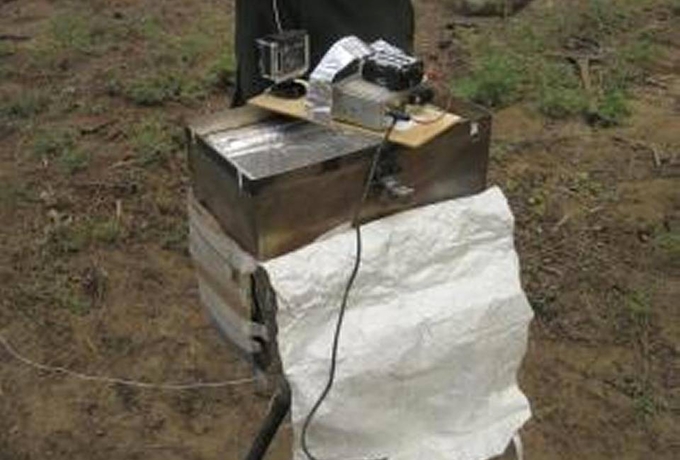
Some of the equipment used by the Fire Behavior Assessment Team in and around the Rough fire, near Kings Canyon National Park. Data recorded by the equipment may help prevent future wildfires. U.S. Forest Service Read more here: http://www.fresnobee.com/news/local/article32600712.html#storylink=cpy

Equipment used by the Fire Behavior Assessment Team. Photo/U.S. Forest Service

By Rory Appleton, Fresno Bee

A special firefighting team with the Sierra National Forest hiked into the mouth of the 56,900-acre Rough Fire on Thursday to drop special equipment in the blaze’s path, and data recorded by the equipment may help prevent future wildfires.

Rough Fire public information officer Shawn Lenske hiked alongside the 10-man Fire Behavior Assessment Team as the firefighters made their way to within a mile of the wildfire, which is now the second largest currently burning in California. The team placed sensors that monitor temperature and wind conditions as well as GoPro cameras at several locations in the Rough Fire’s path.

Lenske, who also works as a firefighter in Los Angeles, said the team members dropped one set of sensors and cameras in an area that had recently burned and another in an area that has never burned.

Firefighters hope to learn just how effective proscribed burns and brush clearing are in slowing the path of a large wildfire and use that information to adjust recommended preventive measures for community members in areas at risk of fire.

Read the whole story


Letter: Tahoe not on cutting edge of environmental planning

To the community,
Although TRPA has spent a lot of time since 2012 touting messages about how “Lake Tahoe is often looked to as an area on the cutting edge of environmental planning” (e.g. 1, 2, 3), we beg to differ. This may have been the case decades ago, but other areas now surpass Lake Tahoe in terms of environmental protection, stormwater technology, and natural resource protection. Here are some examples of how our local planning isn’t quite ‘ahead of the game:’
Making matters worse, the proposed 2015 Lake Tahoe Restoration Act would amend the TRPA Compact to weaken TRPA’s role in environmental protection by requiring TRPA to consider the (presumed) economic impacts of plan regulations. Keep in mind this is often what the corporations and large developers claim to be ‘economic.’ Their ideas of ‘economic’ (increasing their immediate [short-term] profits) are not based on truly helping our locally-owned/small businesses and communities, or long-term protection of Lake Tahoe. TRPA is currently the only agency with land use authority in the Lake Tahoe Basin charged with protecting Tahoe’s environment; the economics of the basin are already being monitored and prioritized by local entities (e.g. counties), along with numerous groups (e.g. Resort Associations). Notably, the original TRPA Compact was strengthened in 1980 because local governments eyeing tax dollars were approving projects that harmed Tahoe’s environment (although TRPA has, unfortunately, returned most project approval authority back to the counties, oversight is still required). The proposed Compact amendment will leave us with no land use authority that truly prioritizes Lake Tahoe’s environment.As depicted in our “Tahoe Regional Overgrowth” map, the North Tahoe region is already facing substantial development proposals that will bring more people, more cars, and more crowding. We are not opposed to new development, but believe it should complement and respect Lake Tahoe’s fragile environment and our unique communities — not overwhelm them. We will continue to keep you informed as these plans and projects proceed.

Sincerely,
Susan Gearhart, Friends of the West Shore president


Calif. offers one day of free fishing

The California Department of Fish and Wildlife is putting on a free fishing day Sept. 5. This means no need to buy a sport fishing license.

All fishing regulations, such as bag and size limits, gear restrictions, report card requirements, fishing hours and stream closures remain in effect. Every angler must have an appropriate report card if they are fishing for abalone, steelhead or sturgeon anywhere in the state, or salmon in the Smith and Klamath-Trinity river systems.

Free fishing days provide a low-cost way to give fishing a try.

Anglers should check the rules and regulations for the waters they plan to fish because wildlife officers will be on duty to enforce them. For more information, go online.


Nevada firewood permits to go on sale

Nevada Department of Conservation and Natural Resources will sell firewood permits starting Sept. 12.

Approximately 150 permits available on a first-come, first-served basis. The wood consists of a mixture of pine and fir, some seasoned and some green.

The permit sale starts at 7am on the 1st floor of the Richard H. Bryan state office building,901 South Stewart St. in Carson City. Permits are $65 per cord – cash or check only – limit one cord per address/family. The sale will close when all permits have been sold.

Permit holders may pick-up firewood from the last week of September through the first week of October at the North Canyon area of Spooner Lake State Park.

Access into North Canyon requires navigation through areas of loose, sandy soils. Four-wheel drive or heavy duty two-wheel drive vehicles are strongly recommended. Trailers may be permitted at the discretion of State Parks personnel.

Contact Jill Alves at 775.684.2793 for more information.


2 authors to give talk at SLT library

South Lake Tahoe’s Friends of the Library is putting on two events in September.

The first in Sept. 15 at 6pm. In partnership with the Lake Tahoe Historical Society the Friends are bringing back author Mary Jo Sonntag. Her presentation will answer questions about the early pioneers in the area, what pioneer life was really like, and what diseases pioneers experience.

Her award-winning book, “Write, If You Live to Get There” tells the true story of her ancestors’ migration from Vermont to Tahoe through a series of family letters spanning more than 120 years. Book sale and signing to follow.

On Sept. 19 at 1pm author Jackie Boor will present “LOGAN: The Honorable Life and Scandalous Death of a Western Lawman”. Boor is the great-granddaughter of this historic sheriff and has unearthed the untold story of his 1906 murder. Dealing with rowdy miners, drunken gamblers, and even Wild West legends like Wyatt Earp was a routine part of the job for onetime Sheriff Logan. This is a story steeped in local history (Logan Shoals and Logan Creek are named for this historic sheriff). There will be a question and answer session, book sale and signing to follow.

Both events are free and at the library on Rufus Allen Boulevard.


Developer fighting to keep Liberty Utilities’ Douglas County solar plant proposal alive

By Anne Knowles

The developer of a solar project rejected by Douglas County last month is contesting the county’s ruling.

Greenstone Renewables LLC filed a petition for judicial review of the Douglas County Commissioners’ decision to uphold an appeal of the special use permit allowing Greenstone to build a 20-megawatt, 260-acre solar plant on Muller Lane in Minden.

The permit had been granted by the Douglas County Planning Commission in May and then appealed by Steve and Mary Walker, whose residential parcel borders the planned facility’s site.

During a long and contentious public meeting on July 2, the commissioners upheld the appeal, effectively killing the solar project.

Greenstone’s petition alleges that by supporting the appeal the county acted “capriciously and arbitrarily” and that in the process Greenstone was denied “substantive and procedural due process rights” resulting in “real and significant damages.”

The 34-page petition outlines the project’s history, including the county staff’s recommendation to the Planning Commission to approve, and the Walkers’ subsequent appeal.

The petition alleges county commissioners and the Walkers, which it repeatedly describes as long-time lobbyists for the county, had opportunity to discuss the solar project on an ex parte basis — that is, without Greenstone present.

Specifically, the developer claims that in a meeting with Vice Chairwoman Nancy McDermid, the commissioner said she considered the solar project a “visual blight” and would be sure to submit into the record two aspirational documents — the Open Space Plan and the Valley Vision Plan — even though neither plan, unlike the county’s master plan, has legal status and had not been included in the Walkers’ appeal.

The petition then claims the Walkers were allowed to submit additional material after the appeal deadline, including a reference to the two vision plans, which were cited by commissioners during the decision to uphold the appeal.

The Walkers disagree.

“The record of the Douglas County Board of County Commissioners was very clear. It was a 5-0 vote which was firmly grounded in the fact the Greenstone solar industrial plant application did not meet the requirements of the Douglas County Master Plan,” Mary Walker told Lake Tahoe News.

The petition contends Greenstone’s project met all the requirements set out by the county, including disclosure of a possible, on-site battery storage facility, which became a bone of contention during the July 2 commission meeting when commissioners said they were unaware of it.

Douglas County District Court Judge Tod Young will be conducting the review, which should take between six and nine months, according to Cynthea Gregory, deputy district attorney for the county.

The next step is for Greenstone, with the coordination of the county, to submit to the court the entire record, including commissions’ meeting minutes, email and other documents, and for the county to file its opposition to the petition.

The judge will then decide if there is “substantial evidence” to support the commissioners’ decision, said Gregory.

Greenstone did not respond to a request for comment on the suit.
 

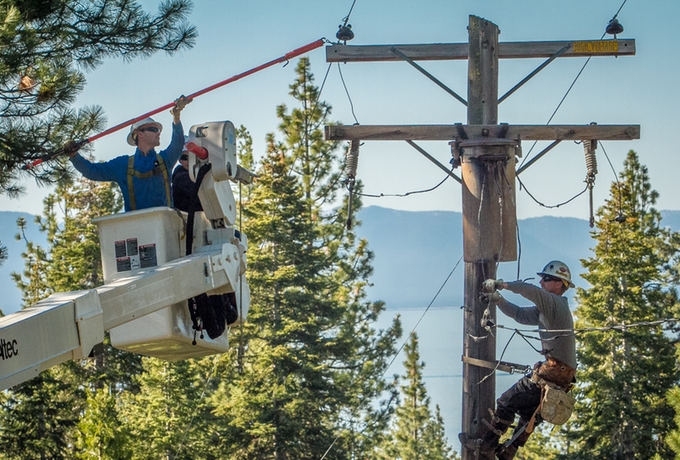
A crew from Liberty Energy replaces a transformer in Tahoe City, Calif., on June 5th, 2014.

Liberty Utilities would like to use more power from renewable sources. Photo/Provided

Meanwhile, Liberty Utilities, which had signed a preliminary power purchase agreement with Greenstone, is looking elsewhere for solar power in order to meet its next compliance goal set by California’s renewable energy portfolio.

“At this time, Liberty Utilities is not pursuing the Minden solar project,” Travis Johnson, Liberty’s director of utility planning and business development, told Lake Tahoe News.

The power company, which serves customers in Truckee, Alpine County and the California side of Lake Tahoe, is hoping to bump up the power generated by a second project its pursuing.

In April, Liberty applied to the California Public Utilities Commission to operate two solar projects, the 20 MW facility in Minden and a 40 MW plant in Luning, an unincorporated, small town about 140 miles southeast of Minden and 80 miles northwest of Tonopah.

The Luning project process has gone more smoothly. The operation is to be built entirely on Bureau of Land Management land in a much more remote area of Nevada. (The town has 38 registered voters, according to Mineral County, where Luning is located.)

In late July, the BLM approved the 560-acre project. Mineral County had already granted it a special use permit in 2014 and was able to review and comment during the BLM approval process, according to Laura Miner, business development manager, at Invenergy LLC, the project developer. (Liberty plans to purchase the facility from Invenergy once it is built.)

After the Minden plant was nixed, Liberty amended its application with the CPUC to increase the Luning plant capacity from 40 MW to 50 MW.

Johnson said the plant was originally designed for 50 MW but the company was shooting for a combined total between the two projects of 60 MW to meet the RPS.

“We sized our solar projects at 60 megawatts to get us close to compliance,” said Johnson. “Luning can’t do 60 megawatts on its own, it can only do 50 megawatts. We’re hoping for a CPUC decision by the fourth quarter.”

Johnson said he’s optimistic the project will be approved. The filing was protested by the CPUC’s Office of Ratepayer Advocates in a routine procedure to guarantee ratepayers are represented.

“ORA thoroughly reviewed Liberty’s application, and entered into settlement negotiations with Liberty Utilities to resolve our concerns.  The Motion for Settlement will be filed this week,” Lisa-Marie Salvacion with ORA told Lake Tahoe News in an email.

If the Luning project is approved, construction will start in early 2016 and Liberty should be producing power by the end of the year.

That will bring Liberty’s portfolio to 25 percent renewable, up from 22 percent currently, but the RPS requires the company to use 27 percent by 2017.

So, assuming no other projects go online before then, Liberty will acquire the other 2 percent from NV Energy.

Liberty and NV Energy have a new power purchase agreement that goes into effect January 2016. The new PPA, if approved by the CPUC, eliminates all coal-fired energy from Liberty’s portfolio.

The new PPA will save Liberty $2.34 million through a reduction in demand charges, improvements in system transmission, solar credits and drop in costs due to elimination of coal, according to Rich Salgo, Liberty Utilities vice president of operations.

Liberty is also awaiting CPUC approval for a 17.34 percent rate increase. The increase would go into effect in January 2016 and raise $13.6 million to cover costs associated with the distribution of power to its 49,000 customers.


Letter: EDC needs to listen to residents

Publisher’s note: This letter was originally sent to the El Dorado County Board of Supervisors and reprinted with permission.

Supervisors,

Last year, at your annual Tahoe Board of Supervisors meeting, you couldn’t swing a dead cat in that room without hitting a grant writer or grant getter – often one and the same person. The rest of the room was packed with Nevada groups, government/agency employees and “sustainable” agenda pushers. The deck was stacked against the people of Meyers; most of whom had to stand out in the hall, and of course, we weren’t being paid to be there.

To date, the TRPA has directed our plan and we, residents and businesses, have had little say. We have asked for an independent, expert-run survey, something the city of South Lake Tahoe invested in with much success, to more accurately write a community plan that we can live with for years to come. Petitions, letters, and grass roots neighborhood canvassing have shown a very different feedback than what has been presented to you. A lot of important issues have been ignored.

As I see it, issues with the new Meyers Area Plan include the new allowable building and land use information that is not being accurately compared to the existing allowables in our 1993 plan; such as the “anything goes mixed-use“ zone change, taller building heights with incentives to go higher – disregarding community meeting decisions, and larger building densities – in some cases, four times more units per acre.

Changes in the new plan are advantageous to large investors, but don’t do a thing for small business. Say an investor wants to build a three-story apartment but the code allows four stories. Wanting the most return on his investment, he will build out to the maximum allowable height and density. The county Building Department cannot stop or deny this if it is in the plan. This is why it’s so important to spend the time, inform the community and weigh publically in real English the long-term impact of our plan. This is not the TRPA’s plan to live with. We have to live with the outcome.

Furthermore, we have no representation. Trying to explain the powerful agency influences to an “off the hill” supervisor simply doesn’t work. Supervisor Sue Novasel does understand, but apparently, cannot communicate or advise you other supervisors? Not sure how that works or how we, as a community, can be fairly heard.

Please consider the new Meyers draft as just a draft – don’t put it forward for CEQA review. It ain’t cooked yet.

Thank you,

Angela Olson, Meyers


Poll: Californians want policing reforms

By Conor Friedersdorf, Atlantic

On Wednesday, the ACLU of Southern California released the results of a statewide survey that it commissioned to gauge the attitudes of likely voters toward policing reforms.

The results were overwhelming:

  • 84 percent favor requiring police officers to wear body cameras.
  • 74 percent of survey respondents believe the public should have access to footage from those body cameras any time that a police officer stands accused of misconduct. A narrow majority believes that the public should have access to allfootage.

As for investigations into misconduct by police officers, 79 percent believe the public should have access to the findings if there has been wrongdoing, and 64 percent believe the public should have that same access anytime a cop is even accused.

Read the whole story