Tahoe Tails– Adoptable Pets in South Lake Tahoe

Paisley

Paisley

Paisley is a 1-year-old female kitty who is a great mouser. She is quite playful, and is OK with well-mannered dogs.

Paisley loves to be around people, and can get a little over excited at times and play rough, so she would probably do best in a home without really small children. She was adopted fairly recently, but her new owner died so she is looking for a new home.

Paisley is spayed, microchipped, tested for FIV, and vaccinated. She is at the El Dorado County Animal Services shelter in Meyers, along with many other dogs and cats who are waiting for their new homes. Go to the Tahoe animal shelter’sFacebook page to see photos and descriptions of all pets at the shelter.

Call 530.573.7925 for directions, hours, and other information on adopting a pet.

For spay-neuter assistance for South Tahoe residents, go online.

— Karen Kuentz


Birders on quest to document all Tahoe species

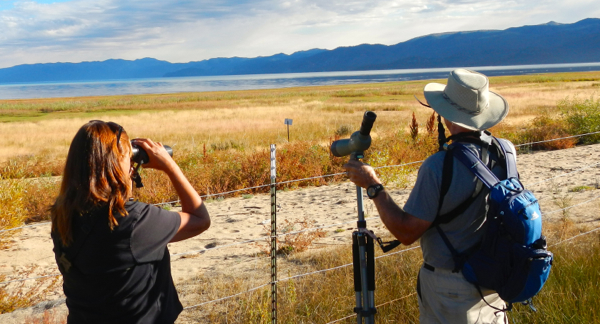
Jenny and Bob Sweatt look for shorebirds Aug. 26 near the Upper Truckee Marsh. Photo/Kathryn Reed

Jenny and Bob Sweatt look for shorebirds Aug. 26 near the Upper Truckee Marsh. Photo/Kathryn Reed

By Kathryn Reed

It’s quiet except for the sounds of birds. To the untrained ear the songs they sing all sound the same. For birders it’s like they can communicate with these feathered friends.

American coot with baby. Photo/Jenny Sweatt

American coot with baby. Photo/Jenny Sweatt

Even without seeing the animal, experienced birders know what lurks above or is hiding in the brush. It’s not uncommon that birds are heard before they are seen.

This is part of the wonder of birding.

With scopes, binoculars, cameras and guidebooks in hand, several birders were out last Wednesday in the Upper Truckee Marsh. This locale, to many in the know, is the birding paradise of the Lake Tahoe Basin.

American kestral Photo/Jenny Sweatt

American kestral
Photo/Jenny Sweatt

Within two hours one day last week Jenny and Bob Sweatt saw a black Phoebe, yellow-rumped warblers, kildeer, spotted sandpipers, plover, Northern harrier, coots, white faced ibis, Caspian terns, least sandpiper, sora, peregrine falcon and a few more.

The South Lake Tahoe couple is atop the leader board in the Tahoe Big Year competition being put on by the Tahoe Institute for Natural Science. The goal is to identify as many birds as possible in the basin this calendar year. She is at 204 and he is at 203, with Lori Allessio the next closest at 198. This is the inaugural year for the Tahoe Big Year.

There are more than 300 species in the basin.

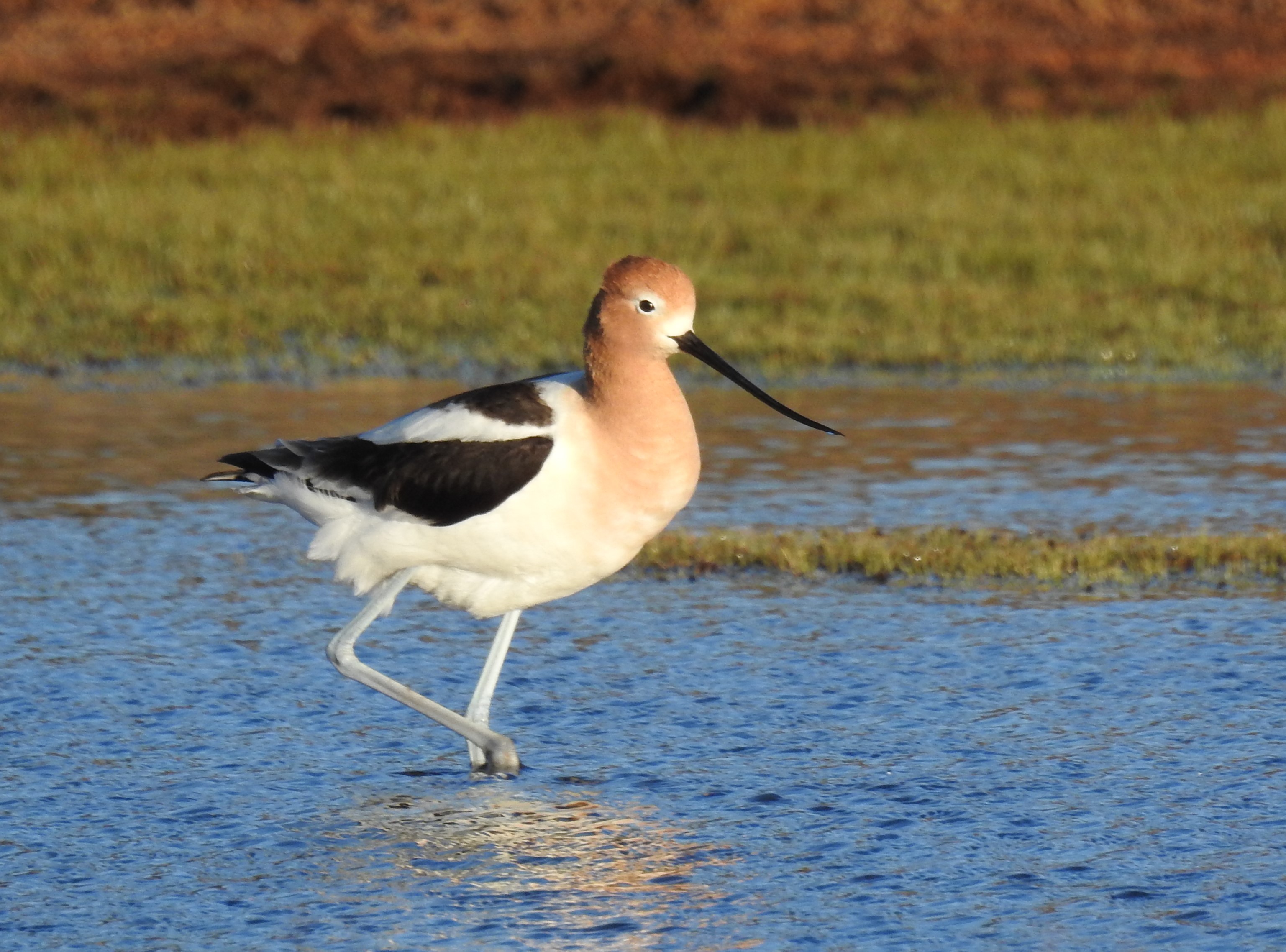
Avocet Photo/Jenny Sweatt

Avocet
Photo/Jenny Sweatt

“We call it an adrenaline rush when we see a bird for the first time. It’s really exciting,” Jenny Sweatt told Lake Tahoe News.

They go out every day for four to six hours a day. They admit it helps to be retired. But they also aren’t bored by it.

“We used to be those people laughing at birders. And now we are one of them,” Bob Sweatt told Lake Tahoe News.

Dowitcher Photo/Jenny Sweatt

Dowitcher
Photo/Jenny Sweatt

They take their binoculars wherever they go. They say birding is addicting. Until this year it’s not something they did.

While they don’t know all the calls of the birds, apps on their phones help identify the animals.

The duo has taken pictures of every bird they’ve seen. Sending them in to TINS helps with identification.

They took a picture of a juvenile Caspian tern with bands on its legs. This means a research group is tracking it. They’ve submitted the band codes to the organization’s website in hopes of learning where the tern has been so far.

Birding every day allows the couple the opportunity to see the landscape change – the water level fluctuate, flowers bloom and die, migratory birds come and go, people frolicking.

Bald eagle Photo/Jenny Sweatt

Bald eagle
Photo/Jenny Sweatt

Camaraderie exists among the birders. They discuss what they’ve seen and what they think they’ve seen. Last Wednesday the Sweatts ran into Don and Lynn Harriman. The South Tahoe couple lead free bird watching excursions from the end of San Francisco Avenue every Wednesday at 8am. TINS has been leading bird walks this summer, too.

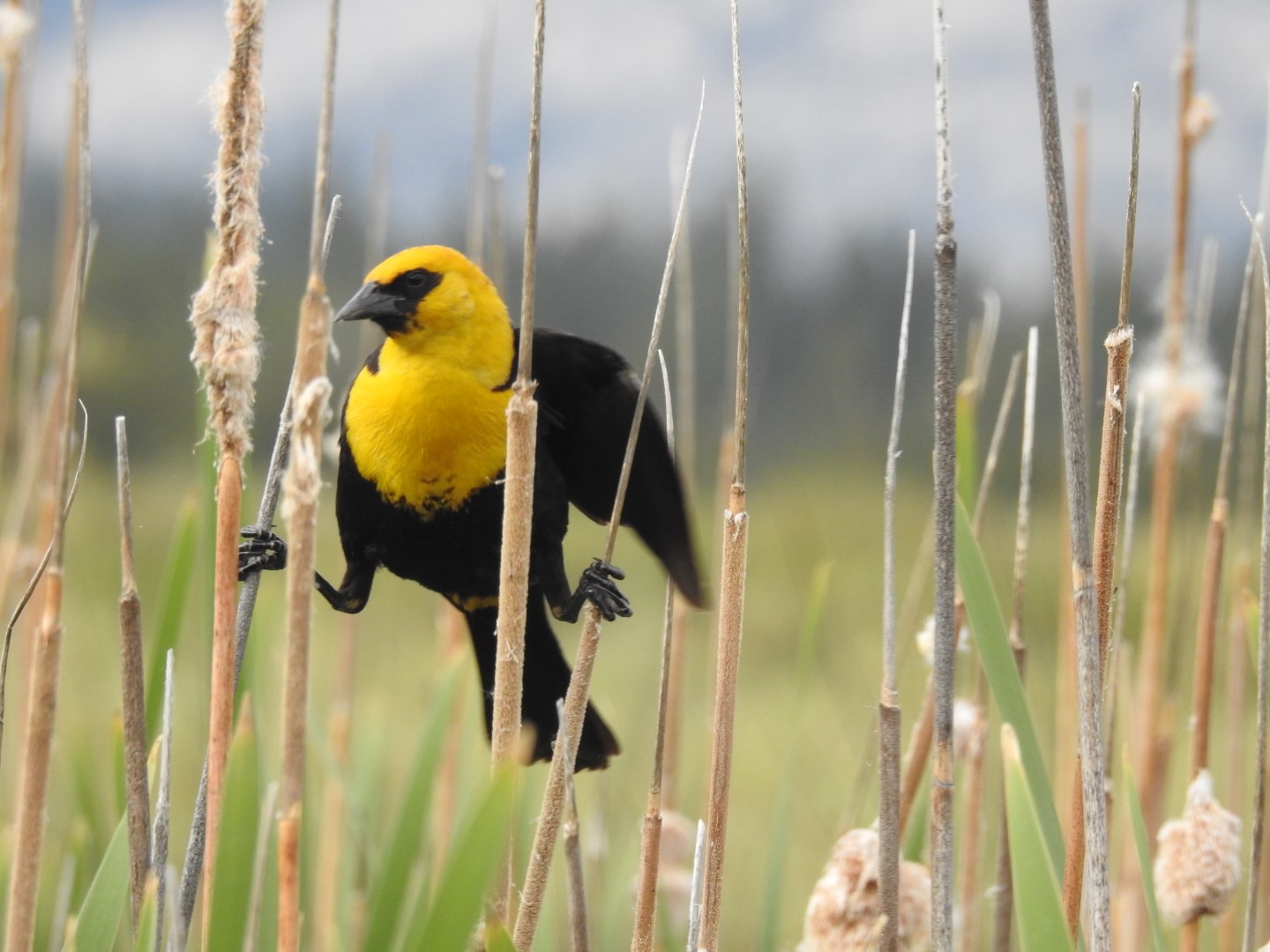
Yellow headed blackbird Photo/Jenny Sweatt

Yellow headed blackbird
Photo/Jenny Sweatt

“We see a lot of migrating shorebirds, resting and refueling here before heading on to Mexico or South America. We see dogs flushing out and chasing shorebirds, scaring them down the beach, only to have another dog scare them back again,” Jenny Sweatt told Lake Tahoe News. “There are also some airplanes and touring companies who drop down and buzz the shoreline, scattering birds in all directions. People should give some consideration to birds and their amazing but stressful journey. Let them rest.”

Mostly, though, there is a sense of serenity in the morning. It’s the birds and their watchers.

“Every bird has something amazing about them,” Bob Sweatt said.


Opinion: The difficulties of enrolling a kid in school

By Joe Mathews

“Is this the line for the U2 tickets?” a neighbor asked me.

Nope. The line extending down the block was just another group of California parents forced to prove that we actually live where we’re trying to send our kids to school.

Joe Mathews

Joe Mathews

With a new school year comes another fraught season of student enrollment. After years of hearing political rhetoric about the centrality of educational access to California’s civic life, I’ve been surprised to discover, as a father, all the official hurdles to putting your kid in public school.

The long line I was standing in represented just one step in the process of making sure my 6-year-old had a seat in first grade. Mind you, I wasn’t signing up for a charter school or any special program, but merely re-enrolling him in the same neighborhood school where he completed kindergarten in June.

To do that, I first had to complete the online “student verification” process of our small San Gabriel Valley school district. It took me an hour to provide contact and demographic info and review 17 legal documents, whose 54 pages covered privacy, complaint procedures, media access to students, and my responsibility to help with homework and regulate my son’s TV watching.

With online registration complete, I searched for paper documents that I had to present in person at the district office to show I lived in the district. I would need one document from each of three categories. The first included a deed of trust, closing escrowing papers, a lease (which had to have children’s names), a property tax bill, or a mortgage payment receipt from the last month. The second category covered utility, cable or phone bills (all had to be within last month). A third category consisted of car registration, health insurance, bank statements, pay stubs, or tax returns.

I have covered gubernatorial candidates who didn’t disclose this much. And there were caveats. No online bills or direct deposit pay records would be accepted.

The district offered hours on three August weekdays to show documents. Fortunately, I had taken off the week in question, knowing that I’d have to deal not only with my 6-year-old’s enrollment, but also with hundreds of pages of other forms to cover child-care arrangements for my two younger sons.

While navigating school enrollment requirements is time-consuming and frustrating, figuring out whom to blame is even harder.

My district is no outlier; school districts around the state have similar rules. And given the dysfunction of California school finance, it’s hard to blame local districts for making sure they don’t allow non-residents to slip into their schools. The state has often sent IOUs instead of cash to districts, and currently restricts how much school districts can save for rainy days. Local districts, including mine, have convinced voters to raise parcel taxes to fill state funding gaps, and must assure taxpayers that only local families are benefiting.

Even so, the zeal to make sure we all live within the right district lines is a form of statewide madness. Despite recent reforms, California’s educational system remains so centralized in Sacramento — funding, curriculum, and regulations come from there — that all 38 million of us live, effectively, in one statewide school district.

That makes it especially frustrating that, even as parents are required to produce so much data on their kids, the state shirks its responsibilities to collect and utilize student data.

Specifically, the state has been slow to build and fund its system for K-12 data; Gov. Jerry Brown even vetoed an effort to compile attendance data statewide with the goal of reducing truancy. More crucially, California has failed to follow other states in building databases to link individual data from preschool, community college, universities, and employment.

Brown has portrayed the collection of such data as a state imposition on local communities. But such a database provides the best chance scholars and policymakers to judge how the state is preparing tomorrow’s workers, and help teachers identify ways to improve. A good database might even relieve school districts of some hassles of pressing parents for information each fall.

In line at the district office, I waited nearly an hour before reaching the room for residency verification. First, I produced a driver’s license, then my documents at a second table. After a few minutes, I was told my child was enrolled.

But three days later, I got a robo-call from the district saying my child wasn’t enrolled. No one could help me at the district office, so I banged on the locked elementary school door. An administrator let me in, checked her computer, and said everything was in order.

The robo-call had been just another glitch in a system that doesn’t make much sense at all.

Joe Mathews is California & Innovation editor for Zócalo Public Square, for which he writes the Connecting California column. He wrote this for Thinking L.A., a partnership of UCLA and Zócalo Public Square.



Study: Renewable energy requirement creates jobs

By Chris Megerian, Los Angeles Times

As lawmakers consider new measures to combat climate change, researchers at UC Berkeley released a study saying stronger renewable energy requirements would lead to new jobs.

California law requires the state to get 33 percent of its electricity from renewable sources, such as solar and wind, by 2020. A bill by Sen. Kevin de León, D-Los Angeles, would increase that standard to 50 percent by 2030.

Because building renewable energy facilities is a temporary gig, the study uses measurements in “job years” to estimate how much work would be created. One “job year” equals enough work to employ somebody full time for a year.

Read the whole story


New end for Appalachian Trail possible

By Katharine Q. Seelye, New York Times

MOUNT KATAHDIN, Maine — The storied Appalachian Trail, which begins 2,190 miles away in Georgia, ends here, with a final scramble up Maine’s highest peak — some of it nearly vertical, much of it blocked by boulders. For those who have trekked five or six months, Katahdin’s iconic summit is an exhausting challenge with a rewarding end.

“It takes your breath away,” said Chuck Wood, 64, a hiker from Norristown, Pa. “Just to be there, it’s like an audience with the Lord.”

But that experience is now in jeopardy. Faced with increasing crowds and partylike behavior by a few — including an ultramarathon runner who celebrated at the summit last month with a spray of champagne — officials here are threatening to reroute the end of the trail off Katahdin and out of Baxter State Park.

The very idea has stunned the hiking world. Katahdin has been the trail’s northern terminus for more than 80 years. For the thousands who set out annually to follow its entire path, moving the trail’s endpoint off this rocky peak would be a momentous detour, forcing long-distance hikers to end their treks not with a bang but a whimper.

Read the whole story


Age is irrelevant when it comes to fitness

By Nick Heil, Outside

Last February, 59-year-old Ned Overend, aka “The Lung,” aka “Deadly Nedly,” won the first National Fatbike Championships, held in Ogden, Utah. Fat Bike Nats isn’t exactly the Tour de France, but it’s no charity ride, either. Overend had to compete against a field of much younger pros, including former national mountain bike champion Travis Brown, 46, on a tough 19-mile course.

It’s tempting to dismiss Overend as a genetic freak, an outlier who defies comparison with the rest of us. He has dominated nearly every sport he’s entered since the early ’90s, from cross-country mountain bike racing to off-road triathlon. But even among the genetically gifted—and many elite athletes are—Overend is unique in his competitive longevity. Which is the reason he’s also one of the dozen or so athletes spotlighted in Joe Friel’s latest book, “Fast After 50”, part of a growing library devoted to salt-and-pepper chargers past (and occasionally well past) the half-century mark.

I recently spent a few weeks immersed in “”Fast After 50, along with a few other books on the topic, including Margaret Webb’s “Older, Faster, Stronger”, Lee Bergquist’s “Second Wind”, and Bill Gifford’s excellent and entertaining “Spring Chicken”. My interest was both professional and personal. I was staring down the gun barrel at 50, the ominous milestone, just a year and change away. Should I prepare to surrender to backgammon and bocce, or was there still hope for my lifelong addiction to biking, skiing, climbing, and other outdoor activities and races?

Read the whole story


CalPERS looks to cut financial risk

By Melody Petersen, Los Angeles Times

California taxpayers have never paid more for public worker pensions, but it’s still not enough to cover the rising number of retirement checks written by the state’s largest pension plan.

Even before the stock market’s recent fall, staffers at the California Public Employees’ Retirement System were worried about what they call “negative cash flows.”

The shortfalls — which totaled $5 billion last year — are created when contributions from taxpayers and public employees who are still working aren’t enough to cover monthly checks sent to retirees.

To make up the difference, CalPERS must liquidate investments.


Because the more conservative investments are expected to reduce CalPERS’ future financial returns, taxpayers would have to pick up even more of the cost of workers’ pensions.

Read the whole story


Snippets about Lake Tahoe

A red-shouldered hawk as  seen through a scope.

·       The Tahoe Institute for Natural Science, Lahontan Audubon Society and Tahoe Rim Trail Association are co-sponsoring an easy stroll to search for migrant birds heading south for the winter at Spooner Lake on Sept. 12. For more info, go online.

·       Thrifty ice cream is returning to South Lake Tahoe. It will open later this year inside Rite-Aid.

·       Tahoe Business Expo is Oct. 30 at Harveys in Stateline It will include exhibits by business owners and seminars. Exhibits will be from 2-8pm and seminars from 10am-5pm. For more info, go online.

·       As of Aug. 30, more than 6,000 firefighters remain on the lines battling 12 active wildfires in California.


El Dorado County adopts Laura’s Law

The El Dorado County Board of Supervisors last week unanimously voted to implement an assisted outpatient pilot program, also known as Laura’s Law.

This will help give those who are mentally ill an avenue to get help. It gives county mentally health officials, as well as courts, family members and probation officers the right to mandate mental health treatment in certain circumstances.

A maximum of $500,000 will be spent over three years. The money comes from state Mental Health Services Act Funds, Community Corrections Partnership funding; and Medi-Cal funding if applicable.

It has been a 10-year endeavor by advocates to get El Dorado County to take this action.

Placer County implemented Laura’s Law in 2014.

— Lake Tahoe News staff report


Letter: Making a difference at Mt. Tallac High

To the community,

As we quickly approach the start of the new school year, there is great excitement and anticipation for the developing Career Technical Education (CTE) Pathways throughout the Lake Tahoe Unified School District for all students designed to lead to rewarding careers.

As an alternative choice school in the district, Mt. Tallac High School has been working closely with our community and is implementing Phase II of our School to Career Pathways program. Similar to the world renowned Homeboy Industries of Los Angeles, we believe the business of second chances is everyone’s business.  We recognize and embrace the fact that many of the Mt. Tallac students choose to stay in Lake Tahoe making up a large portion of our community work force and therefore, we have designed our program to meet the needs of our local community.

With the launch of Phase I of the school to career program last year, we incorporated a student time clock, community day, and various guest speakers from local businesses. This year we are adding certificates of skill, internships, and job placements to create a seamless transition from school to work.

We are thrilled to have South Tahoe Refuse as our partner in education, internship, and job placement as appropriate, and we are optimistic this model will expand to other local businesses interested in working with as we grow our school to career partnerships.

Holly Greenough, Mt. Tallac High School director