No takers for old KMS site despite lower price

Even with a lower price tag, no buyer has come forward to purchase the old Kingsbury Middle School site in Stateline.

The topic was on the Douglas County School District’s board agenda last week.

Superintendent Teri White said the district had anticipated an offer would come forward, but it didn’t materialize. However, she said it’s possible something will happen in the future.

“There has been some interest and we’ve had some inquiries,” White told Lake Tahoe News. “The latest resolution allowed for averaging the two appraisals which brought the price down a little; to $3.125 million.”

DCSD in January 2012 voted to put the 10-acre school on the market with an asking price of $4 million. The buildings encompass 36,000-square-feet.

The item is on a three-month cycle to keep coming back to the board.

— Lake Tahoe News staff report


Douglas County forming flood task force

Douglas County is looking for residents to participate in a Flood Control and Roads Task Force.

The countywide task force will consist of residents and staff with complementary skills such as storm water, flooding, drainage management, engineering and other related technical skills. The task force will be responsible for establishing a recommended process to develop a Countywide Storm Water Flood Containment and Roads Master Plan as well as potential funding strategies.


Anyone interested in being on the task force must submit an application describing their qualifications and interest in 300 words or less. Entries are due Sept. 18 at 5pm. Email it to countymanager@douglasnv.us.


Time to help clean up Truckee River

The 20th annual Truckee River Day is Oct. 18.

Volunteers have their choice of half or full day restoration projects with different levels of difficulty. There will be 10-12 projects, including restoration at Dry Creek in Russel Valley, seeding and mulching at Johnson Canyon, milfoil surveys in Martis Valley, and revegetating near Boca Townsite. Work starts at 9am or 11am and ends at 2pm or 3pm.

The River Fair will be from 1-4pm at Granite Flat Campground.

This community event is presented in partnership with Sierra Watershed Education Partnerships. The fair features environmental activities for kids and adults. Food will be provided free of charge by Northstar.

To participate, register online by Oct. 15.


Study: Longer school lunch is healthier

By Karen Kaplan, Los Angeles Times

In the continuing quest to improve the health quotient of school lunches, experts have proposed fancy chefs, cutesy lunch boxes and smiley-faced stickers. Now comes a more straightforward suggestion – just make the lunch period longer.

The idea that schools could persuade kids to eat better without making a single change to their cafeteria menus may sound like pie in the sky, but its proponents have some data to back them up. After analyzing the eating habits of 1,001 elementary and middle school students in Boston-area schools, researchers found that the more time students had to finish their lunches, the more fruits and vegetables they ate and the more milk they drank.

One of the six schools that participated in the Modifying Eating and Lifestyles at School – or MEALS – study gave students as little as 20 minutes for lunch. Some of that time had to be spent getting to the cafeteria and standing in line when they got there. By the time they finally sat down with their trays, some kids had only 10 minutes to eat.

Read the whole story


Wine in cans is catching on in the U.S.

By S. Irene Virbila, Los Angeles Times

Wine in cans? It just doesn’t track. You hear that unmistakable pop of a beer can opening — only it’s wine inside, not beer. And it’s not cheap plonk either, but some serious juice.

Though Australia’s Barokes Wines was probably the first to try the idea, way back in 1996, the idea is just catching on here. And no outrage from Paul Hobbs, one of the world’s most lauded winemakers, when asked about it.

“I love the idea of good wine in a can,” Hobbs said. “Wish I had thought of it.It does indeed strike me as very practical, especially for folks on the go who in certain circumstances simply seek to enjoy fine products in an uncomplicated way, spontaneously — a trip to the coast, hiking, etc.In that respect, this concept is so exciting!”

Calm down. Nobody’s putting Château d’Yquem or Romanée Conti into cans just yet. This new mode of packaging is meant for easy-drinking wines that won’t be languishing in the closet for years.

Read the whole story


Then and now: South Shore in the 1920s

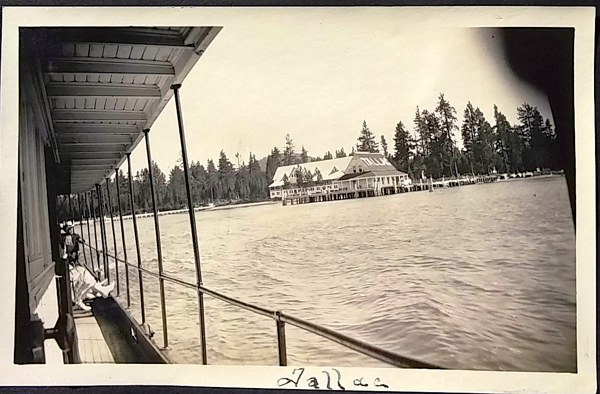
Cherie Boulton, a Lake Tahoe News reader, is sharing her aunt’s family album snapshots which were taken in the 1920s during trips to Lake Tahoe.

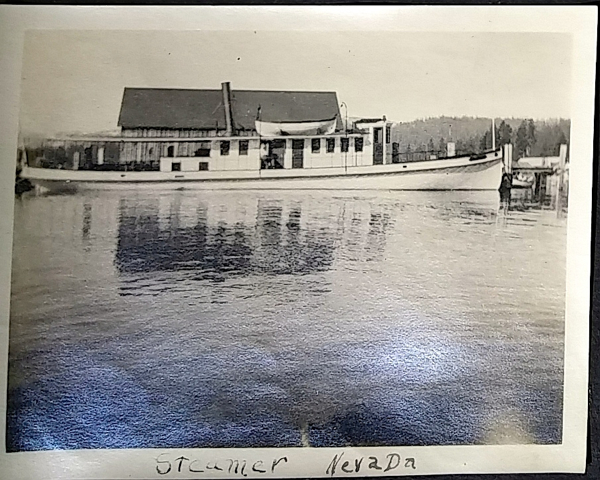
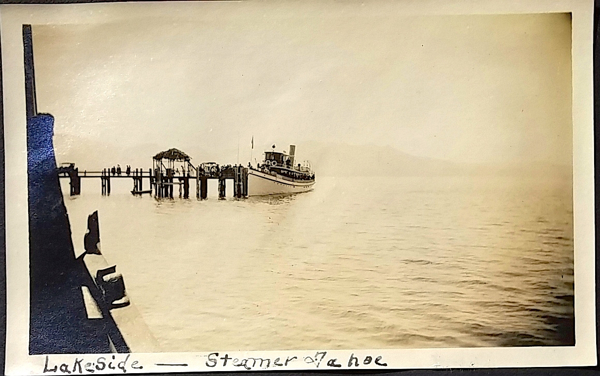
The slight yellowing is indicative of these 90-year-old prints. According to E. B. Scott’s “The Saga of Lake Tahoe”, all three steam ships shown below met their fates within a year of each other.

Photo/Cherie Boulton

Photo/Cherie Boulton

The Meteor, launched in 1876, was an 80-foot-long steam tug, ultimately scuttled near Glenbrook in 1939.

Photo/Cherie Boulton

Photo/Cherie Boulton

The 60-foot long Nevada (originally Tallac) cruised Lake Tahoe from 1890 to 1940.

Photo/Cherie Boulton

Photo/Cherie Boulton

The 169-foot-long Tahoe still lies on the lake bottom near Glenbrook where she was scuttled after serving as a passenger ship and mail carrier from 1896 to 1940.

Photo/Cherie Boulton

Photo/Cherie Boulton

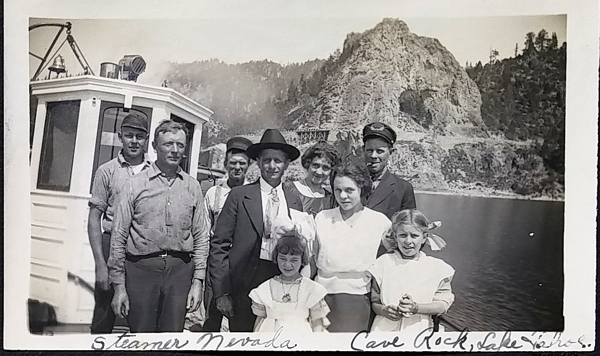
Boultan’s aunt and family members are seen on board the Nevada in the 1920s. Behind them, notice the highway trestle going around Cave Rock, before the first tunnel was bored.

Photo/Cherie Boulton

Photo/Cherie Boulton

The family was onboard the Tahoe when they snapped this view of Lucky Baldwin’s Hotel Tallac site at South Shore. Baldwin died in 1909, and his daughter Anita had the sizable hotel and most of its facilities razed in the late 1920s, partly because she rejected commercial development.

Photo/Google Earth

Photo/Google Earth

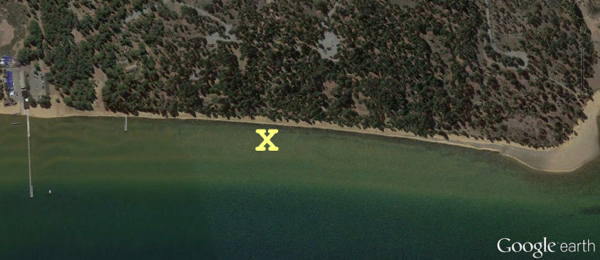
The yellow X indicates that same beachfront today from an aerial view looking south, showing virtually no vestiges of Hotel Tallac. That’s Camp Richardson Marina at far left and Kiva Beach at far right.

— Bill Kingman


Star Lake — a stellar hike in the Sierra

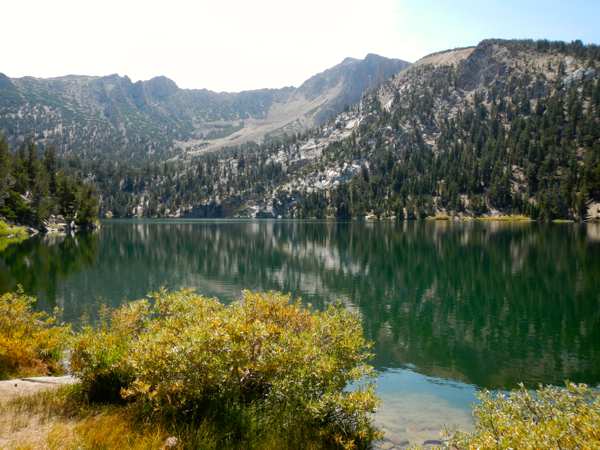
Star Lake is at an elevation of more than 9,000 feet. Photos/Kathryn Reed

Star Lake is at an elevation of more than 9,000 feet. Photos/Kathryn Reed

By Kathryn Reed

“Are we there yet?” is never a good question because inevitably the answer is “no” and the destination is still a ways off.

Such was the case with the hike to Star Lake a week ago. High Meadow trailhead is up, straight up, no switchbacks, on an old pitted road that is more suitable for a four-wheel drive vehicle than legs.

Enduring this stretch of trail, though, was well worth it. Star Lake is a jewel in the Sierra. As Rosemary said, it must have gotten it’s name from being so high it’s like the stars would be within reach if it had been nightfall.

The lake is at 9,100 feet.

Carolyn, who was wearing her FitBit, recorded 35,375 steps for the entire hike (which included walking around her house that morning) – as well as having logged 14.53 miles.
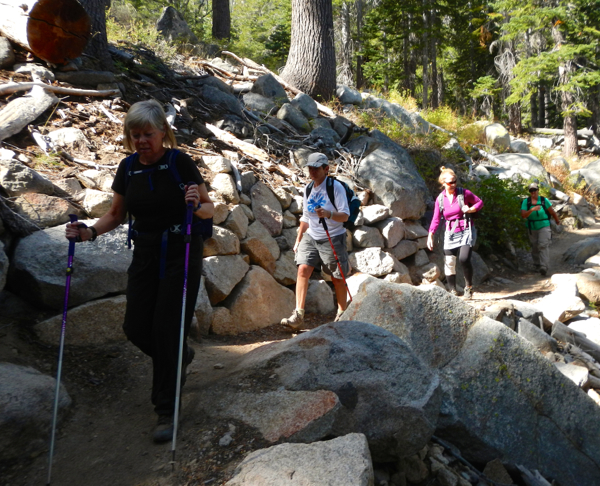
Carolyn, Rosemary, Brenda and Sue on their way to Star Lake.

Carolyn, Rosemary, Brenda and Sue on their way to Star Lake.

Before reaching High Meadow we turned off to the right toward Star Lake. (There’s now a sign there.) The trail became single-track, more gradual – even level at times, with the lodgepole and Jeffrey pines being interspersed with some juniper trees higher up. At one point the five of us walked through a quartz field; not a common sight in Tahoe.

Intermittently views of Lake Tahoe and the entire South Shore unfolded below us.

Water flows in a couple spots, which AJ was appreciative of.

Our destination – Star Lake – was too cold for our gang to swim in, but that didn’t stop others from cooling off. A couple tents were in the area, with openings to views of the jagged mountains surrounding the lake. Plenty of beach-like areas surround the water – perfect for a lunch break.
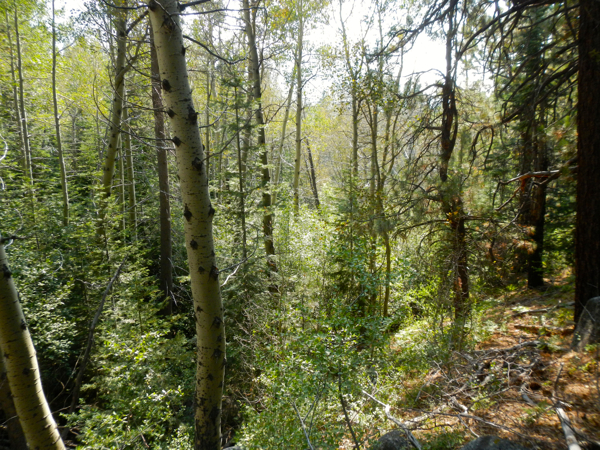
A fertile environment, including numerous ferns, along Cold Creek.

A fertile environment, including numerous ferns, along Cold Creek.

We were able to make a loop to avoid the road on the way back. We turned right toward the meadow on our way out.

The U.S. Forest service in 2012 completed a three-year, $2 million restoration of the meadow that realigned Cold Creek to more of its natural meander.

A slew of trails are in the area – including the Tahoe Rim Trail. It’s popular with mountain bikers. But one needs to be in good shape and able to navigate challenging terrain.

“After three seasons of work, the Monument Pass trail was completed in 2014. The trail connects from High Meadows to the Tahoe Rim Trail at Monument Pass with interesting rock formations, aspen groves, and views of Lake Tahoe.  The Star Lake Trail was completed in 2012 and was rerouted from the original road, which was overly steep with a fall line alignment. The trail gently climbs for approximately 3.8 miles to Star Lake and the Tahoe Rim Trail,” Garrett Villanueva, trails expert with the USFS, told Lake Tahoe News.

Monument Peak – which is the backside of Heavenly Mountain Resort – is on one side of the meadow at 10,067 feet. The meadow is at an elevation of 7,834 feet. Across the other side of the meadow are Freel, Jobs and Jobs Sister.
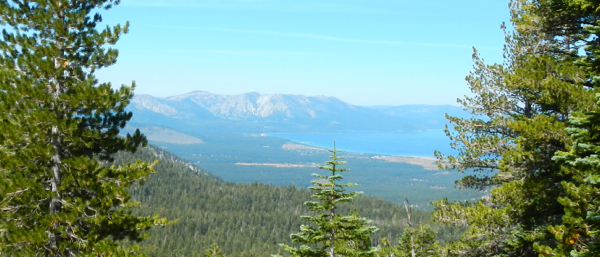
Lake Tahoe from the trail.

Lake Tahoe from the trail.

The foliage is more dense and lush along the Cold Creek trail. Near the top the aspens look healthy, whereas closer to the bottom the leaves have black splotches, with many branches barren. Still, this is so much prettier than the road we went up on in the morning. It’s also longer, but well worth it.

There were more “Are we there yets?” on the way down, but no one was complaining about having spent another glorious day hiking in Lake Tahoe.

—–

Getting there:

From South Lake Tahoe – get onto Pioneer Trail. Turn onto High Meadow Drive. This is the corner where Sierra House Elementary is. Drive as far as you can. Take the main trail that looks like a road.

Opinion: This is no time to be lax about fire

By Jeff Meston

Early in 2015, the U.S. Forest Service, as well as our partners at the National Weather Service, predicted this to be a significant year for wildland fires throughout the Western states.

A combination of a sustained period of drought, coupled with weather that is conducive to nearly perfect burning conditions have challenged local firefighting resources.  Those predictions have rang very true as we continue to hear about new fires occurring almost daily all over the Western states. This year will go down as one of the most hazardous years for wildland fire.

Jeff Meston

Jeff Meston

Locally, firefighters have responded to a variety of wildland fires within our region and thankfully have been able to mitigate them quickly and efficiently. Sadly, we recently lost a USFS firefighter who tragically lost his life battling an incident south of Echo Summit.

The California Fire & Rescue Mutual Aid System is the best in the world, and our agencies along with our partners in Nevada have deployed local resources to fight fires throughout California. This year our local U.S. Forest Service Lake Tahoe Basin Management Unit obtained use of the Super Scooper, a superb firefighting plane to reinforce our ground firefighting resources, now based at the Lake Tahoe Airport. Our No. 1 goal is to prevent the ignition of wildfires, and to accomplish that, we need the public’s help.

We live and play in a forest. Where are you discarding your cigarette butts? Are you parking on dry grass? Did you start a campfire in a prohibited location? Did you put it out completely? Are you burning your trash? Are you causing sparks while driving?  Over 90 percent of unintended wildfire is human caused in the Lake Tahoe Basin.

If you live in or own a home in the region, have you completed your defensible space? If not, why not? Without defensible space, it is unreasonable to think that fire agencies can place a fire truck to defend your home during a wildland fire. Look around your neighborhood, how many homes are there? Is it easy or hard to gain access to your home? Are your streets wide enough for a fire truck to access the neighborhood and for you and your neighbors to pass that engine to evacuate? Firefighting resources are limited and there is not a home in existence worth a firefighter’s life.

Help us to help you by following the following basic defensible space tenants.

·         Vegetation surrounding a building or structure is fuel for afire. Even the building or structure is considered fuel.Research and experience have shown that fuels reduction around a building or structure increases the probability of it surviving a wildfire. Good defensible space allows firefighters to protect and save buildings or structures safely without facing unacceptable risk to their lives. Fuels reduction through vegetation management is the key to creating good defensible space.

·         Properties with greater fire hazards will require more clearing. Clearing requirements will be greater for those lands with steeper terrain, larger and denser fuels, fuels that are highly volatile, and in locations subject to frequent fires.

·         Creation of defensible space through vegetation management usually means reducing the amount of fuel around the building or structure, providing separation between fuels, and/or reshaping retained fuels by trimming.

·         In all cases, fuels reduction means arranging the tree,shrubs and other fuel sources in a way that makes it difficult for fire to transfer from one fuel source to another. It does not mean cutting down all trees and shrubs, or creating a bare ring of earth across the property.

·         A homeowner’s defensible space clearing is limited to 100feet away from his or her building or structure or to the property line, whichever is less, and limited to their land.

·         Homeowners who complete fuel reduction activities tha tremove or dispose of vegetation are required to comply with all federal, state or local environmental protection laws and obtain permits when necessary.

·         For more information on what homeowners can do to create defensible space around their home and property, go online.

Jeff Meston is fire chief of South Lake Tahoe.


Court decisions good news for FOIA users

By Jonathan Peters, Columbia Journalism Review

As the Freedom of Information Act approaches its 50th birthday next year, a major advocacy effort continues to push important reforms in Congress. But Capitol Hill isn’t the only place where FOIA’s future is being forged. Two federal appeals courts recently handed down opinions that clarify and affirm the rights of requestors and the responsibilities of agencies — one of them with particular importance for groups that plan to release publicly the information they gather.

That case comes from the D.C. Circuit, which in late August handed down an opinion that has big implications for advocacy groups and nontraditional publishers, increasing their chances of successfully claiming FOIA fee waivers. The case arose after Cause of Action, a conservative nonprofit organization, submitted three FOIA requests to the Federal Trade Commission, which denied the nonprofit’s fee-waiver claims.

The FOIA permits agencies to charge reasonable fees for “document search, duplication, and review, when records are requested for commercial use.” Depending on the request, these fees can be substantial. But certain types of requests and requesters are entitled to fee waivers, and two were at issue in this case.

Read the whole story


Residents run for safety as wildfire explodes

By Corina Knoll and Bettina Boxall, Los Angeles Times

Fueled by heat and winds, a wildfire exploded Saturday afternoon to 10,000 acres in Lake County, threatening several communities and leaving four firefighters with second-degree burns.

The Valley Fire spread so quickly that residents in Cobb and surrounding communities had little time to flee. Photos on social media showed towering flames descending on towns and jammed highways.

Evacuees crowded roads in the area, with firefighters warning that more than 1,000 structures were threatened. There were reports Saturday night that some homes were lost and that people were trapped awaiting rescue.

The state was calling in hundreds of firefighters from around California to battle the blaze, which was hopscotching across oak woodlands and grasslands, driven by 20 to 30 mph winds.

Across Amador and Calaveras counties, nearly 4,000 fire personnel battled the Butte fire that began southeast of Sacramento and has plowed through 65,000 acres. Swift and stubborn, it started Wednesday, doubled in size the following night, then doubled again the next day — prompting Gov. Jerry Brown to declare a state of emergency.

Read the whole story