Firefighters make small dent in NorCal fires

Updated 8:18pm

The Butte and Valley fires burning in Northern California continue to grow, though firefighters are gradually gaining control. The cause of both fires remains under investigation. Evacuations are still in effect and thousands of structures remain threatened.

Smoke from the Butte Fire, which has been burning in Amador and Calaveras counties for nearly a week, will continue to impact the Lake Tahoe Basin and Truckee areas today, but not to the extent that it did over the weekend.

The Butte Fire:

  • 71,523 acres
  • 35 percent containment
  • 135 residences and 79 outbuildings lost, 4 structures damaged
  • Sept. 9 start date
  • From CalFire: “Firefighters continue to fight the fire aggressively but critical fuel moisture levels, steep terrain, and limited fire access continue to provide challenges.”

The Valley Fire:

  • 62,000 acres
  • 10 percent contained
  • 1 civilian fatality; 4 firefighters hurt
  • 400 houses lost, plus several hundred other structures; 4,000 structures threatened
  • Sept. 12 start date
  • Fire started near Cobb in Lake County and has spread into Napa and Sonoma counties.
  • From CalFire: “Firefighters from across California are aggressively fighting the Valley Fire that has continued to spread in hot, windy conditions. The fire continues to grow as firefighters work to construct fire lines, while protecting lives and property.”

— Lake Tahoe News staff report


NTPUD looking to restructure board elections

The North Tahoe Public Utility District is asking registered voters within the district to complete the election format change survey by Sept. 15.

Results will be announced at the Oct. 13 board meeting.

The board is looking to go from members being elected to a specific seat to an at large model. Since formation in 1948, the NTPUD has elected its five-member board by specific seat number; they serve staggered four year terms. These seats do not represent geographical areas. The change would allow all candidates to run for all board positions available during that election cycle.

There is no additional cost to running elections in this manner. The next scheduled election will take place in November 2016  when the seats of John Bergmann, Tim Ferrell and Sue Daniels are up.


Tahoe Tails — Adoptable Pets in South Lake Tahoe

Joey

Joey

Sometimes the shelter has lots of big dogs (like two weeks ago), and sometimes we have lots of little dogs — like right now. Joey is one of eight small dogs at the shelter.

He is a 2-year-old Yorkie mix who is just 9 pounds. He is the sweetest little guy, with an easygoing personality. He is good with dogs, kids and doesn’t seem to mind sitting cats. He gets the wiggles and is quite playful, but he also loves to be held and petted.

Joey is neutered, microchipped, tested for FIV, and vaccinated. He is at the El Dorado County Animal Services shelter in Meyers, along with many other dogs and cats who are waiting for their new homes. Go to the Tahoe animal shelter’s Facebook page to see photos and descriptions of all pets at the shelter.

Call 530.573.7925 for directions, hours, and other information on adopting a pet.

For spay-neuter assistance for South Tahoe residents, go online.

— Karen Kuentz


Storytelling extravaganza rolling into Tahoe

WordWave is a compilation of events that will bring storytellers from across the nation to Lake Tahoe for a three-day literary festival that goes well beyond traditional book readings.

It is Oct. 9-11 at Valhalla on the South Shore. Details about the various events are online as is the opportunity to purchase tickets, however some things are free.

Lake Tahoe News asked WordWave founder Kim Wyatt to share what the three-day event is all about. Besides being the force behind the literary event, Wyatt is owner of Bona Fide Books, an independent publishing house based in Meyers.

Kim Wyatt

Kim Wyatt

LTN: How did the concept of WordWave come about?

Kim Wyatt: I was tabling with Jennifer Basye Sander at the AWP conference in Seattle. There were 10,000 writers there and we talked about how great it would be to have a literary event in South Lake Tahoe. We liked the model of San Francisco’s Lit Quake, a weeklong lit event, and wondered if it might be feasible for Tahoe. And we came up with WordWave.

LTN: What do you hope to achieve by having this three-day festival of story on the South Shore?

KW: Of course we want people to come out to the Tallac Historic Site and hear great writers. But my personal goal is to highlight the fantastic talent we have in the region. The Sierra Showcase will feature Suzanne Roberts, Michael Makley , June Saraceno from Sierra Nevada College, Michael Branch (High Country News), Ann Marie Brown and Jeremy Evans to name a few. These are writers getting national recognition. And Reno’s poet laureate, Gailmarie Pahmeier, will also make an appearance.

LTN: Do people need to be a writer or voracious reader to enjoy the event?

KW: No. We didn’t want it to feel like an excusive literary event, so we opened it up to storytellers in general, including plays. We held a playwriting contest, and received entries from around the world. We’re excited to launch three new one-act plays on Oct. 10 at the Boathouse Theater – how cool is that? NEA storytelling fellow and Paiute elder Ralph Burns will talk about oral storytelling, and Washoe drummer Ben Rupert will present on drumming. Christian Kiefer (author of “The Animals”) will present on songwriting. There is also a novel writing camp for kids, and Maker’s Station. So, there is something for everyone — we want to encourage everyone to either tell their story, or at least see the value of storytelling.

LTN: How did you decide which authors to invite?

KW: Jennifer suggested Garth Stein, who wrote “The Art of Racing in the Rain,” and when we mentioned of to a few people, they were thrilled. He had just published a book about a mansion in the woods, so we decided to have our fundraiser at the Grand Hall with Garth. A local programming committee—me, Bruce Rettig, and Suzanne Roberts—put out a call for abstracts to regional writers, and we got a great response, which shaped our Sierra Showcase. We decided to round it out with Pam Houston, Gayle Brandeis, and Camille Dungy, because they are great writers and teachers.

LTN: There is a nice mix of local and internationally known authors-panelists. Do you see this being more than a locals’ event?

KW: Absolutely. I go to writing events all over the country, and nobody else has our lake. It’s the perfect site for a writer’s getaway. I think WordWave could be an annual event that draws people from all over.

LTN: Please explain what the Timber Ball—Steampunk in the Woods event is all about.

KW: The Tall Timber Ball—Steampunk in the Woods is our fundraiser. We wanted to have a really fun, swinging party that was somewhat literary, and steampunk has its roots in Jules Verne. So there is a costume element, and we will be awarding a prize to the best look. Think Edwardian Burner. And rather than sit around banquet tables, we want people to move. So we hired a steampunk DJ who will spin electroswing—just try sitting still!—and the steampunk décor and our “curious” auction will have people talking. And there is a photo booth. Big fun. (You can pick up steampunk garb at Gaia-Licious here in town. They have goggles with wings!)

LTN: The Makers Station is more hands-on and a different side of storytelling. What will people be able to do here? In this day of writing and reading on electronic devices, why is the history of print important?

KW: People will be able to create their own books at the Maker’s Station. And Ben Rupert will demo drum making, another form of storytelling.

The history of print is important because the book is the most democratic invention ever created—anyone can get their hands on a book and connect. Books teach us and help us feel less alone. The invention of the printing press radicalized the world, bringing literacy and education to the masses. You really don’t want to get me started ….

LTN: How many submissions did you get for the one-act play competition? How were they whittled down to the winners? How many will be read that Saturday night?

KW: We received 193 submissions to the one-act play competition, a huge success. Three brand new plays will be premiered on Oct. 10, and at least two of the playwrights will come in for rehearsal.

LTN: Prices are reasonable – from free to $100 for the Steampunk. Is the money being raised enough to cover the expenses or are sponsors helping or is there a nonprofit component?

KW: We were committed from the beginning to have a free event, a public day with great events for readers and writers. Our hope is that the Steampunk Ball will cover expenses, but we have also received a lot of support from the community. We have a great pool of volunteers, with Denise Haerr heading up our hospitality committee. Valhalla Tahoe is our fiscal sponsor, and will receive a percentage of the proceeds.

Our fabulous sponsors include the LTVA, Valhalla Tahoe, the Friends of the Library, the Soroptimist International of Tahoe Sierra, the Rotary Club of South Lake Tahoe, Paula Foley, Lennard and Cynthia Brown-Carlson, and Ronda and MJ Schaer and so many more. Organist David Brock is also hosting a fundraiser for WordWave. So we’re trying really hard to make it happen and exceed expectations.

LTN: Do you anticipate this being an annual event? If so, would you mind sharing what might change in coming years?

KW: Yes, absolutely. We’ll have to evaluate after this year and see what people liked, and want more of.

LTN: Is there anything else you would like to add?

KW: Just that I am super happy to be able to contribute to the cultural scene in South Lake Tahoe. There is mad talent here that everyone should know about. And that I hope people will come out for WordWave! There is something for every budget and every taste. I just want to get people excited about reading, and about telling their stories—it matters that we do.

— Lake Tahoe News staff report


Opinion: Why heroin costs less than cigarettes

By Lenny Bernstein, Washington Post 

I’m no expert on the street price of heroin, but after talking to some people who are, I can tell you this: The illegal opiate at the center of the latest drug epidemic is very cheap. A couple of experts compared it to the price of a pack of cigarettes.

As a non-smoker, that sort of amazed me, so I decided to check. In many states, it is indeed true.

Ashley Kennedy, an addict currently in rehab, told me she could buy a bag of heroin in Baltimore for about $5. According to this survey conducted by The Awl, a pack of cigarettes costs $7.75 in Maryland. The Campaign for Tobacco Free Kids put the price of a pack at $6.45 in 2013. Either way, a single dose of heroin is less expensive than 20 smokes.

Read the whole story


High rates of bacteria found in ground beef

By Carina Storrs, CNN

Every time you eat a burger, you could be getting a side of bacteria with it. Most packages of ground beef in the grocery store contain at least one type of bacteria that could make you sick, according to a survey by Consumer Reports.

Researchers looked at 300 samples of ground beef from grocery stores in 26 cities across the United States. They included a range of leanness and cuts, from sirloin to chuck. About 40 percent of the packages bore labels stating they were “organic” or that the cows had been grass-fed or had not been given antibiotics.

The Consumer Reports team looked for five types of bacteria that have been found on beef, including E. coli O157, a strain that causes bloody diarrhea and abdominal pain and has been linked with the highest number of outbreaks of foodborne illnesses from beef.

Read the whole story


1 dead, hundreds homeless as fires ravage Calif.

Updated 9:31pm

By Associated Press


MIDDLETOWN — Authorities say a wildfire that overtook several Northern California towns has killed at least one person and destroyed more than 400 homes and businesses.

A California Department of Forestry and Fire Protection spokeswoman released the tally Sunday evening as firefighters continue to battle the out-of-control blaze north of San Francisco in Lake County.

Lynn Valentine said officials confirmed one fatality, though she had no immediate information on the deceased.

She said the fire has destroyed 400 homes, two apartment complexes and 10 businesses. Most of the destruction occurred in the communities of Middletown and Hidden Valley Lake, as well as homes along a shuttered highway.

The fire has burned at least 50,000 acres. At this point, it’s zero percent contained. It’s being called California’s worst wildfire of the season.

The devastation from the latest in a string of wildfires in Lake County comes after a separate wildfire to the southeast destroyed at least 81 homes.

Cal Fire spokesman Daniel Berlant said the fire started near Cobb, in unincorporated Lake County, and hit the communities of Middletown and Hidden Valley Lake particularly hard.

The fire initially pushed toward the southeast, but began moving north Sunday, according to Berlant.

Residents fled from Middletown, dodging smoldering telephone poles, downed power lines and fallen trees as they drove through billowing smoke.

Whole blocks of houses were burned in parts of the town of more than 1,000 residents that lies about 20 miles north of the famed Napa Valley. On the west side of town, house after house was burned to their foundations, with only charred appliances and twisted metal garage doors still recognizable.

Early Sunday evening, the fire spread into the Geysers area near the Lake County border and the Big Sulphur Creek drainage.

Gov. Jerry Brown declared a state of emergency in Lake and Napa counties Sunday because of the extensive damaged caused by the Valley Fire, according state officials.

The governor has also called up the California National Guard as part of the state of emergency and requested money from the Federal Emergency Management Agency, state officials said.

Napa County opened its emergency operations center Sunday and some people who had to flee the fire are staying at the Napa County Fairgrounds in Calistoga, county officials said.

Advisory evacuations were ordered by CalFire for Pine Flat Road at addresses 5000 and above as well as Geysers Road both out of Healdsburg (addresses 6000 and above) and Geyserville (addresses 9400 and above).

Advisory evacuations notify residents that existing conditions dictate that a mandatory evacuation order may be given in the near future, but that the threat to lives is not yet imminent.

Firefighters on Sunday afternoon could be seen driving around flaming utility poles to put out spot fires. Homeowner Justin Galvin, 33, himself a firefighter, stood alone at his house, poking its shin-high, smoking ruins with a piece of scrap metal.

“This is my home. Or it was,” said Galvin, who spent all night fighting another fire in Amador County.

Wind gusts that reached up to 30 mph sent embers raining down on homes and made it hard for firefighters to stop the Lake County blaze from advancing, CalFire spokesman Daniel Berlant said. Four firefighters were injured Saturday while battling the flames.

“This has been a tragic reminder to us of the dangers this drought is posing,” he said.

At least 10,000 residents in the area have been evacuated. “My dad worked hard for us to have that house and it’s sad that all those memories are gone … we lost everything,” said evacuee Roberto Vazquez.

Napa County officials have opened an emergency operations center to help with the response to the Valley Fire, county officials said.

Money from FEMA will come through a Fire Management Assistance Grant to reimburse the state for up to 75 percent of eligible expenses used to extinguish the fire, FEMA officials said.

FEMA officials have also sent two response division liaison officers to the California Office of Emergency Services in Sacramento, according to the agency. The liaisons will stay abreast of the fire and report to FEMA leaders, FEMA spokesman John Hamill said Sunday.

Hamill said the fire could prompt a greater federal response, if the fire exhausts state resources. “There could be a capacity issue,” he said.

To his knowledge Brown has not asked for a presidential disaster declaration, which would give California more federal resources.

Cal OES spokesman Brad Alexander said another request for federal help is always on the table. He said right now state officials are focusing on protecting lives and property.

He said state officials are in touch regularly with federal officials in Washington, D.C.

Mandatory evacuations are in effect in parts of Napa County, including Summit Lake Drive, Ink Grade Road, and Howell Mountain Road North beginning at White Cottage Road to Pope Valley, county officials said.

American Red Cross officials have set up a shelter at the Calistoga Fairgrounds and the officials are asking people to make donations to fire survivors at redcross.org.

County officials said people are scamming survivors through social media by asking evacuees’ for their addresses. The scammers say they are part of a news crew covering the fire and will check on the evacuee’s home, county officials said.

Burglars use the ploy to steal things, according to county officials.

Sheriff’s deputies are patrolling evacuated areas and advise evacuees to avoid giving out their addresses online.

It will be about two days before evacuees can return home, according to CHP officials.

Whole blocks of houses burned in parts of Middletown, where firefighters were driving around guardrails and flaming utility poles to put out spot fires Sunday afternoon.

On the west side of town, house after house was burned to their foundations, with only charred appliances and twisted metal garage doors still recognizable.

George Escalona told the Associated Press that parts of his town, including his home, have burned to the ground.

In some areas of town “there is nothing but burned houses, burned cars,” Escalona said, adding that he has nothing left but the clothes he was wearing.

The 60-square-mile fire erupted Saturday afternoon and rapidly chewed through brush and trees parched from several years of drought, Cal Fire said. Entire towns as well as residents along a 35-mile stretch of highway were evacuated.

The four firefighters who were injured were all members of a helicopter crew. They were airlifted to a hospital burn unit, where they were being treated for second-degree burns and were listed in stable condition, Berlant said.

Brown had already declared a state of emergency for the separate 101-square-mile wildfire about 70 miles southeast of Sacramento that has destroyed at least 81 homes and 51 outbuildings and turned the grassy, tree-studded Sierra Nevada foothills an eerie white. Fire officials had earlier counted 86 homes destroyed, but issued the new figure Sunday morning.

Crews by Sunday morning had increased containment on that blaze to 20 percent.

The fire, which broke out on Wednesday was threatening about 6,400 more buildings.

“I lost my business — it’s all burned up — my shop, my house, 28 years of living,” said Joe Thomas, who lives near the community of Mountain Ranch. “I got to start all over. It’s depressing.”

Thomas, who runs a tractor dealership and repair business, said he and his wife grabbed papers, his work computer, photos and their four dogs. But they left a goat, five ducks, six rabbits and more than 30 chickens behind.

“I turned the pens open and turned them lose. I just couldn’t gather them up,” he said. “All we want to do is go home. It’s miserable.”as been declared by Gov. Jerry Brown for the areas of all of these fires.




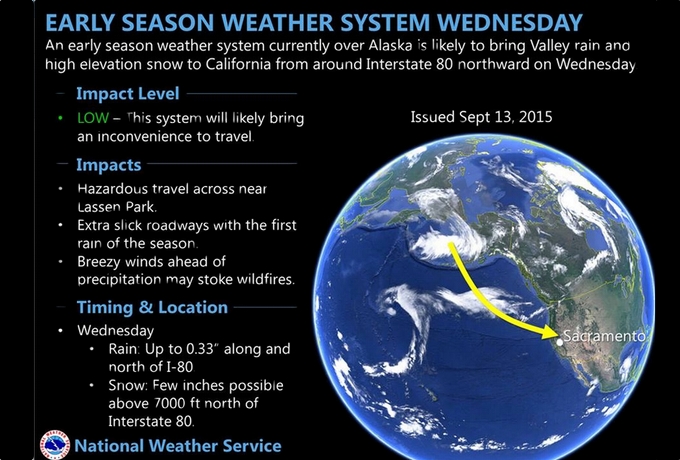
First snow of season in forecast for Tahoe area

weather grafix

Winter may arrive before fall in Lake Tahoe.

The National Weather Service in Reno is calling for a few inches of snow above the 7,000 foot level north of Interstate 80 on Sept. 16.

A chance of thunderstorms is possible for Monday and Wednesday in the basin and Truckee areas. Temperatures at the lake will dip to the high 50s.

A lake wind advisory is in effect from 11am Monday to 11pm Tuesday. Waves could reach 4 feet.

— Lake Tahoe News staff report


Added salt not always good for athletes

By Erin Beresini, Outside

Been popping salt pills like M&Ms during long workouts thinking they’ll do your body good?

You might want to think again: According to St. Louis University nutrition and dietetics professor, Ted Weiss, extra sodium from concentrated sources like salt capsules doesn’t actually enhance athletic performance. In fact, downing the pills may even cause hypertension.

“A lot of sports nutrition practices directly contradict what we know about positive health practices,” Weiss says. “Just because something makes you run faster doesn’t mean it’s healthy. Cocaine does that too, but that doesn’t mean it’s good for you.”

For years, the FDA has recommended Americans take in no more than 2,300 milligrams of sodium per day. But endurance athletes can easily exceed that amount when they gulp electrolyte capsules during exercise—some pills are stuffed with more than 200 milligrams of sodium each.

Read the whole story


Scientists conduct drought study in 6 western states

By Keith Ridler, AP

BOISE, Idaho — Federal scientists are conducting a low-flow stream study in six western states in an attempt to gain insights that could help resource managers better allocate scarce water supplies during future droughts.

U.S. Geological Survey workers are measuring flows and temperatures through September in nearly 500 streams mostly in upper tributaries in Idaho, California, Nevada, Oregon, Utah and Washington.

The report could ultimately be used for everything from deciding how much water to release from dams, how many cattle to allow on grazing allotments, how much water will be available for farmers in irrigation districts and decisions about rivers that contain fish protected under the Endangered Species Act.

“If water managers can understand which streams are most vulnerable it helps them target efforts for drought relief,” said Chris Konrad, a research hydrologist with the federal agency and the study’s project chief.

The spring snowpack in the West in 2015 was much lower than long-term averages, and many rivers in the region are now at historically low flows.

What is especially unusual about the low snowpack, Konrad said, is that many areas received average amounts of precipitation. However, it came down as rain rather than snow, meaning it immediately ran through basins rather than forming a high-elevation snowpack that functions as a kind of reservoir slowly melting through the summer to replenish streams.

“This is pretty extreme by historical standards,” Konrad said. “I don’t know that we can expect this kind of year frequently. But at the same time, we also know climate models are telling us we should expect warmer winters and in some years less snowpack. If we see one year like this, it’s likely that we’ll see more years like this.”

One of the key goals of the $465,000 study is to determine which basins are most vulnerable to a low snowpack and which basins have the kind of geology that can mitigate a lack of snow with groundwater.

About 160 of the streams are in Idaho.

“Groundwater can act kind of like a buffer,” said Dave Evetts, data chief at the Geological Survey’s Idaho Water Science Center. “They’re going to know based on snowpack and precipitation amounts which areas may be impacted more severely by that kind of drought situation.”

That kind of information could be used by the U.S. Bureau of Land Management when it comes to grazing allotments or setting stream flows where fish are present in water rights agreements, agency spokeswoman Jessica Gardetto said.

“We use a lot of USGS products and studies,” she said. “We incorporate a lot of their data into our NEPA (National Environmental Policy Act) reports.”

Brian Sauer, water operations manager for the Middle Snake River field office with the Bureau of Reclamation, said the additional information could be helpful in knowing how much water to expect in the spring when managers are trying to fill reservoirs but also leave space to protect against downstream flooding. It could be especially helpful following a winter like 2015.

“It’s possible that more rain than snow could make us operate slightly differently,” Sauer said.
Joel Fenolio, senior water manager for the Upper Columbia with the U.S. Army Corps of Engineers, said one year won’t change how the agency operates dams. But he said the agency would be interested in the USGS report for 2015.

“It was a challenging winter to figure out total water supply,” he said. “There was a lot of precipitation, but it didn’t build as snow like is usually does. It just kept running off.”
Another key component of the study is tracking water temperature. Many species of fish, some with federal protections, can’t survive in warm water.

Geological Survey officials say the report will be published in 2016.