This spring, as California withered in its fourth year of drought and mandatory water restrictions were enacted for the first time in the state’s history, a news story broke revealing that Nestlé Waters North America was tapping springs in the San Bernardino National Forest in Southern California using a permit that expired 27 years ago.
And when the company’s CEO Tim Brown was asked on a radio program if Nestlé would stop bottling water in the Golden State, he replied, “Absolutely not. In fact, if I could increase it, I would.” That’s because bottled water is big business, even in a country where most people have clean, safe tap water readily and cheaply available. (Although it should be noted that Starbucks agreed to stop sourcing and manufacturing their Ethos brand water in California after being drought-shamed.)
In 2014 bottled water companies spent more than $84 million on advertising to compete with each other and to convince consumers that bottled water is healthier than soda and safer than tap. And it seems to be paying off: Americans have an increasing love of bottled water, particularly those half-liter-sized single-use bottles that are ubiquitous at every check-out stand and in every vending machine. According to Beverage Marketing Corporation, a data and consulting firm, in the last 14 years consumption of bottled water in the U.S. has risen steadily, with the only exception being a quick dip during the 2008-09 recession.
The sow of which I speak was treed and tranquilized in the tree at Incline High School on Sept. 16.
The trapping of this sow is a travesty. This sow could have easily been handled by the book from the bear aversion training manual entitled “Responding to Human-Black Bear Conflicts A guide to non-lethal Bear Management Techniques” used by many law enforcement, wildlife agencies, and forestry bear managers in a multitude of jurisdictions here in the U.S. and Canada. It was first developed and applied in the national parks of Canada and the United States.
Walking this bear off into the desired direction could have easily been achieved with the NDOW officers present. Instead they decided to trap a lactating sow and hold her for three days. Not only has that cub gone three days without mother’s milk, that three days could slow or end the production of milk for her cub. Add to that the stress this bear and her cub have suffered to this point!
NDOW is trap/kill happy. Talk about a serious overreaction to an easily remedied situation. Carl Lackey is completely out of control and operates by the seat of his pants with no real operational plan or standards in place. And they keep little or no documentation on each trapping, release, or depredation, or so they tell us at the Bear League, other than blood draw and tagging.
On Sept. 18 criminal complaints were filed against IVGID Public Work’s Director Joe Pomroy and NDOW Deputy Director Jack Robb for violations of the Public Records Act including concealment of documents, the later of which is a Class C Felony. The Washoe County Sheriff’s Office is investigating.
And the vast majority of bears he actually releases, as opposed to killing, he releases in the Nevada bear hunt zones, by his own inadvertent admissions now and again. And I find it interesting that many of those he kills are far too small to be considered trophies to hunters. This man doesn’t even possess a degree in biology, so how exactly is he the NDOW state biologist? As far as I know being a sustainability major in college does not qualify him in any way, shape, or form to hold that title.
People need to start calling him out on the carpet and hold him and NDOW to a higher standard of professionalism, which seems to be set to a very low bar within NDOW.
Toogee Sielsch, member and bear aversion specialist for the Bear League
Family missing following West Slope fire
By Vallejo Times-Herald
A Benicia family is missing following a fire in El Dorado County, according to a press release Friday.
Adam Buchanan, his 7-year-old son Gavin and Gavin’s mother Molly McAfee have been reported missing after a fire gutted Buchanan’s cabin near Georgetown in El Dorado County “last weekend,” according to the release.
The actual date of the fire was not immediately available.
The name Caesars Tahoe was associated with Stateline for more than 30 years. Photo/Bill Kingman
Opening as Park Tahoe in 1978, Caesars acquired operations the following year, as reflected by the marquee in the 1982 photo above.
Although barely legible, the bottom of the marquee reads: “KRLT Presents An Afternoon With Donald Duck.” The radio station’s featured star was Clarence Nash, the man who voiced Donald Duck on all the Walt Disney cartoons. At dinner that evening, one of the menu items was roast duck. He declined.
The large marquee allowed for numerous announcements. Photo/Bill Kingman
With new ownership and new name came a new marquee in 2006. By 2014, the red-orange paint had become sun-bleached.
A modern electronic sign is installed Sept. 17. Photo/Bill Kingman
Part of a multi-million dollar renovation this year of MontBleu includes an electronic digital sign.
Installation of the sign was finished the afternoon of Sept. 17. Photo/Bill Kingman
— Bill Kingman
Hundreds gather to celebrate South Lake Tahoe
South Lake Tahoe celebrates its 50 years with a parade on Sept. 19. Photo/Kathryn Reed
By Susan Wood
Tears of joy and sentiment. Cheers of happiness and celebration.
In a burst of community pride, hundreds of people gathered Saturday on Highway 50 and Al Tahoe Boulevard leading into Bijou Community Park to mark a picture-perfect day for a parade and party to honor South Lake Tahoe’s 50th anniversary.
For most longtime residents and even some newbies, it was one of the city’s finest hours, or two, to witness 67 parade entries of floats, walkers, classic cars, fire trucks and appropriately a snowplow make its way through town that morning. Although the official 50th birthday falls in November, the city and its citizenry took full advantage of clear blue skies and warm temperatures to honor the past, present and future of this resilient mountain town nestled in the Sierra Nevada Mountain Range.
South Lake Tahoe is celebrating the past and future. Photo/Kathryn Reed
“I’ve waited 26 years for this. What a good day to celebrate and see a little bit of history. Look there’s Old Smokey, putting out our fires,” said Kimberly Jamison, who runs the Mailbag at Highway 50 and Tahoe Keys Boulevard.
Jamison has lived on the South Shore for a quarter century and believes the most memorable times are the ones in which the residents celebrate what they share – community spirit.
She was joined on the corner in front of the shopping center where her business is located by a brand-new resident. The group enjoyed the old cars honoring the classes as far back as 1965, the city’s inaugural year.
Mayor Hal Cole spoke of how the city is on a path to making positive improvements. Photo/Kathryn Reed
“We’ve moved a lot, and we’ve never moved anywhere where it’s been so welcoming,” said Jessica Branson. She brought her three children Jonah, 10, Trevor, 7, and Nolan, 6, to the parade route to witness the spectacle. “We love it here.”
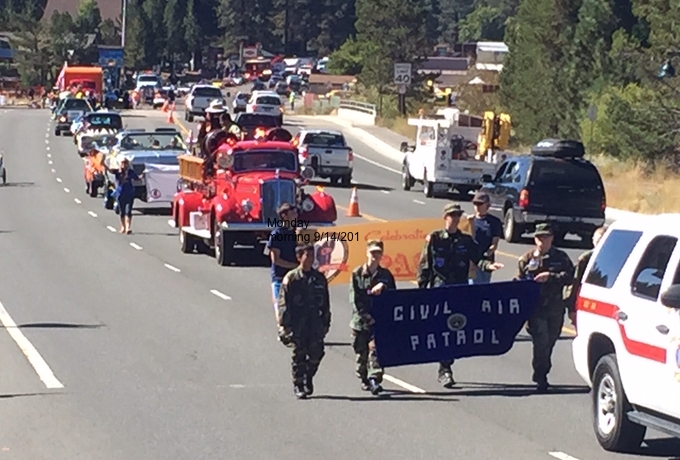
Up the highway, Kevin and Sheri Livingston came from Gardnerville and staged themselves near Al Tahoe Boulevard to cheer on their son Daniel. The 14-year-old boy marched in the Civil Air Patrol, a task his parents said he had looked forward to for quite a while.
“He wanted to be involved in a community project,” his father said.
Children who were spectators seemed just as engaged during the parade.
In a demonstration of community pride among three generations, grandma Sandy Jones joined her daughter Samantha Jones with her daughter Kiki, 6 – who attends Sierra House Elementary School, to watch the city throw its street party.
Sandy has lived with her daughter here for 30 years and wasn’t going to miss it. The two huddled together, identifying participants as they went by. One of them yelled happy birthday to Samantha.
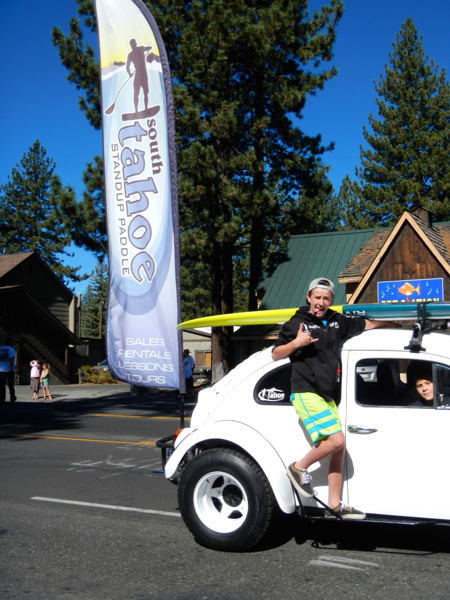
Mark Allen with Tahoe SUP. Photo/Kathryn Reed
Dance instructor Marcia Sarosik knows so many people, she fell behind her float and group who shimmied to “Dancing in the Streets.” She ran down the street with a mock Olympic torch. Sarosik ran a leg of it in 2002 when the torch graced the town on its way to Salt Lake City.
The elder Jones reflected back on the past, recalling small, homespun parades in the late 1980s at Tahoe Valley. The youngest said she liked the present day, filled with ribbons and balloons. Kiki waited patiently for her cousin Emerson Hawkins, 9, to walk with the Lake Tahoe Vikings Pop Warner contingent.
The camaraderie in the community was unmatched.
“I like that everybody comes together here. We’ve gone through a lot in South Lake Tahoe,” said Julie Incopero, a resident of 40 years who sat in a beach chair with her sheltie dog, Buddy. Incopero listed the Angora Fire of 2007 that ripped through 254 homes and the abduction of Jaycee Lee Dugard as a child as examples of a community in catharsis. She also mentioned appreciating how the community supported her when her daughter McKenzie got a blood cancer and needed help.
Some things you don’t forget.
Apparently, members of the community didn’t fail to forget how cycling guru Tom Wendell worked tirelessly to make the community more bike friendly.
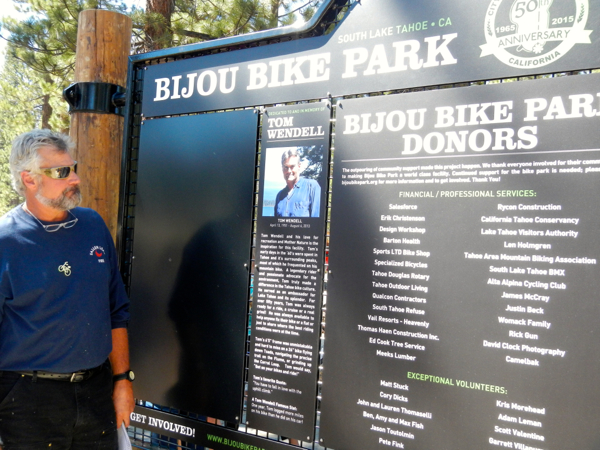
As the parade resulting from the hard work of former Councilwoman Brooke Laine emptied out into the city’s Bijou Community Park, dignitaries and bike advocates took the opportunity to dedicate its new bike park to a man who was undaunted in his pursuit to pass on the two-wheeling legacy – Tom Wendell.
Ted Wendell brought many people to tears with his tribute to his brother, Tom, for whom the Bijou Bike Park was dedicated. Photo/Kathryn Reed
Wendell died a few years ago, but now his legacy lives on in the center of town in the shadow of the pine trees he rode through along with other destinations and journeys that exemplified his coveted life in South Lake Tahoe.
“Welcome to our new bike park,” City Manager Nancy Kerry said to hundreds of people gathered for the formal unveiling. The park represents a maze of gnarly jumps, banks and turns that mark a turning point in public-private partnerships for the city embracing its recreation-oriented heritage and future.
“This is the most significant recreation opportunity we’ve had in years,” Mayor Hal Cole told the attentive crowd of several hundred people. “This city is on a mission to make this town first class in recreation.”
Cole labeled the park a “perfect place to put his name” when speaking of Wendell.
The mayor was followed by the ever-so humble Assistant Public Works Director Jim Marino, who couldn’t seem to accept his award and instead dedicated his honorary plaque to his fellow city employees. He waxed poetic in speaking of the park, calling it a venue of “flow” that represents the “flow in life.”
Apparently, there’s no stopping the city now.
The park was billed as a training place for athletes as well as an ideal hangout for youngsters wanting to master the art of two-wheeling like life-long BMX advocate and city Recreation Coordinator Lauren Thomaselli, who also received an award, and city Parks and Recreation Commissioner Peter Fink, who pedals the talk of cycling. (He and his wife, Karen, did an 8,000-mile cross-country trip years ago.)
The parade was the length of four football fields. Photo/Susan Wood
“This is what a citizenship can do,” Pete Fink said, while looking out at the park.
Councilman Tom Davis, who has spent several years serving the city, called the project “your government at its finest.”
To those close to the subject, the bike park was long in coming – a project that prompted many to want to pick up and shovel to see it happen instead of sitting as a ream of paper on a shelf.
And no one knows that better than Ben Fish, who is president of both the Tahoe Area Mountain Biking Association and Bijou Bike Park Association. Fish held up a rough sketch he drew in 2011 to show what can happen when you take an idea and hand it over to a visionary like Kerry, an open-minded city council and building types like Marino. He received more than a plaque and bike socks for his efforts. His wife, Amy, wheeled out a new bike on behalf of TAMBA. She was in tears when she honored his dedication with the gift.
Just as attendees were on the edge of heart-tugging sentiment, Wendell’s brother, Ted, took the microphone and reduced many to tears in discussing his brother Tom’s tenacious efforts to “do the right thing” by his community and support all things and venues that were bike friendly. Wendell, who Cole describes as “a gentle giant,” showed up at countless meetings with a smile and charm.
“He never wavered from his convictions, whether they were popular or not,” Wendell said of his brother, Tom. “He was always trying to make things for the better.”
The brother listed things that Tom did to exemplify passion and pursuit of outdoor recreation – including his Zen-like time on his mono ski, surfing longboard and his bicycle billed as his most treasured possession.
“He was always in the present. He had that gift, and he shared it with everyone,” Wendell said.
Brutally heart-warming, Wendell said he’ll remember Tom’s favorite lines: “C’mon, the best part is the uphill,” “What ropes? Sorry sir,” and “That looks pretty safe, doesn’t it?”
Tom Wendell had an adventurous spirit that didn’t go unnoticed. And now it’s being passed on.
Ted Wendell told the crowd he came down to the bike park and ran into a young rider who called the course “so totally sic,” meaning awesome.
It was as though Tom was there between the trees as the city of South Lake Tahoe moves into another half century, cultivating recreation advocates of a new generation to take part.
Ted Wendell reminded everyone, “Tom would say: ‘Be the change you want to see.’”
Opinion: Homelessness isn’t one-size-fits-all
By Quinn French
The homelessness issue in America can feel like an overwhelming and abstract problem. As such, it’s understandable that politicians talk about it in broad terms and propose broad policies that treat all types of homelessness as the same.
But as someone who was homeless until quite recently and is committed to finding solutions, I believe the key is to address homelessness with incremental policy initiatives, targeting specific groups. And I think we should start with homeless young people, who have immense potential to change their lives with assistance.
I was 18 and living with both my parents in Santa Monica in 2008 when the economic downturn came. My dad, a salesman in the commodities industry — primarily via telemarketing — and the sole breadwinner, was no longer able to maintain his level of income. My mother, who has Huntington’s disease, was deteriorating at a progressive rate and couldn’t take care of herself. We fell behind on our rent, and I couldn’t continue at Santa Monica College, where I had been enrolled for a semester. Finally, we were evicted and my mother went into a nursing home, partially funded and cared for by her brother. Dad and I stayed in a Culver City motel for about a month. Then we moved into his car, a compact Geo Metro.
That began a six-year journey for me. At first, my dad made a go of it in the car, finding secluded spots to park and moving around from night to night to avoid the notice of the police. My dad was trying to get work, and I was spending a lot of time at the public library reading.
I learned about the Ocean Park Community Center (OPCC) shelters and wanted to access their services, but my dad, too proud to accept a handout, refused. So we split up; I moved into a shelter, he stayed in the car. We lived separately from then on, but stayed in touch and continued to support each other.
I desperately wanted to get work and develop skills. I started with telemarketing, trying to emulate my father, but I couldn’t make any real money at it. I worked retail at Sears in Santa Monica, but that was a dead end. Over time, I couldn’t make enough money to meet the savings goals that the OPCC shelter set for me. I left their program.
Eventually I decided Santa Monica was the problem, with a cost of living that’s too expensive for someone trying to pull himself out of homelessness. So I moved east into downtown Los Angeles, looking for work everywhere and moving between shelters, including PATH (People Assisting the Homeless) and the Weingart Center. When my situation grew particularly bad, I even slept on the streets. The transportation system often defeated me; I’d miss a bus back from a job and miss the inflexible curfew at PATH, and spend the night visiting coffee shops, diners, and other 24-hour places.
One day in 2014, desperate for a place, I called L.A. County’s 211 phone line for housing services and learned about Jovenes, a program serving young homeless young men, ages 18 to 24. I was 24, nearly too old. But after a wait, I got in, and it made a difference.
Jovenes’ focus on a specific subset of the homeless population made its services much more effective. It was designed for people like me – there was greater flexibility with regards to curfew and such. If you were running late because of an interview or a class, you could call your case manager and explain the situation. And because my fellow Jovenes clients were around my age, it was easier to compare notes and make connections than in a typical shelter.
At Jovenes, I found it easier to make progress. When I got into the program, I had just finished a six-month gig at the L.A. Food Bank. Jovenes helped me find warehouse positions that allowed me to save enough to put down first and last months’ rent for an apartment owned by the organization. I now pay rent on $500-a-month unit in the South Park neighborhood near downtown. (Thanks to an additionally subsidy program, I’m slowly building up to the full amount over 12 months.)
I also have found time to go back to school at Santa Monica College. It’s a hike, but Santa Monica has a strong transfer rate; in two years, I expect to have an associate’s degree, and then transfer to USC (just a mile away from my house).
I don’t want to make the Jovenes program seem perfect. It isn’t. And I know it doesn’t work for everyone. Still, I think they have very innovative and effective systems in place, designed for a specific demographic. I understand why the other shelters I stayed at had certain regulations and rules. Parents with minor children, recovering drug addicts, disabled veterans and the mentally ill all have different needs. And so do homeless youth. The biggest mistake that’s being made in the homelessness services field is trying to use a one-size-fits-all approach.
I’m still working to improve my life and those of my peers. In particular, I’m motivated to address and combat the issue of youth homelessness. One part of this was serving as a counter in the Los Angeles Homeless Services Authority (LAHSA)’s Homeless Count. The goal is to improve how we figure out the size of the homeless population. One focus has been to get out in the field and do more counting of homeless youth (who might be living on the streets or in a car, as I once did). The counts are also reaching into new regions that were missed before; I was part of the first youth count in East Los Angeles.
I think there’s real potential for homeless young people to help each other — to learn from our mistakes and to bond over our successes. A young person can go from an orphan or homeless or in a gang to being a fully formed successful adult — in the space of two or three or five years. I’m fortunate to be one of those who have changed.
Proponents of a $9 billion school-construction bond have turned in enough valid voter signatures to qualify for the November 2016 ballot, Secretary of State Alex Padilla announced Friday. The school borrowing measure would be the first since 2006.
Voters have approved about $45 billion in K-12 and higher education borrowing since 1998. All of the measures – totaling $9.3 billion in 1998, $13.05 billion in 2002, $12.3 billion in 2004 and $10.4 billion in 2006 – were placed on the ballot by the Legislature.
The pot of bond money is almost tapped out, and the state faces an estimated $20 billion backlog of applications.
Last week a neighbor filed a complaint against me with the city of South Lake Tahoe for marijuana odor and an illegal grow op. Standard procedure for responding to such a complaint is a full scale home invasion by SLEDNET, destruction of all plants, shut off of electricity and removal of the electric meter.
Steve Kubby
Standard procedure here in South Lake Tahoe, also mandates that the cops first contact the SLT Building Dept to see if I have a permit, which I do. I am one of only 12 SLT resident who actually has gone through the considerable expense of setting up a legal garden in my garage.
Instead of a home invasion with heavily armed cops, I was visited by a polite man who simply wanted to see my garden and to see what we could do about the odor. Upon inspection I was told there was no odor being emitted and that I was not in violation.
All that odor was from me toking up in my own back yard and that is still 100 percent legal.
I’m still toking, my garden is thriving and life is good.
Steve Kubby, South Lake Tahoe
Ag secretary on quest to cut food waste
By Karen Matthews, AP
Agriculture Secretary Tom Vilsack announced a goal this week to cut the amount of food that Americans waste by 50 percent by 2030.
“The United States enjoys the most productive and abundant food supply on Earth, so too much of this food goes to waste,” Vilsack said in New York City, where he was joined by food-industry representatives and officials from the Environmental Protection Agency.
Vilsack likened the effort to reduce food waste to the anti-littering campaigns of the 1960s and ’70s that shamed Americans for tossing trash out car windows. “This is the logical extension,” he said. “This is the next litter campaign.”
The U.S. Department of Agriculture estimates that Americans waste 133 billion pounds of food every year, or 31 percent of their overall food supply.
Vilsack said other nations waste similar amounts and the U.S. must lead a global effort to use food more efficiently. “This is an opportunity for us to make a statement and provide leadership,” he said.
EPA officials said the massive waste is a problem not just because the food could feed the hungry but also because it ends up in landfills and affects the environment.
“Twenty-one percent of all the waste in landfills is food,” EPA Deputy Administrator Stan Meiburg said. “Once it’s there, it produces methane, which is a greenhouse gas.”
Leslie Sarasin, president and CEO of the Food Marketing Institute, a food retailers’ trade association, said the industry supports cutting food waste because it operates on a “razor-thin” margin of 1 or 2 percent.
“Reducing food waste at all levels in the food chain — farm, factory, store and home — is certainly one of those issues with economic and emotional appeal,” she said.
The officials spoke at a facility in Long Island City, Queens, operated by the nonprofit City Harvest, which started in 1982 as an effort to salvage excess food from restaurants. City Harvest now takes donations from businesses and farmers and delivers it to 500 food banks and soup kitchens.
Vilsack toured the warehouse packed with donated produce like carrots that were too big to sell and called it “truly inspiring.”
He said the campaign to cut food waste includes educating consumers about how long to keep food before it must be thrown out.
He said he recently used the USDA’s new mobile FoodKeeper app to determine whether chicken salad in his refrigerator was still good.
It was, and he ate it.
Snippets about Lake Tahoe
· Sierra-at-Tahoe just sent out 330 passes to Lake Tahoe Unified School District straight-A students from the 2014-15 school year. This is the highest number of passes ever given out by the ski resort for this purpose.
· When Alex Ramon closed his long-running show Illusion Fusion in Stateline 18 months ago he made a promise to come back to the Tahoe-Reno area. On Oct. 8 he fulfills that promise at Harrah’s Reno. For more info or to buy tickets, go online.
· California Department of Motor Vehicles’ final day of Saturday office hours will be Oct. 24.
· Tahoe Valley Elementary School fourth-grade teacher Gene Matteucci will be receiving the outstanding educator award next week from the Oregon California Trails Association.
· Here is the Sierra roadwork schedule from Caltrans for the week.