Proposed campground unpopular with residents

By Kathryn Reed

KINGS BEACH – Is it a campground or is it a resort? Is it enhancing or hurting existing recreation? Is it a precursor for future development on the ridge? Is it precedent setting? Will it add to already heavy traffic on the North Shore?

These are just a few of the many questions the Tahoe Regional Planning Agency Governing Board will have to answer as the proposed Brockway Campground makes its way through the planning, permitting and approval process.

On Wednesday the proponents, Mountainside Partners (formerly East West Partners), spelled out plans to turn an undeveloped parcel off Fibreboard Freeway into a 550-site campground that would include tent camping, RVs and ecoshelters.

More than 200 people turned out for the nearly 2½-hour presentation. All of the 27 individuals who spoke were against the project.

The Sept. 23 unveiling gave the Governing Board an opportunity to learn about the controversial project without an action required. The application was submitted in July. An environmental impact report and environmental impact statement will be required.

Proponents were a bit contradictory in describing the terrain – at first saying how it is a disturbed site because of all the logging that has gone on there in the past (the land is owned by Sierra Pacific Industries), but then invoking how going forward it will be treated like a national park, with a bit of reverence.

Angela Lin with Square One said light from the campground would not be visible from North Shore towns. Many in attendance did not agree with that conclusion.

Attorney Lew Feldman touted the recreation benefits. The audience said a massive campground would negatively impact the current hiking and mountain biking by putting development in the middle of the forest.

In addition to the camping, there will be a swimming pool, lodge for dining and other structures.

Traffic concerns were repeated by many. Fibreboard Freeway, which is a misnomer because it is really a pothole filled U.S. Forest Service road, is off Highway 267 near Northstar. People wonder what the campground would do to already congested roads, as well as what the air quality impacts would be.

When TRPA votes on the project five of the California representatives will have to say yes for it to pass.

Detractors are already lining up.

“This is really blurring the definition between a campground and a resort,” Hal Cole, who represents South Lake Tahoe on the TRPA board, said. “This is not where I want a campground. This is hard to swallow on a lot of levels.” (He is a contractor by trade.)

Clem Shute, California governor appointee to the board, is weary of the former proposal of 112 residences for this site being “suspended” instead of “abandoned.” He called it suspicious and that it was like a threat to have it still lurking out there.

Shute and others pointed out how the Regional Plan says development should occur near urban areas or town centers, and that campgrounds per plan area statements should be near infrastructure. This proposal does not conform to those existing criteria.


Opinion: Expect increase in bear activity

By Carl Lackey

As autumn begins, the appetite of the Sierra Nevada black bear takes a dramatic swing upward. Motivated by signals from nature known as zeitgebers, the bears spectacularly increase their daily caloric intake from 3,000 calories per day to upward of 25,000 calories per day.

This physiological wonder is known as hyperphagia. Nature’s dinner bell is ringing.

Hyperphagia is a period where bears eat as much as they possibly can so they can put on as much fat as possible to carry them through winter hibernation. Nothing much gets in the bear’s way when they are this hungry.

Armed with that big appetite and motivated by zeitgebers like decreased daily sunlight and cooler morning temperatures, the bears will search far and wide in the hunt for food. Those 25,000 calories are the human equivalent of eating about 50 cheeseburgers per day over the next couple of  months.

The moon is at or nearly full for the rest of September and the first days of October. They will eat up to 20 hours per day during a full moon period as they pile on the fat. People living in bear country should not be tempting these already hungry bears with easy access to garbage, bird feeders, bowls of pet food or ripened fruit falling from trees.

Areas most at risk of attracting bears by granting access to garbage and other attractants are the Lake Tahoe Basin, west Carson City and the foothill areas of Douglas and Washoe counties.

Nevada has had four dry winters in a row and the natural foods that the bears desire are not in abundance in the wild lands. Plants that create nuts and berries like manzanita, squirrel tail, snowbush, desert peach and rosehips are highly desired but not always abundant in dry years. It will be a busy next few weeks in bear country.

People needing to report nuisance bear activity can call the NDOW’s Bear Hotline telephone number at 775.688.2327.  For information on living with bears persons can go online and find the ”Bear Logic” page.

Carl Lackey is a biologist with the Nevada Division of Wildlife.


Move over Millennials, here comes Gen Z

By Alex Williams, New York Times

Hear the word “millennial,” and plenty of images spring to mind.

There’s Facebook’s Mark Zuckerberg, in his hoodie, earning his first billion by the age of 23.

There’s Miley Cyrus, preening for the cameras in a flesh-baring act that recalls a Snapchat sexting session.

They’re brash, they’re narcissistic, they’re entitled. Or so the cliché goes.

But what about “Generation Z,” the generation born after millennials that is emerging as the next big thing for market researchers, cultural observers and trend forecasters?

With the oldest members of this cohort barely out of high school, these tweens and teens of today are primed to become the dominant youth influencers of tomorrow. Flush with billions in spending power, they promise untold riches to marketers who can find the master key to their psyche.


While it is easy to mock the efforts of marketers to shoehorn tens of millions of adolescents into a generational archetype, à la the baby boomers, it is also clear that a 14-year-old in 2015 really does inhabit a substantially different world than one of 2005.

Read the whole story


Author to give talk at S. Tahoe Library

Friends of the South Lake Tahoe Library on Oct. 24 are hosting William Lindemann, local author of contemporary and historical fiction.

During the past 25 years he has researched, written and developed exhibits for art, history, and technology museums and state parks. In addition, he wrote and produced an award-winning historical short film, “Auto Tour of Lake Tahoe 1915”, which he will share at the talk.

Lindemann’s books, “Between The Waves”, “Timbre Coulee”, “Counterpoise”, “Down The Fall Line”, and “River’s End” are available as ebooks.

The free talk is at 1pm at the library, 1000 Rufus Allen Blvd.


Sugar pine planting open to the public

Employees from Zephyr Cove Resort, Spooner Summit Recreation and Lake Tahoe Cruises are partnering with the Sugar Pine Foundation to replant trees at Spooner Summit.

Sugar pine trees, the world’s largest species of pine with the longest cones, are dying from white pine blister rust, a nonnative invasive fungus. Originally they accounted or 25 percent of Lake Tahoe’s forests but now make up less than 5 percent of the forest composition.

On Oct. 17 from 10am-noon employees help restore the forests at Lake Tahoe by planting yearlings.

The event is open to the public. Interested people may contact admin@sugarpinefoundation.org.


Poor students lose ground with Common Core

By Diana Lambert and Phillip Reese, Sacramento Bee

Despite longtime efforts to reduce the achievement gap between rich and poor students in California, the divide grew much wider under the state’s new testing system, according to a Sacramento Bee review of state data released this month. About 21 percent of economically disadvantaged students in California met state math standards under the new Smarter Balanced Assessment System, compared with 53 percent of all other students.

That means the percentage of wealthier students meeting state standards is about 2.5 times higher than the percentage of economically disadvantaged students. By comparison, under the previous testing system used in 2012, the percentage of students scoring “proficient” was about 1.5 times higher for wealthier students than for poor students.

The new statewide exam is based on Common Core standards, a national set of guidelines intended to promote critical thinking, analytical writing and problem-solving skills. Students often must combine several skills to correctly answer questions, and memorization is less valuable. Students, regardless of income level, fared worse than under the previous testing system, but low-income schools suffered the steepest performance declines.

Read the whole story


Grant will pay for Tahoe Water Trail signs

Sierra Business Council has been chosen as a recipient of a Tahoe Truckee Community Foundation grant in the amount of $7,500.

The money will be used to support the planning process for educational Lake Tahoe Water Trail wayfinding signage to help paddlers have a safe and fun adventure, and to protect natural resources.

The grant provides much needed funds to allow the Sierra Business Council to work with lakewide public access land managers and recreation providers to discuss the process for development and installation of coordinated educational signage at primary public launch locations.

The goal is to have the signs in place for the 2016 paddling season.

Signage will provide water safety and resource conservation tips, and navigable paddle routes and distances to locate public beach access to shoreline businesses, nearby hiking trails, historic sites, lodging and campgrounds.


Nevada ‘rock crawler’ wants to revive rugged sport

By Benjamin Spillman, Reno Gazette-Journal

Imagine the vertical world of rock climbing combined with the power and sound of off-road racing.

Now you understand rock crawling.

The small-but-compelling niche of off-road motorsports involves driving heavily modified 4x4s up and over boulders that would be difficult to climb on foot, let alone with a couple thousand pounds of steel and rubber.

It’s essentially the logical extension of weekend trail driving for people willing to spend tens of thousands of dollars and countless hours working on their 4x4s.

Read the whole story


Darted bear drowns in Nevada

By Jeff DeLong, Reno Gazette-Journal

A black bear drowned Monday after it was tranquilized by wildlife officials and then ran into a pond in Dayton and slipped beneath the water, according to the Nevada Department of Wildlife.

The bear, an 8-year-old, 300-pound male, was reported to be wandering through the Dayton Valley Golf Club Monday evening, department spokesman Chris Healy said.

Read the whole story


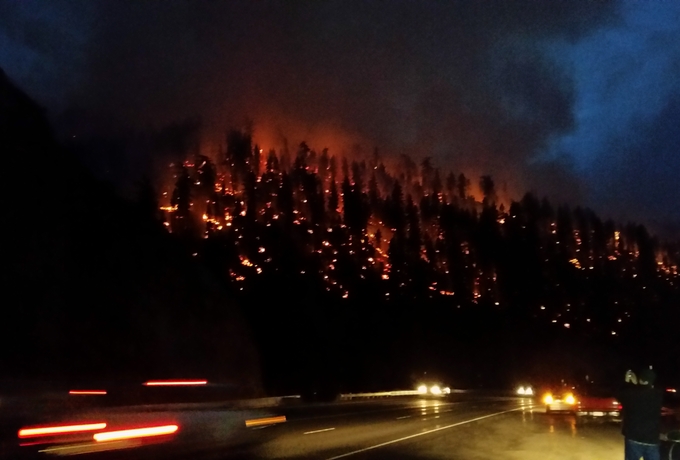
Science: Controlled burns help prevent larger fires

A controlled burn on Spooner Summit in 2014. Photo/Carolyn E. Wright/Copyright

A controlled burn on Spooner Summit in 2014. Photo/Carolyn E. Wright/Copyright

By Francie Diep, Pacific Standard

In the right forests, one important way to prevent large fires is to let small ones burn. That’s the conclusion of recent research into wildfires, which has found that small, controlled fires remove dry brush that would serve as fuel to mega-fires if allowed to build up.

In addition, moderate fires can nourish the soil and germinate the seeds of plants evolved to work with wildfire. (Lodgepole pinecones = real-life dragon eggs.)

If you’re from California, or live in another region that’s prone to wildfires, you may already know this. Researchers and forest managers know it too. A quick search finds a number of official documents that talk about the importance of removing brush, setting off controlled “prescribed fires,” and letting small wildfires burn far away from buildings. This is a major departure from the common practice of the recent past, when nobody cleared brush and firefighters put out all forest fires. researchers now acknowledge such habits set the stage for the large, out-of-control fires of today.

Read the whole story