Hospitals see uptick in cycling injuries
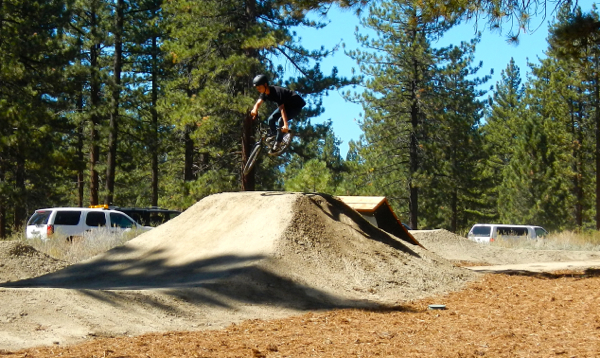
A cyclist gets some air at the Bijou Bike Park. Photo/Kathryn Reed

A cyclist gets air at the Bijou Bike Park. Photo/Kathryn Reed

By Kathryn Reed

On opening day of Bijou Bike Park people were calling it the “bone yard” even though no ambulances were needed.

The description had to do with the tricked out features and the potential for injury.

Hospitals in the U.S. saw the number of bike injuries double between 1998 and 2013, according to the American Medical Association. And it’s not just young people who are getting hurt; the biggest increase was for those 45 and older.

When it comes to cycling deaths, fewer children died in the last four decades, while deaths for those between the ages of 35 and 45 tripled, according to Morbidity and Mortality Weekly Report.

Barton Memorial Hospital is not seeing quite the same trend with injuries. In 2012 the South Lake Tahoe facility recorded 63 hurt cyclists where trauma care was activated or the patient was transferred for additional care. That number does not include minor or non-trauma injuries. There were 41 in 2013 and 66 in 2014.

Of those injuries the ages are broken down as follows:

2012 2013 2014
0-10 7 1 6
11-20 11 4 10
21-30 6 18 8
31-40 12 5 8
41-50 12 3 12
51-60 9 6 14
61-70 5 2 7
71-80 1 2 1
Total 63 41 66


“Riding a bike properly fitted to an individual can reduce crash potential as well as musculoskeletal problems. Not having proper conditioning or training relative to the demands of the trail or road ride chosen can certainly increase chances of an accident. For example, if someone is severely taxed by the uphill portion of a mountain bike ride, their agility and reaction time is likely to be affected on the downhill portion where speed increases and quick reactions are important,” Lance Orr, Barton emergency physician and medical director of the Emergency Department, told Lake Tahoe News.

In 2012 and 2013 about three-fourths of the injuries were sustained by men. That number grew to 80 percent in 2014.

Barton is seeing fewer head injuries because more people are wearing helmets. Still, they are the predominant injury.

Source: Barton Health

Source: Barton Health

“A large percentage of road bike accidents involve vehicles and these accidents can be severe,” Orr said. “From my perspective as an emergency medicine physician, a fair number of bicycle accidents that occur in town involve consumption of alcohol on the part of the rider. That is an uncommon issue for the distance road biker or typical mountain biker.”

Equipment beyond a helmet can be helpful when mountain biking. Even some of the people at the bike park are wearing pads.

“Padded equipment and full face helmets can reduce injuries even for the average rider provided vision and mobility are not impaired by the equipment,” Orr said. “Sometimes using additional equipment can have the opposite effect and lead riders to feel they can tackle a ride they previously felt was beyond their ability level.”

Locals had been dominating the Barton ER visits, but that changed in 2014 when 59 percent of the injuries occurred to visitors. In 2012, it was 63 percent locals in the ER with bike injuries, and 68 percent in 2013.

First aid kits are not common among cyclists, so treating wounds immediately doesn’t always happen.

“I always carry a roll of white athletic tape. You can tape up cuts with it and, if you know, you can fashion a splint using sticks,” Lars Ensign, a Barton ER doc, told Lake Tahoe News.

The doctors recommend using clean water to wash out abrasions or lacerations.

When it comes to learning what to do on the trails, the docs recommend a clinic, watching YouTube videos and progressing on courses – like the multi-level Bijou Bike Park.




Opinion: Participation should not determine grades

By Emily J. Klein and Meg Riordan, Huffington Post

“Stop counting participation as part of a student’s grade.”

As a professor of teacher education at Montclair State University, every time I teach our unit on assessment, I begin class with this statement. Usually, there’s a nervous giggle that spreads around the room, and my students wait for me to say, “Just kidding.” But I’m not, and neither is my colleague Meg Riordan, who for years has been supporting Expeditionary Learning leaders and teachers to implement a clear vision for students’ learning that includes standards-based grading: separating academic achievement from the habits that support it—such as participation, effort, or timeliness.

Imagine two students. They both receive an 80 as their final course grade. Ideally, that number should reveal what each student did or did not understand about the content and demonstrate her ability to perform particular skills. But what happens when the teacher includes “class participation” as 25 percent of the grade? Student A might have received a 90 on the final comprehensive exam or project, which assesses content and skills. Or maybe Student A received a 65 but, due to constant participation in class, benefited from a boost to her grade.

Read the whole story


Pesticides tied to childhood cancers

By Nicholas Bakalar, New York Times

Childhood exposure to indoor insecticides is associated with an increased risk for certain childhood cancers, a new study has found.

Researchers reviewed 16 studies of children exposed to indoor pesticides, including professional pest control services, indoor flea foggers, flea and tick pet collars, and various ready-to-use roach and ant sprays. The analysis, in Pediatrics, included 7,400 cancer cases matched with 9,437 healthy control subjects.

Exposure to indoor, but not outdoor, residential insecticides was associated with a 47 percent increased risk for childhood leukemia and a 43 percent increased risk for childhood lymphomas. Outdoor pesticides used as weed killers were associated with a 26 percent increased risk for brain tumors.

Read the whole story


Transit and trailheads subject of talk

How can we improve transit options to trailheads and other dispersed recreation areas? That is the topic of the next Tahoe Talks Brown Bag Lunch series.

The free talk is Oct. 21 from noon-1:30pm at Lake Tahoe Community College in the Aspen Room.

This panel will discuss barriers to improving transit to trailheads and other dispersed recreation areas, plans in the works, the role of technology in improving transit, and how different groups can work together to improve transit.

The speaker panel will include; Mary Bennington, executive director Tahoe Rim Trail Association; Carl Hasty, district manager Tahoe Transportation District; and Daniel Winegar, director of recreation for Marriott Timber Lodge and Grand Residence Club.


Students sought for FBI Teen Academy

The FBI is looking for high school juniors within the 34 California counties served by the FBI’s Sacramento field office to participate in the Sacramento FBI Teen Academy.

The academy is Nov. 20 in Sacramento.

Prior classes engaged in classroom discussions offering insight into a number of topics and specialties such as the importance of making good choices when using online communication platforms, the difference between freedom of speech and violation of federal law, what is required of all FBI applicants, the FBI’s domestic and international roles, and discussions about adjudicated cases. Hands-on experiences involving the evidence response team, bomb techs, and auto shop also offered students the opportunity to learn about a limited number of FBI tools and techniques firsthand.

Application packages are available online. The deadline to apply is Oct. 23.com


‘Mini-Mousehole’ to benefit Truckee pedestrians, cyclists

A tunnel for non-motorized traffic will improve safety in Truckee on Highway 89. Photo/Caltrans

A tunnel for non-motorized traffic will improve safety in Truckee on Highway 89. Photo/Caltrans

By Barbara Barte Osborn, Sacramento Bee

There’s a “light in the tunnel” for the Truckee-Tahoe area’s numerous bicyclists and hikers, who have long had to negotiate Truckee’s 25-foot-wide, 1928 Mousehole tunnel on Highway 89.

A smaller tunnel just for them was punched through east of the Mousehole last week, and a paved pedestrian/bike trail through it, connecting West River Street and Deerfield Drive, is expected to be finished early next summer.

Although the tunnel phase is now completed, Truckee and Caltrans officials advise that much work still needs to be done before it will be safe for the public to travel through.

Read the whole story


LTCC to host three art exhibits

Lake Tahoe Community College begins the fall art season with a free artist reception Oct. 1 for three exhibits.

From 5-7pm people will be able to meet the artists, see their works up close, and enjoy light refreshments.

In the Haldan Gallery inside the library building, Southern California artist Yu Ji presents Recent Drawings. LTCC Art Department Co-Chair Phyllis Shafer will give a short talk about Yu’s works in the Haldan at 5:30pm Oct. 1. This exhibit will be open through Dec. 4.

In the Fine Arts Building’s Foyer Gallery will be Ellen Nunes’ Creation Series: A Collaboration With Nature.

The third exhibit, the Student Gallery Winners Exhibition in the Commons/Main Building, is an invitational exhibit in which LTCC art students who were award winners in last spring’s annual Student Art Exhibition are invited to show their winning pieces, along with three new works of art.


It’s time to end the tyranny of olive oil

By Roberto A. Ferdman, Washington Post

On a weekend morning not long ago, I found myself in the kitchen, near the burner, whisking eggs while a pan absorbed the heat from a light flame. I was making breakfast for a few friends. The mood was light. The coffee was dark. Music played in the background, and everyone sat silently, anticipating the meal.

That is, until I reached for the butter.

“That’s a lot of butter,” one friend uttered from behind a newspaper.

“Is there any olive oil?” another asked.

“Yeah, I would really prefer olive oil,” a third joined in. “If that’s ok,” he added, softening the demand.

I looked down at the poor, marginalized, misunderstood stick of coagulated deliciousness. And then back up at the table, where the butter skeptics sat. Three rather slender men in their late twenties, terrified of a little dairy fat.

“Fine, I’ll make my eggs separately,” I said, audibly disappointed. “But I’m not sharing.”

Read the whole story


Fantasy sports and the cost of weird gambling laws

By Neil Irwin, New York Times

Sports leagues in the United States, and the networks that broadcast their games, prefer to pretend that everyone watching their games does so for the pure love of competition, the occasional nonchalant reference to the gambling point spread by a football announcer notwithstanding.

But as anyone who has turned on a television during sports programming in the last few months knows, there is a boom in “daily fantasy sports”sites. They offer the prospect of six- and seven-figure prizes in contests based on the statistical performance of a roster of athletes the entrant chooses in a wide range of sports, with the NFL the most popular.

DraftKings and FanDuel have quickly become among the biggestadvertisers on TV and the Internet, with scenes of fantasy players celebrating their winnings. The companies have entered partnerships with teams and attained billion-dollar-plus valuations from prominent investors that include pro football franchise owners.

An entire industry has emerged out of a legal loophole for something that looks a whole lot like sports gambling, which is illegal outside of Nevada and a few other states.

Read the whole story


K’s Kitchen: Peaches with lemon verbena

By Kathryn Reed

I’m not sure I had heard of lemon verbena until my landscaper planted it in my herb garden. This meant needing to figure out what to do with it besides taking a leaf or two along with some peppermint and popping it in my mouth.

Brian, the landscaper, said his girlfriend makes tea out it. I can see this being good, but have not tried it.

Tearing up a few pieces and tossing them in a green salad has been fabulous.

But I have a lot so I needed a way to use even more. Fortunately, the peach season seems to be extended at the Tuesday farmers’ market in South Lake Tahoe. (The last day of the market is Oct. 13.)

Start off with a little sugar when whipping the cream. Add more until you get the sweetness you like. The peaches are going to be sweet, so take that into consideration.

For some reason the cream was not whipping into peaks the day I made this. Impatience could have been part of the problem. Still, it was thicker than pure liquid out of the container. The peaches were swimming in the cream, which still tasted great.

I could envision cooking the peaches on the barbecue as well.

peach-lemon verbena

            Peaches with Lemon Verbena Cream

2 C heavy cream

½ C fresh lemon verbena leaves, packed – plus a few for garnish

4 large ripe peaches, halved and pitted

¼ C butter (salted or unsalted) at room temperature

¼ C sugar, divided

In small pan bring cream to a simmer. Remove from heat and then add lemon verbena. Cover and steep for 15 minutes. Strain cream into bowl. Chill covered for at least one hour.

Place peaches in a rimmed pan or baking dish. Brush with butter and sprinkle with half of the sugar. Roast in 450-degree oven until peaches caramelize a bit, about 20 minutes.

Beat cream with remaining sugar into soft peaks. Serve peaches and cream together, with lemon verbena leaves as garnish.