USFS gearing up for seasonal burns

Eldorado National Forest will begin controlled burns as soon as weather conditions are favorable. Approximately 4,660 acres of National Forest land are slated to be burned this fall, winter and spring.

The prescribed burns that are planned will occur in the following Eldorado National Forest locations over the fall, winter and spring:

  • Amador Ranger District:
  • Lost Horse Prescribed Burn (Units 3-6) – 423 acres located on the north side of Hwy 88 across from Bear River road.
  • Mokey Bear – 360 acres just east of Lumberyard on Highway 88.
  • Oski Bear – 373 acres south of Bear River Reservoir.
  • Amador District Pile Burn – 100 acres district wide.
  • Placerville Ranger District:
  • Iron Trap Prescribed Understory (Unit 27, 17, and 1) – 1,445 acres located near the intersection of Mormon Emigrant Trail and Silver Fork Road
  • Marshall Mine Prescribed Understory – 142 acres located near Happy Valley and 880 acres near Baltic Ridge
  • Grizzly Flat Prescribed Burn – 7 acres near Grizzly Flat
  • Silver Saddle (Units G, I, J) – 276 acres near Silver Fork road.
  • Placerville District Pile Burn – approximately 111 acres of pile burning on Silver Fork road, the Baltic Ridge area, at the Institute of Forest Genetics, at Sly Park Station and at Grizzly Flat Station.
  • Pacific Ranger District:
  • Understory Burn – 350 acres. Pacific District Pile Burn – 100 acres district wide.
  • Georgetown Ranger District:
  • Georgetown District Pile Burn – 100 acres district wide.

Smoke from prescribed fire operations is normal and may continue for several days after an ignition depending on the project size. Project managers coordinate with state and local county air pollution control districts and monitor weather conditions closely prior to and during prescribed fire projects. Crews also conduct test burns before igniting a larger area, to verify how effectively fuels are consumed and where smoke is expected to travel.


TAP prepping for annual Holiday Festival

Tahoe Arts Project is hosting the 4th annual Holiday Festival on Nov. 14-15 at South Tahoe Middle School’s multipurpose room.

The event will take place Saturday from 10am-4pm and Sunday from 10am-3pm.

It will feature art, craft and food vendors, entertainment, raffle prizes, and a visit from Santa. Admission is free.

Booth space is still available. For more info, call 530.542.3632.


Dismal revenue numbers for Tahoe casinos

August was not a good month for casinos at Lake Tahoe, with both ends of the lake posting double-digit decreases compared to 2014.

Stateline casinos were down 33.55 percent from 2014, according to the Nevada Gaming Control Board. North Shore casino revenues were down 15.68 percent year-over-year.

Statewide the casinos collected $908.2 from gamblers in August, a decline of almost 1.4 percent.

— Lake Tahoe News staff report


Water year ends with parched conditions

By Matt Stevens, Los Angeles Times

The year of the brown lawn and shortened showers concludes today, with water officials citing bleak statistics and expressing hope that the next few months will bring the heavy rains California so desperately needs.

“Water year” 2015 was hot, dry and fiery, compounding the misery brought on by a fourth year of drought.

Water watchers keep track of precipitation and storage using Oct. 1 as a starting point. That day is considered the beginning of the wet season and the “water year.”

It was exactly halfway through the 2015 cycle — on April 1 — that Californians were schooled on just how dire the circumstance had become.

On that day, Gov. Jerry Brown stood in a barren field — one normally covered by several feet of snow — to announce historic water conservation restrictions. The Sierra snowpack’s water content measured just 5 percent of normal, obliterating the previous record low of 25 percent.

Read the whole story


Road beat: Tweaks enhance Sonato Eco

Sonata Eco continues to be a pleasurable ride. Photos/Larry Weitzman

Sonata Eco continues to be a pleasurable ride. Photos/Larry Weitzman

By Larry Weitzman

Introduced as a 2015 model in the summer of 2014, the new Sonata Eco differs from the standard Sonata in two basic ways. First, instead of the 2.4L normally aspirated Theta four-cylinder 185 hp engine it receives a small turbocharged 1.6L Gamma four-cylinder engine making 177 hp. Secondly, the ECO gets a trick seven-speed dual clutch tranny instead of the six-speed auto cog swapper that has a torque converter. Those are the main differences.

Sure there are other little tweaks here and there like outside mirror mounted turn signals, auto head lights, 10-way power with lumbar driver’s seat and more, otherwise it is the same great automobile.

Specifications Price with destination $24,085 to $28,310 Engine  Four cylinder inline 1.6L turbo 16 valve 177 hp @ 5,500 rpm 		  	        195 lb.-ft. of torque at 1,500-4,500 rpm Transmission Seven speed Dual Clutch automatic with a  manual mode Configuration Transverse mounted front engine with front wheel drive Dimensions Wheelbase 110.4 inches Length 191.1 inches Width 73.4 inches Height 58.1 inches Track (f/r) 63.5/63.5 inches Ground clearance 5.3 inches Cabin volume 106.1 cubic feet Trunk volume 16.3 cubic feet Fuel Capacity 18.5 gallons Weight 3,371 pounds Steering lock to lock2.78 turns Turning circle 35.8 feet Wheels 16X6.5 inch alloys Tires 205/55X16 Co-efficient of drag 0.27 Performance 0-60 mph 7.16 seconds 50-70 mph 3.71 seconds 50-70 uphill 5.50 seconds Top Speed Beyond sanity Fuel economy EPA rated at 28/38/32 city/highway/combined. Expect 32 mpg in suburban driving and 44 plus mpg on a level highway at 70 mph.

Specifications
Price with destination $24,085 to $28,310
Engine
Four cylinder inline 1.6L turbo 16 valve 177 hp @ 5,500 rpm
195 lb.-ft. of torque at 1,500-4,500 rpm
Transmission
Seven speed Dual Clutch automatic with a manual mode
Configuration
Transverse mounted front engine with front wheel drive
Dimensions
Wheelbase 110.4 inches
Length 191.1 inches
Width 73.4 inches
Height 58.1 inches
Track (f/r) 63.5/63.5 inches
Ground clearance 5.3 inches
Cabin volume 106.1 cubic feet
Trunk volume 16.3 cubic feet
Fuel Capacity 18.5 gallons
Weight 3,371 pounds
Steering lock to lock2.78 turns
Turning circle 35.8 feet
Wheels 16X6.5 inch alloys
Tires 205/55X16
Co-efficient of drag 0.27
Performance
0-60 mph 7.16 seconds
50-70 mph 3.71 seconds
50-70 uphill 5.50 seconds
Top Speed Beyond sanity
Fuel economy EPA rated at 28/38/32 city/highway/combined. Expect 32 mpg in suburban driving and 44 plus mpg on a level highway at 70 mph.

Of course its long wheelbase of 110 inches and length of 191 inches is identical to all other Sonatas; the difference is in the powertrain and what a surprising powertrain it is. Its 177 hp is achieved at a low 5,500 rpm and it belts out 195 pounds of twist from between 1,500 to 4,500 rpm from its 1.6L direct injected engine. It uses a twin scroll turbocharger to achieve this high level of performance and this is where it gets good.

In reviewing my recent test of a standard Sonata from about six months ago, it had good performance in the three performance tests of 0-60 mph, 50-70 mph and 50-70 mph uphill with numbers of 7.82 seconds, 4.25 seconds and 6.56 seconds respectively. However the tiny heart of the Eco produces bigger results with numbers of 7.16 seconds, 3.71 seconds and 5.50 seconds respectively, out running the 2.4L engine by over half a second in each category and a full second in the uphill climb. That is a significant difference. On top of that it returns EPA fuel economy over 10 percent better (EPA numbers are 28/38/28 mpg city/highway/ combined vs. 24/35/24 mpg) than the standard 2.4L engine which incidentally has 8 more hp.

In real life the fuel economy difference on the highway is more like 15 percent at a steady 70 mph with a two-way run averaging 44 mpg versus 37 mpg. Overall the Eco averaged about 32 mpg versus 28 mpg and in a run from Placerville to South Lake Tahoe and back the Eco averaged 36.6 mpg in light traffic while averaging at least 55 mph. Also contributing to this performance is the extremely efficient and smooth seven-speed DCT tranny that responds with reflexes better than an NHL hockey goalie. Coefficient of drag is minuscule, wind cheating 0.27

Of the drawbacks, only two tiny ones are noticeable? First at idle I experienced a little bit of rough running and two, there is some turbo lag even with the more sophisticated twin scroll single turbo. But these are very minor issues and as demanding as I am with respect to automobile performance and economy, I would buy the Eco over the normally aspirated Sonata. The Eco even matches the 0-60 mph performance of the Sport 2.0T, but the Sport’s 68 hp advantage was too big to overcome in passing tests where the Sport outperformed the Eco by the same margin that the Eco outperformed the standard Theta engine Sonata.

However, the Eco fuel economy is substantially better than the Sport, with the same Placerville to SLT and back run averaging 30.6 mpg and a highway average of about 35 mpg.

Handling is about the same as the standard Sonata although the standard wheels and tires are slightly smaller (16X6.5 inch alloys; 205/55X16 radial rubber). You won’t notice any difference as the handling is nimble and the steering is very quick at 2.78 turns lock to lock. The all independent suspension is virtually identical to standard Sonata. But the ride quality seemed slightly quieter as did what noise factor there was. The engine is extremely smooth and quiet almost turbine or electric like. The small engine only spins 2,050 rpm at 70 mph. Wind and road noise are nearly nonexistent, except for the coarsest roads.

Technology is at the driver's fingertips

Technology is at the driver’s fingertips

Braking for the Eco is also almost identical to other Hyundai Sonatas with the identical four wheel disc setup. But perhaps the tire difference extended its 40 mph panic stop by about a foot to a still excellent 41 feet. Besides the ABS and other dynamic safety intervention electronics, there are a plethora of airbags, rear back up camera, cross traffic alert and more.

Inside is a luxurious interior. There is only one option package for the Eco and that is the $4,100 Tech package which adds a blind spot warning system, leather and heated seats, NAV and really turns the Eco into a car wanting for nothing. The front chairs are sublime, the instrument package is complete. Everything, dash, doors, center console and most everything else is soft touch materials. Rear seating is huge as according to EPA Sonatas are classified as a large car. The trunk is a massive 16 cubic feet.

Compared to the super slick interior of the Sonata Sport, the Eco while not as stylish but is actually more comfortable.

Eco is a single priced car starting and ending at $23,275 plus $810 for the train from Montgomery, Alabama. The aforementioned Tech package is worth every penny of its $4,100 and the Carpeted floor mats are $125. That’s it, $28,310. This is the Sonata I would buy, great performance and outstanding fuel mileage plus a sublime ride. Throw in 100,000 mile warranty and a full tank of gas of 18.5 gallons you will love it when the trip computer show a remaining range of about 600 miles and as you cruise down the highway at 70 mph, the range gauge will actually go up. It’s like making fuel.

Larry Weitzman has been into cars since he was 5 years old. At 8 he could recite from memory the hp of every car made in the U.S. He has put in thousands of laps on racetracks all over the Western United States.


S. Lake Tahoe does without traditional city hall

Publisher’s note: This is one in a series of stories Lake Tahoe News will be running leading up to the 50th anniversary of South Lake Tahoe on Nov. 30.
slt 50th logoBy Kathryn Reed     

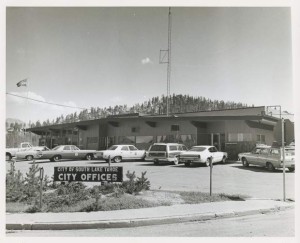
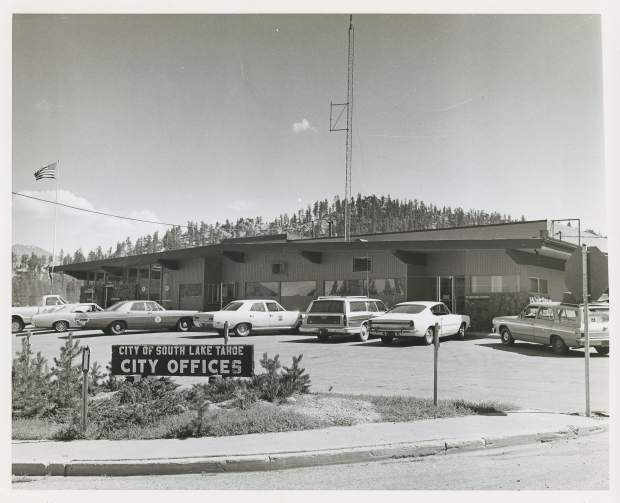
South Lake Tahoe was supposed to have a designated city hall that would be in the middle of town, not one shared with aeronautical services.

Politics is the easiest answer for why it didn’t happen. Plenty of finger pointing has gone on in the last 40 years to prove that no one person is at fault for the building never coming to fruition. But there is still a family who will forever be wronged. They gave the land for a city hall and instead cops and criminals occupy it.

The city is not letting the past stop it from moving forward. There are plans afoot to turn the lobby of Lake Tahoe Airport into a welcome center. This is where the bulk of the city’s business is conducted. In the last couple years a “city hall” sign was erected.
City Council meeting locations 1965 -- Tahoe Savings and Loan basement, Highway 50/Takela (now county offices) 1970 – 11044 Fremont St. (old police department near the bowling alley) 1970 – 1275 Meadow Crest, South Tahoe PUD building 1700 D St., (city offices were here; now where buses are stored) 1975 – 2155 South Ave., Alpine Professional Building (old TRPA office) 1021 Al Tahoe Blvd., Lake Tahoe Unified School District office 3064 Lake Tahoe Blvd., art building (now senior center) 1984 – 1900 Lake Tahoe Blvd. (old phone company offices) 2006-present – 1901 Airport Road Source: South Lake Tahoe

City Council meeting locations:
1965 — Tahoe Savings and Loan basement, Highway 50/Takela (now county offices)
1970 – 11044 Fremont St. (old police department near the bowling alley)
1970 – 1275 Meadow Crest, South Tahoe PUD building
1700 D St., (city offices were here; now where buses are stored)
1975 – 2155 South Ave., Alpine Professional Building (old TRPA office)
1021 Al Tahoe Blvd., Lake Tahoe Unified School District office
3064 Lake Tahoe Blvd., art building (now senior center)
1984 – 1900 Lake Tahoe Blvd. (old phone company offices)
2006-present – 1901 Airport Road
                                                                                    Source/Photo: South Lake Tahoe

As far as city officials – elected and staff – are concerned, the airport is city hall. With the city deciding commercial air service is not viable nor will it be pursued, the FAA is fine with South Lake Tahoe using the structure as a city hall and not an airport terminal.

Could there ever be something more? Possibly.

“If we were to ever have a city hall in this community, I think what might provide a good return on the investment for the community is a civic center, not just a ‘city’ hall. A building where Tahoe Regional Planning Agency, city, Tahoe Transportation District, and El Dorado Count would all have staff in the same building, primarily for permitting and licensing, the most common government requests,” City Manager Nancy Kerry told Lake Tahoe News. “For the community members, to be able to go into one building, one location and have joint meetings, get all the information in one visit, greater coordination of information, permit processing and conducting government business would be a huge benefit and good return on the investment.”

Something like that, though, would cost millions of dollars. And to be determined is if taxpayers would want it even if the money were available.

The early days

Incorporation was the focus when the city started, not where business would be conducted.

“That subject simply didn’t rise to the level of importance to make it on someone’s agenda,” Laurel Ames said of a city hall. Ames was one of the leaders in getting South Lake Tahoe incorporated in November 1965. “The one big idea that emerged in the first years after incorporation was the need for a convention center. The idea was from John Williams, the first city manager. That history is short. It was proposed for the county campground and I think there was a bond issue, then the people voted it down.”

Del Laine, who served on the council from 1976-80 and 1984-88, remembers a time when the electeds met in what are now the county offices in the government complex where the sheriff’s and public health offices are. The council seats were at the same level as the public – unlike today. It was the 1970s, when the Tahoe Regional Planning Agency was just getting off the ground, and a man leapt across the table in anger.

Today, there is always a police officer – often the chief – at each council meeting.

“When the first five (Brad Murphy, Gerald Martin, Eugene Marshall, Norman Woods and Don Clarke) met, it was over dinner and anyone could attend. They would discuss council business over dinner before the formal meeting,” Laine told Lake Tahoe News.

City archives are incomplete when it comes to listing all the places the council met as well as where city employees worked.

Marjorie Springmeyer at the dedication of her family's land that was to become a city hall. Photo/South Lake Tahoe

Marjorie Springmeyer at the dedication of her family’s land that was to become a city hall. Photo/South Lake Tahoe

A designated city hall

Marjorie Springmeyer and her brothers, Bill and Knox Johnson, wanted to honor their parents, who were early pioneers in the area. They owned large swaths of land; with the three still having title to hundreds of acres. They decided to give South Lake Tahoe land on Johnson Boulevard (named after their family) for a city hall.

The deed signed June 25, 1967, states, “On or before June 30, 1972, Grantee will construct or will cause to be constructed on the herein-above described real property, one or more office buildings which shall contain office space for the use and occupancy of various basic municipal government departments, services and offices, including by way of example and without limitation, grantee’s building, Planning, and Recreation Departments and City Manager ….”

Instead, a courthouse, police station and sheriff’s office were built on that land.

It didn’t matter that the agreement said if the city failed to comply with the deal, that the title would revert back to the Johnson siblings or their heirs.

“I’ll never get over that deal … how they screwed up our land with the courthouse,” Springmeyer told this reporter years ago.

The courthouse got built because of a 1972 agreement between South Lake Tahoe and El Dorado County in which the two entities agreed to build city and county offices on the Johnson land. The county gave the city $1 for the rights to the land.

Springmeyer filed a lawsuit to prevent El Dorado County from taking over what had been her family’s land. She lost the initial lawsuit as well as the appeal. The judge ruled the administrative uses on the land were consistent with the wording of the agreement.

It didn’t matter that Bill Johnson was on the Board of Supervisors from 1969-80.

The county agreed to “convey to city an easement for the construction by the City of public offices (sic) building ….” In a preceding paragraph the buildings to be located on the acreage included “County offices, County courts, City Council chambers, City offices, County Sheriff’s facilities, City Police facilities and other County and City facilities …”

On March 21, 1983, Knox Johnson wrote a letter to the Board of Supervisors saying “there has been perjury committed in the courts” and his family “made a civic contribution”. The letter went on to say,  “If it’s only worth $1, then I should have it.”

No one has ever been able say why exactly a city hall never got built. Today there is no space at the government center to do so.

Through the years other locations considered for a city hall include Bijou Community Park and the 56 acres where Campground by the Lake sits.

South Lake Tahoe's city hall is Lake Tahoe Airport. Photo/LTN

South Lake Tahoe’s city hall is Lake Tahoe Airport. Photo/LTN

Going forward

In March, when the council was devising goals for the next 18 months, overhauling the airport lobby to turn it into a showcase of sorts was discussed. Right now it’s hard to know one is walking into a city building. There was also talk of expanding the area to include a welcome center for visitors because coming in on Highway 50 from the west is the main route tourists reach South Lake Tahoe.

The engineering staff is working on a conceptual design and associated costs. Details will come back to the council later this year or early 2016, with the goal of starting the remodel in summer 2016.

The logic to staying at the airport is that the city owns the building. Plus, for 50 years it has survived without a building with the sole purpose of being a city hall so building one now doesn’t seem economically logical or feasible.

Not all cities have a distinct, ornate building along the lines of San Francisco’s city hall.

“A city hall can’t just be a pretty building; it must provide meaningful return on investment to the community. It should improve how the local government functions, provide new, improved and enhanced services and be a building that encourages civic engagement, promotes community pride of town ownership, provides opportunity for civic, community and cultural events – both art and culture – and opportunities for strengthening partnerships between government and the public,” Kerry said.

She is more concerned with providing quality services than the building from which those services are provided.

Even so, the city is on a quest to improve the infrastructure is has and not start from scratch. This means money will be spent at the airport to make sure it functions efficiently for the indefinite future.

“The building is our current city hall and will remain an important asset to the community for many years as so noted in the Airport Master Plan. The airport serves not only air travelers, but also serves community members conducting business with the city,” Kerry said.


Opinion: Preschool not always the best choice

By Megan McArdle, Bloomberg

Universal preschool has become the ginseng of American politics, a sort of broad-spectrum nostrum that will cure almost anything that ails you. Inequality, male-female pay gaps, crime, poverty — just apply some early childhood programs, and watch those maladies fade. Expect to hear this a lot from Hillary Clinton in the coming presidential race.

And what kind of a crotchety, sour, greedy old columnist could be opposed to such a wonderful idea? I’m so glad you asked.

In truth, I am not opposed to early childhood education programs. I am opposed to blind boosterism of such programs, the kind that confidently predicts marvelous results from thin empirical evidence, and briskly proceeds to demand huge sums be spent accordingly.

Read the whole story


Legalizing weed unlikely to turn kids into potheads

By Christopher Ingraham, Washington Post

A central idea of the war on drugs has always been that loosening restrictions on drug use — by decriminalizing it, or allowing medical use, or legalizing some drugs completely, or even simply discussing legalization — will “send the wrong message” to kids and lead to increased teen drug use and all the problems associated therewith.

But particularly in the realm of marijuana policy, the evidence has repeatedly shown this notion to be inaccurate. After all, 20 states have passed decriminalization measures. And since 1996, 34 states have passed some sort of medical marijuana bill. But, according to two studies published in the past month, teen use of marijuana has fallen over that same period.

“Despite considerable changes in state marijuana policies over the past 15 years, marijuana use among high school students has largely declined,” concludes one of the papers, published in Drug and Alcohol Dependence.

Read the whole story


Soroptimist has money to give to nonprofits

Soroptimist International of South Lake Tahoe has $25,000 to give to local nonprofits.

SISLT’s goal is to fund quality projects that serve clearly identified needs of women and children in the South Shore community. They will consider new programs, improvements and enhancements to current programs, as well as supporting programs that have been proven effective in bettering the lives of women and children in the community.

Grants between $5,000 and $25,000 will be awarded to no more than five nonprofit organizations.

The application period is open through October. For more information, email sisltfoundation@gmail.com.


Election gambling may return in 2016

By Joshua Brustein, BloombergBusiness

The website Intrade gained almost mythical status in certain circles during the 2012 presidential election by letting users bet on how the elections would turn out. Gamblers thought it was fun, and economists marveled at how well the prediction market produced accurate forecasts.

Intrade users traded contracts that paid out if a certain event happened in the future. If a $10 “Obama wins Ohio” contract was trading for $6, that meant the market gave him a 60 percent chance of taking the state. Intrade’s users guessed right on 49 of 50 states.

But Intrade’s biggest success was followed almost immediately by a lawsuit from the U.S. Commodity Futures Trading Commission, which forced the company to close its doors in March 2013.

Two competing projects—Truthcoin and Augur—are now fighting to be the next Intrade by the time the 2016 election is in full swing. And if they work as promised, they will be much harder to shut down.

Read the whole story