Why Americans eat like animals

By Abigail Carroll

American eaters, they’re like a pack of animals, hustling dinner in 10 minutes or less. It sounds like a recent complaint, but in fact it comes from 1864, when the Englishman John Francis Campbell was startled at the rapidity with which fellow steamboat passengers consumed their meals as they floated down the Ohio River. They were quick as foxhounds over their food, he marveled. Because service was family style, you risked leaving the table hungry if you failed to keep up. And Campbell wasn’t sure this speed such a good thing.

As this anecdote suggests, Americans’ affinity for hurried consumption—along with plenty of criticism for this tendency—go back a long way, at least as far back as when Campbell and his fellow passengers were journeying. The steady pursuit of efficiency, which informed new methods of travel, agriculture, and manufacturing, also informed American eating and has indelibly molded the modern American meal.

The trend was pervasive in 19th century, when European travelers often wrote amusingly of the swiftness with which Americans “dispatched” their food. They referred to meals at hotels as being “swallowed” or “gone through.” An Englishman at a hotel in Washington noted that boarders breakfasted in five minutes, while another Englishman, having learned the American way, recorded that he proudly rushed to the table to contribute his “strenuous efforts to the work of destruction”—that is, the destruction of several dishes, if not also of his digestion.

Why did 19th-century Americans have a penchant for hustling their meals? Most of the Europeans who commented on our gustatory speed failed to tender an explanation, though one observer accounted for it simply as “part of the go-ahead character of the people.” It was true: Americans were on the go, especially come the Industrial Revolution, which drove the growth of cities and changed the nature of work for a broad swath of the population. When factory clocks began to replace agricultural rhythms, meals underwent a thorough re-organization and deep transformation.

Workers in cities could no longer return home for a midday meal because of the increasing distance between work and home and the decreasing amount of time allotted for a midday recess. So dinner shifted to the evening, and a new meal emerged to fill the void: lunch. The idea here was a glorified snack, a stopgap between breakfast and dinner. Cold food was quick food, so it fit the bill, as did handheld items such as sandwiches, which didn’t require cooking, cleanup, or the use of utensils. If you wanted soup or hash or a slice of pie, you could visit one of the new cafeteria-style restaurants called quick lunches—pioneers of food service efficiency. From the one-arm joint (where you sat at a one-person table and didn’t have to waste time in conversation) to the automat (where you acquired food from a kind of giant vending machine and didn’t have to deal with wait staff or a cashier), fast food options of the late 19th and early 20th centuries abounded. They saved you time, and time was money.

Alternatively, some office workers chose to avoid the hassle of the quick lunch by eating a light meal from home at their desks. In 1904, Good Housekeeping profiled one such luncher who, complaining that his mind did not work as clearly for the first hour or two after a hot midday dinner, had shifted from restaurant meals to a sandwich prepared by his wife. “After eating in my office,” he explained, “I have a quiet hour to work without being bothered by the clamorous clients that infest a down-town law office at all other hours of the day.” For him, lunching light and alone meant productivity and peace.

Companies knew that time was money, and executives began to worry that quick lunch restaurants might cause workers to become sluggish from indigestion, reducing their productivity and compromising their profitability. Cold lunches brought from home also came under criticism because the science of the day found warm food to be more easily digested. “Neither dinner pail nor quick lunch … sends employees back to work in the afternoon with anything like the spirit with which they came in the morning,” noted Elmer Henry Fish in his 1920 managerial text, How To Manage Men. The solution was company lunchrooms that did more than serve free coffee (though that was a start); they also offered a selection of hot items at or near cost. These would fuel workers appropriately while keeping them on the premises, sparing them the stresses of undue hurry.

Breakfast underwent a similar transformation, turning lighter and quicker in the mid- to late 19th century—and efficiency became its hallmark. When reformers such as Sylvester Graham and William Andrus Alcott started promoting bread made from unbolted flour along with vegetarianism as a panacea for all manner of bodily ills, their primary aim was to improve Americans’ failing health—especially of the digestive sort. But the new, lighter, grain-based breakfast they promoted also happened to feed Americans’ desire for convenience, and convenience oiled the engines of profit.

John Harvey Kellogg of Corn Flakes fame invented a product he baptized Granola, his first cereal, not just to find a novel way of serving whole wheat at his sanitarium, but also to save time. “It was very difficult to prepare cereals,” he noted, looking back on his busy medical school life in New York City, where he had rented a small third-story room. “It should be possible to purchase cereals at groceries already cooked and ready to eat.” Instant cereal was the answer—you just added milk. Toast became a convenience food when sliced bread and pop-up toasters appeared on the scene, and it fit perfectly into the new breakfast model, upholding the twin pillars of convenience and health. While a traditional farmer’s breakfast demanded precious time and was likely to overtax the desk-worker’s digestive powers, ultimately reducing his output, cereal and toast saved time and kept your body fit for sedentary tasks.

The American pursuit of efficiency continues to shape our meals today, especially breakfast and lunch. Take, for example, the decline of Kellogg’s. Breakfast cereal was once a godsend for busy mothers, but now, as Devin Leonard reports in Bloomberg Businessweek, “Many people grab something on the way to work and devour it in their cars or at their desks while checking email.” Fast food breakfast sandwiches, single-serving yogurts, smoothies-to-go, and individually wrapped breakfast bars are taking the place of cereal and toast, and as they do, the drive for convenience carves the morning meal into an even more mobile, snack-like, and efficient eating occasion. Given our increasing interest in grazing, lunch is also looking less like a meal and more like a snack.

While many people who are disillusioned with the modern food system and our fragmented relationship with food are calling for a return to the art of the traditional meal, convenience continues to shape the way we eat. Perhaps this is because work has always shaped the way we eat, and what better way to make good on one’s time than to skip the hassle of meals altogether and simply fortify oneself with snacks? Or so the logic goes. In the 1830s, the Frenchman Alexis de Tocqueville noted the “feverish ardor” with which Americans seek to improve their well-being, and in this pursuit, he remarked, “they show themselves constantly tormented by a vague fear of not having chosen the shortest route.” Arguably, when it comes to eating, snacks and snack-like meals are “the shortest route.” In the era of industrialization, ideas about efficiency not only transformed the way we travel, work, farm, and manufacture, but also the way we eat. We Americans are still making our gustatory decisions with efficiency in mind.

Abigail Carroll is the author of “Three Squares: The Invention of the American Meal”. She has taught at Boston University, and she lives and writes in Vermont. She wrote this for What It Means to Be American, a national conversation hosted by the Smithsonian and Zócalo Public Square.


Letter: Kirkwood takes a turn at Bread & Broth

To the community,

The Adopt A Day of Nourishment sponsor for Bread & Broth’s dinner on Sept. 14 was Kirkwood Mountain Resort. Through its sponsorship, Kirkwood provided the funding for the meal and sent a hard working sponsor team that thoroughly enjoyed the opportunity to help serve the community.

“This has been a great experience,” said Jarrett Morgan, senior administrative assistant for base operations. “It was great to show up and be able to help right away. I speak for the group; you can count on us any Monday needed. Thank you for the opportunity to give back to our community.”

Sharing the volunteer experience with Morgan were fellow Kirkwood teammates Nick Griess, property manager; Brian Bigley, direct of base operations; and John Jennings, manager product, sales and services.

These AAD sponsors volunteers are an integral part of all the work that goes into putting the B&B dinner service together. The B&B volunteers really appreciate their help and enjoy working with all of our sponsor crews.

B&B would like to thank Kirkwood Mountain Resort and the Vail EpicPromise Grant Program for their many sponsorships throughout the year. The $250 donation for hosting each dinner provides hot, nutritious meals to our very grateful dinner guests.

Carol Gerard, Bread & Broth


Tahoe man hits hole in one in Meyers

Victor Uriz celebrates his hole in one on Oct. 2. Photo/

Victor Uriz celebrates his hole in one on Oct. 2 at Lake Tahoe Golf Course. Photo/Terry Darrough

“Sometime it’s better to be lucky than to be good” is how Victor Uriz summed up sinking a hole in one at Lake Tahoe Golf Course in Meyers.

The South Shore resident who has being playing golf for about eight years hit the shot Oct. 2 on hole 17.

Uriz’s sister, Cathy Darrough, and her husband, Terry Darrough, witnessed the event.

Uriz, who lives in the Angora burn area, told Lake Tahoe News he is not a very good golfer – “I’m out there hacking away a lot.”

The regular playing time and classes through Lake Tahoe Community College must have taught him something since his shot is something the pros rarely accomplish.

— Lake Tahoe News staff report


Former SLTPD officer loses battle with ALS

Robert "Bud" Heng

Robert “Bud” Heng

Robert “Bud” Heng passed away Oct. 1, 2015. He was 62.

Bud was a graduate of South Tahoe High School.

While he worked for the South Lake Tahoe Police Department he was recognized as Officer of the Year. He went on to serve with the DEA where he rose to the rank of supervisor out of the San Francisco office.

Bud was also a published author and licensed financial advisor.

He died as a result of Lou Gehrig’s disease (ALS). It was diagnosed in February 2015.

He is survived by wife, Jodie; daughters, Brittany and Gabby; parents Robert and Marline; and brothers Scott and Jim.

Services are pending.


Then and now: The corner of love

xxxx Photo/Bill Kingman collection

Highway 50 and Kingsbury Grade was not always a major intersection in Stateline. Photo/Bill Kingman collection

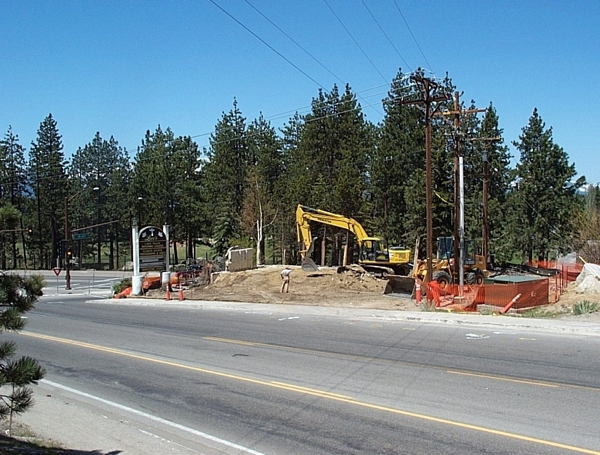
Kingsbury Grade in the early 1960s was mostly unpaved, joining Highway 50 with a simple stop sign posted on a corner of dirt, rocks and trees. A gate blocked wintertime travel over Kingsbury’s summit at Daggett Pass.

Love's Wedding Chapel was a fixture on the South Shore. Photo/Dave Borges collection

Love’s Wedding Chapel was a fixture on the South Shore. Photo/Dave Borges collection

That corner of Kingsbury and Highway 50 is where the Rev. Raymond Love of Nevada opened the South Shore’s first wedding chapel about 1970. According to People magazine, Love’s Wedding Chapel monopoly was conducting 5,000 weddings a year.

Love's Chapel came down in May 2003. Photo/Bill Kingman

Love’s Chapel came down in May 2003. Photo/Bill Kingman

Competing wedding chapels later opened in neighboring California. Love’s Wedding Chapel on Kingsbury Grade closed and was demolished in 2003.

It's hard to know this corner was ever developed. Photo/Bill Kingman

It’s hard to know this corner was ever developed. Photo/Bill Kingman

Landscaping with shrubs, trees and grass has reclaimed that corner, now fronting a major intersection.

— Bill Kingman


Marathon founder not ready to hand off baton

This marks the 20th year of the Lake Tahoe Marathon. Photo/Provided

This marks the 20th year of the Lake Tahoe Marathon. Photo/Provided

By Susan Wood

It may take as much dedication, stamina and love for the sport to run marathon operations as it does to compete in one.

When athlete extraordinaire Julie Moss finished the marathon of the Ironman in Hawaii in 1982 by crawling, six-time champion Mark Allen was so moved, he married her. It was one of the most unforgettable moments in sports.

And those endorphins can be just as important in the joint venture of a business deal, the hallmark of American society.

Locally, just ask Lake Tahoe Marathon founder and race director Les Wright – or even runner, adventure-sport guru Sean Sweeney. Sweeney, 48, and his business partner Jason Collin wanted to last year follow in the footsteps of Wright, now 73, and manage the high altitude marathon known for its stunning views and multitude of auxiliary running events. (It starts Oct. 8.)

But after an enduring more than a year of negotiations and rewrites beginning in March 2014, the deal fell apart.

Wright declined to comment on what happened. Sweeney, however, provided a bit of the high-road account.

Sweeney expressed interest in stepping in to take it over years ago. Wright, according to Sweeney, seemed interested enough to put together a contract involving an exit strategy and 15 concessions including one in which Wright would remain the race director and get paid.

“We spent a lot of time and a lot of energy, and we had an influx of new ideas,” said Sweeney, who also works in the Sierra-at-Tahoe marketing department.

Sweeney believes having 26 events “diluted” the weekend’s main event for the marathon purist.

“He has a lot going on,” Sweeney said. “We wanted to learn from him. But it was going on 14 months, and (he and his wife Cara) were going on vacation. We told him: ‘Vacation or not, if you don’t sign, we’re not interested.’”

Wright declined to sign, and the offer was pulled off the table.

“I’m probably never going to retire,” Wright admitted to Lake Tahoe News. This year is the 20th anniversary of the marathon.

Wright started the Lake Tahoe Marathon upon retiring from Lake Tahoe Unified School District as a physical education teacher at age 53.

“I did all those things I wanted to do when I retired – golf, fished, scuba and running. Then, I said: ‘I’m bored. I’m going to start a marathon,’” he recalled saying to himself in 1995.

Where to place the route was the big question.

He always noticed the captivating stretch along Lake Tahoe’s West Shore from Tahoe City to South Lake Tahoe.

“The beauty of that road gives me chills,” Wright said.

He put out fliers for the September event, and “it just took off from there,” he reflected back on the early beginnings. The first year brought out 250 runners. The next year, 1,300 people signed up. The high mark was 2,800 entries set a few years ago.

Collectively, the event rakes in about $20,000 in proceeds that are earmarked to groups such as Tahoe Arts Project, Valhalla and Tahoe-area schools. Volunteers work the 18 aid stations on the 26-mile route starting at a not-for-the-faint-of-heart 6,227 feet with a 2,000-foot elevation gain. It now ends at Lakeside Beach after two decades of ending at Pope Beach.

Along the way for the Thursday through Sunday extravaganza, Wright has added events – to the point the collage may seem overwhelming to the average participant. There’s the Tahoe Triple (three marathons in three days), Trifecta (three half marathons and a full marathon involving the East Shore.) Tack on a 10K, a swim-run duathlon, standup paddleboarding and kayak races as well as two pumpkin fun runs. In addition, a four-person marathon relay has been added to entice those not wanting to tackle a 26-miler or even half the distance.

“A lot of people will like to do that,” he said.

Overall, about 2,000 people have signed up this year for the multitude of events.

Race director Les Wright fires the start gun. Photo/Provided

Race director Les Wright fires the start gun. Photo/Provided

“No matter when I do it, there’s a conflict,” Wright said, illustrating the focus of events at Lake Tahoe in recent years. The events have been in September and October.

And under the guise of “there’s a reason for everything,” Sweeney and Collin have excelled in their own right by launching Epic Tahoe Adventures, a company that specializes in events to cultivate athletic prowess.

One successful event is the Rock Tahoe Half Marathon scheduled on June 18. With 2016 being its second year, the event has already signed up 500 participants and may take up to 3,000. The first year brought out 2,000 runners. Its slogan “run-rock-recover” goes well with Tahoe’s work-hard, play-hard mantra.

Add in a little techno benefit such as participant access to a recorded clip of themselves on the course, and the half marathon set on the East Shore has an appeal all its own. For starters, the website received more than 800,000 hits – 30,000 in the first two hours, according to Sweeney.

And more is in store from Sweeney’s athletic company.

This could be all good news to a runner like Brenda Knox, a Tahoe Mountain Miler.

“The race is well done. When I finished (this) year’s, I signed up immediately after,” said Knox, who has also competed in the Lake Tahoe Marathon. She’s “not a fan” of shuttles, so seeks out ways to avoid them. This year’s Rock Tahoe Half Marathon fit the bill.

And according to Lake Tahoe Visitors Authority Executive Director Carol Chaplin, there’s room around the lake for both events.

“In some ways, the two events are not comparable,” she said.

Chaplin pointed out how Rock Tahoe is a half and Lake Tahoe Marathon is a half, as well as a full version, along with other events.

Also, one is scheduled in June, while the other is slated in October.

Better yet, both events go hand in hand with Tahoe tourism stakeholders’ quest to make “outdoor recreation pretty much the focus,” Chaplin said.

“Whether there’s growth potential, we can’t answer that now. But I do think this area can support these two events. They don’t compete. We support more than one music event – as long as it’s not on the same weekend,” she said.


Letter: Thanks for great bike park opening

To the community,

On behalf of the city of South Lake Tahoe I would like to extend sincere gratitude to all of the individuals and merchants who donated product or provided services to help make our Bijou Bike Park grand opening a tremendous success.

On Sept. 19, thousands of youth and families joined City Council and staff to celebrate the Bike Park project with a free barbecue, ice cream, and music. A special thank you to grill master Steve “Tee” Branch and Anthony Pulera for sweating over hot coals for three hours to serve 1,000 people hot dogs and burgers. Emery, Caroline, Audrey, Van, and a few community members who just stepped in to help when they saw the need are all my super heroes for the day.

Additional kudos go to the following businesses who donated product or service to make this day a success: Sierra Gold Seafood, Beacon Restaurant, Lakeview Café, C&M Foods, Raley’s, Grocery Outlet, and Bonanza Produce. Throughout the day cash donations were collected on behalf of the Bijou Bike Park Association in the amount of over $800. The volunteer organization has designated these funds to purchase a permeant tool cache for ongoing maintenance of the park.

Finally, thank you to disc jockey Rob and announcer Jersey J provided by OnCourse Events who provided the energy and a true party atmosphere. Everyone who contributed to this successful event should pat themselves on the back for supporting a new recreation asset that will further identify our region as a recreation destination.

Sincerely,

Lauren Thomaselli, recreation manager city of South Lake Tahoe


Colo. skiers may be able to pay to avoid traffic

By John Aguilar, Denver Post

Travelers on Interstate 70 in Colorado will get the chance this week to sound off on proposed toll rates on a soon-to-open express lane for ski traffic — a lane that could rank as the nation’s priciest per mile.

The eastbound-only lane, designed to relieve the crushing congestion of a return trip to the city from Colorado’s mountain ski resorts, is scheduled to open to vehicles in December.

Colorado Department of Transportation staff members have suggested a tolling range of $3 to $30 for the 13-mile stretch, which lies between the Empire exit and Central City Parkway, near Idaho Springs.

At the maximum suggested toll rate, motorists would be paying $2.31 a mile to ride the express lane — a higher rate than any other toll road in the United States.

Read the whole story


Snippets about Lake Tahoe

league·       The League to Save Lake Tahoe replaced 4,000 square feet of lawn with water-wise native plants at its South Lake Tahoe office.

·       Placer County Department of Child Support Services was recognized as the 2015 Most Improved Program by the Western Interstate Child Support Enforcement Council.

·       Eldorado National Forest will lift fire restrictions Oct. 5. This means forest visitors in possession of a valid California campfire permit may have open campfires outside of designated campgrounds.

·       Truckee is seeking input on a project that would make a number of improvements to Donner Pass Road between Coldstream Road and the McIver Roundabout. For more info, go online.

·       Staples, which has been open the last two Thanksgivings, will be closed this Turkey Day.


Plastic bag manufacturers file second Calif. measure

By Associated Press

Plastic bag manufacturers filed a second ballot measure on Friday in California’s fight over a statewide plastic bag ban.

The American Progressive Bag Alliance, which represents bag manufacturers, proposed an initiative that would require bag fees estimated at more than $400 million a year go into an environmental fund rather than be kept by grocers.

California’s first-in-the-nation state ban on plastic shopping bags was put on hold this year when the trade group placed the issue before voters on the November 2016 ballot.

If voters uphold the ban, grocers will be allowed to charge a fee of at least 10 cents for using paper bags.

Under the new initiative, voters will be asked to direct those fees from grocers and retailers into an environmental protection fund.

“While we are confident California voters will reject the statewide bag ban scam at the ballot in 2016, we know that 84 percent of people believe that bag fees in general should go to a public purpose, instead of increasing profit margins for grocers,” said Lee Califf, executive director of the plastic bag alliance.

Supporters of the ban have criticized manufacturers for spending millions on the referendum campaign to continue selling single-use plastic bags. A message left with Californians vs. Big Plastic, a coalition of environmental, labor and business groups supporting the plastic bag ban, wasn’t immediately returned Friday afternoon.

Gov. Jerry Brown signed the bag ban after one of the fiercest legislative battles of 2014, pitting bag-makers against environmentalists. It was scheduled to be phased in starting in July at large grocery stores and supermarkets as a way to cut down on litter and protect marine life.

The bag alliance said the ban will cost manufacturing jobs and boost profits for grocers, who can charge customers a premium for bags now given away for free.
Environmental activists have successfully pushed plastic bag bans in cities across the U.S., including Chicago, Seattle and Austin, Texas. Hawaii also is on track to have a de facto statewide ban, with all counties approving prohibitions.

More than 100 cities and counties in California, including Los Angeles and San Francisco, already have such bans. Several other California local governments plan to move forward with their own bans as a result of the referendum, including San Diego, Santa Barbara County, Sacramento, Oceanside and American Canyon.