Panelists empower women to be change makers
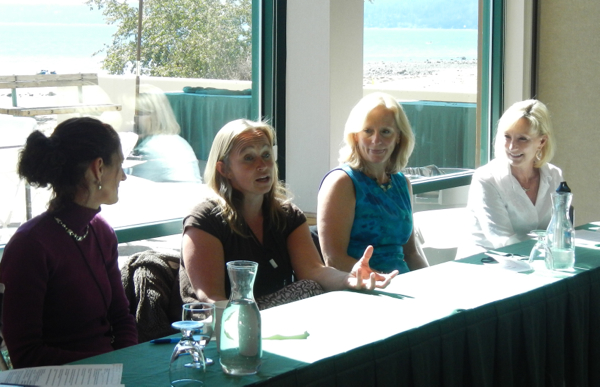
Talking about how to get things done when it seems impossible are, from left, Rebecca Bryson, Kathy Haven, Kristin York and Cindy Gustafson. Photos/LTN

Talking about how to get things done when it seems impossible are, from left, Rebecca Bryson, Kathy Haven, Kristin York and Cindy Gustafson. Photos/LTN

By Kathryn Reed

KINGS BEACH – Creating change is not always an easy undertaking – whether it’s personal or professional. But if it is to happen, it has to start with the individual.

That was the overriding message Oct. 2 as more than 100 people attended a daylong retreat in Kings Beach.

Women as Change Makers was designed to have an impact on women in the greater Lake Tahoe area by providing a series of diverse workshops. Rayona Sharpnack of the Institute for Women’s Leadership was the keynote speaker, focusing on getting women to not be afraid to make positive changes in their lives.

The breakout sessions included:

·       Making the Impossible Possible: Changing Systems Within Systems

·       Global Change Makers

·       Men as Partners to Women as Change Makers

·       Sowing the Seeds of Local Food Systems

·       The Art of Storytelling

·       Getting it Done: Lessons from Female Innovators and Entrepreneurs.

The all-day event was a fundraiser for Zawadisha, an organization started by local Jen Gurecki that provides small loans for items with big impact to women in rural Kenya.

Tenacity and collaboration are two traits that kept surfacing during the Making the Impossible Possible panel discussion.

“It’s not just the how and what. It’s the why. I think women are great persuaders,” Cindy Gustafson, general manager of Tahoe City Public Utility District said. “Persuasion is not just talking, it’s also listening.”

She said to get things done it takes passion, persuasion, patience and persistence.

There was a time when putting in sidewalks in Tahoe City was met with so much resistance that others would have moved on to the next project. Not Gustafson. She put the four P’s to work and eventually got the sidewalks put in.

Joining her in imparting ideas about how to overcome obstacles to get things done were Rebecca Bryson with Lake Tahoe Sustainability Collaborative, Kathy Haven, Bijou Community School two-way immersion program, and Kristin York, Sierra Business Council.

York stressed the need to find common ground to establish a working relationship so the differences could more easily be overcome.

Bryson has found that stories and emotions can paint a more poignant picture than just a bunch of facts and figures.

Haven touched on needing to know one’s audience and change the delivery of the message to suit particular groups.

“Change is scary, but it’s the only constant we have,” York said. “Sometimes detractors make the project better.”

Oftentimes people foresee an idea meaning more work. Coming in willing to do some of the heavy lifting could help the idea come to fruition.

Michelle McLean, from left, SunMie Won an d Jana Vanderhaar discuss the imporance of local food systems.

Michelle McLean, from left, SunMie Won and Jana Vanderhaar discuss the importance of local food systems.

In the Sowing the Seeds of Local Food Systems talk the discussion centered on getting back to our agrarian roots.

“A lot of people don’t have basic cooking skills,” SunMie Won of Slow Food Lake Tahoe said. “A lot of food is heated or just assembled.”

Jana Vanderhaar with Verdant Connections and Michelle McLean of the Sierra House Elementary School growing dome project joined Won in promoting growing food locally.

McLean said parents at the South Shore school didn’t think their children would eat what was grown in the dome. At first the kids didn’t want to touch the soil, they were scared of bees and worms. They had to be taught this is how food is made – it doesn’t just come from a grocery store.

“This is life. It’s what we need to get back to,” McLean said.

The program is so successful in its first year full year that students are eagerly eating what they have sown, and no longer have a problem getting dirty to do the work needed to keep the domes alive.

“We’ve become so far removed from our food that we are scared of processing our own food,” Vanderhaar said.

She raises chickens and rabbits. The former for eggs and meat, and the latter for their meat, as well. She is the one who handles the butchering and preparation of the animals.

While all three admit growing edibles in the Tahoe-Truckee area is challenging, they also pointed out how it can be done with good results. While some in the audience were looking for a sure bet about what to grow and how to do it, the panelists said there is no foolproof way of farming in this climate or elevation, that it is a continual learning experience.

What they also all stressed is the need to know where one’s food comes from – and the backyard is the way to ensure it is the freshest.

“Planting seeds really empowers everyone,” Won said.



Opinion: Why Americans can’t write

By Natalie Wexler, Washington Post

It’s no secret that many Americans are lousy writers. Just ask any college professor or employer, including those at prestigious institutions. With theadvent of e-mail, writing ability has become more important than ever, and writing deficiencies have become increasingly apparent.

Surely one reason so many Americans lack writing skills is that, for decades, most U.S. schools haven’t taught them. In 2011, a nationwide test found that only 24 percent of students in eighth and 12th grades were proficient in writing, and just 3 percent were advanced.

If students get writing assignments at all, they’re usually of the “write about how you feel” variety. There’s value to that kind of exercise, but it doesn’t provide kids with the tools they need to write analytically.

Read the whole story


Calif. winemakers using less water to grow grapes

By Ellen Knickmeyer, AP

RUTHERFORD — The grape vines that grower Frank Leeds tends in Napa Valley stand among the unheralded heroes of California’s drought, producing decade after decade of respected Cabernets and other wines without a drop of added water.

In a state where farms and dairies take the biggest gulp of the water supply, Leeds and the owners of his Frog’s Leap Winery are among a minority — but a growing minority — of California growers and winemakers who believe that when it comes to wine grapes, the less irrigation, the better.

“This is not struggling, skinny, tiny grapevines, right?” Leeds asked proudly earlier this growing season while leading a tour through the dry-farmed rows of wine grapes.

Frog’s Leap’s vines stood several feet apart from each other, giving the roots plenty of room to plunge into the soil and find moisture. Just across a narrow country road, black tubing of drip irrigation laced through another vineyard’s grape vines, more crowded but looking no less bountiful than their un-watered neighbors at Frog’s Leap.

Wine grapes, California’s No. 3 cash crop, in general are far less thirsty than the state’s No. 2 cash crop, almonds. But with 615,000 acres of wine grapes in production in California, wine industry trends in water use clearly have an impact on the overall water supply.

As wine growers close out harvest this month, California is ending a fourth year of severe drought, with mandatory cutbacks in water for cities and towns statewide, and for many farms.

Overwhelmingly, the debate in California’s wine industry over water use is driven by what’s best for the quantity and quality of the grape crop, more so than conservation.

All sides — the irrigated, the unirrigated, and the in-between — feel strongly that their way is the right way.

For Marc Mondavi, a third-generation producer in one of California’s most influential wine families, it only makes sense that grapes thrive best with an occasional sip of running water.

“I always tell people, I give them a little scenario: They put you and I in the middle of the Mojave Desert,” in a foot race, Mondavi said. “Who’s gonna run the distance? More than likely the person who’s had some water” to drink along the way.

In the early days of California winemaking, as in parts of France and Spain today, all wine was dry-farmed.

At the famed 1976 Judgment of Paris wine-tasting, which showed the world that California wines could meet or surpass French wines, some of the Napa Valley samples were dry-farmed, meaning they received no water beyond the 25 inches of rain that fall in Napa County during an average year.

By the 1980s and 1990s, however, as the wine industry boomed, water use increased.

“California producers in particular really wanted to control nature,” said George Taber, a long-time wine writer. “They realized they could have less acreage and greater production if they put their vines closer together and turned on the water.”

These days, the large majority of California’s vineyards are irrigated. That’s especially true in California’s dry Central Valley, where many of the wine grapes for the unmonied masses are produced.

Even in the lusher Napa and Sonoma valleys, home to many of the wines that define California’s industry, irrigation today is more the rule.

The fear driving irrigation for some vineyards — the “r” word.

“I do know that (various) wineries have a preference, but the overarching preference is that the fruit is sound and it arrives at the winery not shriveled up as a raisin,” said Rhonda Smith, a viticulture farm adviser in Sonoma County.

If dry-farming is haunted by the specter of raisins, the counterpoint is what wine critic and reporter Eric Asimov in 2008 dubbed Napa Valley “jammy fruit bombs ” — higher-alcohol, unsubtle wines from some irrigated grapes.

To get the water right, more and more producers, including Mondavi, use a range of high-tech moisture sensors.

And nearly a third of wine-growers are going further, ramping back watering in the belief that “deficit irrigation” generally produces better wine, said Joel Peterson, a noted winemaker at Sonoma Valley’s Ravenswood winery.

With less water, judiciously applied, the vines “will do exactly what they’re supposed to do” to produce the best grapes possible, Peterson said.

Ultimately, dry, wet or in-between, “it’s just a matter of your farming husbandry,” Peterson said. “Honestly, I think you can grow grapes either way.”

For Leeds and other dry-farmers in the Sonoma and Napa valleys, dry is the way to go, whether California’s winter rain and snow come back or not.

Dry-farm and deficit growers believe deeper roots give the grapes their taste of terroir, or place.

“We didn’t start dry-farming because of the drought, and when the drought’s over, we’re still going to dry farm,” Leeds said. “It’s for the health of the vine, and I’ll go to bat against anyone over the health of the vine.”


Closures possible on Camp Rich bike trail

Construction work will cause delays or temporary closures of portions of the Pope-Baldwin Bike Path over the next few weeks. This is better known as the Camp Richardson bike trail.

The U.S. Forest Service Lake Tahoe Basin Management Unit is rerouting portions of the bike path near Camp Richardson Resort to provide a better, safer experience for riders.

The Forest Service does not expect closures to last more than half a day and will provide alternate routes when possible.


Snippets about Lake Tahoe

cigarette·      Dry fire conditions still exist. Smokers are reminded that the outdoors is not to be used as an ashtray.

·      Tahoe Donner will have snowmaking at the downhill area this winter.

·       Carson High School grad Matt Williams has been fired as the manger of the Nationals baseball team.

·       James Winn, professor at UNR and Reno Chamber Orchestra principal pianist, on Oct. 25 at 2pm will perform his own piano concerto written for the RCO more than 20 years ago, and maestro Theodore Kuchar will lead the orchestra in a symphony by Mozart made famous in the film “Amadeus”. The event is at Nightingale Concert Hall, Church Fine Arts Building, UNR. For more info, go online.


Millions in CalFire prevention funds not spent

By Jim Miller, Sacramento Bee

Amid a drought that has created bone-dry conditions across much of California’s wildland area, a state fire prevention account has ended recent fiscal years with tens of millions of dollars unspent.

The money has been generated by a contentious, 4-year-old fee pushed through by Gov. Jerry Brown and legislative Democrats over the objections of Republicans and rural property owners. The state collected more than $300 million through June and spent about $260 million, including roughly $228 million on administration and statewide prevention activities, vegetation clearing, defensible space inspections and other programs. About $22 million went to a state tax agency to cover collection costs.

But as fires burned hundreds of thousands of acres this year, the state ended the fiscal year in June with an estimated $43 million in fee money left over.

More than 800,000 property owners pay the fee, most of them $117.33 a year for each habitable structure.

Read the whole story


Snow beginning to fall at Tahoe resorts

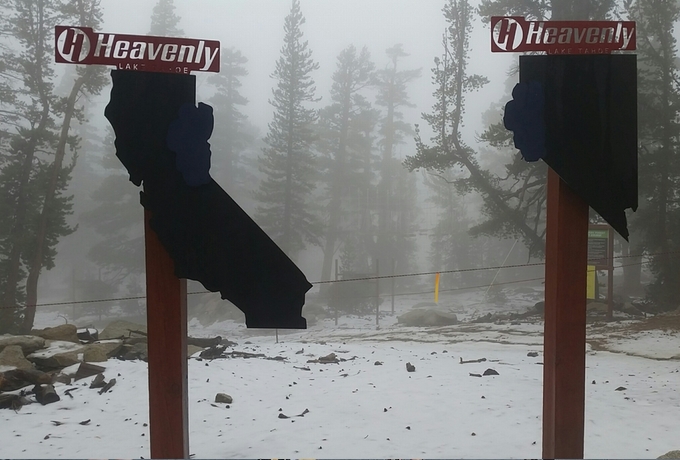
A dusting of snow covers part of Heavenly. Photo/Provided

A dusting of snow covers part of Heavenly. Photo/Provided

Mother Nature is bringing snow to the mountains. The rain at lake level the past couple days came down as white stuff higher up.

Snowmaking at Heavenly Mountain Resort is slated to begin Nov. 1 — conditions permitting.

The South Shore resort hopes to open Nov. 20.


WHS student earns $10,000 scholarship

Whittell High School student Kelsey Kjer was one of 80 students in the country to win a scholarship from Nordstrom.

The senior was notified about the award last week at the school.

Teacher Cathy Johnson said Kjer was recognized because of “all her hard work during her high school career.”

In addition to receiving the $10,000 check for college, Kjer was also given a Macbook Air. Nordstrom officials presented the award at the school.

More than 6,000 applications were received by the department store chain.

— Lake Tahoe News staff report


More jobs and fewer people, but limp raises

By Associated Press

WASHINGTON — Companies have posted a record number of job openings just when a diminished proportion of Americans are either working or looking for work.

That combination ought to push up pay. Yet it hasn’t worked out that way, at least not yet. Wage growth actually dipped in September.

The ongoing mystery of sluggish pay growth is important to everyone who wants a raise. It’s also frustrating for the Federal Reserve, which wants to see the steady job gains of the past several years translate into higher pay. This would boost the Fed’s confidence that the economy’s growth is sustainable and that inflation will return to the central bank’s 2 percent target.

U.S. businesses certainly seem interested in hiring. There were nearly 5.8 million open jobs at the end of July, the most since record-keeping began in 2000. At the depths of the recession in 2009, that figure was barely above 3 million.

Yet on Friday, the government’s monthly jobs report showed that the percentage of people in the workforce — those who either have a job or are looking for one — reached a 38-year low of 62.4 percent.

Why? Because many Americans who were once unemployed have become discouraged, returned to school or chosen to stay home, in some cases to care for relatives. Their exodus has helped shrink the unemployment rate to a seven-year low of 5.1 percent. That’s because people who aren’t actively looking for a job aren’t counted as unemployed.

So with fewer Americans on the hunt, employers, who face a record number of advertised jobs, should be feeling pressure to raise pay. But average wages in September rose just 2.2 percent from a year earlier, a tepid pace far below the 3.5 percent gain typical of a healthy economy.

One likely reason pay isn’t growing faster, economists say, is that the low unemployment rate overstates the job market’s strength. That is, some people who the government thinks have “dropped out” and whom it no longer counts as unemployed would actually take a good job if it were available. If those people had left the workforce permanently, employers would be compelled to offer more pay to draw from a smaller pool of potential hires.

If so, this has implications for the Fed’s interest-rate policies, economists say: It suggests that the Fed should keep rates lower for longer. Stronger economic growth and more robust hiring could spur more discouraged workers to look for a job. Only then might pay levels broadly increase.


Employees win right to bypass arbitration

By Bob Egelko, San Francisco Chronicle

Employees in California can file whistle-blower claims against their employers on behalf of themselves and their fellow workers, a federal appeals court ruled Monday in a long-sought victory for employees confronting a case-by-case, business-friendly arbitration system.

The 2-1 ruling by the Ninth U.S. Circuit Court of Appeals in San Francisco followed last year’s California Supreme Court decision, in a separate case, allowing employees to invoke the Private Attorney General Act against employers who violate state labor laws. That law sets monetary penalties for violations — typically, $100 per employee for each pay period of violations and $200 per employee for repeated violations — and awards 25 percent of the money to the employees, and the rest to the state.

Employees can rely on that law, the state court said, even if their employment contract required all workplace disputes to be resolved in individual arbitrations before a private panel, with little right to appeal.

Read the whole story