4 environmental films to be shown in Tahoe City

Patagonia, well-known for its environmental activism and green stewardship, has created community engagement called the New Localism. The company conveys this new mantra most strongly through film.

On Oct. 21 in collaboration with Alpenglow Sports four environmental films will be shown on the North Shore. “The Fisherman’s Son”, “Defined by the Line”, and “Mile for Mile” will be followed by the critically-acclaimed and award-winning “Damnation”. Each film documents a different environmental fight being waged to protect a unique wild place and/or natural resource.

While the films document global issues, organizers say the goal of the evening is to galvanize and inspire the community to become more involved in environmental issues in North Lake Tahoe.


The screening will take place at 7pm at Tahoe City’s Tahoe Art Haus & Cinema. Tickets are $5 and can be purchase online.


’16 election changing health care debate

By Noam N. Levey, Los Angeles Times

With the first primaries of the 2016 presidential campaign just months away, the national healthcare debate is poised to enter a new phase, more focused on consumers’ pocketbooks than on re-litigating the 5-year-old Affordable Care Act.

Hillary Rodham Clinton, who is campaigning on a detailed program to crack down on rising drug prices and runaway medical bills, is making a play for the hearts of voters increasingly irritated about what they have to pay for healthcare.

Clinton has issued an implicit challenge to her Republican rivals who continue to campaign with broadsides against Obamacare but few details about how they would address consumers’ basic healthcare worries.


Most Americans want their elected leaders to protect them from surprise out-of-network medical charges. They want government to ensure health plans have sufficient networks. And they want more information about the prices of doctors’ visits, tests and procedures, according to the poll, by the nonprofit Kaiser Family Foundation.

By contrast, fewer than half the respondents want their elected officials to deal with concerns about the Affordable Care Act. Just a third want it fully repealed.

Read the whole story


South Lake Tahoe’s Basecamp Hotel putting down stakes to attract locals and tourists

Basecamp Hotel in South Lake Tahoe is catering an active and younger clientele. Photos/Kathryn Reed

Basecamp Hotel in South Lake Tahoe is catering to an active and younger clientele. Photos/Kathryn Reed

By Kathryn Reed

In some ways staying at Basecamp Hotel is like glamping, only every room has at least four walls. In some ways it like a hostel – because of the communal venues – but there is no need to share a room with strangers. In most ways it is redefining what casual, relaxed, fun lodging with good beer and food is all about.

The idea is that it is the base camp for fun in South Lake Tahoe for a traveler who has no intention of spending the bulk of their time in the room.

Basecamp is trying to create a community of travelers and locals. The beer garden is open to anyone of drinking age. Plenty of locals were enjoying it during the summer concerts because the sound travels easily across the street from Harveys.

“We want guests to feel like they are locals. We want that interaction,” General Manager Amber Gardner told Lake Tahoe News.

This weekend is the inaugural Oktoberfest. West Coast beers are on tap or in bottles/cans.
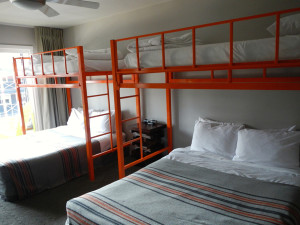
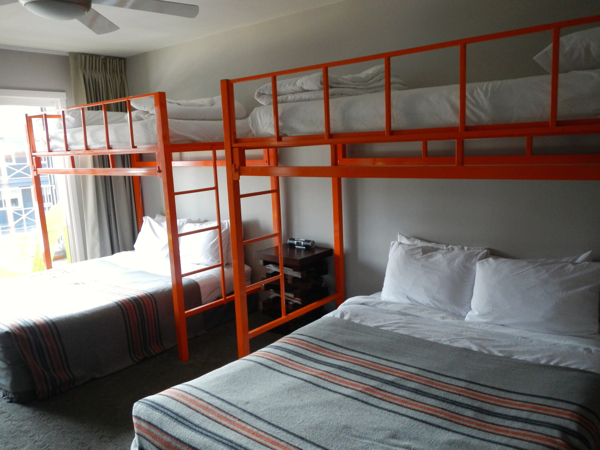
Rooms have few frills, but all the basics.

Rooms have few frills, but all the basic necessities.

Christian Strobel in 2012 renovated what was the boarded up, bankrupt 50-room Block Hotel near the state line in South Lake Tahoe. In summer 2014 he and his partner Neils Cotter acquired the adjacent Capri motel, making an additional 24 rooms available last December.

Slapping on a coat of paint and new furniture were not enough. The old Capri parking lot was turned into a greenbelt of sorts for people to hang out on, play games and enjoy a bite and beer. Entrances to the rooms were completely changed, in addition to being overhauled.

The beer garden was the porte-cochère for the Capri, while the kitchen used to be the on-site manager’s living room.

Three large garage type doors roll up so there is a seamless flow between the indoors and outdoors. When it’s cold, the glass still provides an airiness. Even the concrete floors add to the casual urban feel.

It's not necessary to be a guest to enjoy the beer garden.

It’s not necessary to be a guest to enjoy the beer garden.

Adjacent to the beer garden is a playroom with ping-pong and a television. It can double as meeting space.

“Accessible and casual” is the concept of the entire venue.

Chef Nathaniel Lawrence is creating a pub type menu, with lots of bratwurst. He searched quite a while before he found the perfect pretzel bun. Wild game sausage will be rotated in.

(The hotel owners also own the restaurant at Lakeside Beach and the wedding venue there, so Lawrence was busy cooking there this summer as well.)

Creative, good food is what he was serving the day this vegetarian reporter popped in. The watermelon salad included his prized pickled onions with feta and fennel vinaigrette.

The portabella dog was something no one else in the basin is doing. On the same bun the meat eaters get, slices of portabella mushroom were interspersed with arugula, cucumber and avocado. It was divine.

“My background is fine dining. I’m trying to incorporate it,” Lawrence told Lake Tahoe News. His goal is to make as much from scratch as possible, and to buy it as local as possible.

Dessert – strawberry shortcake – comes in a mason jar. It was creative in presentation, the perfect amount, and a good balance of cubed cake with the sliced berries.

Vegetarians and meat eaters are bound to be satisfied.

Vegetarians and meat eaters are bound to be satisfied.

This winter Basecamp intends to resume the family-style dinners on Thursdays-Fridays-Saturday – which are open to anyone. Lunch is also a possibility down the line. For guests, it means not having to go anywhere else; for locals it means another destination.

The beer garden becomes the breakfast room in the morning.

The communal feel of Basecamp is carried throughout the property, with a 16-person hot tub and fire pit that are fenced in. There is also a rooftop hot tub.

S’mores are always available to roast on one of the seven fire pits.

For those needing a place to lay their head at night there are 16 room types to choose from. The family room sleeps six; it has two full size beds with a twin bunk bed above each.

Some rooms have gas fireplaces, a few have private balconies, some come with bathtubs.

In room amenities are sparse and masculine. Lanterns are the lights. The orange-gray décor is comforting.

The Basecamp concept is expanding, with a hotel in Boulder now open and the old Aviva in Tahoe City being renovated with a summer 2016 opening. Each has a slightly different theme, with the South Lake Tahoe one being bear oriented and North Shore trout.

—–

Notes:

·      The inaugural Oktoberfest celebration is Oct. 10 from 2-8pm at the beer garden.

·      The hotel is located at 4143 Cedar Ave., South Lake Tahoe.

·      Phone is 530.208.0180.

·      The beer garden is open from 3-11pm.


Opinion: The reign of recycling

By John Tierney, New York Times

If you live in the United States, you probably do some form of recycling. It’s likely that you separate paper from plastic and glass and metal. You rinse the bottles and cans, and you might put food scraps in a container destined for a composting facility. As you sort everything into the right bins, you probably assume that recycling is helping your community and protecting the environment. But is it? Are you in fact wasting your time?

In 1996, I wrote a long article for the New York Times magazine arguing that the recycling process as we carried it out was wasteful. I presented plenty of evidence that recycling was costly and ineffectual, but its defenders said that it was unfair to rush to judgment. Noting that the modern recycling movement had really just begun just a few years earlier, they predicted it would flourish as the industry matured and the public learned how to recycle properly.

So, what’s happened since then? While it’s true that the recycling message has reached more people than ever, when it comes to the bottom line, both economically and environmentally, not much has changed at all.

Despite decades of exhortations and mandates, it’s still typically more expensive for municipalities to recycle household waste than to send it to a landfill. Prices for recyclable materials have plummeted because of lower oil prices and reduced demand for them overseas. The slump has forced some recycling companies to shut plants and cancel plans for new technologies. The mood is so gloomy that one industry veteran tried to cheer up her colleagues this summer with an article in a trade journal titled, “Recycling Is Not Dead!”

While politicians set higher and higher goals, the national rate of recycling has stagnated in recent years.

Read the whole story


More professionals are working as freelancers

By Kia Croom, San Francisco Chronicle 

Freelance work is on the rise, according to the Bureau of Labor Statistics, which reports more than 15.5 million people in the United States are self-employed and working independent contractors.

The Bureau anticipates that by 2020 more than 40 percent of American workers (60 million people) will follow suit. Workers across the country are leaving and even turning down corporate jobs to become entrepreneurs.

So what exactly has these professionals shifting gears from working at corporations to working for themselves? A Harvard Business Review report from 2012 cites growing employee dissatisfaction and the removal of barriers that once made independent contracting challenging. New online marketplaces are making it easier for consultants to find work.

Additionally, contractors are finding jobs that permit them to work remotely—opening them up to a broader range of opportunities. Plus, companies are seeking contractors with competitively priced fees for services.

Read the whole story


East West, KSL buy Snowmass base village

By Jason Blevins, Denver Post

Vail-based East West Partners and Denver’s KSL Capital Partners, the owner of Squaw Valley and Alpine Meadows ski area, are partnering to purchase and complete development of the base village at Snowmass.

Details of the deal with seller New York-based Related Companies’ Related Colorado were not disclosed.

One of the few undeveloped base villages at a major ski area, the Snowmass village has a troubled history. Related bought the base village — which voters had approved for a transformative development in 2004 — from resort developer Intrawest and Aspen Skiing Co. in 2007 for $169 million.

Read the whole story


Dietary guidelines won’t include sustainability


By Gabrielle Canon, Mother Jones

When the USDA’s Dietary Guidelines are released later this year, they’re sure to make waves in the nation’s food economy. Updated every five years, the rules—the government’s official line on what Americans should eat to stay healthy—inform decisions on everything from agricultural subsidies to government food assistance programs to school lunch.

But there’s one thing the new guidelines won’t touch: the health of our environment.

In a statement posted Tuesday on the USDA website, Agriculture Secretary Tom Vilsack and Health and Human Services Secretary Sylvia Burwel announced that the guidelines will not include recommendations about how to choose foods with the lightest impact on the planet. The dietary guidelines, they wrote, are not “the appropriate vehicle for this important policy conversation.”

Read the whole story


Brown signs aggressive climate change bill

By Michael R. Blood and Judy Lin, AP

Gov. Jerry Brown signed an ambitious climate change bill on Wednesday, aiming to increase the state’s use of renewable electricity to 50 percent and make existing buildings twice as energy-efficient by 2030.

“The goal is clear, and California is in the forefront,” Brown said at a signing ceremony at the hilltop Griffith Observatory, where a hazy downtown Los Angeles provided the backdrop.

Brown tried for an even stronger measure that would have also directed state regulators to enforce a 50 percent drop in petroleum use in the next 15 years, but oil interests defeated that part of the package.

He characterized the loss as a short-term setback and insisted that the world needs to wean itself off fossil fuels as quickly as possible.

“What has been the source of our prosperity now becomes the source of our ultimate destruction if we don’t get off it. And that is so difficult,” Brown said.

The Legislature approved the watered-down SB350 in the final hours of the legislative session on Sept. 11.

The measure does not specify how California will achieve these far-reaching goals, deferring the details to the state’s Air Resources Board, Energy Commission and Public Utilities Commission. The boards’ members are mostly appointed by the governor and have broad influence over the state’s economic life.

Lawmakers blamed a multimillion-dollar advertising campaign by oil companies, which raised fears of job losses, for defeating the petroleum reduction requirement.

Both houses are controlled by Democrats, but Brown accused Republicans of failing to take action to slow global warming. He recalled that Ronald Reagan, a Republican, was California’s governor when the state created the Air Resources Board in response to the smog in Los Angeles, and that Republican President Richard Nixon signed the Clean Air Act.

“That was a time when Republicans really got it. We hope they are going to come back to the good old days of Reagan and Nixon, when people cared about clean air and clean water,” he said.

Brown, a Democrat, began the year with a vow to push the most aggressive greenhouse-gas emissions benchmark in North America through the Legislature.

His goal builds on landmark legislation signed by Republican Gov. Arnold Schwarzenegger in 2006. That legislation established the first U.S. program to cap and trade emissions as a way to reduce pollutants to 1990 levels by 2020.

That program, second only to the European Union’s in size, imposes extra costs on polluting businesses and has kept the state on track to get a third of its electricity from renewable sources in five more years.

Brown took his campaign around the world, even meeting with the pope in July. But he lost a key political battle among moderate Democrats in Sacramento amid intense lobbying by the oil industry and California’s utilities.

Some lawmakers were willing to accept forced cuts in petroleum use if the Legislature could have more power over the Air Resources Board, which has been implementing the greenhouse gas emissions law.

But Brown refused to give up what he sees as his executive authority.

Brown said cleaner-running cars and energy-efficient appliances will improve the environment, but he warned that the world’s coming transition from carbon-producing fuels to solar, wind and other renewable energies will be difficult.

“I never want to minimize the task ahead,” he said. “It’s not going to be easy, and it’s not going to come overnight. There is no quick, one thing you can do.”


Sugar-syrup showdown headed for court

By Edvard Pettersson, Michelle Cortez and Shruti Singh, BloombergBusiness

Big Sugar and Big Syrup are heading for a showdown.

After years of bickering, U.S. sugar companies and their rivals, the makers of high-fructose corn syrup, are going to trial over what exactly constitutes a “natural” sweetener.

Big Sugar argues high-fructose corn syrup doesn’t qualify. Big Syrup, predictably, disagrees.

Billions of dollars are at stake. But this legal dispute masks a bitter reality for both sides: Americans are consuming less sugar and corn syrup than they used to. Nutritionists agree with what parents have been telling kids for a long time: too many sweets are bad for you.

Read the whole story


Bankrupt Caesars division amends restructuring plan

By J.D. Morris, Las Vegas Sun

Caesars Entertainment Corp.’s main operating division has adjusted the way it intends to emerge from bankruptcy and wants to prolong its period of exclusive control over its restructuring plan by four months.

The division, known as Caesars Entertainment Operating Co. or CEOC, announced today that it filed an amended restructuring plan in bankruptcy court and asked to extend its exclusivity period until March 15. Court records show Caesars’ exclusivity period — during which no one else can file a competing restructuring plan — is due to expire Nov. 15.

Caesars said in a statement that has support from creditors holding more than 80 percent of the division’s first-priority debt. It said the plan also provides “enhanced recoveries” to junior creditors.

Caesars is the parent company of Harrah’s Lake Tahoe and Harveys.

Read the whole story