SNC student found safe

Sierra Nevada College student Dianne Thacher, who had been reported missing days ago after traveling to Santa Barbara, has been found.

She is back in Incline Village.

The Washoe County Sheriff’s Office has confirmed that she is safe, not injured and that there was no foul play associated with her disappearance.

Deputies said Thacher allegedly met a male acquaintance from Lompoc when her vehicle received a flat tire. Her cell phone battery died shortly afterward. Thacher reportedly stayed with the male acquaintance for several days at various locations in Santa Barbara County. When she left to return home, he saw the media coverage indicating that she was a missing person and contacted the sheriff’s office.

— Lake Tahoe News staff report


Calif. retracts plans to have violent criminals be firefighters

By Don Thompson, AP

SACRAMENTO — California corrections officials on Tuesday dropped a plan to include prisoners with violent backgrounds in the nation’s largest and oldest inmate firefighting unit, a day after the proposal was first reported by the Associated Press.

The state still plans to expand the program to include inmates who have up to seven years left to serve on their sentences, instead of the current five years, Department of Corrections and Rehabilitation spokesman Jeffrey Callison told the AP.

But as for considering inmates who have been convicted of violent crimes, “We will not be changing that,” he said. “We’re not looking to expand the list of crimes that inmates have committed when considering who is eligible for fire camp service.”

The story drew nationwide attention as California endures four years of drought and a deadly fire season. Public safety concerns were raised by critics including the union representing state firefighters who oversee the inmates while they are fighting fires.

However, Callison denied that the publicity killed the proposal.

“Nothing was finalized, and even without the stories who knows what might have emerged?” he said.

The department continues to search for ways to increase the pool of potential firefighters, he said. The number has been falling in recent years because lower-level offenders are being sent to county jails instead of state prisons.

Currently about 3,800 inmates assist professional firefighters in California, but that is down from about 4,400 in previous years.

The department considers only inmates with no history of violent crimes, but had proposed adding inmates convicted of violent offenses such as assaults and robberies if they had attained a minimum-security classification after years of good behavior.

Corrections spokesman Bill Sessa had told the AP the proposal was in the final review stage within his department. It had not yet been sent to the Department of Forestry and Fire Protection, which said it also would have had to approve the changes.

The two agencies formed a committee this summer to consider how to keep the firefighter program adequately staffed. The committee is considering using inmates with longer sentences left to serve, said CalFire spokeswoman Janet Upton, but had not been asked to consider using inmates with violent backgrounds.

“They listened to the public sentiment, which is very well appreciated,” said Mike Lopez, president of the union representing state firefighters who oversee inmates at fire scenes. “It sounds like now they’re taking a step back and reevaluating their process, which is a good thing.”

The AP reported that even firefighters serving time for nonviolent crimes have committed in hundreds of assaults and batteries, along with weapons possessions, indecent exposures and other crimes in the last 10 years. Officials said the rate is much lower than in higher-security prisons.

The inmate firefighters are guarded by a few correctional officers while in the state’s 43 unfenced camps, but while fighting fires are overseen only by unarmed CalFire captains. They use hand tools to build fire breaks through terrain that is inaccessible to bulldozers, and made up about one of every five state, federal and local firefighters battling recent blazes.


Experts: Wet winter would hurt Tahoe’s clarity

By Kathryn Reed

Lake Tahoe’s clarity will take a serious hit if El Nino materializes this winter.

That was the message delivered Tuesday night by a panel of stormwater experts.

Winter is coming – Is Lake Tahoe Ready? was the subject of the talk hosted by the League to Save Lake Tahoe on Oct. 13 at Lake Tahoe Community College. No, was the simple answer.

While predictions of a grand El Nino keep being reinforced by weather experts, the fact is the Lake Tahoe Basin is on the northern end of the weather system’s path. Today the chance of a significant El Nino for this area is a little more than 30 percent.

It was also pointed out that El Ninos have meant extreme wet and extreme dry winters for Tahoe. Which it will be is not ascertainable by the experts’ models.

“If we have a big year, we’ll see the effects of that. That doesn’t mean we won’t recover,” said Alan Heyvaert with the Desert Research Institute in Reno. “If we have a big rain year, we will see the lake degrade.”

While public landowners throughout the basin have put in a billion dollars worth of stormwater systems in the last 15 years, they are for the most part designed for the 20-year storm. That means if something more extreme arrives, the systems may overflow, causing untreated water to reach Lake Tahoe. This in turn degrades the clarity.

For Russ Wigart, who heads El Dorado County’s stormwater program, he is more concerned about the 100-year runoff than the 100-year storm.

Wigart and Jason Burke, stormwater manager for South Lake Tahoe, each went over the slew of systems in place to keep sediment from reaching this alpine lake. They agree more than 70 percent of the particles clouding the lake comes from the urban environment. Wigart at first said 90 percent of that 70 percent is from roads, with commercial properties the next largest contributor, then residential sites. Then he waffled and said there is no exact breakdown of what makes up the 70-plus percent.

Even so, the bulk of the infrastructure being put in is to treat what is flowing off the roads. This is done through stormwater basins, sweeping the streets – particularly after brine or decomposed granite (a traction substance) has been applied in winter.

It wasn’t until the late 1990s that people started to realize roads are conduits for bringing gunk to the lake. It has been in the last handful of years since the Lahontan Regional Water Quality Control Board put in the total maximum daily load mandate that jurisdictions, state departments of transportation and others started to make road runoff such a priority.

Even to this day no one knows how many outfalls there are into Lake Tahoe. Heyvaert said there are 170 that have been documented. Pipes carrying the dirtiest water are getting filtration systems first.


Opinion: Lake Tahoe deserves federal funding

By Dianne Feinstein

In 1997, Lake Tahoe hosted President Bill Clinton and Vice President Al Gore.

The presidential forum they held may not sound like much — meetings with local leaders, grand speeches and the like. But in fact that visit transformed the future of Lake Tahoe.
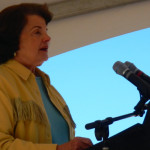
Dianne Feinstein

Dianne Feinstein

The presidential forum signaled the end of decades of neglect and put the Tahoe basin on a path to recovery. Since, each year we’ve held a summit to bring together key local, state and federal stakeholders — and a great partnership has formed.

I can say, without a doubt, that the work is paying off. In fact, I left the 19th annual summit, hosted in August by Nevada Sen. Dean Heller, feeling more optimistic than ever about the future of Lake Tahoe.

In July 1997, we faced a steep climb. Conservation and restoration efforts were fragmented and uncoordinated, with a host of competing priorities. Now, nearly two decades later, the pieces of the puzzle are sliding into place.

More so than other years, I left the summit last month confident that we can save this magnificent lake.

The No. 1 source of my optimism is the exceptional team we have in place, a true public-private partnership that is thriving and seeing real results. The diverse set of stakeholders has coalesced over the decades into something very special, sophisticated and successful.

It’s a bi-state team that includes federal, state and local officials; businessmen and women; lake scientists; fire chiefs; Forest Service officials; planners; advocates and local residents.

The team includes countless individuals who have dedicated so much time and energy to keeping Tahoe Blue; people like: Govs. Jerry Brown and Brian Sandoval, who continue a great tradition of their predecessors — throughout the years governors such as Arnold Schwarzenegger, Jim Gibbons and Kenny Guinn have all taken part; John Laird of the California Resources Agency and Leo Drozdoff of the Nevada Department of Conservation and Natural Resources; Patrick Wright, who leads the California Tahoe Conservancy; Joanne Marchetta of the Tahoe Regional Planning Agency; Sudeep Chandra, who is an expert on invasive species at the UNR, and Geoff Schladow, of the Tahoe Environmental Research Center and is an expert on lake quality at the UC Davis — their expertise is critical to protect the lake; Amy Berry, who helps raise restoration funds from the private sector through the Tahoe Fund; supervisors from El Dorado and Placer counties in California and from Washoe and Douglas counties in Nevada; and so many gifted others.

In a time of budget cutbacks and lowered expectations, it’s important to realize just how much this bipartisan team has been able to achieve to help Lake Tahoe.

In 2000, I authored the Lake Tahoe Restoration Act, which was cosponsored by my California and Nevada colleagues, Sens. Barbara Boxer, Harry Reid and Richard Bryan. This bill kicked off a 10-year cleanup effort, injecting $300 million in federal funds that eventually funded more than 600 environmental projects.

Since then, local, state and federal governments — with a lot of help from the private sector — have invested more than $1.8 billion into Lake Tahoe’s future. California has invested $693 million since the 1997 summit. Nevada has committed $118 million, plus an additional $300 million from the Southern Nevada Public Lands Management Act, which includes land sales. The federal government’s total is at $593.4 million. Local governments have put in $77.1 million. And the private sector has committed $328.3 million.

I can’t underscore enough the importance of the private sector in all this. Their efforts really show that a public-private partnership can work.

In fact, right before this year’s summit, I attended the Tahoe Fund dinner on the Nevada side of the lake, and the year before on the California side. And the Fund has raised more than $2.5 million over these two years.

This money has supported environmental improvement projects and others such as the Take Care initiative, which is helping to build a new culture of care taking in the region.

The $1.8 billion, which has been used wisely the on the ground, is responsible for a lengthy list of accomplishments.

Years ago, Lake Tahoe was so clear you could see more than 100 feet down. By 1997, however, runoff had reduced that famed clarity to just 64 feet. Today, thanks to a lot of hard work — as well as the drought, which has lowered the lake by 3 feet — we’ve increased water clarity to nearly 78 feet. The highways around the lake are being transformed so that grit and dirt, which would otherwise run into the lake, are being diverted into catch basins. To date, we’ve improved erosion control measures on more than 700 miles of roadway.

The team has improved more than 16,000 acres of wildlife habitat, including more than 1,000 acres of sensitive wetlands that filter polluted runoff before it enters the lake. Places like Upper Truckee River, Angora Creek, Trout Creek and Blackwood Creek have all benefitted from these projects.

We’ve added 2,770 feet of shoreline for public use, improving local quality of life and helping to transform the local economy, as seen in South Lake Tahoe and Commons Beach in Tahoe City.

We’ve created or improved 143 miles of bike and pedestrian routes. Projects like the Stateline to Stateline Bikeway are seeing thousands of users, and work continues to build a fully-developed trail system around Tahoe.

A comprehensive aquatic invasive species inspection system has been put in place to prevent species like the quagga mussel or Asian clam from entering and devastating the ecosystem.

And we’re protecting the Tahoe basin from the threat of wildfire by clearing land of the small trees and undergrowth that fuel fires. To date, we’ve cleared nearly 60,000 acres of land, nearly twice the area of San Francisco.

For all the great work the team has achieved, there’s still a lot more work to do.

This year, an additional bill — the Lake Tahoe Restoration Act of 2015 — is being carried by Sen. Heller, and Sens. Boxer, Reid and myself are cosponsors.

In order to build on all the work we’ve accomplished, we need to recommit the federal government to saving Lake Tahoe.

The threats facing the lake — erosion, invasive species, wildfires and climate change — are very real, and they aren’t going away anytime soon. We need to confront these challenges head-on and solidify our gains.

Our bill would authorize $415 million over 10 years, with the following primary goals: Further reduce the risk of catastrophic wildfire; fund the environmental improvement program to complete additional environmental restoration projects; enhance the lake’s storm water management, critical to water clarity; and increase the number of watercraft inspections to combat invasive species.

Simply put, I can’t think of a natural wonder more deserving of protection for future generations than Lake Tahoe.

Next year, as he approaches his well-deserved retirement, Sen. Reid will host his last Tahoe Summit.

Like other years, he’ll take stock of the improved roadways, the watercraft inspection stations and all the new recreation options.

I believe we’ll also be able to show him the impressive strength of the public-private partnership we launched over 18 years ago. Alongside the lake, it’s a team that I know will endure.

Dianne Feinstein, D-Calif., is the senior senator for California. 


Suit: Nestle using expired permit to grab Calif. water

By Geoffrey Mohan, Los Angeles Times

Environmental groups sued the U.S. Forest Service on Tuesday, alleging that the agency has allowed Nestle Waters to draw water from a creek in the San Bernardino Mountains under a permit that expired more than 25 years ago.

The company, owner of the Arrowhead bottled water brand, has drawn millions of gallons from the west fork of Strawberry Creek under a permit it apparently acquired in 2002.

At a time when residents have been asked to cut back water use during the record-setting drought, the diversion for commercial bottling to consumers once again has put Nestle in the cross hairs of the state’s water squabbles. The company faces scrutiny over its water withdrawal activities elsewhere in the state.

Read the whole story


Anglers oppose proposed fishing gear restrictions

By Rich Ibarra, Capital Public Radio

The California Department of Toxic Substances Control is considering banning some types of metal fishing gear. However, fishermen are launching a petition against possible changes.

The California Sportfishing League is gathering signatures for a petition that would oppose changes in fishing tackle regulations.
There is concern about a possible ban on lead sinkers or gear that contains zinc or copper.

Marko Mlikotin with the league says there are no environmental studies showing fishing tackle poses an environmental hazard.

Read the whole story


Halloween stories to be told at ZC Library

Tilly the Witch (aka  Carol Nageotte) will be telling spooky stories at the Douglas County Public Library in Zephyr Cove on Oct. 28 at 5:30pm.

Dress in your Halloween costume for this special storytime. Children will receive a Halloween treat to take home.

Children ages 4 and up will listen to Halloween stories from the library’s collection including a flashlight story. Tilly the Witch will end the program with her favorite poem, “Spider on the Floor.”

The library is located at 233 Warrior Way.


Pen and ink artist to give demonstration

Bill Migan will give a demonstration Oct. 14 on his techniques using pen and ink to create images of the Wild West and old buildings with great character.

A drawing featuring many of Nevada’s historic places won Migan the Spirit of Nevada award at the Nevada Day art show in 2013.

Migan’s demonstration will be part of the Tahoe Art League’s monthly meeting on Wednesday at 6pm at the South Lake Tahoe Senior Center (3050 Lake Tahoe Bvld.). It is free.


Costumed dog walk in South Lake Tahoe

Dogs will be getting in the Halloween spirit on Oct. 14 as part of Dawgs on the Run’s monthly walk.

The walk starts from the parking lot at High Sierra Dental Care (1060 Ski Run Blvd, South Lake Tahoe) at 5:30pm. Dogs must be on leash.

The walk is free, to participate in the costume contest it costs $5.


Snippets about Lake Tahoe

placer county·       Placer County staff designed a new logo that will be used going forward.

·       Diamond Peak’s Vincent Murillo, lead lift operator and maintenance assistant, received the 2015 Rocky Mountain Lift Association Lift Operations Person of the Year award.

·      Carson City Trail Users is having a public workshop Oct. 20 from 5:30-7:30pm at the Carson City Community Center (851 E. Williams St.) regarding the Eagle Valley trails.

·       Rhonda Sneeringer has been selected as Barton Health’s chief medical officer. She currently serves as the vice chief of staff for Barton Health. She is a pediatric and adult hospitalist and has practiced medicine at Barton Hospital for three years.

·       Sabrina Owen, supervisor of El Dorado County’s Mental Health Services in South Lake Tahoe, will be the guest speaker at the Rotary Club of South Lake Tahoe’s meeting on Oct. 14 at noon at Harrah’s Lake Tahoe. The public is welcome.