Poetry reading at Lake Tahoe Community College

In celebration of National Poetry Month, the Writers’ Series at Lake Tahoe Community College will host poets Jan Beatty and Gayle Brandeis for a reading and conversation on April 17 at 8pm in LTCC’s Roberta Mason Library.

This event is free and open to the public. Books by both authors will be available for purchase.

Beatty’s fifth book, “Jackknife: New and Selected Poems,” was published in January 2017 by the University of Pittsburgh Press.

Brandeis is the author of the memoir “The Art of Misdiagnosis: Surviving My Mother’s Suicide,” “The Selfless Bliss of the Body (Poems),” “Fruitflesh: Seeds of Inspiration for Women Who Write,” and the novels “My Life with the Lincolns, Delta Girls, Self Storage,” and “The Book of Dead Birds,” which won the Bellwether Prize of Fiction of Social Engagement. She teaches at Sierra Nevada College and at Antioch University Los Angeles.


Outdoor education Tahoe-style for 5th-graders

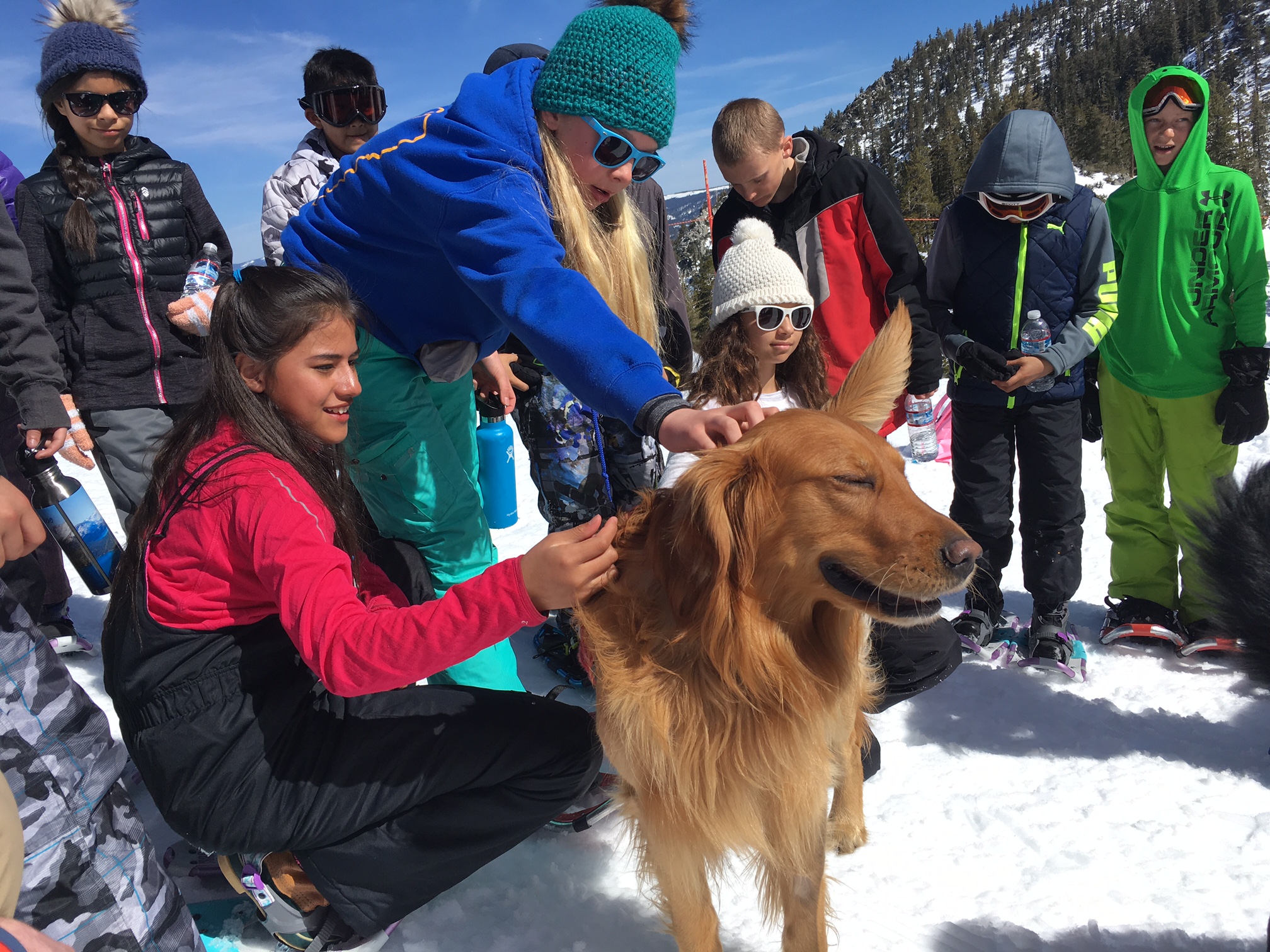
Neyeli Jimenez, left, and other students pet avalanche dog Peak. Photo/Terra Breeden

By Terra Breeden

Playing in the snow isn’t all fun and games. It can be deadly without the correct preparation or tools.

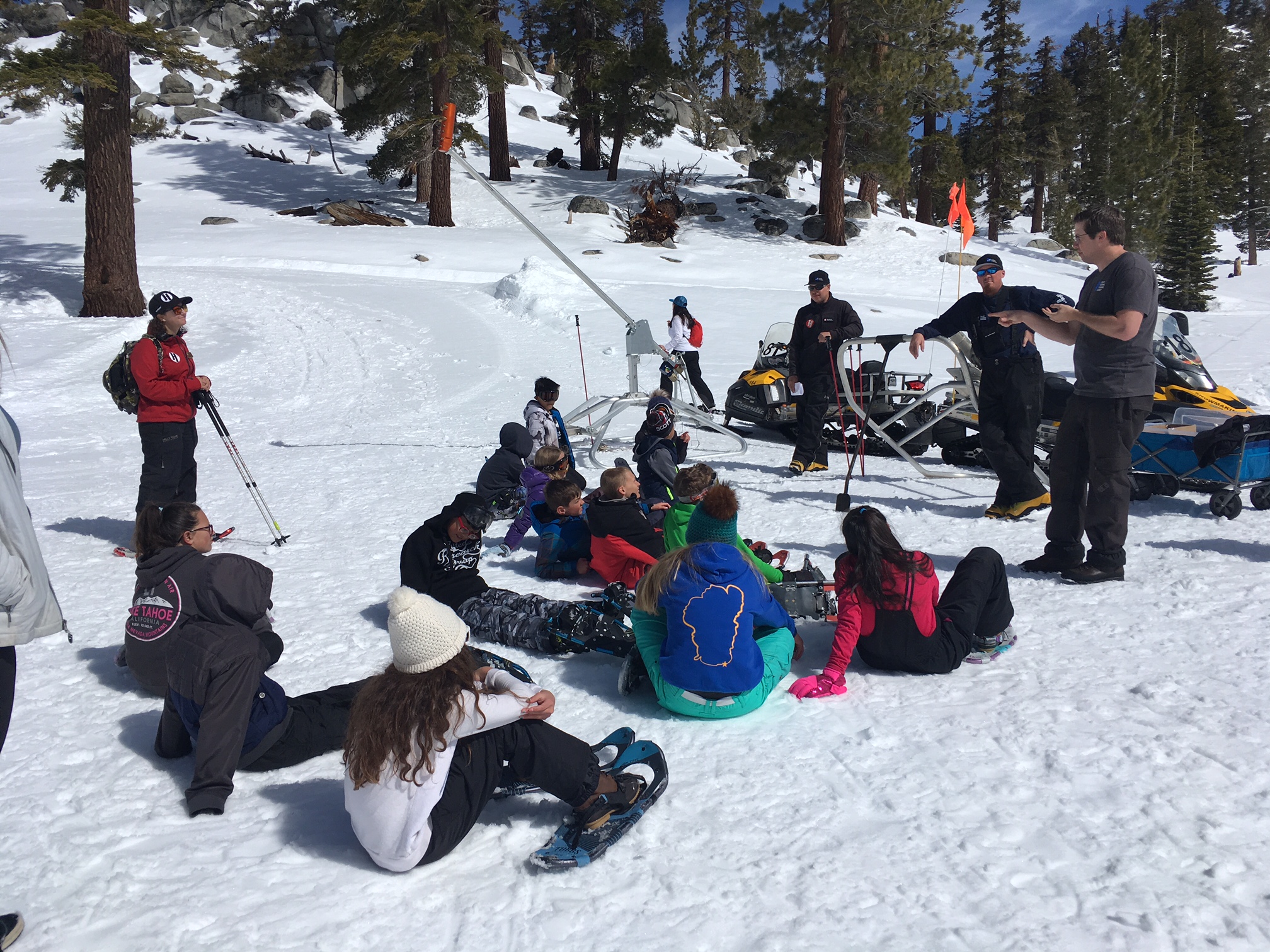
At the avalanche awareness and snow safety station hosted by David Reichel from the Sierra Avalanche Center, students learned how to rescue an avalanche victim by using a beacon and probe. They also learned how to check avalanche conditions by looking at the layers of snow in the snow pack. Avalanche conditions on this day were moderate.

On this particular day students from Bijou Community School were being taught a wealth of information about the outdoors.

“We realized that not every kid gets a chance to get outdoors, so this gives them that experience,” Adam Jensen, environmental education specialist at the Tahoe Regional Planning Agency, told Lake Tahoe News. “The goal is to get every student outdoors to learn about their natural environment.”

Alaina Corona and her classmates trek on snowshoes from station-to-station. Photo/Terra Breeden

Fifth-graders from Bijou joined the third annual Winter Adventure EpicPromise Program at Heavenly Mountain Resort last week. Designed to educate local kids about Lake Tahoe winters, more 300 children from across the Lake Tahoe Unified School District have joined ski patrollers and teachers for the program this year.

The program brings a different group of fifth-graders from the district to the mountain. During the event, the children snowshoe to education stations at the top of the tram at Heavenly where they learn about Lake Tahoe’s winter wildlife, avalanche awareness, snowpack conditions, environmental protection, and snowmaking technology.

At the avalanche awareness station, Heavenly rescue dogs Peak, a golden retriever, and Vader, a black Lab mix, were introduced to the students. Ski patrollers explained how the dogs are trained to locate people who have been buried in a snow slide.

Heavenly snowmaking gurus explain how they help Mother Nature. Photo/Terra Breeden

“My favorite part of this learning station were the dogs,” 10-year-old Neyeli Jimenez said as she petted Peak who wagged his tail.

Students were divided into three groups and snowshoed to three different learning stations set up by Heavenly staff.

“Snowshoeing is tiring, but fun,” 11-year-old Alaina Corona told LTN.

Each learning station had its own educational goal. At the winter wildlife station volunteers from the Tahoe Institute for Natural Science (TINS) taught students about the animals that live in the basin during the winter season. There are three types of winter wildlife in Lake Tahoe the volunteers explained; animals that hibernate, those that migrate away from the cold, and animals that tolerate the snowy season.

“I enjoy having an outdoor experience with the kids and teaching them about the wildlife that’s in the area where they live,” TINS intern Gary McGaughey told Lake Tahoe News. “It helps the students relate what they’re learning in school to the Tahoe region.”

Students took part in a scavenger hunt where they discovered evidence of winter-tolerant wildlife. At this station, the children learned how to spot animal tracks, identify droppings left by wildlife, and find pine cone seeds discarded by hungry animals.

“We like to show them how animals adapt to survive the winter,” TINS education manager Michelle Witte said.

At the final station, students were taught about the snowmaking science and environmental restoration Heavenly employs on its slopes. Ski runs can be erosion hot spots, flowing with muddy water in the spring. Heavenly rehabilitates the soil by sowing a native seed mixture of wildflowers and grasses to prevent erosion.

“This is what Heavenly does to protect our environment and Lake Tahoe,” Heavenly sustainability manager Frank Papandrea told the students.

Heavenly has 100 miles of pipeline pumping water to its snow-guns in the winter. The children were shown how snowmaking technology works and learned about the weather conditions needed to produce snow.

“Heavenly didn’t get much snow over the winter so we had to make it,” snowmaking supervisor Billy Clark said. “We are snowmakers, scientists and weathermen. Without us, you would have been skiing down dirt this year.”

After visiting the learning stations, students gathered in the snow for a picnic lunch.

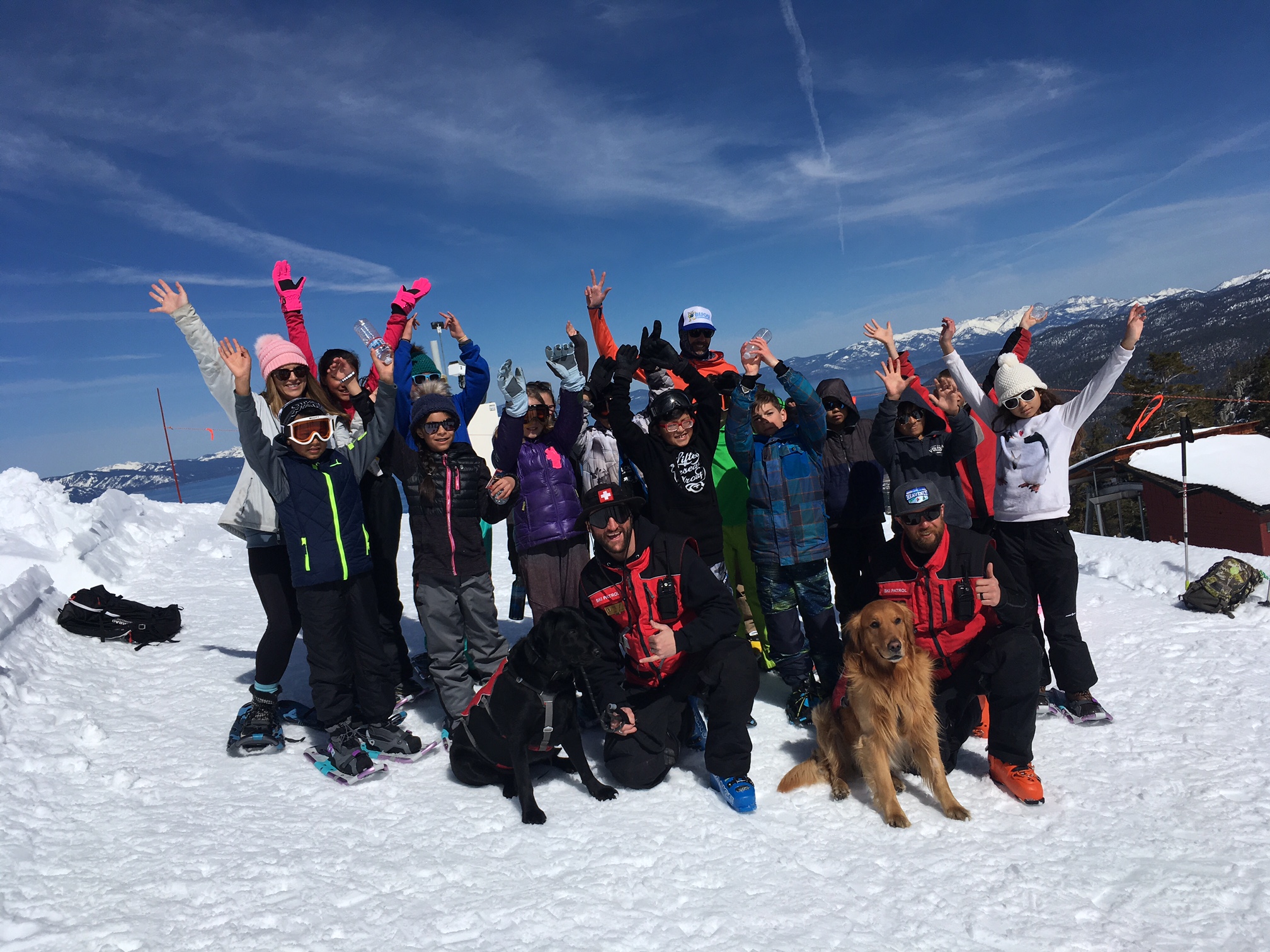
All in all, the Winter Adventure Program was a big hit with the Bijou students. The children had the opportunity to enjoy the outdoors on a day that was sunny and clear, snowshoe to the top of a mountain with views of the lake and received a winter education whilst doing it. 

Bijou fifth-graders spend a day at Heavenly learning about the outdoors. Photo/Terra Breeden

“I like being at Heavenly today because I get to be with my friends and be outside,” Alaina said. “I learned how to snowshoe, how to make snow, and about avalanches and animals. It’s fun.”

The Tahoe Institute for Natural Science, Sierra Avalanche Center, and the U.S. Forest Service partnered with TRPA to provide the educational activities during the Winter Adventure Program Funding for the program was secured by TRPA through the Vail Resorts EpicPromise Foundation.

“A lot of kids in Lake Tahoe don’t get to experience snowshoeing or other outdoor activities. We saw that need and decided to do something about it,” Jensen said.

The EpicPromise Foundation is designed to enhance education and sustainability in Vail Resort communities. For the Winter Adventure Program this year, Heavenly comped 400 tram tickets for students and donated $675 to provide bus transportation from the schools to the resort.

“EpicPromise provides funding to a large number of nonprofits on the South Shore,” Papandrea told Lake Tahoe News. “Our goal is to provide support in our resort communities and give back.”


Letter: Group effort to pull off Drug Store Project

To the community,

If you had walked onto the Lake Tahoe Community campus on April 3, you would have never guessed that there were 325 sixth-grade youth and 220 agency and volunteer workers throughout the corridors, all learning information on how and why to keep themselves safe from drugs.

“Choices, what are yours?” was the theme of our efforts in keeping our youth drug free. With the country’s attitudes and norms about drug use changing, times are even more difficult for our kids. Attitude changes in marijuana use is very confusing and many of us struggle to get our youth to understand the dangers that could lie ahead for them. Many of our kids have people they love who use various drugs at home. With that the propensity that they will use is of great concern.

The adolescent brain and body are developing, and this development doesn’t stop until into one’s 20s. I don’t think anyone out there doesn’t want their child to reach their full potential intellectually or emotionally, but it could happen for your child if they do choose to use. Experimentation with gateway drugs; alcohol, tobacco, or marijuana could lead to other drug use and even death. Several of us who believe in this event have first- hand experience with this.

With the conclusion of our 15th annual Drug Store Project want to thank the many agencies, service clubs, businesses, and volunteers who provided this program for our youth.

Teaching our youth about the dangers of all drugs; marijuana, alcohol, tobacco, e-cigarettes, over-the-counter as well as prescriptive medications, gets more challenging each year as states provide new legislation and products are packaged to entice our minors. This year our 320 sixth-grade students had the assistance of over 200 volunteers to send a clear message that they are valued. The agencies and groups who provided this program strongly believe that a difference can be made for our kids. Collectively we believe that if youth are provided knowledge about the effects drugs have on the body, the mind, family and social life, productivity, and overall life experiences, many more will choose not to experiment and not to participate in drug use.  If we can collectively put off the “age of onset” to experimentation, then we can see a difference for our youth.  Less drug use means less demand. Less demand is less costly in lives and in all facets of the economy. 

We’re especially proud of the South Tahoe High School Friday Night Live members, themselves past participants in the program when younger, who took their day to emphasize to the younger youth that drugs do not need to be a part of their lives. They can “choose” to stay healthy and safe. We also continue to have the assistance of our California National Guard assigned to the Joint Task Force Domestic Support – Counter Drug and Naval Air Station-Fallon military personnel. 

Tahoe Youth & Family Services is the agency under which our program is based. It takes money and people to make this event happen for our youth. The Drug Store Project continues to be supported completely through donations, grants, and in-kind donations from businesses.

I’d like to extend my gratitude to the following entities: Barton Health, California Conservation Corps, California Highway Patrol, CALSTAR, Cal Tahoe JPA, Camelot Party Rentals, Douglas County Search & Rescue, El Dorado Community Foundation, El Dorado County District Attorney, El Dorado County Mental Health, El Dorado County Probation Department, El Dorado County Public Defender, El Dorado County Search & Rescue – Tahoe Team, El Dorado Sheriff’s Office, El Dorado County Superior Court, Harrah’s Foundation, Harrah’s HEROS, Joint Task Force Domestic Support-CD, Kindred Hospice, Kiwanis Club of Lake Tahoe, Kiwanis Club of Tahoe Sierra, Lake Tahoe Community College, Lake Tahoe Resort Hotel, Lake Tahoe Unified School District, Lake Valley Firefighter’s Association, Lake Valley Fire Protection District,

Naval Air Station Fallon, Nevada Funeral Services, Pro Leisure, South Lake Tahoe Fire Department, South Lake Tahoe Police Department, Soroptimist International of South Lake Tahoe, Soroptimist International of Tahoe Sierra, South Lake Tahoe Police Officer’s Association, South Tahoe Drug Free Coalition,

South Tahoe High School Friday Night Live, South Tahoe Middle School, Tahoe Optimist Club, Tahoe Douglas Fire Protection District, Tahoe-Douglas Rotary Club, Tahoe Turning Point, Tahoe Youth & Family Services, Zephyr Cove Elementary, and Community Volunteers.

We hope that children and their parents openly discuss the dangers of all drugs on a regular basis. Get educated together and know what is happening in your community. We invite every parent of a child who experienced the program to take the time to complete the parent survey online. Your input will help our program for future years.

Gratefully,

Lisa Huard, Drug Store Project coordinator


How the New Deal helped seed the modern environmental movement

By Benjamin Alexander, The Conversation

Eighty-five years ago, on April 5, 1933, President Franklin D. Roosevelt signed an executive order allocating $10 million for Emergency Conservation Work. This step launched one of the New Deal’s signature relief programs: the Civilian Conservation Corps, or CCC. Its mission was to put unemployed Americans to work improving the nation’s natural resources, especially forests and public parks.

Today, when Americans talk about “big government,” the connotation is almost always negative. But as I show in my history of the Corps, this agency infused money into the economy at a time when it was urgently needed, and its work had lasting value.

Corps workers planted trees, built dams and preserved historic battlefields. They left trail networks and lodges in state and national parks that are still widely used today. The CCC taught useful skills to thousands of unemployed young men, and inspired later generations to get outside and help conserve America’s public lands.

The spiritual value of outdoor work

Roosevelt had sketched out much of his concept for the CCC well before his inauguration on March 4, 1933. Proposing the corps on March 21, he asserted that it would be “of definite, practical value” to the nation and the men it enrolled:

“The overwhelming majority of unemployed Americans, who are now walking the streets and receiving private or public relief, would infinitely prefer to work. We can take a vast army of these unemployed out into healthful surroundings. We can eliminate to some extent at least the threat that enforced idleness brings to spiritual and moral stability.”

Congress enacted the bill on March 31, and Roosevelt signed it that day. Although there was no precedent for such a vast mobilization, enrollment started a week later in New York, Baltimore, Washington, D.C., Pittsburgh and other major cities, then fanned out across the country. By midsummer, some 250,000 men aged 18 to 25 had signed up. Their six-month term might be spent at one camp or several; it might be located across the continent or, rarely, just across town.

Another day, another dollar

CCC recruits came from families on relief. Agents from local welfare offices screened prospects, then passed them along to the Army for a physical examination and a final decision. The Army also managed the huge task of transporting successful applicants to hundreds of work camps. The corps established operations in all 48 states and the territories of Puerto Rico, Alaska, Hawaii and the Virgin Islands, as well as a separate American Indian division.

Most enrollees were young unmarried men, but the CCC also created special companies of war veterans. This policy was Roosevelt’s response to the 1932 Bonus March, in which thousands of World War I veterans camped out in Washington, D.C., demanding early payment on promised military service bonuses, only to be evicted at gunpoint by order of then-president Herbert Hoover. (Some scholars believe this debacle helped clinch Roosevelt’s election later that year.)

CCC recruits could only bring a single trunk; tools were provided on-site. Many Corps members packed musical instruments, and some brought their dogs, which became company mascots. At the start many recruits slept in tents and bathed in nearby rivers. Those without experience in the great outdoors learned key lessons fast, such as how to avoid using poison ivy for toilet paper. Some succumbed to homesickness and dropped out, but most adjusted, forming baseball teams, music combos and boxing leagues.

Although the CCC was a civilian organization, the camps were run by the Army and bore some of its hallmarks. Dining facilities were called mess halls, beds had to be made tightly enough to bounce a quarter off them, and workers woke to the sound of reveille and went to sleep with taps. Commanding officers had final say over most issues.

At work sites, the Agriculture and Interior departments – custodians of U.S. public lands – were in charge. CCC members planted 3 billion trees, earning the nickname “Roosevelt’s tree army.” This work revitalized U.S. national forests and created shelter belts across the Great Plains to reduce the risk of dust storms. The corps also surveyed and treated forests to control insect pests and created forest fire prevention systems. Over its decade of operation, 42 enrollees and five supervisors died fighting forest fires.

Corps members created and landscaped 711 state parks, and built lodges and hiking trails in dozens of national parks and monument areas. Many of these facilities are still in use today. Attractions including the Grand Canyon, Grand Teton and Yellowstone National Parks, and Civil War battlefields at Gettysburg and Shiloh bear signatures of CCC work.

For their labors, corps members received $30 a month – but as a condition of enrollment, the CCC sent $22 to $25 each pay period home to their families. Still, at Depression prices, $5 was enough to visit nearby dance halls and meet girls once or twice a week. These forays sometimes ended in fights with jealous local men, but also led to many lifelong marriages.

Ripple effects

In total, close to 3 million workers and their families received support from the CCC between 1933 and 1942. The corps also provided jobs for well over 250,000 salaried employees, including reserve military officers who ran the camps and so-called “local experienced men” – unemployed foresters who lived near the camps and were hired mainly to help supervise enrollees on the job.

Camps also hired unemployed teachers to offer informal evening classes. Some 57,000 enrollees learned to read and write during their CCC stints. Camps offered many other classes, from standard subjects like history and arithmetic to vocational skills such as radio, carpentry and auto repair.

Like other New Deal programs, the CCC had flaws. Party patronage heavily influenced hiring of salaried personnel. Although the law creating the CCC banned racial discrimination, black enrollment was capped. Many African-American enrollees were housed in “colored camps” and could only go into town for recreation and romance if black communities existed to serve them.

The CCC also discriminated socially, enrolling young men with families but excluding rootless transients who wandered from town to town in search of work and food. These men could have reaped great benefits from the CCC, but its leaders imagined an unbridgeable cultural gap between young men who came from families and others who came from the byroads. And the corps only enrolled men, although Eleanor Roosevelt convinced her husband to let her and Labor Secretary Frances Perkins organize a smaller network of “She-She-She” camps for jobless women.

Congress terminated funding for the CCC in 1942, after the United States entered World War II, although Roosevelt argued that it still played an essential role. Many men who had gained physical strength and learned to handle Army discipline in the CCC later entered the armed forces.

The tree army’s legacy

Beyond its physical impact, the corps helped to broaden public support for conservation. In the 1940s and 1950s, youth groups such as the Oregon-based Green Guards volunteered in local forests clearing flammable underbrush, cutting fire breaks and serving as fire lookouts. Others, such as the Student Conservation Association, advocated for wilderness protection and conservation education. Hundreds of former CCC enrollees helped lead these efforts. Today many teenagers work in national parks, forests and wildlife refuges every summer.

Although it is hard to picture a CCC-style initiative winning political support today, some of its ideas still resonate. Notably, the Obama administration’s economic stimulus plan and some proposals for upgrading U.S. infrastructure present federal spending on projects that benefit society as a legitimate way to stimulate economic growth. The CCC combined that strategy with the idea that America’s natural resources should be protected so that everyone could enjoy them.

Benjamin Alexander is a lecturer in social science at New York City College of Technology, City University of New York.


Book explores world of wildland urban interface firefighting

By Tracy Ross, Outside

On July 9, 2016, two hitchhikers camping illegally on private land north of Nederland, Colorado, piled rocks onto a campfire that they hadn’t fully extinguished. Shortly after, wind (most likely) flamed the embers into a blaze. By 1:30 p.m., tentative puffs of smoke gathered above the ad hoc site, flanked by groves of dry aspen and conifer. The fire soon made a 40-acre run up a hill and across a ridge heavily populated with homes.

A year and a half later, I know that wildland firefighters acted heroically to stop the blaze that would come to be known as the Cold Springs Fire. It eventually charred 430 acres of private land and 98 acres of Forest Service land, required 12 Type 1 and Type 2 fire crews, employed 744 fire-related personnel, and cost a total of $3.5 million.

Journalist Heather Hansen had been following firefighters from Station 8 in Boulder, Colorado, for months when the Cold Springs Fire broke out in Nederland. (She even became a certified wildland firefighter in the process.) In her new book, “Wildfire: On the Front Lines with Station 8” ($25; Mountaineers Books), an entire section is devoted to a fire that personally affected my life—which, truthfully, may have influenced my positive feelings about the book. But what Hansen really focuses on is telling the story of fire management and mitigation in the West, layered with the added context of history, science, landscape, and human behavior.

Read the whole story


Memorial ski-party at Heavenly for Sakioka

Ronson Sakioka

The Ronson Sakioka Memorial “Face Rat” Party will be April 6 at Heavenly Mountain Resor.

Ronson was one of the original Face Rats. He died last year.

Friends will be begin skiing The Face at 2pm, then everyone will meet at the top at 4pm for a final run with Ronson at 4:20pm.

The party will be from 5-7:30pm at the Cal Bar.

Bring memories and any photos to share.


Pet waste a major pollutant outdoors and at home

Vancouver, B.C., uses humor to get people to pick up after pets. Photo/LTN

By Wes Siler, Outside

In the United States, pet dogs produce 21.2 billion pounds of poop each year. All that poop is polluting water sources, both in urban areas and the backcountry, largely because dog owners aren’t doing a good enough job picking it up. Let’s look at the reasons why dog poop has become such a problem, and examine what we can do about it.

Two reasons: There’s too much of it and it’s full of bacteria and parasites. 

To study the issue, the Leave No Trace Center for Outdoor Ethics tracked “canine defecation events” on Boulder, Colorado’s Open Space and Mountain Parks lands for a little over a month last summer. Those 45,000 acres see 5.3 million human visits each year, and many of those visitors bring their dogs along, resulting in 60,000 pounds of left-behind dog poop each year.

Read the whole story


Comedians to entertain at Hard Rock

Comedians Shayla Rivera, Monique Marvez and Jade Esteban Estrada take the stage inside Vinyl at the Hard Rock Lake Tahoe on May 5 in an evening of comedy billed as Three Latinas and a Navé (which is how host Howie Nave has had his last name pronounced for years).

Rivera has been a staple on Nave’s morning radio show every Wednesday for years and has built up a sizable following in Tahoe and online amongst Latina women with her no-holds barred segment “It’s Rocket Science with Shayla Rivera” on KRLT 93.9FM.

Rivera was a bonafide rocket scientist working for NASA on their space shuttle program for seven years. Her point of view comes from being herself, a woman, a Latina, a mother, a rocket scientist, a mystic.

Marvez is a versatile performer and writer who now has three Showtime specials.

Estrada (aka The Prada Enchilada) started his gender bender’ career being a choreographer to Latin diva Charo, a scratch vocalist to the Back Street Boys and has headlined over 250 Pride events worldwide.

Doors open at 8pm, show starts at 8:30pm. Must be 21 or older For ticket information, go online.


Time to register for LTUSD for 2018-19

Registration for Lake Tahoe Unified School District at all elementary schools will be April 30-May 11.

To be eligible for kindergarten a child must be 5 on or before Sept. 1. If a child will be 5 between Sept. 1 and Dec. 2, he or she qualifies for transitional kindergarten, a two-year kindergarten program at Tahoe Valley Elementary School. 

LTUSD is also offering an Early Entry TK program for students born between Dec. 3, 2018 and March 31, 2019. This optional program is only available as space is available in the TK program. Petition for entry into this program by contacting Tahoe Valley directly.

California law requires the following:

  • Child’s birth certificate
  • Proof of immunizations, which includes the Varicella (chicken pox), Hepatitis B and for most children, the last booster shot. Children will not be enrolled in school without presenting an up-to-date immunization record.
  • Health examination upon entry to school (schedule with your family physician).
  • Oral health examination upon entry to school (dental examinations that have occurred in the last 12 months meet this requirement).
  • Proof of California residency (lease agreement, mortgage statement, utility statement, etc.)

Call your neighborhood for an appointment: Bijou Community School 530.543.2337, Sierra House Elementary 530. 543.2327 and Tahoe Valley Elementary 530.543.2350.


Wet storm to drench Lake Tahoe Basin

The National Weather Service in Reno has issued a flood watch from April 6 at 5pm to April 8 at 5am for the greater Lake Tahoe area, as well as parts of the Carson Valley and Reno areas.

A strong atmospheric river will impact the Sierra. Significant precipitation will combine with high snow levels to bring an enhanced flooding potential for rivers, creeks, streams and urban areas.

Rain is expected to start Friday night and last into Saturday.

Snow levels will start at 9,000 feet, dropping to 7,000 feet on Saturday evening.

High temps are expected to be in the 40s and 50s in South Lake Tahoe, with most lows above freezing for the next several days.

— Lake Tahoe News staff report