Snippets about Lake Tahoe

SLTPD  Officer Mark Hounsell and Argo·       A GoFundMe account has been set up for the four Hounsell children whose parents died last weekend in car accident. To donate, go online. Mark Hounsell was an officer with the South Lake Tahoe Police Department.

·       There will be a free drive-through flu shot clinic in Truckee on Oct. 21 from 2-5pm at the Catholic Church parking lot.

·       The U.S. Ski Team has launched a mobile iOS app. The free app features alpine, freestyle and Nordic skiing, and gives users access to the most up-to-date information from the World Cup circuit and beyond.

·       The Truckee Donner Land Trust will immediately begin releasing water stored in Van Norden Reservoir to comply with California law and to address public safety requirements.

·       Subway is going to stop serving chicken raised with antibiotics before March 2016, and will stop serving pork and beef raised with antibiotics by 2025.


Lawyer: Reno journalists were victims of Tesla guards

By Daniel Rothberg, Las Vegas Sun

Security personnel at Tesla’s Northern Nevada battery manufacturing plant engaged in a violent skirmish with two employees of the Reno Gazette-Journal earlier this month and rammed their vehicle with an ATV, according to a letter from the newspaper’s counsel.

According to the attorney’s letter, the alleged assailants, apparently security personnel working at the construction site for the $5 billion Tesla Gigafactory, shattered the driver’s window with a rock, slit the driver’s side seatbelt, aggressively removed the RGJ journalist from the vehicle and secured him in a position face-first in the dirt.

The letter, released on Monday, provides a depiction of events that calls into question the narrative Tesla released about the Oct. 9 incident in a post last week. In that post, Tesla said the Reno journalists struck two security guards and hit Tesla’s ATV with their Jeep as the journalists attempted to flee the construction site.

Read the whole story


Drought-stressed Calif. forests face a radical shift

By Thomas Curwen, Los Angeles Times

Biologist Greg Asner first heard the numbers in April, but they did little to prepare him for what he saw.

The Forest Service had estimated that nearly 12.5 million trees in the state’s southern and central forests were dead. But as Asner peered down upon the same forests from his airplane at 6,000 feet, he saw something far worse.

California’s drought-parched landscape was poised for a radical transformation. Much of the low-elevation forests near Mt. Pinos in the Los Padres National Forest and in Pinnacles National Park were going to disappear if trends continued.

A scientist with the Carnegie Institution for Science, Asner has a practiced eye for forest health, and with instruments aboard his plane that give him X-ray eyes into the foliage, he is able to assess not just dead trees but trees so stressed by the drought that their death is likely.

Read the whole story


Truckee to host Big Truck Day

Big Truck Day is coming to Truckee on Oct. 24 from 11am-2pm.

This is the seventh year the town will have its big rigs on display for the public to see. Local contractors, the California Highway Patrol, U.S. Forest Service and others will also be at the event.

The event is at the public service center, 10811 Stockrest Springs Road.

There is no charge to attend. Food will be for sale.


Parking for backcountry users being addressed

The Tahoe Regional Planning Agency, El Dorado County, and members of Tahoe Backcountry Alliance are partnering to create a coalition to maintain and enhance public access for winter backcountry skiing and snowboarding.

Nearly a dozen agencies are convening this week to begin a comprehensive conversation about roadside access to some of Tahoe’s more important backcountry skiing locations.


While backcountry skiing has been growing in popularity, parking and access to popular peaks have become increasingly challenging. That issue surfaced this month when a Caltrans project to reduce soil erosion and stormwater pollution on seven miles of Highway 89 between Emerald Bay and Meeks Bay displaced some on- and off-road parking used by the backcountry skiers.

To make up for that lost parking, TRPA and Caltrans approved a project revision to install a 25-by-180-foot paved pullout just south of D.L. Bliss State Park, and California State Parks offered to provide plowed winter parking at the D.L. Bliss State Park Visitor Center.

TRPA said it will review upcoming water quality improvement projects around Emerald Bay that Caltrans has already received permits for to ensure that maintaining or enhancing parking areas for backcountry access is considered in those highway plans.


Winter White tickets on sale

Tahoe Regional Young Professionals is hosting its annual Winter White Holiday FUNraiser on Nov. 21 from 6-10pm at Riva Grill in South Lake Tahoe.

All proceeds from this year’s event go to help Live Violence Free, a local organization committed to promoting a violence free community through education and advocacy to address domestic violence, sexual assault, child abuse and basic needs.

TRYP will provide light appetizers, door prizes, silent auction items, and a costume contest.

Tickets may be purchased online. It is $25 for TRYP members, $40 for others.


South Lake Tahoe councilmember censured

By Kathryn Reed

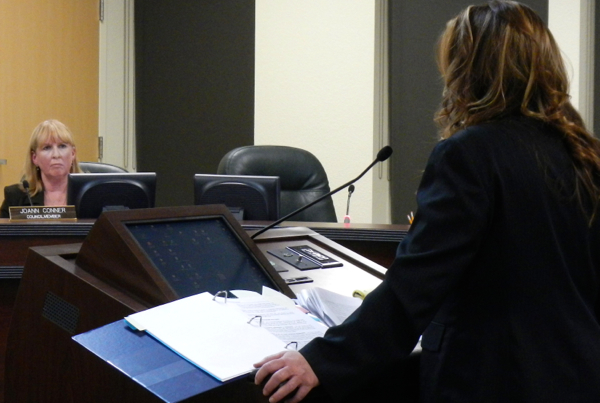
On identical 4-1 votes Monday the South Lake Tahoe City Council ratified the city manager’s decision to ban Councilmember JoAnn Conner from interacting with staff and agreed to censure her. Conner was the dissenting vote on both measures.

It took nearly 3½ hours to reach those conclusions Oct. 19.

Some in the city say the issues involving Conner started immediately after she was elected three years ago this November. Members of this council and previous ones have reached out to her individually and collectively to express their displeasure with her words and actions.

“I have witnessed her conduct for many years,” Mayor Hal Cole said, intimating a pattern of negative behavior.

“I have personally seen Ms. Conner treat staff in a disrespectful manner. I have personally seen Ms. Conner treat citizens in a disrespectful manner during city council. I have personally seen Ms. Conner lose emotional control to the extent that I thought that she was not speaking in a logical or professional manner,” Sass said. “I believe members of this City Council, including myself, are hesitant and uncomfortable working with Ms. Conner. It’s my opinion that Ms. Conner poses a financial risk to our city as a result of potential litigation from city staff.”

Councilmember Wendy David said, “The hostile environment you have created and cited has not only damaged our city, the city you were elected to serve, but has created fear, real fear of you and your potential retaliation and behavior.”

South Tahoe Councilmember JoAnn Conner listens has her attorney Jacqueline Mittelstadt makes a point Oct. 19. Photo/Kathryn Reed

South Tahoe Councilmember JoAnn Conner listens as her attorney Jacqueline Mittelstadt makes a point Oct. 19. Photo/Kathryn Reed

Lake Tahoe Community College President Kindred Murillo wrote a letter that referenced the hostility she incurred when giving a talk to the council. El Dorado County Supervisor Sue Novasel also wrote a letter. Neither she nor her assistant, Judi McCallum, will speak directly to Conner because of her language and demeanor.

City Manager Nancy Kerry said the only way Conner would speak of former Councilwoman Brooke Laine was to call her a c-u-n-t. F bombs, Kerry said, are standard from Conner.

It has gotten to the point that employees are scared of Conner, fearing for their jobs and that she will pull the funding for projects they are working on or ax money from their departments. This in turn impedes their ability to do their jobs.

Kerry early last month made the decision to ban Conner from talking to staff after at least six complaints were levied against the councilmember by staff to the city attorney.

Cole said in the weeks since that action was taken Conner’s behavior – mostly through social media – borders on harassment and retaliation. That is what led him to seek censure.

Censure is not punishment, according to City Attorney Tom Watson, but instead is a statement saying certain behavior is not being condoned.

What wasn’t agreed to between Watson and Jacqueline Mittelstadt, who represented Conner, is whether evidence needed to be presented to substantiate the censure and to what degree this was a judicial hearing. Watson said no evidence had to be given, that councilmembers need not answer questions and that it was not a judicial hearing in any sense. Mittelstadt disagreed.

When it comes to censure the city’s protocols say, “A decision to censure requires the adoption of a resolution making findings with regard to the specific charges, based on substantial evidence, and approved by the affirmative vote of at least three council members.”

What the attorneys vehemently disagreed about is whether that evidence had to be presented to Conner.

(Mittelstadt had been the city’s attorney, having quit in 2010 after a brief, contentious tenure.)

City Councilman Tom Davis in particular said Conner was violating protocols of conduct. Such a protocol is not posted on the city’s website.

“I find it ironic that in the very same hearing, the city councilmembers failed and refused to comply with the requirements of the very protocols they proceeded to censure another council member for allegedly violating,” Mittelstadt told Lake Tahoe News.

Seven letters were read into the record, with one supporting Conner and six favoring the city’s actions. Thirteen people spoke at the meeting – 11 for Conner, one for the city, and one person didn’t take a side. About 60 people attended the meeting.

Many who spoke said the hearing should not be done in public. Legally it had to be. Many expressed support of Conner, saying she was the only councilmember who helped them. Some said the actions are violations of Conner’s free speech rights.

At Monday’s meeting Conner did not say a word publicly, but instead consulted with her attorney who was allowed to sit next to her. This pushed City Attorney Watson to a lower level sitting area.

Kerry told Lake Tahoe News it is the city’s policy that Conner is entitled to have her attorney’s fees for the censure process be paid for by the taxpayers. Any further legal fees would be her burden. It remains to be seen if Conner will sue the city.

“I believe that the action of the council (Oct. 19) is not legally defensible,” Mittelstadt told Lake Tahoe News after the meeting. “I have to talk to Councilmember Conner as to what she wants to do.”

Mittelstadt started the afternoon by saying she was seeking to have the entire matter delayed and for both sides to sit down to reach an agreement. The council didn’t even vote on that proposal. Mittelstadt said she is still willing to get her client and city officials in a room to hash things out.


Opinion: Should apartment buildings be smoke-free?

By Esther Schiller

A former Marine I know has been living in a six-unit apartment building in Van Nuys, in L.A.’s San Fernando Valley, for about four years. The rent is reasonable, the neighborhood is diverse, and the landlord is helpful. But this man has a problem, which is why he just called me. His next-door neighbor smokes.

The neighbor smokes everywhere: in his own unit, in the driveway, in front of both the former Marine’s and his own doors. The smoke is getting into my acquaintance’s unit. This is not good. He has asthma and a heart condition. When the former Marine was a child, he lived with his grandmother, whose heavy smoking turned her apartment walls brownish-yellow and made him especially vulnerable to tobacco smoke. But he can’t afford to move.

To make things more complicated, the building my acquaintance lives in is regulated by a rent-control law. This law, designed to protect tenants from egregious rent increases and potential eviction, does not permit the landlord to change the conditions of tenancy except for minimal rent increases each year. Even if the landlord wanted to do something, he couldn’t require the former Marine’s neighbor to stop smoking on the property.

At Smokefree Air For Everyone, a Los Angeles-based nonprofit I direct, we get calls from people dealing with similar problems at least once a day. S.A.F.E. has been funded for 15 years by the California Department of Public Health’s Tobacco Control Program to disseminate information about the problem of drifting tobacco smoke in residential buildings, and we’ve surveyed thousands of people who live in apartments and condos. Although the percentage of California adults who smoke is now less than 12 percent, our surveys have found that more than one in three nonsmokers who rent in L.A. County are still exposed to secondhand tobacco smoke.

This is a local problem and a national issue. According to the Centers for Disease Control and Prevention, about 80 million (one in four) Americans live in multi-unit housing, and more than one in three renters—the same percentage as we found in our L.A. County surveys—are exposed to secondhand smoke. Secondhand smoke kills more than 400 infants and 41,000 adult non-smokers every year. Infants exposed to secondhand smoke have a higher risk of Sudden Infant Death Syndrome, and children are more susceptible to respiratory infections, ear infections, and asthma attacks. In adults, secondhand smoke can cause heart disease, stroke, and all kinds of cancers.

An air quality study in Los Angeles County in 2011 showed that tobacco smoke particles move from unit to unit through cracks in fixtures, electrical outlets, pipes, vents, and baseboards, as well as through shared ventilation systems and windows. Environmental scientist Neil Klepeis, who conducted the study, believes as much as 30 to 50 percent of the air in a residential building may come from other units, regardless of whether the buildings are new or old. “Tobacco smoke particles in units of non-smokers can reach significant levels equal to and exceeding those of a smoky bar or casino,” he says.

Even so, most apartment renters don’t complain about their exposure to tobacco smoke. Some don’t want to start a war with their neighbors; some believe, erroneously, that there is a legal right to smoke; and some simply believe that complaining won’t help, which is frequently true. Many landlords and property management companies, even in cities without rent control, believe there is nothing they can do about a tenant who smokes. They may not understand the public health implications of their residents being forced to breathe their neighbors’ toxic tobacco fumes. Or they don’t want to be bothered with enforcing a no-smoking rule or spending money to evict a tenant for smoking. In the worst cases, we’ve seen landlords threaten to evict tenants who complain about a neighbor’s tobacco smoke in lieu of addressing the problem.

But even landlords who take legal action against tenants whose smoking is seriously affecting other tenants, on the grounds that they are creating a nuisance, may find themselves dealing with judges who are not knowledgeable about the hazards of exposure.

Condominium owners are not exempt from the problem, either. They are more likely to complain than renters, but condo boards rarely take action to help. S.A.F.E. advises people not to purchase a condo unless there is some kind of law or regulation in place that protects the residents of the building from all kinds of smoke, including smoke from cigars, hookahs, electronic cigarettes, and marijuana.

Fortunately, public housing authorities, national and state institutions, and some housing corporations around the country have begun to look at the problem. The U.S. Department of Housing and Urban Development and the CDC recently released position papers stating that all multi-unit housing should be smoke-free.

Although they remain in the minority, some landlords, apartment corporations, and condominium boards are beginning to recognize the financial benefits of no-smoking policies. It is a lot less expensive to prepare a unit for the next resident if the previous resident didn’t smoke in it. There is less danger of fire. We hear from realtors that prospective buyers or renters don’t even want to look at units in buildings with lobbies and halls that smell of smoke. In addition, in California and some western states, an insurance group will provide a 10-percent discount for insurance for multi-unit residential buildings that have established no-smoking policies.

Approximately 40 California cities and counties have passed ordinances regulating secondhand smoke in apartments and even in condominiums. Some of the ordinances include banning the use of electronic cigarettes, and some include the smoking of marijuana. On September 15, the city of Manhattan Beach held a first reading of a housing ordinance that will require no smoking in all apartments and condos by May 2017; they used an ordinance recently adopted by Culver City as a model. Santa Monica, a city with rent control, recently passed an ordinance requiring new vacancies in apartments and condos to become non-smoking, and requiring landlords and condo boards to inform prospective residents about units that are still being smoked in. However, there are no laws regulating smoking in multi-unit residential buildings in the city of Los Angeles.

At the state level, change is happening as well. The California EPA’s Office of Environmental Health Hazards Assessment has designated marijuana smoke as a human carcinogen. 1-800-NO-BUTTS provides help in several languages over the phone for people trying to quit smoking. The more laws and restrictions that have been put in place to limit where people can smoke, the more the rate of smoking has dropped.

The CDC is providing funding for organizations throughout the country to spread the word about the financial and public health benefits of smoke-free multi-unit housing. In Los Angeles, the CDC has funded UCLA’s Center for Health Policy Research to work with apartment associations, community leaders, and policy makers to help people to live without worry of smoke exposure.

Perhaps the ex-Marine who has been suffering from secondhand smoke may eventually be able to breathe clean air.

Esther Schiller is the executive director of Smokefree Air For Everyone (S.A.F.E.). Their project, the Smokefree Apartment House Registry, lists the vacancies of apartment owners who have made their properties non-smoking.



Airlines upgrading wine cellars to woo passengers

By Elin McCoy, Bloomberg Markets 

This past spring, Joost Heymeijer arrived in Bordeaux with the Emirates airline wine team for a four-day marathon of tasting barrel samples. They ended up purchasing almost 1 million bottles as futures, zeroing in on 60 famed crus classés, such as Château Cheval Blanc. When the wines are ready to drink, they’ll be poured gratis in Emirates’ first and business classes.

“A long journey looks a lot better with a glass of fine Bordeaux or champagne,” says Heymeijer, who’s in charge of the airline’s in-flight catering. “That’s why we’ve spent half a billion dollars on the wine program over the past decade.”

Emirates is one of many airlines adding elite wines to the list of luxury perks like massage beds and Michelin-starred cuisine as a long-term strategy to win wealthy travelers’ loyalty.

Read the whole story


Retailers speeding up deliveries in time for holidays

By Anne D’Innocenzio, AP

Christmas won’t come early this year, but the gifts might.

Just in time for the winter holiday shopping season, Amazon, Walmart, Macy’s and other retailers are working behind the scenes to make sure they can deliver online orders to shoppers faster.

Retailers are building bigger warehouses — some the size of 20 football fields — to handle shipments. They’re also sending orders to shoppers directly from their stores and using sophisticated software that tells them the quickest, cheapest way to get orders shipped.

And Amazon is cutting the time it takes to process an order from hours to minutes by using robots to pull items for shipment in its warehouses.

It’s a race for time by retailers as more people shop online. U.S. online sales are expected to increase 12 percent to $371 billion this year, accounting for 10 percent of overall retail sales, says Forrester Research. As online shopping grows, so does the impatience of shoppers who want their orders fast.

Traditional brick-and-mortar stores are trying to catch up to Amazon.com, which set the standard for speed with its two-day delivery for members of its Prime loyalty program who pay $99 a year. Even Amazon feels pressure to please customers who have little tolerance for lengthy delivery waits.

For many retailers, the goal to meet the demands of shoppers for speedy service is to make two-day delivery standard.

That’s half the average for standard delivery for the top 40 online retailers, according to data company StellaService. But most are stopping short of guaranteeing customers faster deliveries.

Walmart says it aims to get packages to shoppers who get standard shipping within two days for a majority of the U.S. this holiday season. The retailer now uses 83 of its more than 4,500 U.S. stores to ship to customers.