Calif. lawmakers travel to Australia for drought lessons

By Associated Press

California lawmakers are joining environmental, labor and business leaders on a trip to see how Australia managed its longest and most severe drought on record.

The nine-day visit that began Monday comes as California finishes its fourth year of drought. Australia endured a 12-year drought from 1997 to 2009.

Democratic Senate President Pro Tem Kevin de León of Los Angeles says California can learn how to adapt to what could be more frequent extreme weather due to climate change.

Assembly Minority Leader Kristin Olsen, a Republican from Modesto, is among the 11 lawmakers from both political parties on the trip.

Also attending is California Water Commission member Daniel Curtin.

The trip is organized and paid for by the California Foundation on the Environment and the Economy, a nonpartisan, nonprofit think-tank.


Recreationists lack transit options in Tahoe

By Jessie Marchesseau

This summer the Tahoe Rim Trail Association led the Connecting Tahoe Rim Trail Users to Transportation Alternatives project to study who was using the trail, what mode of transportation they used to get there, whether or not they were using two vehicles as shuttles (which equals even more miles driven) and whether or not they would use transit if it were available.

Results showed 86 percent of hikers arrived by car, 34 percent drove two vehicles in order to self-shuttle, and 59 percent indicated they would consider using transit if it were available. The project went on to examine what transit is currently available, what other communities are doing with similar situations, the alternatives going forward and finally made recommendations as to future transit policies and projects.

Mary Bennington, TRTA executive director, was pleased to announce that since they completed the study, transit stops have already been established in both directions at the Spooner Summit trailheads. The TRTA is also working on creating a TRT app that would help hikers plan and arrange trail access.

Public transit, specifically as it relates to people getting to trailheads, was the subject of the Oct. 21 Tahoe Talks Brown Bag Lunch Series put on by the Tahoe Metropolitan Planning Organization at Lake Tahoe Community College.

The series is designed as a lunchtime forum for residents to learn about and discuss topics affecting the community such as transportation, the environment and economic issues.
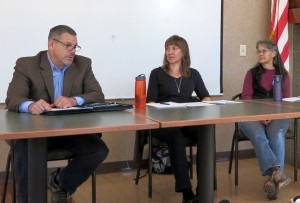
George Fink, Anjanette Hoefer, and Mary Bennington talk Oct. 21 about transit in Tahoe for recreationists. Photo/Jessie Marchesseau

George Fink, Anjanette Hoefer, and Mary Bennington talk Oct. 21 about transit in Lake Tahoe for those accessing trails. Photo/Jessie Marchesseau

This month’s Tahoe Talk was the first in a two-part series to be continued Nov. 18. The speaker panel consisted of Bennington; George Fink, transit system program manager for Tahoe Transportation District; and Anjanette Hoefer, supervisory civil engineer with the U.S. Forest Service. David Reichel, wilderness education coordinator for LTCC, acted as the moderator.

Bennington echoed what the other two panelists had said before her: there is a lot of opportunity here for public and private shuttle services.

Fink focused his short presentation on the importance of public transit and the need for it here in Lake Tahoe, in addition to the need for some changes to our existing system, such as a way for buses to transport more bicycles since an increasing number of riders are bringing their bikes along. (TTD is considering purchasing bike trailers to pull behind the smaller buses). He also discussed issues with transportation funding. Getting dollars for transit is difficult in general, but there are a number of circumstances at work in Tahoe which make it even harder.

Government money for transit is unpredictable, at best, and unquestionably inadequate. There are federal, state and local taxes allocated to transit uses, but they don’t add up to enough to make significant improvements to systems nationwide, and definitely not here in Tahoe.

Tahoe is unique in its transit needs for a number of reasons: first of all, the basin is located in two states, five counties and one city. No individual jurisdiction wants to pay for the transit services in other counties, and California doesn’t want to pay for transit in Nevada and vice versa. This makes funding public transportation from one side of the lake to the other complicated as it crosses so many boundary lines.

Another issue unique to Lake Tahoe is the huge lake right in the middle of the community. There is no central area or hub where everything disperses from like there is in Mammoth, Park City or Breckenridge. Recreation opportunities are located all along the highway that encircles the lake. As a result, adequate transportation to trailheads and recreation areas requires covering a lot more miles.

And finally, there is the issue of only about 50,000 people living in the Lake Tahoe Basin and somewhere in the neighborhood of 400,000 using the facilities. Tourism drives the local economy, but most tourists are not residents. Therefore a lot of the people using the roads and transportation services are not paying into county funds used to finance them.

But, Hoefer pointed out, not all transportation has to be provided by government services. Offering shuttles to and from popular trailheads could be a commercial opportunity for local businesses. She said the Forest Service is looking into creating some sort of permitting system for such services between its trailheads.

“With the public transportation, as you can see, there’s limited funding,” Hoefer said. “We can’t get people from everyplace within the basin to the trailheads they want to be. And there’s an opportunity for commercial providers to provide that, and we want to help work on ‘what does that look like, and how do we do it?’”

The floor was also opened to the 30 or so people in attendance to ask questions and share ideas. Some of the other suggestions/topics touched on included a shuttle to Echo Summit and/or Echo Lake, a Fallen Leaf Lake shuttle, a scenic bus or trolley tour encouraging tourists to ride rather than drive all the way around the lake, a ferry system, how to inform tourists of public transit opportunities, what to do about parking lots for people riding these shuttles, how to get more bikes on buses, and possible ways to get money for implementing any of these ideas.

There is also another side of the issue to consider: would public transit and easy access to trailheads cause overuse of certain areas and trails, ultimately damaging the forests and environment in the long run? It’s a question which can only be answered when and if any of this actually comes to fruition.

Part 2 of the Tahoe Talks Brown Bag Lunch Series on Transit: What’s in Store for Transit North and South? will be Nov. 18, noon-1:30pm in the Aspen Room at LTCC.



Opinion: Collaboration keeps plant from being endangered

By Joanne Marchetta

Lake Tahoe has been recognized for another important conservation success. Our region’s proactive, collaborative strategy to protect Tahoe yellow cress, begun almost 15 years ago, is working so well that the plant does not need additional protections under the federal Endangered Species Act.

This conservation success story is yet another example of epic collaboration – how unparalleled partnership and collaboration are getting things done at Lake Tahoe. In this case, protecting a unique wildflower species that once teetered on the brink of extinction has avoided the need for additional federal protections that would have regulated many private homeowners as well as many public recreation areas.

Joanne Marchetta

Joanne Marchetta

Tahoe yellow cress is a flowering perennial plant that grows only along Tahoe’s beautiful, and popular, sandy beaches. Patches of the wildflower must spread and shift with the ever-changing water levels of our lake. The flower is found nowhere else in the world.

U.S. Fish and Wildlife Service this month announced its decision not to list Tahoe yellow cress as a federally endangered or threatened species after an extensive review found previously identified habitat threats no longer pose significant risk to the health and well-being of the species.

Over the last 10-plus years, those habitat threats to Tahoe yellow cress have been managed and successfully reduced by the broad group of federal, state, local, and private sector partners on the Tahoe Yellow Cress Adaptive Management Working Group. This group has protected the plant and its habitat with a comprehensive conservation strategy that was first put into action in 2002 to keep this unique and rare Lake Tahoe wildflower from disappearing forever.

That conservation strategy has been successfully implemented. So much so that in announcing its decision, the Fish and Wildlife Service, said, “The efforts of the Lake Tahoe area working group and its technical team and the partnership they’ve built over the past decade to protect this unique plant have truly exemplified the most basic function of the Endangered Species Act – to protect and conserve ecosystems and the species that depend upon them. They have continued to raise the standards for the next generation of conservation and convinced us that Tahoe yellow cress has a bright future on the beautiful shores of Lake Tahoe.”

That success has not come easily, and it has involved the dedicated and coordinated work of many partners at Lake Tahoe, including regulatory and land management agencies, private property owners, and the public.

Members of the Tahoe Yellow Cress Adaptive Management Working Group include California Department of Fish and Wildlife, California State Lands Commission, California State Parks, California Tahoe Conservancy, League to Save Lake Tahoe, Nevada Division of Forestry, Nevada Division of State Lands, Nevada Division of State Parks, Nevada Natural Heritage Program, Tahoe Lakefront Owners’ Association, U.S. Forest Service, U.S. Fish and Wildlife Service, and the Tahoe Regional Planning Agency.

Protecting Tahoe yellow cress and its habitat is one of the goals of the environmental improvement program, the collaborative capital improvement program that TRPA manages to restore Lake Tahoe’s environment and improve recreational opportunities. More than 50 public and private partners work together to prioritize and implement projects through the EIP, including projects to protect Tahoe yellow cress.

This broad group of stakeholders saw the problems facing Tahoe yellow cress and formed a collaborative working group to take on the challenge of protecting this imperiled wildflower species in its one-of-a-kind home here at Lake Tahoe. By partnering and working together we have protected Tahoe yellow cress and its habitat, collected and germinated seeds to plant new populations of the wildflower to increase its range, and educated people about this plant and the importance of protecting it while enjoying Tahoe’s beaches and natural areas.

This decision by the U.S. Fish and Wildlife Service shows that our partnership and collaboration are working and that our conservation strategy is sound. Members of the Tahoe Yellow Cress Adaptive Management Working Group recently updated that conservation strategy and have agreed to continue to implement it.

We agree with the U.S. Fish and Wildlife Service that Tahoe yellow cress has a bright future at Lake Tahoe. But this conservation success story also shows there is a bright future for partnership and collaboration at Tahoe. And partnership and collaboration have proven time and time again to be what is most needed to find common solutions and solve many more of our environmental challenges at Tahoe.

Joanne Marchetta is executive director of the Tahoe Regional Planning Agency.


Weight gain possibly tied to later bedtimes

By Nicholas Bakalar, New York Times

There may be a link between later bedtimes and weight gain, new research suggests.

Researchers studied 3,342 adolescents starting in 1996, following them through 2009. At three points over the years, all reported their normal bedtimes, as well as information on fast food consumption, exercise and television time. The scientists calculated body mass index at each interview.

After controlling for age, sex, race, ethnicity and socioeconomic status, the researchers found that each hour later bedtime during the school or workweek was associated with about a two-point increase in B.M.I.

Read the whole story


Snippets about Lake Tahoe

halloween·       Douglas County Parks and Recreation is hosting a free Halloween Carnival at Kahle Community Center in Stateline on Oct. 31 from 4-6:30pm for all ages.

·      Tahoe Paradise Resort Improvement District’s board meets Oct. 22 at 6pm at the park.

·       Author Luis Alberto Urrea is part of the Writers in the Woods series at Sierra Nevada College on Oct. 23-24. He will give a free reading Friday from 7-9pm, and conduct a workshop Saturday from 9am-noon. The cost of the workshop is $50. Go online to register.

·      Tahoe Arts Project, which is in season 29, is having an online fund-raising drive.

·     A memorial service for South Lake Tahoe police Officer Mark Hounsell and his wife, Jeanne, will be Oct. 24 at 11am at LifePoint Church, 1095 Stephanie Way in Minden.


Suspect in drive-by shooting named

Sam Tovar

Sam Tovar

South Lake Tahoe police are looking for Sam Tovar, 32, in connection with a drive-by shooting last week.

Officers searched a mobile home park on Oct. 20, but did not locate the suspect.

Tovar — who also goes by Primo and David Angeles — is a suspect in the Oct. 14 shooting of a 19-year-old South Lake Tahoe man near Ski Run Boulevard and Highway 50. The victim was shot in the leg.

Anyone with information is asked to call the South Lake Tahoe Police Department at 530.542.6100 or Lake Tahoe Secret Witness at 530.541.6800.

— Lake Tahoe News staff report


Study: Western wildfires threaten water supplies

By Bill Theobald, USA Today

WASHINGTON — The risk of severe wildfires in the West also threatens the region’s increasingly scarce water supply, a study finds.

The study, released Wednesday by the American Forest Foundation, highlights that wildfires are not just a public lands issue. Private and family lands also are at high risk, the study found, and much of that land is in critical watersheds.

“Unless we figure out how to treat all the lands … we are all at risk,” said Tom Martin, president and CEO of the foundation, noting that efforts to maintain healthy forests as a fire-prevention measure have focused mostly on public lands.

He said the foundation, which promotes stewardship by family forest owners, launched the study because it wanted to learn more about how the two biggest issues in the West right now — water shortages caused by extreme drought and the severe wildfire season — are related.

Read the whole story


Placer County tries to spur tourist development

Place County this week took steps to make it easier for developers to build lodging for tourists.

The Board of Supervisors on Oct. 20 approved the North Lake Tahoe Town Centers Economic Development Incentive Program and Implementation Plan.

“The program seeks to build more certainty into the development and permitting processes, reducing the risk to investors interested in projects in the North Tahoe communities,” the county said in a press release.

One of the big problems with development in the Lake Tahoe Basin is that the Tahoe Regional Planning Agency has thwarted a traditional free market as well as the ability of jurisdictions to put in normal zoning laws by creating commodities out of tourist accommodation units and commercial floor area.

South Lake Tahoe has plenty of TAUs, but not much CFA, while the opposite is true for Placer County. It is so bad Placer has been in the business of buying hotels in the city so it would have TAUs for developers.

TRPA is working on a pilot program to convert TAUs to CFA and vice versa.  That was not brought up at this week’s meeting.

TRPA per the Regional Plan also wants to keep development – new or renovations – in town centers. For Placer County, this means Tahoe City and Kings Beach.

Tahoe City and Kings Beach do not have a wealth of choice for tourists to stay. To help spur development Placer County has incorporated the proposed Tahoe City Lodge into its environmental documents that are being created for the Tahoe Basin Area Plan.

The lodge is a 120-unit hotel on 3.1 acres that is being proposed to be built across from Commons Beach on Highway 28.

But there are other locations that want to benefit from the new program.

Alex Mourelatos of Mourelatos Lakeshore Resort in Tahoe Vista told supervisors the program should include smaller projects outside of town centers.

Under the program, Placer County would buy and bank tourist accommodation units and make them available to developers who meet certain criteria. Initial funding to do this will come from capital and transient occupancy tax reserves and the county’s general fund.

— Lake Tahoe News staff report


Food bank to distribute goods in SLT

The Food Bank of El Dorado County will be in South Lake Tahoe with its mobile food pantry, along with a free farmers market on Oct. 28 from 10-11am at the American Legion, 2748 Lake Tahoe Blvd.

El Dorado County residents who meet California Health and Social Services Agency Emergency Food Assistance Program income guidelines are eligible for the hand out. Income guidelines may be found online.

One allocation of groceries per family will be given out.

For more information on how to give or get help, call 530.621-9950 or email info@foodbankedc.org.


Public-land transfer proponents may have violated lobbying laws

By Joshua Zaffos, High Country News

The central organization that advocates for Western states to take over federal public lands, Utah state Rep. Ken Ivory’s American Lands Council, is apparently running roughshod over state legislative rules.

The Colorado secretary of state announced last week that it has “reasonable grounds to believe” the ALC may have violated state lobbying and disclosure rules for failing to report political spending or to register as a lobbyist. The ALC, which leads the West-wide movement to transfer federal lands to states’ control, emailed Colorado supporters this spring to build backing for a bill that would have created a county commissioner-led task force to study the benefits of public-lands transfer to the state of Colorado. (The Senate bill failed by one vote.) The ALC has ushered similar bills through nearly every Western state legislature, with varying success.

The notice of possible violations followed an April complaint from Colorado Ethics Watch, a nonprofit watchdog group.

Read the whole story