Nev. gathering comments on funding low-income areas

By Nicole Raz, Las Vegas Review-Journal

The Governor’s Office of Economic Development is accepting public comment on which areas throughout the state should be designated as Opportunity Zones.

The zones are low-income urban and rural areas where the federal government will provide tax incentives for private investment — by individuals or businesses — into Opportunity Funds.

Read the whole story


Homeless numbers drop in Placer County

Placer County’s homeless population decreased slightly compared to the previous year, according to county results from the annual point-in-time count published by the Homeless Resource Council of the Sierras.

A total of 584 homeless individuals were counted across the county, from Roseville to North Lake Tahoe. The count surveyed unsheltered and sheltered individuals. It was conducted by volunteers and county staff on the night of Jan. 24. By comparison, 663 homeless individuals were identified in the 2017 count.

Of adults who responded to detailed survey questions, 39 percent were chronically homeless, 41 percent reported having a serious mental illness, and 23 percent had a substance use disorder.

Point-in-time counts are not a comprehensive measure of an area’s homeless population, but rather snapshots from a single day that can be used to approximate broad trends. Officials say they are viewed as undercounts for a community’s yearly overall homeless population because many people may move in and out of homelessness throughout the year.


Rain swells Tahoe water bodies, minor flooding

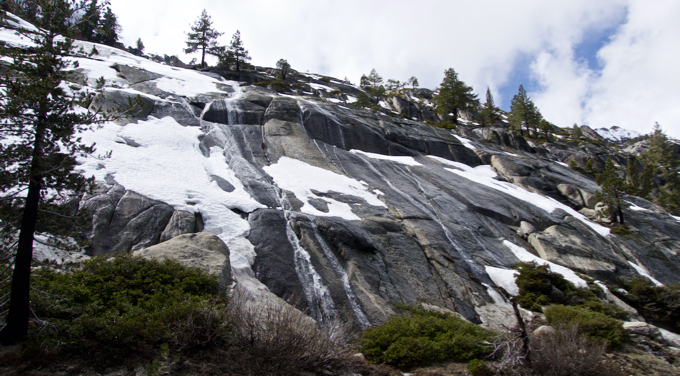
Water tumbles from the granite along Echo Summit on April 7. Photo/Kathryn Reed

By Kathryn Reed

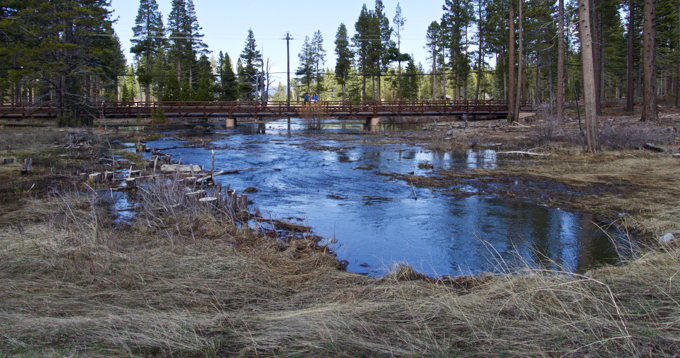
No rainfall records were set in the Lake Tahoe Basin, but what fell has caused creeks and rivers to rise, with standing and running water in unusual places.

Highway 50 going up Echo Summit has water spilling from the granite so fast that it looks like substantive waterfalls have sprung forth.

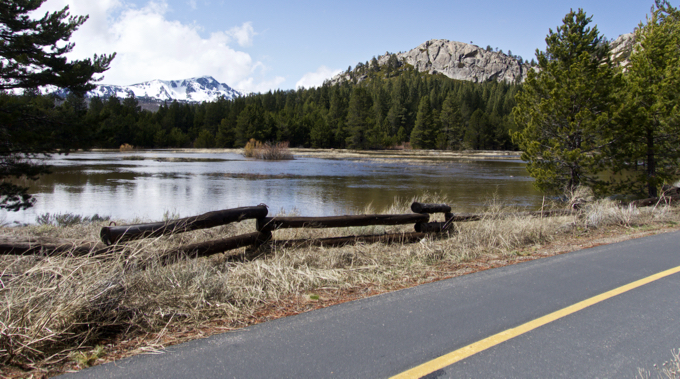
Water is close to the bike trail in Meyers. Photo/Kathryn Reed

A boulder about 8-feet in diameter fell into the passing lane of the highway just west of Sierra-at-Tahoe on Saturday. Caltrans was able to clear it fairly fast.

Water under the 15th Street bridge off Emerald Bay Road in South Lake Tahoe. Photo/Kathryn Reed
In the 24-hour period ending at noon April 7, the National Weather Service in Reno recorded the following rain totals:
• Echo Peak – 4.4 inches
• Alpine Meadows – 3.4
• Meyers – 3.02
• Homewood – 2.93
• Tahoe City – 1.71
• Incline Village – 1.35
• Lake Tahoe Airport – 1.34
• Carson City – 0.59

Jim Marino with South Lake Tahoe public works told LTN there are “no significant problems.”

Low lying area have standing water with some reports of floods.

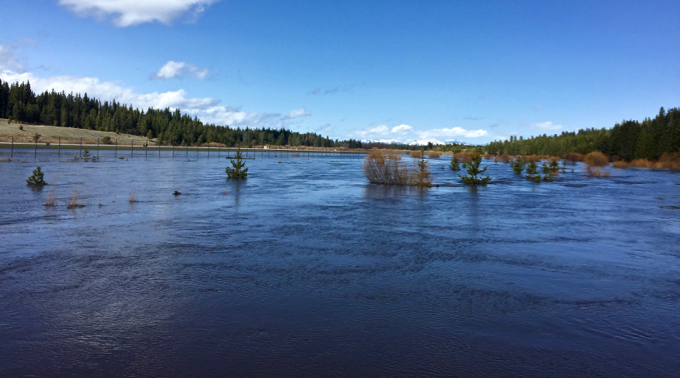
The Upper Truckee River is well beyond its banks in many locations and is raging like the American River in some locations.

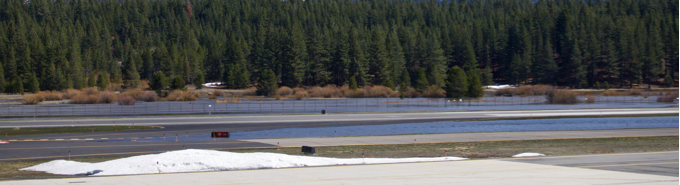
At Lake Tahoe Airport the runways are fine, but the river looks to be encroaching. Plus, the drainage basin between the runways is full, giving an impression it might be challenging for pilots to decipher where to land.

A spokesman for the airport said the only issue for pilots on Saturday was the wind. The water is normal in storms like this.

For some people all this moisture means fun.

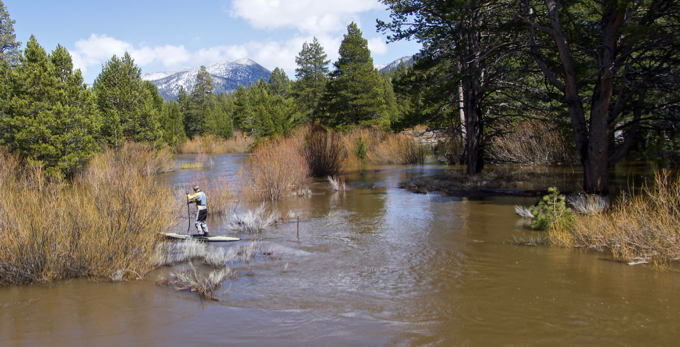
South Lake Tahoe resident Scott Valentine put his paddleboard in the Upper Truckee River on Saturday afternoon at Elks Club and floated to the Tahoe Keys. It took him about an hour to make that 5½-mile trip.

Scott Valentine starts his trek down the Upper Truckee River on April 7. Photo/Kathryn Reed

“There are some serious river hazards out there and running the river is not recommended. I have over 20 years as a professional whitewater guide, I know the river, I was wearing a dry suit, I understand how to read water, and know the consequences,” Valentine told Lake Tahoe News. “People should know that there is water flowing through trees and bushes, there is water flowing over the floodplain making route-finding difficult, there are strong currents and eddy-lines, and there are downed logs, fence posts, low bridges, and barbed-wire in the channel. It makes for an exciting run if you know what you are doing.”

He said the flow was 1,800 cubic feet per second.

It’s hard to know the true boundaries of the Upper Truckee River. Photo/Scott Valentine

The basin is expected to dry out for the next couple of days. Wednesday night into Thursday another system, and a cooler one, is expected to roll in.

It looks like there is more water than asphalt at Lake Tahoe Airport because the Upper Truckee River is well beyond its bank. Photo/Kathryn Reed

Mark Deutschendorf, meteorologist with the National Weather Service in Reno, told Lake Tahoe News, “It could produce some snow at the lake.”

He described this time of year as transitional, with the potential for a little bit of everything – sun, rain and snow, as well as temps warm enough for shorts and cold enough for fleece.


‘Sound blessing’ at Unity at the Lake

Unity at the Lake will welcome back Rene Jenkins as he offers a “sound blessing” on April 8 from noon-2pm.

This is a group sound healing ceremony requiring participants to simply sit or lie down and receive, using ancient indigenous instruments along with some sharing of their historic metaphysical attributes.

Jenkins is a ceremonial sound practitioner and healing performance artist, whose mission of service is to raise consciousness-vibration for individuals and for the planet through sound.

There is a suggested donation of $30, but no one will be turned away.

He will also be performing the music during Unity’s Sunday celebration beginning at 10am.

Unity is at 870 Emerald Bay Road, upstairs in suites 205-7, South Lake Tahoe.


Why weather forecasters still don’t always get it right

By Jeffrey B. Halverson

It was March 2017, and a winter storm named Stella promised to deliver up to a foot and a half of snow to New York City and parts of New Jersey. Officials pushed out blizzard warnings, suggesting the city was under imminent snowy siege.

But only 7 inches fell. Then-Gov. Chris Christie blasted forecasters. “I don’t know how much we should be paying these weather guys,” he said. “I’ve had my fill of the National Weather Service after seven and a half years.”

For anyone following the weather, forecasts for big storms are sometimes still roller coaster rides – with sudden shifts in track or intensity. As a meteorologist who forecasts for a large urban market, I can attest to the frustration. Why can’t we get it right every time, given this era of 24/7 weather data, dozens of satellite and sophisticated computer models? The answer lies in the quirks between the most popular forecasting models.

Battle of the models

Computer forecast models have become the mainstay of weather prediction across North America and many other parts of the world. Run on fast supercomputers, these sophisticated mathematical models of the atmosphere have gotten better over the past couple decades.

Human forecast skill has improved by approximately one day per decade. In other words, today’s four-day forecast is as accurate as a three-day forecast was a decade ago.

Forecasters in the U.S. routinely examine several models, but the two most discussed ones are the American and the European. When the models disagree on the track of a big storm, forecasters must often choose which they believe is most correct. This decision can make or break a critical forecast.

Most meteorologists agree that the European model is the most skillful. This was cemented in March 1993, when it correctly forecast the track and intensity of a historical Nor’easter. Called the “Storm of the Century,” the storm dropped a blanket of heavy snow from the Gulf Coast to the northern tip of Maine.

The storm was a milestone for what is termed medium-range forecasting, or forecasts made three to seven days out. The European model nailed the prediction five days in advance. That meant officials could declare states of emergency before the first flakes ever flew.

Fast forward to 2012, and the Euro was still making correct calls on big, dramatic storms. But this time, the lead time went beyond eight days. The storm was Hurricane Sandy, a massive Atlantic storm. More than a week in advance, the European model predicted an oddball westward jog in Sandy’s track, whereas the American model arced it eastward and harmlessly away from the East Coast. Score: another major victory for the European.

European versus American

Why does the European do so well, compared to its American counterpart?

For one, it’s run on a more powerful supercomputer. Two, it has a more sophisticated mathematical system to handle the “initial conditions” of the atmosphere. And three, it’s been developed and refined at an institute whose singular focus is on medium-range weather prediction.

In the U.S., the medium-range American model is part of a suite of several models, including several short-range prediction systems that run as frequently as every hour. The time, intellectual focus and costs are shared among as many as four or five different types of models.

The public has heard about the European model’s victories. But forecasters also know that the American model is quite skillful; it’s had its share of wins, albeit less high-profile. One of these was Winter Storm Juno, a 2015 Nor’easter that severely impacted the New England coast. Forecasters put out a dire warning for 24 to 36 inches of snow across all of New York City. In an unprecedented move, Gov. Andrew Cuomo shut down the subway system in advance, a move never done for an impending snowstorm.

This doomsday snow forecast was based on the European model. The American model predicted that the storm would be displaced about 50 miles farther eastward – shifting the big thump of snow away from the city proper. In reality, Juno took this eastward track and Central Park ended up with “only” 10 inches – a significant amount of snow, but not a crippling 2 to 3 feet. The unnecessary economic losses from the city’s shutdown were huge, putting meteorologists on the defensive.

In the case of winter storm Stella, the American model massively overpredicted snowfall. But a short-range model called the North American Model correctly predicted a storm track 50 to 100 miles farther east.

Predicting the weather

It all comes down to this: Weather forecasters have many choices for predictive models. The art of forecasting is based on years of experience spent with each model, learning the unique biases and strengths of each. The National Weather Service and other forecasting outfits have made strides in better communicating forecast uncertainty, given the inherent spread in the models. But it still often comes down to that gut feeling: European or American?

Researchers are taking steps to improve U.S. medium-range weather prediction by doubling the computer speed and tweaking the way the model ingests data. Companies like Panasonic and IBM have entered the arena with their own novel weather prediction models.

In the meantime, while we wait for the American model to “catch up” to the skill of the European, there are a few ways people can learn to decipher the forecast message. Individual model runs are less skillful beyond about five days; what you’re looking for is run-to-run consistency. Also, seek out forecasts that frame the predictive uncertainty. For instance, a forecast may suggest alternate scenarios for an upcoming snowstorm: a 20 percent chance of up to 15 inches, or a 20 percent chance that only 4 to 6 inches will fall.

Jeffrey B. Halverson is a professor of geography and environmental systems, and associate dean of the graduate school at University of Maryland, Baltimore.


EDC men accused of violating Clean Water Act

Two El Dorado County men face charges related to the federal Clean Water Act.

Christopher Young, 41, of El Dorado Hills is charged with conspiracy, 12 counts of tampering with monitoring equipment, two counts of unlawful discharge of industrial wastewater, one count of false statements, and one count of witness tampering.

The same indictment charges his brother, Jeremiah Young, 38, of El Dorado, with conspiracy, eight counts of tampering with monitoring equipment, and two counts of unlawful discharge of industrial wastewater.

A federal grand jury handed down the indictment on April 6 against American Biodiesel Inc., aka Community Fuels, and the Young brothers who were employees at its biodiesel fuel manufacturing plant in Stockton. The company is charged with conspiracy, 12 counts of tampering with monitoring equipment, two counts of unlawful discharge of industrial wastewater, and one count of false statements.

The indictment alleges that from March 2009 through December 2016, Christopher Young directed employees to tamper with pH, and flow and volume monitoring devices to allow Community Fuels to discharge hundreds of thousands of gallons of polluted industrial wastewater into Stockton Municipal Utility District’s sewer in violation of the company’s wastewater discharge permit and in violation of the Clean Water Act. Jeremiah Young allegedly participated in the conspiracy.

According to court records, the contaminants were methanol, glycerin, oils and fats, and acids.

The company was supposed to use tanker trucks to haul the wastewater to the East Bay Municipal Utility District wastewater treatment plant in Oakland.

If convicted, Christopher Young faces a maximum of 30 years in prison and a fine of $4.25 million, Jeremiah Young faces a maximum statutory penalty of 10 years in prison a fine of $2.5 million, and the company could be fined $4 million if found at fault.

— Lake Tahoe News staff report


K’s Kitchen: Black Bean, Veggie, Quinoa Medley

By Kathryn Reed

It’s good to be flexible in the kitchen. Sometimes I just start throwing things in a pan and am pleasantly surprised. Such is the case with this recipe.

One of the great things about quinoa is that it is a fabulous source for protein. It can easily be substituted for rice, which has little nutritional value – white rice in particular.

Using soy sauce eliminates the need to add salt, though I’m sure some people will still want to add some.

I liked using arugula because it has a distinct flavor by itself. It’s a green I first came to love when I lived in Sonoma County and grew what seemed like bushels of it. It’s nice to see local grocery stores carrying it now.

For me, this dish was a meal unto itself. I loved having it warm, and then reheating as leftovers. But at room temp or cold would work too.

The arugula makes it seem like a salad, but it is so much more.

Black Bean, Veggie, Quinoa Medley

1 C quinoa

4 T olive oil

1 medium red onion, diced

1 yellow or orange bell pepper, diced

1 small tomato, chopped

¾ C mushrooms, chopped

1 T soy sauce

2 T lime juice

1 chipotle in adobo, minced

1 15 ounce can black beans, drained

½ C cilantro, chopped

4 C packed arugula

Cook quinoa according to directions.

In saucepan heat olive oil over medium-high heat. Sauté onion and pepper until soft. Add tomato and mushrooms. Cook for a few minutes. Then add soy sauce, lime juice and chipotle. Add black beans. Let simmer for at least 5 minutes. Add cilantro. Let flavors meld for a few minutes.

Place arugula in large serving bowl. Then add warm quinoa and veggie mixture. Stir all together and serve warm.


Program strives to break cycle of abuse

By Sarah Pond

Too many of El Dorado County’s children are growing up in homes plagued with domestic violence. Children’s continually developing brains are like sponges that absorb everything, good and bad. They see the adults in their lives modeling various behaviors, ultimately being their primary source of reference.

In a home environment where violence is present, the abusive behaviors become normalized to those who are the direct or indirect victim of such behavior. As a result, the children often exhibit symptoms of posttraumatic stress disorder (PTSD), somatic issues, and behavioral and relationship issues.

One program in El Dorado County, the Second Generation Project, is designed to aid in breaking the intergenerational cycle of domestic violence and helping this vulnerable population understand that the abusive behavior is not normal.

The Center for Violence-Free Relationships has a variety of programs that serve the residents of El Dorado County who are affected by domestic violence and/or sexual assault. One of the most influential of those programs is the Second Generation Project (SGP). SGP is a 12-week group tailored for children ages 8-12 who have been in homes where domestic violence has occurred. In a healing and therapeutic environment, children learn how to talk about their experiences, develop positive coping skills, meet other children with similar experiences, and participate in group activities that foster growth and development.

This powerful program includes sessions for children and adults that are facilitated by a social work professional and a domestic violence peer counselor. Children respond to SGP in different ways, some exhibiting change nearly immediately, while others may have a slower response. For instance, a previous parent who was a participant called after the first session and stated that she noticed immediate changes in her child. She shared that her child was more cheerful, cooperative, affectionate, and her child had asked for their favorite breakfast, which they hadn’t asked for in months. Another mother reported on an assessment administered at the intake that her child exhibited a number of behavioral and physical concerns. The total score for the average child on this assessment is below 47 and her child scored a 97. The mother reported that her child frequently experienced headaches, showed constant signs of sadness or unhappiness, consistently had a negative attitude toward others, and had frequent suicidal ideation. When the mother completed the mid-program assessment, her child’s score had dropped drastically to a total of 24, reporting that her child’s aforementioned symptoms had decreased significantly.

There have been many reports from parents and children alike that are similar to these two cases, sharing their enjoyment of the program, support from the other participants, and increase in confidence in sharing their thoughts and feelings. The Center is excited to share SGP with the community and is continually adjusting the program to ensure it meets the needs of the children. If you would like to hear more about SGP and the center, call 530.626.1450.

Sara Pond is a case manager with the Center for Violence-Free Relationships.


Tahoe rock climber shares her big mountain stories

By Terra Breeden

It’s not always about the summit. This is something rock climbers have to come to grips with.

Professional rock climber Emily Harrington shared her experiences of big climbing this week with an audience of nearly 50 at Blue Angel Café in South Lake Tahoe. The North Shore resident spoke of the triumphs and the peaks that still need conquering.

“Thanks to a lot of hard work and luck, I’ve had the opportunity to travel to some amazing places, but it was not without struggle,” Harrington said. “I get scared of the path I’ve chosen, and I worry about the longevity of my career.”

For Harrington, her rock climbing experiences would not be complete without the influence of the people she has met in the span of her career. She attributes her success to the friends and relationships she’s had over the years, saying they have shaped her life even more than rock climbing.
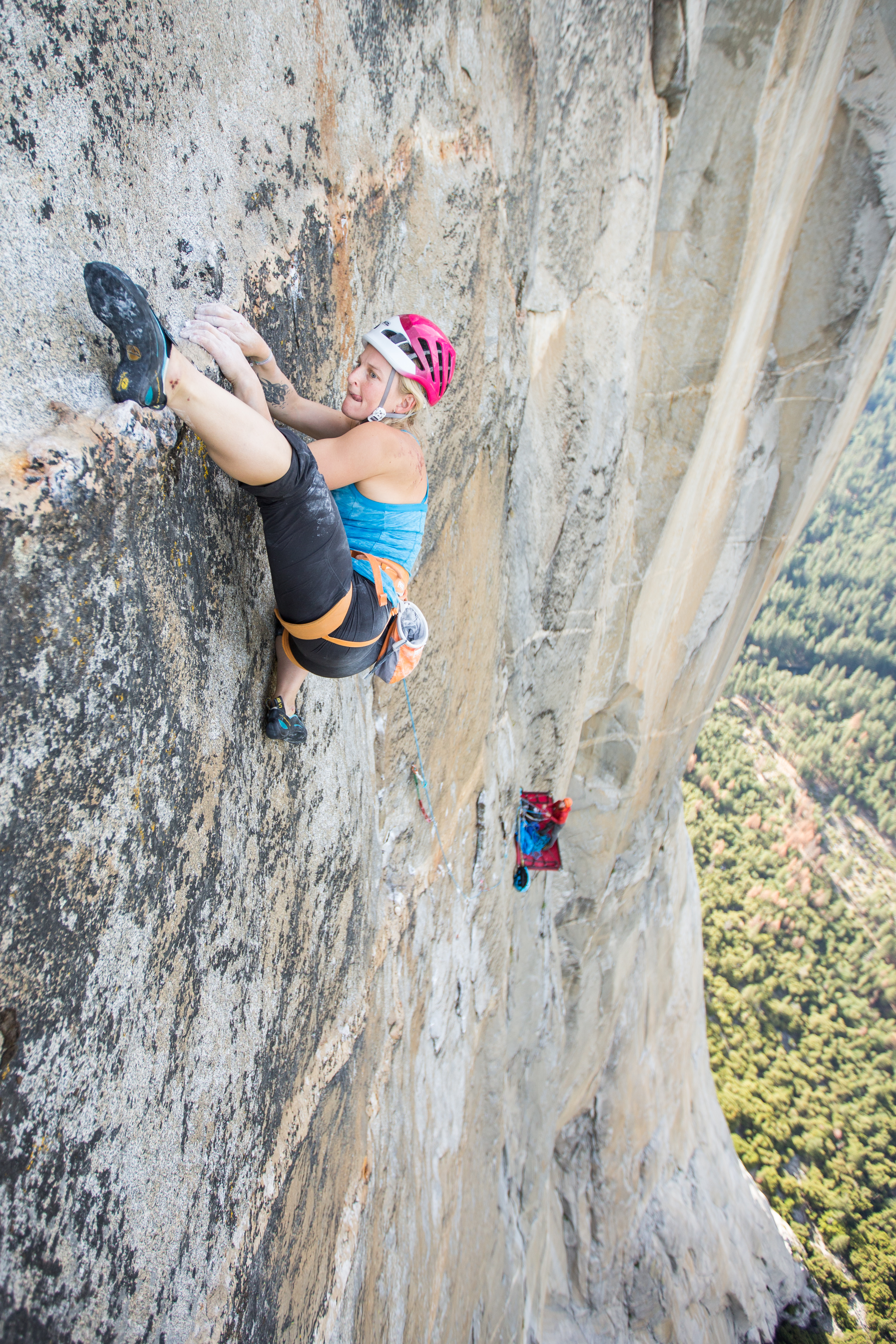
Emily Harrington on a climb in Yosemite National Park. Photo/Provided

During the presentation, Harrington talked about these relationships and how they have influenced her life, starting with her close friend Michelle Parker.

A professional big mountain skier from Squaw Valley, Parker joined Harrington and a group of other Tahoe skiers on an Ecuador ski-mountaineering expedition to Cotopaxi, the famed, snow-covered and active volcano. According to Harrington, the three-day journey up Cotopaxi was fraught with danger from high wind to mud-soaked roads and horrendous weather – “the worst in decades.”

But for Harrington, even though the group was deterred by conditions and was unable to ski the slopes of the volcano, because of Parker’s positive outlook, the trip was a success.

“Certain people make you feel like everything is a good time, even when it’s not,” Harrington said. “We are lucky to call her a Tahoe local.”

Harrington also talked about her relationship with her mentor and professional mountaineering-skier Hilary Nelson, who was just proclaimed National Geographic’s 2018 adventurer of the year.

In 2014, Nelson took Harrington on a 900-mile overland journey though Myanmar to summit Hkakabo Razi, one of the most remote mountains in the world. The duo took almost every mode of transportation available in the developing country to reach the mountain. They boarded a bone-shaking train known as the “death train” because it hadn’t been updated since 1948, they clung to the back of motorbikes manned by Myanmar locals down boggy, mud-soaked roads, and when the roads finally petered out, they walked. Harrington and Nelson hiked 125 miles through the Burmese jungle to get to Hkakabo Razi.

“I did not grasp what I’d signed up for; it was an expedition,” Harrington said. “Hilary is a purist at heart, and this was her adventure.”

When they finally reached Hkakabo Razi, the climbing conditions were horrible. The loose, crumbly rock threatened to come away in the climbers’ hands as they scrambled for the summit. It was dangerous. Harrington was scared and completely out of her comfort zone.

“If something happened, there was no rescue; it wasn’t like modern expeditions,” Harrington said. “We had underestimated the trip and the mountain. It was too technical and too dangerous, and we had pushed ourselves to the limits.”

Harrington and Nelson never made it to the summit. After a lot of discussion, they camped out on a ledge for a few days with the summit in sight and 1,000-foot drops on either side. Then turned back, hiking the 125 miles back to civilization.

“It sucked. But in the end, I realized that the trip was about patience,” Harrington said. “I hope that 15 years from now I will continue to have the drive and passion that Hilary does.”

Originally from Boulder, Colo., Harrington is a Tahoe-transplant who moved here six years ago to join her partner Adrian Ballinger, a professional mountain guide and founder of Alpenglow Expeditions, who Harrington met on Mount Everest in 2012.

“Thankfully, I’ve discovered that it does snow here and that there is amazing granite for climbing,” Harrington told the audience.

Blue Angel Café donated the space for the evening and it was awash in sultry, low lighting with a bar serving wine and craft beer to guests. The event was conceptualized by Lake Tahoe photographer Corey Rich.

“I met Emily when she was 15-years-old and immediately she seemed super smart, talented, and was an incredible athlete,” Rich told the audience. “In 16 years, nothing has changed.”

The 31-year-old Harrington is a sprightly, fierce woman with blonde braids coiled around her head. Although Harrington has claimed five national titles in rock climbing, summited Mount Everest, and free-climbed El Capitan in Yosemite, the talk wasn’t as much about her athletic career as it was about the people who have shaped it.

Harrington began rock climbing competitively when she was 11-years-old and has been pursuing the sport ever since, gaining world recognition for her technical climbing feats. Although she started as a gym-climber, over the years she has transitioned into outdoor climbing, ice climbing, and mountaineering.

“It’s because of these people that I keep believing in myself and have the courage to keep going,” Harrington said. “So I want to encourage others to get out and be uncomfortable and afraid, and find those things that forces them to grow.”

Harrington continues her adventures next week with a rock climbing expedition to Spain and plans to spend her summer climbing in Yosemite.
Letter: Local water agencies oppose drinking water tax

To the community,

A Lake Tahoe regional coalition of local water agencies including, Tahoe City PUD, South Tahoe PUD, North Tahoe PUD, Truckee Donner PUD, Northstar CSD, Squaw Valley PSD, and Alpine Springs County Water District strongly opposes a legislative proposal to tax Californian’s drinking water.

Introduced in 2017 as Senate Bill 623, it is called the Safe and Affordable Drinking Water Fee. It is aimed at residential and business water customers. This statewide water tax is proposed as a way to address a lack of access to safe drinking water for some people who live in rural, disadvantaged communities. We believe there are other effective solutions and appropriate funding strategies to address this important public health and social issue.

Your local, public water agencies are committed to providing safe and reliable water and support the intent of the bill. We understand the severity of the problem and the need for solutions. However, taxing Californians’ water is not the solution. The effect of the bill would essentially tax Californians for something that is essential to life, erode the affordability of water for local water users, turn hundreds of local water agencies into taxation entities that send money to Sacramento, impact families just above low-income thresholds, and would open the door to future taxes on water customers.

Most Californians have likely not heard of this proposed new tax. We believe our customers should be aware of this legislative proposal and our efforts to actively oppose it, unless amended to remove the water tax as a funding mechanism. Fortunately, we stand with a growing coalition of local water agencies across California who are pushing back against the proposed tax because it deprives them of local control and unfairly imposes a tax on a basic necessity of life, your drinking water.

For questions, contact your local water purveyor. Additional information can be found online.

Kurt Althof, management analyst Tahoe City Public Utility District