Growth — but not expansion — in U.S. Internet gambling market

By Wayne Parry, AP

ATLANTIC CITY, N.J. — Internet gambling is slowly growing — but not expanding — after 2 1/2 years of online betting in the United States.

Online gambling revenue is increasing in at least two of the three states that currently offer it — New Jersey and Delaware. The third, Nevada, doesn’t report Internet revenue separately.

But a hoped-for wave of expansion has not happened as many states sit on the sidelines and assess the costs and benefits of the nascent industry.

“Internet gambling revenue in Delaware, Nevada and New Jersey badly missed initial forecasts, which themselves were overly aggressive,” said Chris Krafcik, research director for Gambling Compliance, which tracks gambling legislation nationwide.

New Jersey Gov. Chris Christie’s administration, for example, had initially estimated Internet gambling would bring in $1 billion in its first year. It did about 12 percent of that.

“The negative PR that resulted, fair or not, really took the wind out of the expansionary sails,” Krafcik said.

San Francisco-based Gambling Compliance predicts either California or Pennsylvania will approve Internet gambling next year, followed by New York and Mississippi in subsequent years. In 2016, the group projects, nine states will consider legalizing it, though not necessarily act to approve it.

The industry still faces some nagging issues, as well as looming threats — including an effort in Congress to ban Internet gambling nationwide. The Restoration of America’s Wire Act has been introduced in both chambers this year, backed by billionaire casino mogul Sheldon Adelson, and could come up for a hearing next month.

New Jersey began offering Internet gambling on Nov. 25, 2013, and took in $122 million in its first full year. Over the first 10 months of this year, the Atlantic City casinos have already equaled that total, with their Internet gambling revenue up 17.6 percent from the same period last year.

Delaware won $1.4 million in fiscal year 2014; $1.8 million in 2015, and $500,000 so far this fiscal year, which runs from July through June.

Nevada stopped reporting Internet gambling revenue as a separate item at the end of 2014. Online poker, the only brand of online gambling Nevada offers, is just a drop in the bucket of the state’s $11 billion gambling market.

Online poker is the most popular form of Internet gambling, although the small number of states offering it has kept prize pools low. New Jersey has sought to partner with other states that might legalize it to offer larger, joint prize pools.

PokerStars, the world’s largest Internet poker site, will begin operating in New Jersey in the first half of 2016, and many industry executives expect it to grow the market, though how much remains to be seen. In March, Morgan Stanley cut its estimate of the potential U.S. Internet gambling market by nearly half, pegging it at $2.7 billion by 2020, down from an initial estimate of $5 billion.

At first, one of the main impediments to people getting online to gamble was funding their accounts. Many credit cards wary of running afoul of a law banning banks from funding illegal Internet bets were reluctant to process transactions, but that has changed. New Jersey says MasterCard is approving 70 percent of attempted Internet gambling transactions in the state, while Visa is at 62 percent. PayPal also recently agreed to participate.

From a legal and consumer protection standpoint, Internet gambling has proven to be reliable and transparent, said David Rebuck, New Jersey’s top gambling regulator. Technology to ensure a player is actually within the state’s borders have reduced false rejections — initially a problem — to a negligible issue. And it’s keeping most outsiders from gambling illegally: only two people were found to have successfully placed bets from outside New Jersey since 2013, Rebuck said. Officials confiscated the money in their accounts, totaling about $1,000.

In New Jersey, Internet gambling was seen as a lifeline to Atlantic City’s struggling casinos. Less than a year after it began, four of its 12 casinos went out of business. But for those that remain, Internet gambling often makes the difference between an up or a down month.

“The market was smaller than a lot of people predicted, but the market is growing pretty nicely now,” said Tom Ballance, president of the Borgata, Atlantic City’s top casino and its leading online winner.

Internet gambling has generated $6 million in earnings for the Borgata over the first three quarters of this year, Ballance said.

“In Atlantic City, $6 million in profit is not easy to come by,” he said. “We’ll take that anytime.”

Associated Press writers Michelle Rindels in Carson City and Randall Chase in Wilmington, Del., contributed to this story.
Letter: Need help finding stolen fishing equipment

To the community,

Horseshoe Bar Fish and Game Preserve, which is near Forestville, is devastated to announce that thieves broke into our storage area where we house our equipment for the Wounded Warrior Event that is held the first week in October every year. Finding out that someone felt they needed to steal from these veterans is heart breaking. It is like stealing from a church or organization that helps those less fortunate of our community.

This break-in will set us back many years as the amount of equipment they stole exceeds $25,000 and was not insured.  Much of the equipment has the initials HBP written on it. Only the veterans that attended our events or members of Horseshoe Bar Preserve would have equipment with the “HBP” letters printed on it. Some of the rods were made by Bill Carnazzo and had his name printed on the rods. Many of the waders had the size printed in black felt pen. If you see this equipment being sold, do not say anything or accuse anyone. Please contact us immediately at 916.205.6073 or the sheriff’s department and let them know you believe it may have been equipment stolen from Horseshoe Bar Preserve in Placer County Sheriff’s Office report No. 15-11343.

It has taken years to gather up all the equipment we need for the event.  Volunteers have put in hundreds of hours raising funds and helping to acquire the equipment that is needed to hold the event. We also provide the veterans with the same equipment when the event is over.  Each veteran is given a complete fly fishing outfit with all the flies and equipment needed to continue fly fishing including boots, waders, fly rod and reel, plus the vest/chest packs that have all the supplies needed to fly fish.  The fly boxes have over 100 flies in them to allow the veteran to fish anywhere in the country.

Over the eight years that this event has been held we have helped rehabilitate seriously wounded veterans by teaching them how to fly fish while staying in our campground along the river for four to five days. Literally all of the veterans who have attended our event have said that learning how to fly fish has changed their lives and their families’ lives in so many ways. As one of the vet’s wives said to me this year, “My husband looks forward to being able to go fly fishing every week, and when he returns he is a different person. You can see it in how he seems content and truly excited to tell me how he did and how he was able to forget about his injuries. Your program has changes our entire families’ lives for the better.”

Participating and volunteering in our event is incredibly humbling as you are involved in helping these veterans deal with a wide variety of physical and mental injuries.  It is one thing to hear about their injuries and another to actually live with the vets for five days. You get a firsthand view of seeing what they go through on a daily basis.  You also are humbled by their attitude and desire to be treated as if they had not been injured. Many of these vets refuse to use handicap placards in their cars because they do not view themselves as being handicapped, even though they are missing limbs and suffering serious nerve and brain injuries.

If you would like to help us replenish the equipment that was stolen, please contact us at hbp@surewest.net , 916.205.6073 or go to our website where you can make a donation. The 501-3C number is 27-4671121.

Thomas G.M. Bartos, president and founder Horseshoe Bar Fish and Game Preserve


CalPERS private equity investment fees: $1 billion

By Dale Kasler, Sacramento Bee

CalPERS on Tuesday released long-anticipated figures on how much it pays the companies that manage its private-equity investments: more than $1 billion in the latest fiscal year.

Pension fund officials said CalPERS earned a $4.1 billion profit from those investments.

The release came after the California Public Employees’ Retirement System was criticized by some in the financial community after acknowledging earlier this year that it didn’t know how much it was paying in management fees on its private equity portfolio.

Read the whole story


Mancuso not ready to retire

By Associated Press

Julia Mancuso of Squaw Valley went in for a simple hip surgery — if there is such a thing — and 51/2 hours later had a hip that was completely overhauled.

And one that now will allow the four-time Olympic medalist to race again, albeit not this season, but certainly pain free next year and almost as good as new by the 2018 Winter Games in South Korea.

Then, and only then, will she consider walking away — on her terms.

“I would never stop my career when I feel like it is being kicked when you’re down,” the 31-year-old said as her teammates trained at the U.S. Ski Team Speed Center in Copper Mountain. “It’s like, ‘OK, now that you’re injured, OK, just retire.’ Like, I would never do that. I want to be giving my best chance I can.”

Mancuso tried everything to get her right hip ready for this season, from injections to having a paralabral cyst removed in April. She went to Chile over the summer to test the hip, only to have the pain return.

Surgery was the only real option. There went her season.

The procedure was more complex than her surgeon expected. Fixed some cartilage damage. Cleaned up some bone spurs. Put more anchors in her labrum because there was a slight tear.

“I just had a lot of stuff repaired,” said Mancuso, who also had surgery on her hip in 2006.

She will be on crutches for eight weeks as she goes through rehab in nearby Vail and won’t return to the snow until perhaps the spring. Even then, doctors warned her that her hip probably will be about 90 percent of what it was.

“For me, 90 percent feels like a lot,” she said.

If she had to do things over again, Mancuso might have called it a career after winning a bronze medal in the super-combined at the 2014 Sochi Games.

“Then I could go out on top,” she said, laughing. “See ya later.”

Maybe that could happen in South Korea? After all, she has won at least one medal in her past four Olympic appearances, including gold in the giant slalom at the 2006 Winter Games.

“I’m really excited about the next Olympics and really excited about this adventure, having surgery and being able to work and train hard and reach my physical goals and be able to go out and compete,” she said.

Because lately that pain from her hip hasn’t allowed her to really be at her best. She can trace the trouble with her hip back to a wipeout in France when she was a teenager. She did the splits that day, possibly throwing her hip out of alignment.

“A nagging thing for a long time,” she said. “Last summer, I couldn’t hike and do things my friends can do. Just more motivation to take it easy and go slow.”


The stories of Placer County’s bridges

Placer County is retrofitting its bridges. Photo/Erik Bergen

Placer County is retrofitting its bridges. Photo/Erik Bergen

By Robert Miller 

For decades, cars, trucks, people, bikes and motorcycles have traveled the 117 bridges that are Placer County’s responsibility. From the iconic Foresthill Bridge standing 730 feet over the American River, to the simple, single-lane bridge over Yankee Slough on Dowd Road in rural western Placer County, they have a history.

While there are different reasons behind why the bridges were built, how they were built and their sometimes changing uses, they all have a common thread: engineers in the county’s Department of Public Works and Facilities keep a watchful eye on the structures and when warranted, add them to the list of bridges needing replacement or rehabilitation.

To ensure the county’s roadways are safe for all who use them, the county is continually prioritizing projects to replace or retrofit worn structures. With an average planned lifespan of about 100 years, many bridges are reaching, or have reached, the end of their planned service life. While that doesn’t mean they are unsafe or can’t continue to serve their purpose, it does mean that many of them are overdue for major overhauls – and at nearly the same time. In the last decade, 15 county bridges have been replaced and one was retrofitted. Projects to do similar work to another 14 are either underway or are in the planning stages.

Another commonality for the county’s bridges is how replacement and upgrade projects are funded. The 29 projects mentioned above have a combined cost of $220 million. Of that amount, 92 percent, or $202 million, is from state and federal funding. The county has parlayed about $18 million of local taxpayer money into $220 million worth of public works projects.

Jurisdictions typically use a 100-year bridge lifespan as the benchmark for bridge replacement and rehabilitation. Given the state’s aging infrastructure, for all bridges to meet the 100-year standard, the Federal Highway Administration estimates that about $1 billion a year is needed. The federal government’s annual allotment to California for bridge work is $300 million. While there is competition for funding, the county is judicious in applying for state and federal funding, focusing on those projects that are likely to secure funding.

Last year, the county completed the largest project in county history. Contractors retrofit and repainted the Foresthill Bridge to both improve the span’s integrity and increase its ability to withstand earthquakes and the elements.

The bridge was completed in 1973, after two years of construction. It is the highest bridge in California and the fourth highest in the nation.

Building the bridge was part of the Auburn Dam, a project that was started but never completed. Had the dam been completed, the bridge would have been the sole roadway to Foresthill and forestland beyond when the reservoir behind the dam inundated the canyons below. The three-year, $76-million retrofit and repainting project was done on a bridge that originally cost $13 million to build.

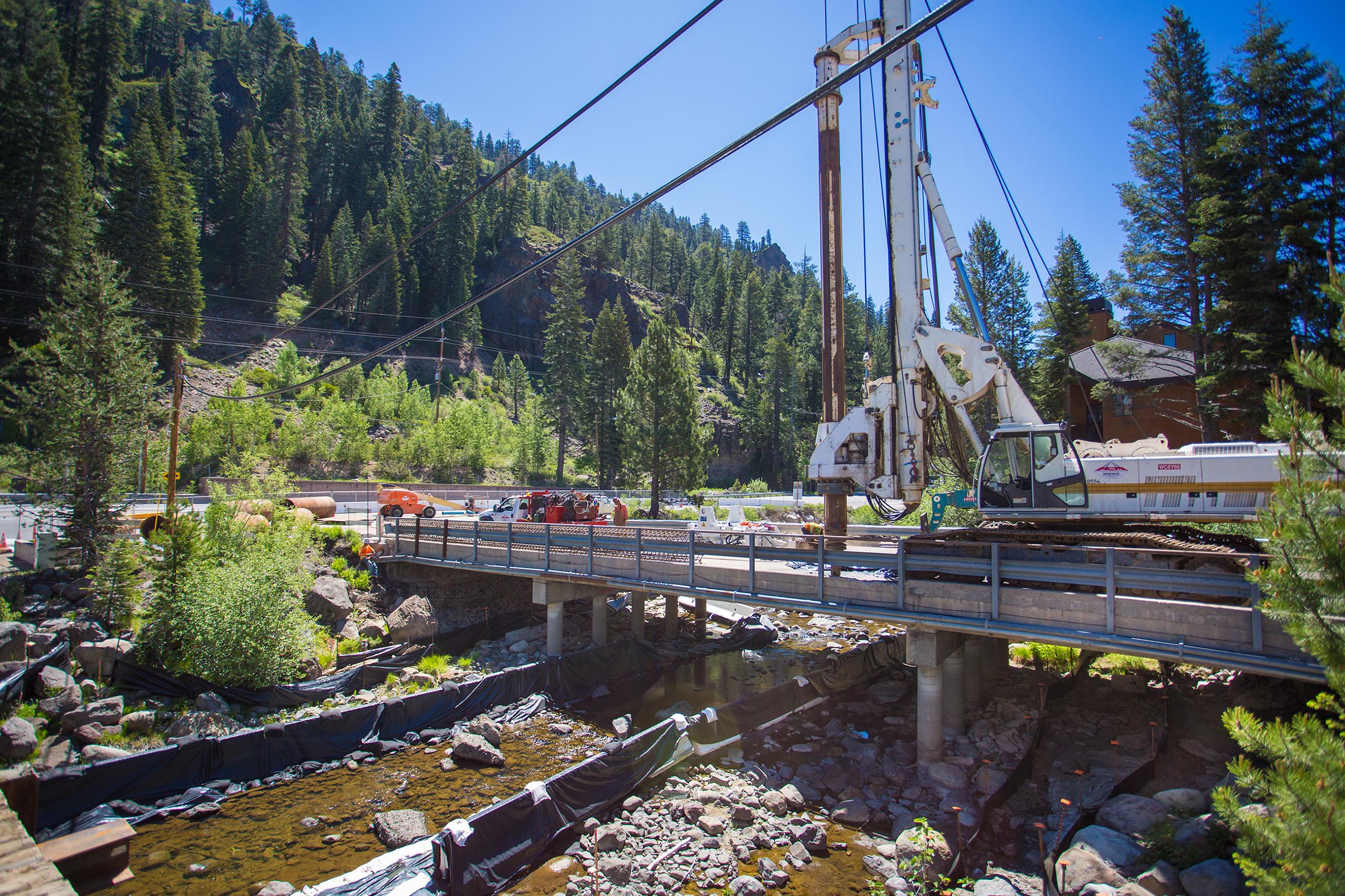
Alpine Meadows Bridge replacement. Photo/Erik Bergen

Alpine Meadows Bridge replacement. Photo/Erik Bergen

The retrofit project won numerous awards, including the prestigious 2014 Bridge Project of the Year award from the American Society of Civil Engineers, an award given to engineers by their peers.

Not all bridges in the county are as stunning as the Foresthill Bridge. But this bridge, like many throughout the county, was showing its age and wear.

Every bridge in the state is inspected at least once every two years by Caltrans.

Bridges in need of retrofitting or replacement can be categorized as structurally deficient or functionally obsolete. When bridges in the county fit into one or both categories they are moved up on the priority list.

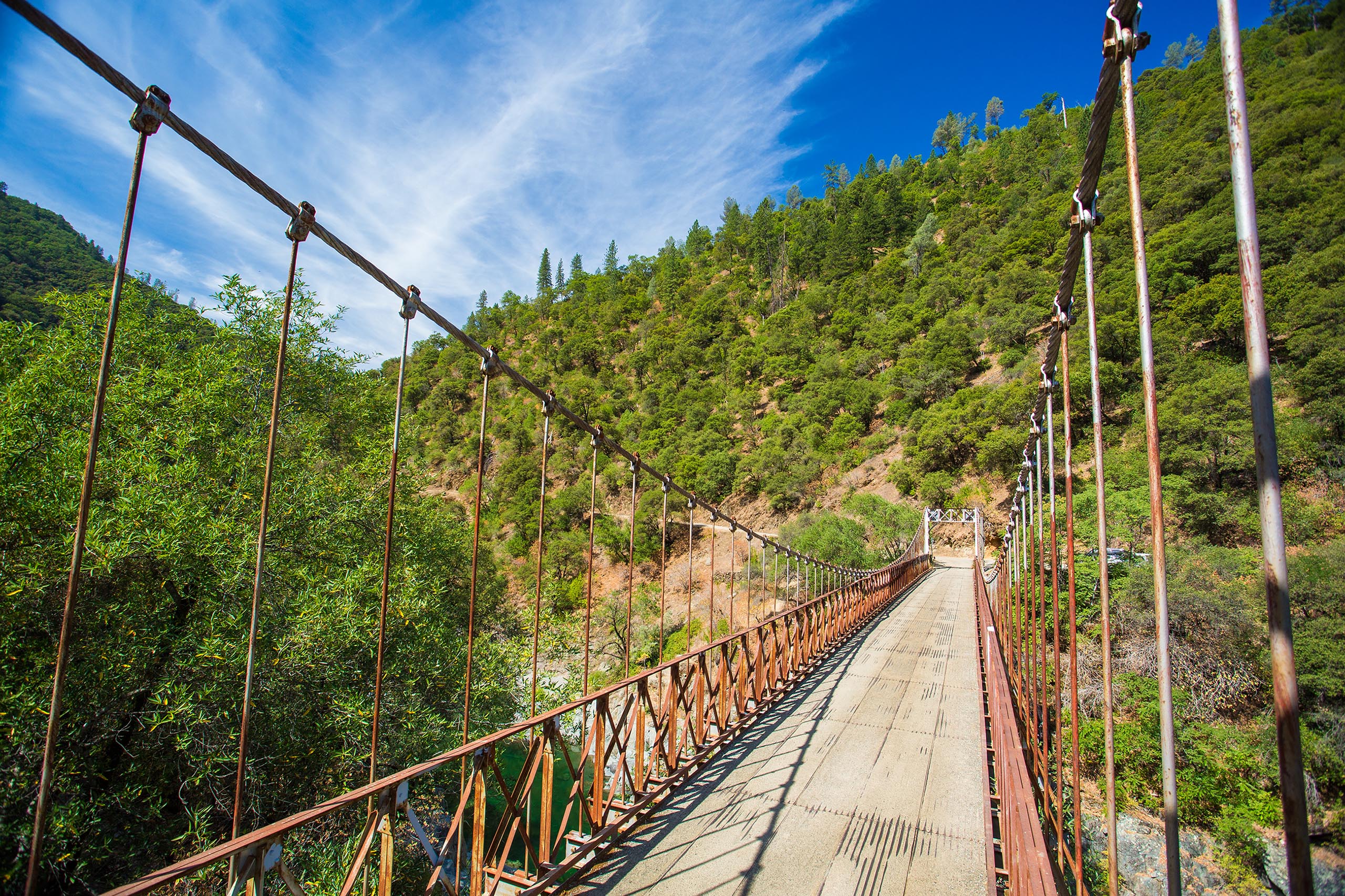
The single-lane suspension bridge at Yankee Jims sits a few feet above the North Fork of the American River on the twisty dirt road between Colfax and Foresthill.
Built in 1930, the suspension bridge was given low ratings by Caltrans after a careful analysis of all the bridge’s components.

Weight limit restrictions were then imposed. Placer County engineers, working with contract consulting engineers, used computer modeling to verify the load limitations and helped determine what future actions should be taken. The bridge, however, is safe.

Any bridge that county engineers feel is a hazard is closed to all traffic. A new bridge is now proposed to span the American River’s North Fork and will likely sit adjacent to the existing structure. County public works is still evaluating several designs and has not arrived at a final decision on what the new bridge will be and whether the existing bridge will remain, and for what uses.

Planning for bridge projects can take five years or more before construction begins. Not only do the engineering and design specifications have to be determined, but a project will also be evaluated for environmental considerations including cultural and biological issues. Building a new bridge can disturb a lot of soil. What may be buried in that soil is of concern for project engineers and it’s not uncommon for archeologists to be called in to evaluate uncovered artifacts. Most county bridges cross creeks or waterways that are home to endangered fish, frogs, snakes, birds and many other protected animals. County engineers lead the effort on each project to include measures that protect endangered species during construction. Additionally, utility lines are frequently attached to bridges. Moving these lines, whether they handle water, sewer, electrical or communications, can be extremely complicated.

The county board of supervisors recently approved an environmental monitoring plan for the Brewer Road Bridge replacement project. The bridge, a 73-year old structure that crosses the Pleasant Grove Creek waterway, will be replaced with a modern bridge that complies with current building standards. As part of the project, a county staff member will be assigned to the project to ensure that adherence to the monitoring plan is maintained. The plan calls for environmental protection measures for numerous creatures, including vernal pool fairy shrimp, steelhead, several reptiles, migratory birds and birds of prey.

Environmental documentation is a complex process. The county strives to be a good steward of the environment and every project will be scrutinized for any environmental impacts it causes. Although construction is not expected to begin until 2018, county supervisors recently approved initial environmental documentation for a project to replace a bridge on Gold Hill Road over Auburn Ravine. This is one of the first steps of many that the county will take before construction actually begins.

The existing Gold Hill Road Bridge is more than 85 years old and is at the end of its useful life. It is deteriorating structurally, and is too narrow for modern vehicles. In addition to environmental considerations, the county solicited public input for the project from nearby property owners and provided updates to a local advisory council. Using the input received, the design for the replacement will preserve the area’s rural character while providing safe access for residents, emergency vehicles, trucks and other users.

As population has changed in the county and technology has advanced, so too have the uses and requirements of roads and bridges. There are two aging bridges in western Placer County that exemplify these changes. One has already been replaced and replacement of the other is poised to begin.

The old steel truss bridge on Cook-Riolo Road in the western county was a single-lane structure built in the flood plain. Due to its age and the increased traffic in the area, Caltrans determined that the bridge is structurally deficient and functionally obsolete. The old bridge was susceptible to flooding, which rendered it impassible and created serious safety concerns. The newly completed bridge sits more than 10 feet above the old one, has multiple lanes and provides safe, protected areas for pedestrians and cyclists.

The Walerga Bridge replacement project, in western Placer County, is scheduled to begin in 2018. This project will build a significantly larger structure to accommodate both increased traffic and to replace an aging structure that periodically floods. The current two-lane bridge is about 125 feet in length. The new bridge will be more than 500 feet in length and approximately 14 feet higher, with barriers separating automobile traffic from pedestrians and cyclists.

The Bowman Road bridges in North Auburn are set to be reinforced in late 2015 with a heavy-duty polymer as part of rehabilitation and seismic retrofit.

A project to replace an aging bridge that is subject to harsh winter weather started this spring. The Alpine Meadows Bridge, an old structure over the Truckee River near Lake Tahoe, is the nexus of trails, pedestrian and bike paths, and a gateway into Lake Tahoe. The bridge spans a waterway that is listed as impaired by the Environmental Protection Agency. The replacement bridge will not only improve travel on the roadway, but will also have environmental benefits. Sediment is one of the pollutants that denigrate the Truckee River. The new bridge will have better drainage and catch basins that will capture silt and sediment, preventing its free flow into the river. Aesthetics will also be improved with a new design that will remove a pier that currently sits in the river, allowing for a more natural water flow.

Robert Miller works for Placer County’s Public Affairs Office.


Soda Springs gives new meaning to yellow snow

By Ryan Sabalow, Sacramento Bee

Should El Niño not live up to the hype and dump heavy snow on the Sierra, skiers and sledders at one resort could be gliding downhill this winter on snow that comes from an unusual source: purified water from the local sewage-treatment plant.

In a testament to how water-dependent industries are adapting amid California’s four-year drought, Soda Springs Mountain Resort this winter will be the first in California to use recycled wastewater for its snow-making system. The water will come from a nearby Donner Summit Public Utility District treatment plant that just received a $24 million upgrade.

Managers at the resort and water district officials assured customers Monday that the snow will be made from “pathogen-free, crystal clear,” highly treated water and that the recycled product actually will be safer than man-made snow transformed from surface water.

Read the whole story


Home ownership slide threatens American Dream

By Rick Hampson, USA Today

NORTH LAS VEGAS, Nev. — A decade ago, when 5,000 settlers a month were arriving in this valley, the suburban frontier moved out into the desert so fast the ZIP codes couldn’t keep up.

Then came the financial crisis, and the frontier stopped at places like the back fence of 4132 Recktenwall Ave.

The four-bedroom house there, meant to be owned by its residents, is today a rental. And the Severance family, meant to be owners, are its $1,365-a-month renters.

It’s all part of a national shift away from home ownership and toward renting.

The U.S. home ownership rate peaked 10 years ago. Since then it has dropped from more than 69 percent to less than 64 percent, where it was a half century ago, with each percentage point representing more than a million households.

Read the whole story


Museum exhibit captures Tahoe in its totality

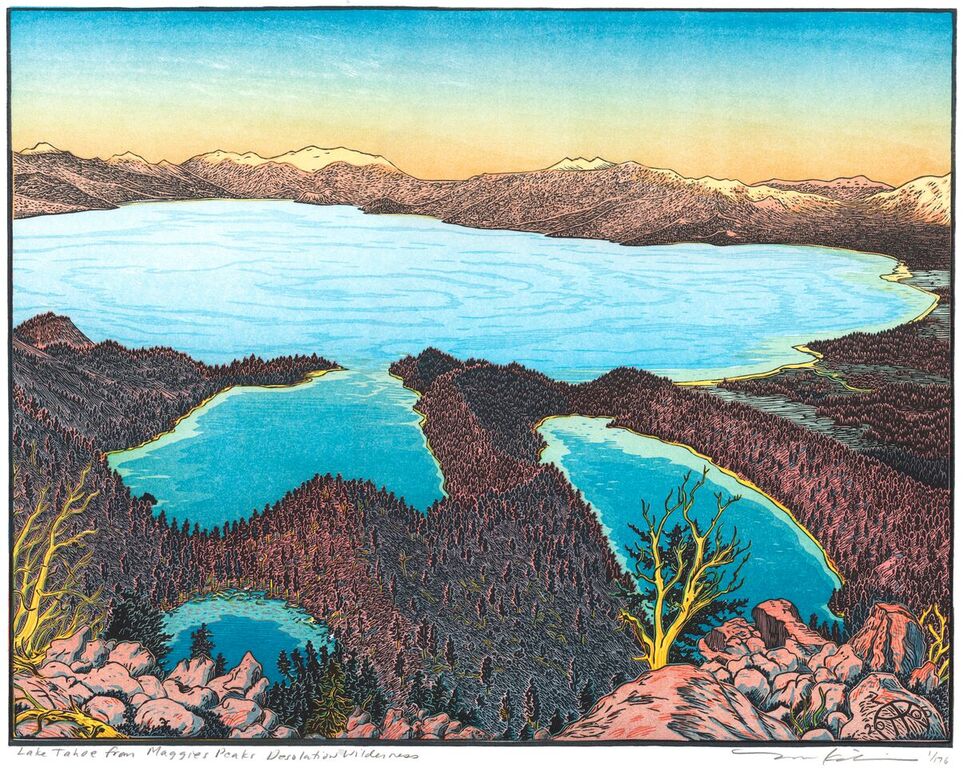
 "Lake Tahoe from Maggie’s Peak, Desolation Wilderness," 2006, Woodcut print © Tom Killion

“Lake Tahoe from Maggie’s Peak, Desolation Wilderness,” 2006, Woodcut print © Tom Killion

By Kim Wyatt

RENO – If you haven’t gone, go.

“Tahoe: A Visual History” at the Nevada Museum of Art in Reno is a stunning achievement. The first major exhibit of Lake Tahoe, Donner Pass, and the nearby Sierra is a remarkable collection of work by 175 painters, photographers, printmakers, cartographers, sculptors, architects, basket weavers and more, spanning two centuries at our favorite place. Five years in the making, with more than 400 objects amassed from public and private collections, this exhibit is not to be missed. And there is still time; it ends Jan. 10.

It’s fascinating to see everyday Tahoe scenes as they were envisioned by a who’s who of artists. Ten galleries showcase the works; there are also exhibits in the lobby and research library. I would recommend starting on the third floor in the Robert Z. Hawkins Gallery, where you will find Washoe pieces, and ending on the second floor at the Maya Lin installation. This gives a sense of narrative to the exhibit; we begin and end at the lakeshore, with our history unfolding in between. It’s a transformative experience.

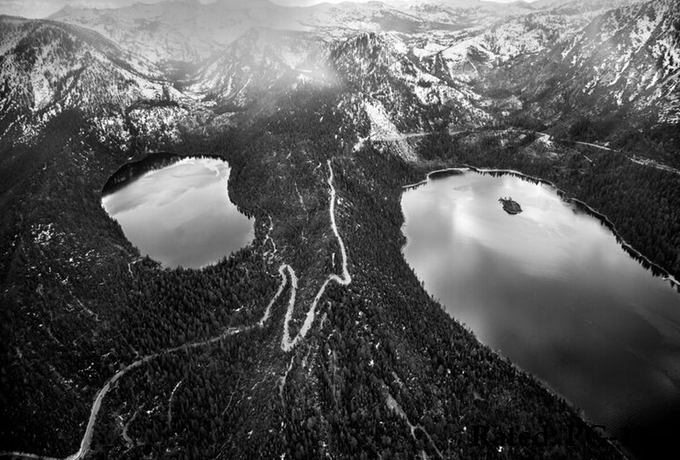
Michael Light, “Highway 89, Cascade and Emerald Lakes and Mount Tallac Beyond, Looking Southwest, South Lake Tahoe, CA, 2014,” Collection of the Nevada Museum of Art, The Altered Landscape, Carol Franc Buck Collection.

The Washoe exhibit begins with functional art: snowshoes, fishing nets, winnowing trays. But Louisa Keyser’s breathtaking degikup baskets are in the realm of fine art. Also known as Datsolalee, Keyser’s basketry was sought after for her innovation and skill. If you think you’re not into baskets, her artistry will likely change your mind.

Just around the corner, John C. Fremont and other early Western explorers kicked off Tahoe creative representation with the first surveys of the area. The resulting maps and sketches revealed to the world the features of Lake Tahoe and the surrounding Sierra. Map geeks will appreciate the detail of our first cartographers.

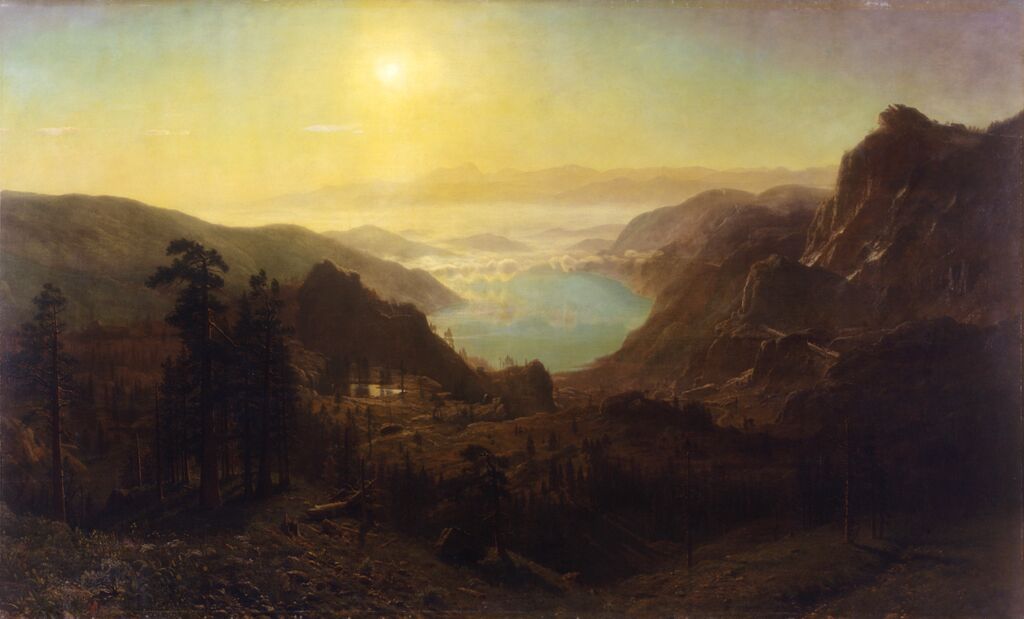
The precision of the maps is in marked contrast to the explosion of color in 19th century landscape paintings by Albert Bierstadt, Thomas Hill and others that anchor the “Golden Age” exhibit. Bierstadt, in particular, was among those to leave exactitude behind for intensity, lingering on clouds, light, and water.

As coach roads opened, artists began to widen their vistas. In the mid-1870s, trees begin to disappear from the works, or grow spotty—a reminder of the Comstock and its costs. By the time we get to Donner Pass, the presence of humans begins to dominate, with glimpses of dystopian landscapes. Idealism gives way to economics.

In “Surmounting the Summit: Donner Pass in the 19th Century,” the building of the transcontinental railroad is rendered in paintings and photographs that celebrate this engineering feat, with little of the blood and guts that went into the making of it.

“Harsh Realities” is one of the more powerful exhibits. In this, artists take on the history of the railroad with Chinese workers at the forefront. I won’t spoil the surprise of “Mountain of Fortune,” but it’s art that shocks and illuminates. There is also a fascinating rebuttal here by artist Zhi Lin to Bierstadt’s “View of Donner Lake, California (1871-72),” commissioned by railroad titan Collis Huntington.

Nick van Woets’ “American Pine Bark” ushers us into Lake Tahoe as seen through the eyes of timber barons: a source of 300,000 board feet removed daily. Tahoe as resource versus a source of inspiration creates a jarring feeling. There are familiar photos of denuded hills around Glenbrook punctuated by a few surprises like a Maynard Dixon sketch.

The second floor begins with tourism, and “The Rise of the Resort.” Once reliable transportation had been achieved via the railroad and steamers, visitors flocked to the lake and needed lodging. There is Tahoe Tavern memorabilia and advertising ephemera; oil paintings are replaced by posters and photographs, which then give way to architecture, impressionism and eclectic depictions of the region. Here, I loved learning about artists new to me, like Anne Brigman, Ruth Bernard and Frances Gearhart.

Albert Bierstadt, "Donner Lake from the Summit, 1873," Oil on canvas, 72⅛ x 120 3⁄16 inches, Collection of The New-York Historical Society, New York.

Albert Bierstadt, “Donner Lake from the Summit, 1873,” Oil on canvas, 72⅛ x 120 3⁄16 inches, Collection of The New-York Historical Society, New York.

The gallery leading to “Water Woes” is dotted with bright contemporary work by Phyllis Shafer, Gregory Kondos and Tom Killian. (If you’re into block prints, this exhibit is a real treat. I’ll be back for more.)

You’ll end at three commissions by Maya Lin, sculptor of the Vietnam Veterans Memorial in Washington, D.C. It’s a good place to wrap up the tour, as these pieces expand one’s perspective of the Lake Tahoe Basin, and our place in it.

There really is something for everyone in this exhibit. I’d give two to three hours; the museum has a café if you want to space it out. And you can get all of your holiday shopping done in the fantastic museum gift shop, which carries the work of local artists. You can also purchase the exhibit’s companion book, a 488-page tome that features the art in the collection and narrative that ties it all together. It’s a beautiful book, and would make a great gift.

This exhibit documents not only art and history, but also the utility of the lake: the Washoe used it for food, the Comstock for wood, the railroad barons for passage. This ambitious collection may very well inspire us to remain stewards of the lake, our lessons made visible.

Go. You’ll be glad you did.

—–

Notes:

  • Tahoe: A Visual History runs through Jan. 10 at the Nevada Museum of Art, 160 West Liberty St., Reno.
  • Admission is $10 general, $8 student or senior, $1 children 6-12; members and children 5 and younger get in free.
  • Hours: Wednesday-Sunday 10am-6 pm; Thursday 10am-8 pm. Closed Mondays, Tuesdays and holidays.
  • In conjunction with the exhibit, the museum is offering classes, lectures, and special events on making pine needle baskets, printmaking, Tahoe cartography, the history of the Chinese in the building of the transcendental railroad and more. For more information, go online.

Kim Wyatt is the owner of the independent press Bona Fide Books.


Opinion: We need an app to deal with politicians

By Joe Mathews

California-based companies like Uber and Airbnb claim to be remaking the world according to the values of sharing and the Silicon Valley magic of leveraging empowering networks. But in politics, they’ve disappointed, confining themselves to narrow lobbying for less regulation of their companies.

So I hereby—in all modesty—offer a proposal. To democratize our politics, we need an Uber that connects us more closely to politicians in the language they understand best: money.

Joe Mathews

Joe Mathews

The political-influence business—from campaign finance to lobbying—is an industry not unlike taxis or hotels: a regulated monopoly that serves too few people at too high a cost. Government is so complicated that, when we need something from it, it’s awfully hard to know, without an expensive lobbyist on retainer, whom to approach. And buying access has become more costly, so fewer people and interests account for more of our campaign donations.

In California, the problem is particularly severe, since we have so many billionaires who can buy access, and so few politicians. California’s state senators, for example, represent 10 times more people than the national average.

But don’t be frustrated. This is the perfect opportunity for a Silicon Valley solution!

Here is the key insight: Most of us don’t need to own a politician. But almost everyone has moments when it would be helpful to rent one. I propose a new app, Rent-A-Pol, to eliminate this inefficiency and allow millions of more people to buy the access and political favors they need.

It’s very much like hailing a ride from Uber. You have a moment when you require help from a politician or government official—maybe you’d like the right pol to write you a letter, return your call, fight a regulation that’s troubling your business, call a hearing to examine an important issue, or introduce legislation you’ve drafted. So you use the app to inform politicians of your needs, and then government officials and their aides let you know what the price will be—either in campaign donations or government fees.

Sure, we’d have to tweak existing laws that define and criminalize corruption, but the end result would be more efficient, and transparently honest, than the disingenuous status quo in which pols do what their big donors want, and everyone denies any causality.

The winners under Rent-A-Pol won’t just be the citizens who get what they want or the politicians who get more campaign money from a broader base. We all win, because of the system’s outright transparency. We’d be able to see the exact price it takes to accomplish certain official actions.

Rent-A-Pol would provide accountability for these transactions via a 360-degree rating system. Not only could citizens rate their rented pols—like you can currently rate your Uber driver—but pols would also be able to rate their influence-seeking customers, based on the reasonableness of their demands. These ratings are game changers—they should make citizens more reasonable and politicians more responsive to our needs.

And Rent-A-Pol would be good for the state budget. The data from the app’s transactions could guide state fiscal policymakers as they try to more accurately price the government’s own fees for various services. The state could also take a small cut of each transaction for the general fund (in a way similar to proposed taxes on marijuana favored by legalization advocates); that money might go to programs designed to boost citizen participation in the political process.

OK, let’s face one hard fact: Despite all the ways that Rent-A-Pol would serve to reform, some brain-dead good government types will yell and moan that this noble technological advance would condone bribery, and worsen the state of our politics. Instead of letting technology make our politics more responsive, these old-school types keep demanding new regulations, most recently with a new ballot initiative that could add to the costs of compliance and thus extend the influence-peddling monopoly of the rich.

I’m sorry, but the notion that government is not for sale is pretense. And everyone knows those anti-corruption laws we’d be tweaking are badly outdated—many of them are part of the same early 20th century reform movements as the health, occupational safety, and labor laws that Uber and Airbnb have so easily flouted. Plus, do you really believe a U.S. Supreme Court that says money is a form of speech is going to disallow the Rent-A-Pol app?

Silicon Valley’s revolutionary technologies are all about disrupting old industries by leveling the playing field, cutting out parasitic middlemen, and empowering individuals. That’s the promise of Rent-A-Pol; for one thing, the app has the potential to decimate California’s ever-growing lobbying industry.

The rich already buy what they want from government. Why not the rest of us?

Joe Mathews is California and innovation editor for Zócalo Public Square, for which he writes the Connecting California column.


Age is not a limiting factor to be a biker babe

By Billie Greer

I’m a 77-year-old Biker Babe. When I first started riding Harleys about 10 years ago, my children and grandchildren shrugged and said: “Well, that’s it. She’s finally gone crazy.”

What possessed me? I’m mild-mannered, wear Anne Klein’s designs, and actually read the Los Angeles Times every day.

Here’s how it began. As a member of Gov. Arnold Schwarzenegger’s staff, I gave a speech on the state budget at a downtown Los Angeles club. Afterward, up came a guy named Mike to ask if the governor still rode his motorcycle and to invite me on a ride with his group of friends. My response was: Not sure about the governor and no!

But he persisted and I got on my first Harley-Davidson—behind Mike—with a borrowed helmet to go to Santa Barbara for the day. My legs were shaking and eyes fixated on the speedometer. I wondered if I had truly lost my mind—even though it turned out to be a sparkling day at the beach.

It wasn’t long before I was riding with Mike, wearing a smile on my face and full-on leathers, the best brand of helmets, and Harley glitter shirts.

I am the only woman who travels regularly with the group  of 10 longtime friends. We bring wine and luggage and are grateful when friends and spouses, including Mike’s wife, accompany us by car. Otherwise, it’s just a few changes of clothes for me. Our group includes CEOs, attorneys, insurance brokers, and the like. Mike is a senior vice president at a major brokerage house.

There are some tattoos among the group—including a full upper body’s work of art—but not many. I’ve learned motorcycle culture has its own traditions. One is determining nicknames for everyone. It’s a group decision, but be wary. If you say you actually like the new name you’ve been given, you’ve blown it. No nickname for you. Mine? The First Lady—with the upmost respect given to Michelle Obama.

Riding has given me 10 brothers who look out for me, and I love them. Each ride provides a new adventure. The focus is on the moment, with daily distractions set aside. Mike and I are not “wired” for sound because talking to each other or blasting music gets in the way of what we are seeing and feeling.

I’ve never been scared, as Mike is one of the best on the road. However, the risks heighten the experience. Yes, we do lane split, but with intense concentration. And, I will not forget a Death Valley trip when Mike said, “Hold on.” That was the first time I experienced traveling well over 100 mph. I feel pretty cool for a great-grandmother.

Harleys are people magnets. Whenever we pull up to a gas station, someone invariably comes over to ask where we are headed. At one motel we stayed in, a staff member was fascinated with our group. Before waving us off in the morning, she turned to me and whispered, “You are one badass.” I had to verify with my grandchildren that this was a major compliment.

Motorcycling can even be good for your wardrobe. We rode through Madrid, a small community not far from Santa Fe. It’s a former ghost town, full of artists, hippies, and bikers. And, what did I find there? A dress that cost next to nothing, which I wore two months later as I walked the Emmys’ red carpet.

The coup de grâce for me was our trip this summer to Sturgis, a small town in the Black Hills of South Dakota, for the 75th annual Harley-Davidson rally. There we were, along with 739,000 other bikers, to celebrate motorcycling. The noise was unbelievable. There were American flag pasties on breasts of all sizes. There were bars, bars, and more bars—some large enough to accommodate bikers riding in on their motorcycles.

I was asked once if I felt safe while in Sturgis. My answer was a strong yes. Good planning by the rally organizers carried the day. Bikers were respectful, as were the police, who were present in large numbers. DUIs were down this year, and no major incidents occurred. However, there were 13 fatal accidents in the Black Hills area related to the rally that saddened all of us.

What’s next? More trips. Adventure. Fun. I can’t wait to experience the magic of the open road again—and to tell my new great-grandson that yes, your great-grandmother is definitely one badass.

Billie Greer is the co-founder of Greer Dailey, a public affairs consulting firm in Southern California. She served as a member of Gov. Arnold Schwarzenegger’s senior staff and is now a consultant on public policy issues.