DC commish says yes to gas tax, no to sales tax

By Anne Knowles

MINDEN — The Douglas County Board of County Commissioners this week voted to raise the gas tax to pay for road maintenance, but failed to pass a sales tax bump to fund a list of countywide projects.

The additional gas tax will make possible much needed road improvements, but the failure of the sales tax hike means the county may not be able to tap into some state and federal matching funds, and will likely struggle to find other ways to pay for each of the dozen projects.

Those proposed projects include total maximum daily load maintenance of catchments, including Kahle urban catchment, Logan Creek, Lakeridge and Lake Village general improvement districts and Cave Rock.
Burke Creek, Rabe Meadow, Nevada Beach sunset
Burke Creek in Stateline is one storm drainage that has had work done to it. Photo/LTN file                              
Projects/county costs to have been funded by failed sales tax: • Stormwater master plan/remediation projects — $500,000 • TDML maintenance of catchments — $450,000  • Highway 395 alternate route study — $1.8 million  • Road maintenance — $4 million • Turn lane on Highway 208 at Albite Road — $200,000 •Roundabout at Highway 88-Centerville Lane — $650,000 •Roundabout at Highway 756-Waterloo Lane — $400,000 • Heybourne Road extension — $1.5 million • Muller Parkway extension — $3.8 million • Ranchos connectivity path — $800,000 •Martin Slough trail, phase II — $60,000 • Pony Express trail, upper portion — $100,000                                                                                               Source: Douglas County
The price tag for the county portion of those projects totals $14.3 million. The sales tax increase, which had an expiration date, was expected to generate $15 million over its 10-year life.

But the total cost is much higher. Some projects would be paid in total by the county, but others, such as a study for an alternative route for Highway 395, would be completed with $7.2 million in additional funds from the state and feds that could be obtained if the county puts up $1.8 million.

“We have the opportunity to kill an awful lot of birds with a relatively small stone,” Commissioner Greg Lynn said at the Dec. 3 meeting while arguing in favor of the tax change. “If we don’t do this, each one will require a separate source now.”

The 5-cent per gallon jump in the county’s gas tax was passed with a vote of 4-1, with Commissioner Barry Penzel voting no.

“It’s a matter of principle,” Penzel said during a discussion before the vote. “When we’re talking about taking money out of taxpayers’ pockets we should at least ask their permission.”

The hike is expected to generate $900,000 annually.

Jim Nichols, county manager, said $600,000 would be earmarked for road maintenance.

The county has a huge backlog of road repairs, amounting to tens of millions of dollars, which it has recently been paying for through allocations from the county’s general fund.

“We have been robbing Peter to pay Paul and not looking to the future,” Commissioner Steven Thaler said. “Public comment seems to be evenly divided. The roads need to be fixed. This is a no-brainer to me.”

During public comment, resident Bob Ballou echoed Penzel.

“These taxes, while they may be for good purposes, ought to be approved by the entire public,” Ballou said.

Nichols said the remaining $300,000 raised by the higher tax would be leveraged to get state and federal grants for the South Shore Revitalization Project, locally known as the loop road.

“We’re not going to benefit from a lot of this,” said Linda Foster, county resident, during public comment. “We’re paying for improvements at the lake that helps the business up there.”

Several people spoke in favor of the tax hike, including Bill Chernock, executive director of the Carson Valley Chamber of Commerce.

“We need an infrastructure that works. Everybody is paying, businesses, visitors, local residents. And there is a rough correlation between how much you pay and how much you use the roads,” said Chernock. “And as far as the Highway 50 portion to make the loop road, that is going to happen. We can start building that fund now and get proactive. That money does flow down the hill.”

The commission also passed a plan for projects to be paid for by the defeated infrastructure sales tax.

The resolution on the projects was required before the commission could take up the tax itself, which was a 0.25 percent increase in the sales tax.

The resolution passed relatively easily, although there was some dissatisfaction with the agreed upon list of projects, even among supporters.

“I support the tax. Do I like the list? No, I hate the list,” said county resident Carlo Luri. “But is it fair? Yes, it benefits the most people in the county.”

Commissioner Lynn agreed.

“I don’t like the list either, but it represents a wide array of stakeholders and will transform the county if all of them can be implemented,” he said.

The tax itself needed a two-thirds majority or four votes. It failed, with Commissioners Doug Johnson and Penzel voting no.

“I’m not afraid of going out there and saying these are good projects, we need this tax,” said Penzel. “This doesn’t have to end the story. We can get it on the ballot.”

District Attorney Doug Ritchie was asked if there is time to get a ballot approved before the next election. He said there are several types of measures and it would depend on which one was pursued.

The three commissioners in support of the sales tax hike each tried to persuade their dissenting colleagues.

Commissioner Thaler said the commission was elected to make big decisions and that the voters had the power to repeal the tax hike.

“They’ve done it before,” he said. “If we don’t pass this, it dies.”

Commissioner Nancy McDermid pointed to Elko County, an equally conservative county, which this week passed a 0.25 percent increase in its sales tax.

“They are not a receiving county, they are a giving county,” said McDermid.

McDermid was referring to the fact that some taxes collected by Nevada’s 17 counties are pooled and redistributed through the consolidated tax distribution.

As a result, Clark, Washoe and Elko counties put in more money than they get back and the remaining 14 counties, including Douglas, receive more than they contribute.

“Now we’re going to hold out our hands while we let others tax themselves?” she asked. “How do we look at the people in Elko and say thank you for raising your taxes?”

Commissioner Lynn conceded it wasn’t an easy choice.

“The timing could be better. It is difficult to bring forward two taxes at once,” he said. “But the gas and sales tax are complementary and if we don’t do this, then shame on us.”

Vonn, Cook show athleticism in downhill

By USSA

LAKE LOUISE, Alberta – Lindsey Vonn (Vail) collected her 16th-career World Cup victory at Lake Louise in the first of two scheduled downhills, but the run was not without pure athletic spectacle to avoid serious disaster. Vonn clocked the fastest splits all the way to the midsection on course where she decided to take a little extra risk with a straighter line, and that’s where she nearly lost it all.

“I came in (to Fish Net) with a really direct line – probably a little bit too direct, and I caught my edge funny. I did the splits. I thought I was going down, then I somehow managed to stay on my feet,” said Vonn. “When I realized I was still in the course, I just got back into my tuck and tried to make up as much time as I could on the bottom. That was not planned. I should probably not do that tomorrow.”

Her smile in the finish area told the crowd that one didn’t come as easily as the final time indicated.

Vonn lost her 0.40-second advantage over Cornelia “Conny” Huetter of Austria with the critical mistake, but she recovered the lost time and added even more with precise gliding to the finish, ultimately outpacing the Austrian by a truly impressive 0.58 seconds.

For Vonn, the winningest woman in World Cup history, another victory at Lake Louise isn’t simply an additional tally mark on her record. She finds value in each and every race at the Canadian resort, even those that haven’t ended on the podium.

“I think last year’s win was probably the most significant for me coming back from two injuries and being able to win again was an incredible feeling. This year it’s just as incredible – I kind of feel old. All the other girls on the podium with me are very young,” noted Vonn. “I kind of felt relieved to be on the top step of the podium again today and to reassert myself as someone who’s not going away in the speed events.”

The 31-year-old speedster was flanked on the podium by two Austrians, the 23-year-old Huetter and 24-year-old Ramona Siebenhofer. It was Huetter’s second podium result of her career and the first for Siebenhofer.

Vonn’s teammate Stacey Cook (Mammoth Mountain) had an equally horrifying mishap at high speed when she caught her edge heading into Timing Flats, but she also pulled off a miraculous recovery and held on to finish in fifth.

“I was coming around the last corner, I was really feeling it and then all I saw was fence. I just kind of got caught up in some old tracks, and I was really just trying to let my skis go, and they went in the wrong direction. There are mistakes that you make from taking risks and there are mistakes you make from a bad plan. And this was a mistake from taking risks, so I have no regrets,” said Cook. “Typically the first race is always the weaker one for me. I like more runs on the track – that’s kind of my thing – I start having more and more fun. So hopefullytomorrow is solid from top to bottom.”

Other U.S. Ski Team finishers in the points included Laurenne Ross (Bend, Ore.) in 19, Alice McKennis (Glenwood Springs, Colo.) in 25, and Jackie Wiles (Aurora, Ore.) rounding out the scoring in 30. Breezy Johnson (Salt Lake City) who was racing her first World Cup race finished 41. Anna Marno (Steamboat Springs, Colo.) was 45.


Snippets about Lake Tahoe

library·      South Lake Tahoe Library’s Winter Extravaganza is Dec. 12 from 10am-noon, 1000 Rufus Allen Blvd. Creation stations will be set up with fun, easy to make, seasonal decorations suitable for all ages. Santa Claus is scheduled to drop by.

·      Lake Tahoe Unified School District’s fourth-graders will be using the city pool through Dec. 17. The pool will be closed to the public between 11:15am and 12:15pm.

·       Have a drink and a snack at Cafe Spice in Truckee while meeting and mingling with fellow slow food-minded friends. This is an opportunity to meet people involved in the slow food movement in Truckee-Tahoe. Tickets for the Dec. 10, 5pm gathering are $10 for a bite and a beverage. Cafe Spice is at 11421 Deerfield Drive.

·      In honor of its 50th anniversary, South Lake Tahoe created a commemorative 123-page book. It is available for purchase at City Hall (1901 Airport Road) for $25.

·       Royal Gorge cross country ski area is open.


Geminid meteor shower viewing and talk

Tahoe Institute for Natural Science and the Tahoe Rim Trail Association are making an excursion to Tahoe Meadows to see the Geminid meteor shower.

This annual meteor shower regularly puts on a display with frequent shooting stars throughout the night. It gets its name from its trail, which radiates from the constellation Gemini.

Representatives of Space Science for Schools will illuminate the mysteries of the night.

The event is Dec. 13 from 8-10pm. Bring lots of layers to stay warm and blankets. It is dependent on a clear sky.

For more information and to register for the free event, contact Sarah Hockensmith at 775.298.0067 or Sarah@TINSweb.org.


Douglas libraries hosting lego building contest

Douglas County Public Library is putting on a Winter Break Lego Building Challenge at the Zephyr Cove and Minden libraries between Dec. 14 and Jan. 2.

Prizes will be awarded to the first and second place winner in each age category. Children and adults may participate; one entry per person.  Children younger than 4 must use Duplo bricks. Winners will be announced Jan. 13.

The Lego Building Challenge is sponsored by the Friends of Douglas County Public Library.

Complete rules and entry forms are available online.


Reno-to-Vegas interstate in highway bill deal

By Associated Press

WASHINGTON — The House and Senate have reached agreement on a five-year, $281 billion transportation bill that would increase spending to address the nation’s aging and congested highways and transit systems, including an extension of the future Interstate 11 connecting Reno and Las Vegas.

The bill would put an end to the cycle of temporary extensions and threatened shutdowns of transportation programs that have bedeviled Congress for the past seven years, making it difficult for states to plan long-term projects.

A draft of the bill boosts highway spending by 14.9 percent and transit spending by 18.1 percent over the life of the bill, said Jeff Davis, an expert on transportation spending with the nonprofit Eno Center for Transportation.

Included in the bill is an extension for the future I-11, which as it currently stands would connect Las Vegas with Phoenix. Nevada’s Washington delegation, including Democratic Senate Minority Leader Harry Reid and Republican Sen. Dean Heller, has lobbied for an extension to Reno.

Heller said in a news release the inclusion of the Reno extension was a boon for the the state’s economy.

“Today’s news that the extension of I-11 was included in the final highway bill is a major win for our state,” Heller said. “Connecting Phoenix, Las Vegas, and Northern Nevada will spur long-term economic development, create jobs, and bolster international trade.”

But the bill still falls far short of the $400 billion over six years that Transportation Secretary Anthony Foxx has said is necessary to keep traffic congestion from worsening, and it puts off the difficult decision of how to pay for transportation programs in a way that’s sustainable for the long term. The federal 18.4 cents a gallon gas tax, the main source of Highway Trust Fund revenues, hasn’t been increased since 1993 and no longer is enough to cover annual spending on transportation programs.


Talk to focus on Tahoe’s prosperity

There will be a discussion Dec. 16 titled Uniting Tahoe’s Communities: Addressing Prosperity for Tahoe’s Residents.

It is free from noon-1:30pm in the Aspen Room at Lake Tahoe Community College

Heidi Hill Drum with the Tahoe Prosperity Center, Jesse Walker of New Economics & Advisory, and B Gorman with Lake Tahoe South Shore Chamber of Commerce will be the speakers.

They will delve into: What does a prosperous Tahoe look like? What does prosperity mean? How can we measure it? The Tahoe Prosperity Center mission is uniting Tahoe’s communities to strengthen regional prosperity. How does government, businesses and communities fit into that goal? What can we do to ensure Tahoe’s residents are prosperous?


Opinion: Prevention can save lives

By Adam McGill

Like all of you, I am heartbroken about the mass murders that occurred in San Bernardino on Dec. 2. All of us were victimized. Of course, not at the same level of the victims’ families, the San Bernardino community, or the courageous first responders, but nonetheless many of us sensed some level of security slip away and more fear crept into our lives.

The frequency and severity of these events is cause for serious concern. Despite what the federal government may ultimately determine in San Bernardino, one of the principal objectives of terrorism is to instill fear in people and that objective was easily accomplished.

Adam McGill

Adam McGill

In Truckee, your police department and its public safety partners routinely plan, train, and drill for events such as Wednesday’s. I am very confident our staff would rise to the occasion and courageously respond to one of these horrific events and perform with valor. Our response would be heroic like the countless other police officers across the country who run toward gunfire on our behalf, but our response would not be the first opportunity to be courageous. That opportunity is reserved for you.

The first opportunity to be courageous most often occurs long before the first 911 call is made that someone is actively killing innocent people. In nearly every case whether it was a mass shooting or the Boston Marathon bombing someone was suspicious of the perpetrator’s activity before the event and those suspicions were suppressed by the witness(es) for one reason or another. The police can respond admirably and even save some lives, but the vast majority of the carnage will have already occurred before they arrive.

Police response and training for these events is critical, but the most important effort must be in the area of prevention. In addition to the police, this responsibility falls upon the shoulders of all of you.

For the last few years, the U.S. Department of Homeland Security has used the slogan, “see something, say something”. I believe we need to take it a step further – beyond “seeing” something. You must use all of your senses and instincts – report any questionable behavior whether we’re talking about true terrorism, workplace violence, or domestic violence, all can be equally as deadly.


Trying to triage or risk assess suspicious behavior on your own is woefully inadequate. The police are trained and equipped with resources not available to the general public. We have access to intelligence information and other tools to perform a thorough threat assessment of the suspect or situation. A threat assessment by the police does not automatically lead to public disclosures, arrests, or other visible police activity. Most often these investigations are very discreet with action only taken in situations that are imminent.

Reporting your suspicions to the police gives us the best opportunity to intervene and prevent a tragedy before it’s too late. We prefer you identify yourself so we can get the most accurate information about your suspicions, but callers can remain anonymous. Tips can be received in person, by phone, via email, or through our online tip system.

Tahoe Truckee Unified School District also uses a text a tip platform.

Living with the consequences of not reporting something or someone suspicious is a heavy burden that can be minimized by passing the information on to the experts and not either ignoring your suspicions or “investigating” on your own.

If you find yourself in an active killing event, you must act. If you can run away, run. If you cannot run, try to hide, but if hiding is not possible or you’re about to be discovered, you must fight back.

Remember, run, hide, fight! A training video on this response can be found online.

Adam McGill is police chief of Truckee.


Court strikes down criminalization of growing pot

By Elizabeth Warmerdam, Courthouse News Service

FRESNO — Citing state protections for marijuana cultivation, a California appeals court struck down Fresno County’s criminalization of marijuana growing.

Adopted in 2014 and amended this year, Fresno’s law prohibits the cultivation of medical marijuana and marijuana dispensaries in all zoning districts, and classifies violations of the ordinance as both public nuisances and misdemeanors.

The ordinance also limits the use of medical marijuana to qualified medical patients at their homes.

Though the Superior Court found that Fresno’s law did not conflict with the Compassionate Use Act and the Medical Marijuana Program, a three-judge panel of the Fifth Appellate District found Tuesday that the defendant has a narrow cause of action challenging the validity of Fresno’s classification of marijuana cultivation as a misdemeanor.

Read the whole story


El Niño not a big deal, according to Lake Tahoe area public works and utility employees

January is usually when the brunt of an El Nino strikes Lake Tahoe. Photos/LTN file

January is usually when the brunt of an El Nino strikes Lake Tahoe. Photos/LTN file

By Susan Wood

Despite the weather phenomenon known as the Christ child that is expected to pack a devilish punch to the West this winter, most Lake Tahoe-area government agencies are conducting business as usual in terms of preparing for it.

Public works departments from one end of the lake to the other beef up resources for winter snow and wind compared with other seasons, but this winter could bring what climatologists and other scientists refer to as a Godzilla El Niño. The weather phenomenon is characterized as a warming of the eastern Pacific and delivers wet storms to the California coast starting near Christmas. It often means more snow to the Sierra Nevada, but may translate to rain given the warmer air temperatures to match the ocean mercury. The large El Niños in 1982-83 and 1997-98 brought flooding (including at the Reno Tahoe International Airport), landslides and huge snow loads for residents, motorists and utility companies to deal with.

With that, Tahoe residents may hope the public agencies and utility companies are as confident about handling El Niño-driven storms as the weather forecasters and climatologists are about it bringing major weather events.

Caltrans crews in December 2010 work on a flooding issue along Highway 89.

Caltrans crews in December 2010 work on a flooding issue along Highway 89.

Latitude wise, Lake Tahoe remains at the cusp of wet versus dry, as is the case with all El Niños years. What might be different in what we’re seeing in recent years are the overall effects of climate change – which has shown to bring extreme weather events. The other unknown may revolve around California coming off an unprecedented four-year drought. Dry ground and heavy, sudden rainfall could turn into flooding in some areas.

With that, sand bags will be available for residents at stations on Rufus Allen Boulevard and Ruby Way through the city of South Lake Tahoe – the one government agency with some winter prep measures that are substantive this year compared to others.

Much of what the city’s Public Works Department is doing for the possibility of heavy snow or other precipitation comes in either a warning or behind the scenes efforts.

“What we want people to know is we can’t clear all streets immediately, but we’ll certainly try. If a big storm from El Niño produces the mother of a storm, chances are we’re not going to get to residential areas as fast,” Assistant Public Works Director Jim Marino told Lake Tahoe News. “We might go through and do a single pass.”

During these times, the city will focus on the major thoroughfares such as Al Tahoe Boulevard, Pioneer Trail and Tenth Street in its eight zones. It has a dozen graders at its disposal, placing four in storage because the harsh winter takes its toll on the machines.

“We’re really not doing anything out of the ordinary. I don’t project any changes (to what the city is doing) –just education,” Marino said.

He has a point. What’s new is the city is launching a web portal in which residents may report a public works-related issue in their neighborhood. For example, citizens may report online water drainage or snow removal issues at the foot of their driveways. An investigator will respond to the service request. From that, a work order is developed and tracked through email so the homeowner or stakeholder may see the progress of fixing the issue.

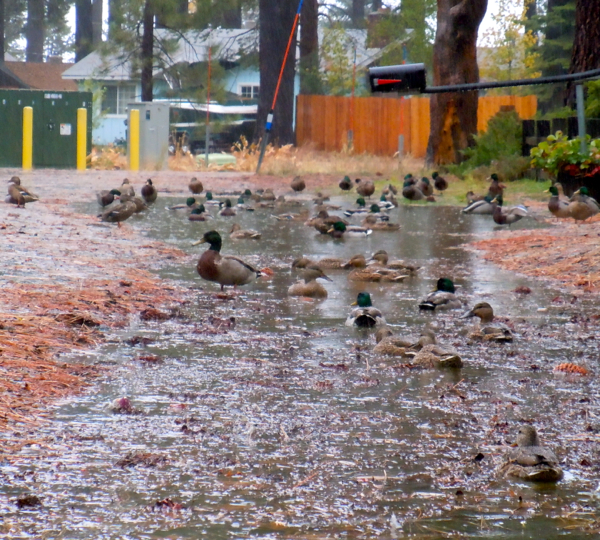
Some South Lake Tahoe streets have drainage issues every winter.

Some South Lake Tahoe streets have drainage issues every winter.

The other new measure for city snow removal involves fun and access – as in clearing the bike paths along Highway 50 and Al Tahoe Boulevard.

Fun and frolic aside, it’s still “business as usual” in preparing for winter for El Dorado County, according to Community Development Deputy Director Don Spear. The county’s snow removal equipment is ready and “on line for any storm that comes our way,” he added. Backhoes and culvert cleaning machines are also at the county’s disposal.

“We have hired extra help for snow removal in the Tahoe basin as we always do every year,” Spear said.

Douglas County maintains there’s limited responsibility for its public works-community development teams in the Tahoe basin. Private contractors plow county-maintained roads.

“While we have no set policies for these roads, snow plowing is provided as needed in response to weather and road conditions. The general rule is that the roads are plowed when 2 inches of snow are accumulated,” said Carl Ruschmeyer, who manages the road system in the Nevada county.

Placer County will bolster its roads with sand and salt, but nothing out of the ordinary.

“It’s not so different than what we’ve done in years past,” said Kevin Tabor, who manages the public works for the county along Tahoe’s West Shore. “(This is) because every winter has the possibility of being a bad winter.”

The states managing the roads relative to Lake Tahoe have put out their regular winter driving messages with a few added measures.

Like every year, the Nevada Department of Transportation started its winter preparations in August by readying more than 80 snowplows and other pieces of snow and ice equipment. More than 32,000 cubic yards of salt and sand have been stockpiled in the area.

The sand is combined with salt and wetted with brine (a water-salt solution) to create more dense sand that “helps reduce how quickly the ice forms and sticks to the road,” NDOT Assistant District Engineer for Maintenance Mike Fuess explained.

And although Caltrans officials admit El Niño “predictions do come to fruition,” the local district claims it “will be ready for any rain, sleet or snow coming our way.”

As usual for pre-winter prep, trucks have been converted to sanders and snowplows, loaders, graders, rotary blowers and tow trucks are at the district’s disposal. Drainage and culverts have been cleared and inspected. Sand, salt and brine have been stocked up. This year, more than 100 independent contract chain installers are signed up, and Caltrans seasonal workers have been hired.

“Our maintenance forces will be ready for any weather conditions this winter,” Andrew Brandt, deputy director of maintenance and traffic operations for the district, told Lake Tahoe News. “Our winter operation plans are in place to address everything from flooding on our valley highways to heavy snow on the Sierra roadways.”

Caltrans has also been busy replacing and installing new snow stakes along mountain highways, cleaning culverts and drainage ditches and trimming trees.

The latter represents a major concern every winter for utility companies like Liberty Energy, which services the California side of Lake Tahoe with electrical power.

“We’ve spent millions over the last four years trimming. We can’t eliminate all trees, but we’ve done what we can do,” spokesman Randy Kelly said. “We don’t know what this winter will bring. There’s been a lot of talk.”

There’s no beefing up of staff this year, but Liberty Energy is part of a mutual assistance network with other energy providers that share resources if one particular area is hard hit. Last year, wind storms created havoc in December and February.

“Wind is our biggest problem, but snow can be,” Kelly added. He used an example in which motorists have the potential of sliding into power poles.

Wet storms often cause trees to fall onto structures or across power lines.

Wet storms often cause trees to fall onto structures or across power lines.

Nevada Energy representatives have indicated the utility company servicing the electrical needs across the border that it plans to do nothing out of the ordinary compared to other winters.

“We’re always looking at the weather,” spokeswoman Katie Nannini said. “A big storm can happen no matter what the predictions are.”

And even if many agencies are conducting business as usual in reaction to extraordinary predictions about this winter, residents might not be judging from the reaction of some roofing companies on the South Shore.

Three local roofing companies’ answering machines were jammed with messages declaring they’re not accepting any more jobs because they’re too booked up.

“We’ve seen an uptick in business due to the forecast of El Niño,” Chris Marchesseault of AAA Roofing told Lake Tahoe News.

A few Sierra Nevada organizations have some concerns about what happens at the ground level.

The League to Save Lake Tahoe shared its most notable concern – lake clarity.

“A stormier winter would mean more stormwater runoff pouring through storm drains and into the lake. So if we get more storms, we’ll be spending extra time working with local jurisdictions and our volunteer pipe keepers to figure out which pipes are bringing the most pollution into the lake,” League Natural Resources Manager Zack Bradford told Lake Tahoe News.

The League manages a tour de force of volunteers who monitor water and debris buildup at drains and pipes. At a recent honorary volunteer dinner, the League hinted to its people to be at a heightened state of alert this year if El Niño materializes like some of the forecasts.

Stormwater managers in particular have more concern than perhaps most agency representatives because it encompasses their jobs.

Russ Wigart, who heads El Dorado County’s stormwater program, has recently expressed concern about a 100-year storm meaning 100-year runoff.

Ditto from Placer County’s water runoff specialist Andy Fecko, who recently deemed El Niño and heavy precipitation as “disastrous” in the Sacramento Bee in respect to West Slope concerns.

And for the feds, their main concern on the West Slope of El Dorado County is the King Fire burn area. Of the 90,000 acres engulfed, the U.S. Forest Service owns two-thirds. That span has Eldorado National Forest officials concerned of safety issues if heavy rainfall causes mudslides.

“The first year after the fire we expanded our capacity of handling erosion and channeling debris under the road,” Forest Service spokeswoman Jennifer Chapman said. She added the heli mulching as another measure on the steep slopes of where the fire burned in particular in the Brush Creek Reservoir and along 11 Pines Road.

“The main message to the public is anybody driving through the King Fire area should be particularly aware if it’s raining,” she said.

And with the early winter starting, the Forest Service has noted that avalanches have already occurred in the Carson Pass area because of the sporadic snow-rain combination as the Sierra Avalanche Center has reported.

“These things make the snow unstable,” Chapman said.