Placer County-A&A Motel deal falls through

Placer County is going to have to find another way to obtain hotel rooms.

After the property owners of the A&A Motel in South Lake Tahoe declined the county’s request to extend the pre-purchase contingency period to April, the county quashed the deal.

Placer needs tourist accommodation units for future projects in Kings Beach and Tahoe City.

The Tahoe Regional Planning Agency has created commodities at of hotel rooms. They have different values depending on the land the hotel is built on. Placer County has a minimal number of TAUs, while South Lake Tahoe has a plethora of them.

“The A&A deal was going to be an important part of our broader efforts to reinvigorate North Shore downtowns, and we’re disappointed that it’s not going to work out,” said Jennifer Merchant, Placer County deputy county executive officer for Lake Tahoe, said in a statement. “We’ll continue looking for more opportunities like this and are still fully committed to moving forward with incentivizing investment in the region.”

— Lake Tahoe News staff report


Nev. wants school choice case dismissed

By Associated Press

Nevada is defending its school choice program that offers parents several thousand dollars to send their children to private schools if they choose.

State solicitor general Lawrence VanDyke argued Thursday in a Clark County court that a case filed by the American Civil Liberties Union and Americans United for Separation of Church and State should be dismissed.

Clark County Judge Eric Johnson didn’t say when he would return with a ruling after hearing three hours of arguments.

VanDyke says the program isn’t unconstitutional because it doesn’t directly fund religious schools. He says the money goes to parents who spend it however they want on education.

Attorney Richard Katskee says there’s nothing wrong with parents choosing to send children to private schools but the state shouldn’t be paying for it.


Then and now: Changes to Bijou

Occasionally I find additional interesting photos about sites previously visited on Then and Now. Here is more pictorial history of the Bijou Center and Conolley’s in South Lake Tahoe:

Young' Bijou in the 1920s. Photo/Lake Tahoe Historical Society

Young’ Bijou in the 1920s. Photo/Lake Tahoe Historical Society

Bijou in the early 1900s included the Young Brothers’ Bijou Resort. Neighboring Conolley’s Resort was just to the west, also on the beach.

Photo/Del Laine Collection, Lake Tahoe Historical Society

Four-wheel drive was not an option in the 1950s. Photo/Del Laine Collection, Lake Tahoe Historical Society

By 1951, Young’s included a market, fountain, and the Bijou Post Office. Adjacent was the historic Bal Bijou dance hall built in the 1930s.

Photo/Del Laine collection, Lake Tahoe Historical Society

The Conolley enclave was leveled more than 40 years ago. Photo/Del Laine Collection, Lake Tahoe Historical Society

The last of Conolley’s buildings later housed Nel’s Tahoe Supply before being razed in the early 1970s. Today that site is the Beach Retreat and Lodge (formerly Timber Cove).

The Bijou Center as it looks in 2015. Photo/Bill Kingman

The Bijou Center as it looks in 2015. Photo/Bill Kingman

What was the Young Brothers Resort is today’s Bijou Center. CVS now occupies most of what was Bal Bijou.

— Bill Kingman


Christmas tree sales on the rise in EDC

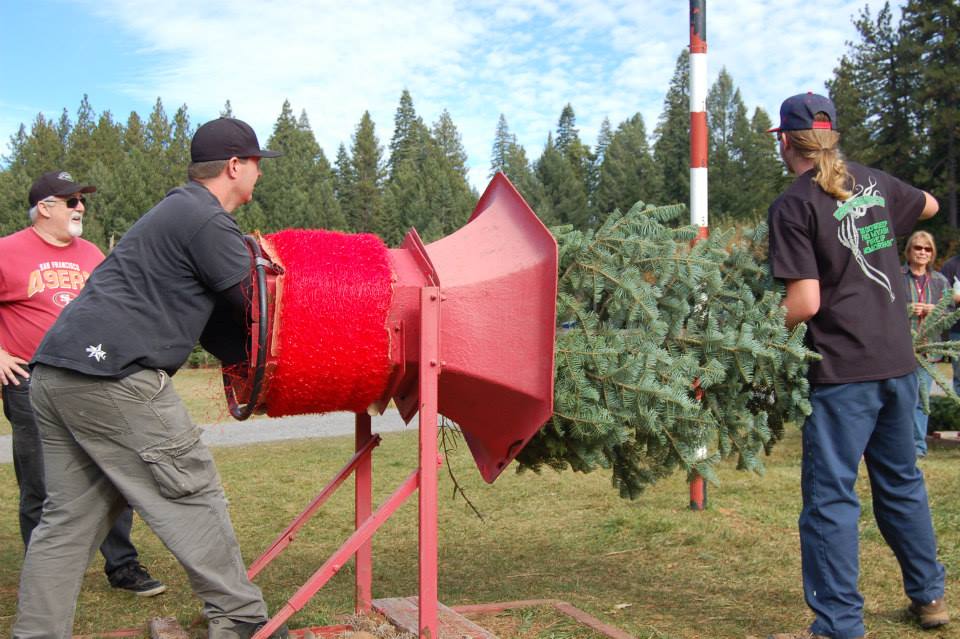
A tree gets wrapped at Harris Tree Farm in Pollock Pines. Photo/Harris Tree Farm

A tree gets wrapped at Harris Tree Farm in Pollock Pines. Photo/Harris Tree Farm

By Kathryn Reed

Christmas trees are big business in El Dorado County and the drought is not drying out the money train.

While the number of trees harvested in El Dorado County is going up, that is not true of the whole state. According to the National Christmas Tree Association, California harvested 383,940 trees in 2002, 119,855 in 2007 and 109,045 in 2012.

(Nevada did not record any trees for any of those years.)

In El Dorado County, the 36,100 trees sold in 2014 had a value of $2.166 million, while in 2013 the 35,808 trees sold were worth $2.148 million, according to the county’s 2014 Agriculture Crop & Livestock Report.

Dee Kobervig, president of the El Dorado County Christmas Tree Growers Association, said cutting down a tree at a farm is a growing business for her 32 members. (There’s about another 30 growers in the county who aren’t part of the organization.)

Photo/Harris Tree Farm Christmas tree tidbits: •Between 25 million and 30 million live Christmas trees are sold in the U.S. every year. •	There are nearly 350 million Christmas trees growing on farms in the U.S. •	For every harvested Christmas tree, one to three seedlings are planted the following spring. •	There are about 350,000 acres in production for growing Christmas trees in the U.S. •	There are close to 15,000 farms growing Christmas trees in the U.S. •	The top Christmas tree producing states are Oregon, North Carolina, Michigan, Pennsylvania, Wisconsin and Washington. •	The most common Christmas tree species are: balsam fir, Douglas fir, Fraser fir, noble fir, Scotch pine, Virginia pine and white pine. Source: USDA National Agricultural Statistics Service, National Christmas Tree Association

Photo/Harris Tree Farm
Christmas tree tidbits:
• Between 25 million and 30 million live Christmas trees are sold in the U.S. every year.
• There are nearly 350 million Christmas trees growing on farms in the U.S.
• For every harvested Christmas tree, one to three seedlings are planted the following spring.
• There are about 350,000 acres in production for growing Christmas trees in the U.S.
• There are close to 15,000 farms growing Christmas trees in the U.S.
• The top Christmas tree producing states are Oregon, North Carolina, Michigan, Pennsylvania, Wisconsin and Washington.
• The most common Christmas tree species are: balsam fir, Douglas fir, Fraser fir, noble fir, Scotch pine, Virginia pine and white pine.
Source: USDA National Agricultural Statistics Service, National Christmas Tree Association

“The demand is probably going to outweigh the amount of trees (in the county),” Kobervig told Lake Tahoe News. “A lot of people are getting rid of fake trees.”

Plus, people like to know where their tree came from and to be part of the process.

Those in the industry call it “farm to floor”, a take off from the “farm to fork” food movement.

Many of the smaller farms are already sold-out for this season.

The trees native to the area are red fir, Douglas fir, white fir, and cedar. But most of the farms grow other trees to accommodate consumers. These include noble, Colorado blue spruce, Swiss silver, Grant fir, and Fraser fir.

“The Nordman out of Norway is the No. 1 Christmas tree in Europe. It seems to be growing really well here,” Kobervig said.

The drought has had some impact on the farmers. Trees are not growing as fast without as much water as normal. Usually it’s the seedlings that require irrigation. Farmers have seen a higher mortality rate with the young trees. Spring rain is important to growth and that just hasn’t happened for the last few years.

“I will admit that some of my noble firs probably had more needle drop because of the heat,” Kobervig said. “Those are trees that normally grow in the Pacific Northwest.”

For Jane Harris of Harris Tree Farm she was watering her seedlings earlier than normal.

With trees taking between 10 and 15 years to reach a sellable size, losing a crop can be devastating.

“A few trees died, but at 4,000 foot elevation it is not as warm as some other farms,” Harris said of her Pollock Pines farm.

What helped this fall was having cold temperatures. This meant the needles were set, which is safer once the tree is cut – it won’t dry out as fast and be a fire hazard.

One thing tree farmers do to help sustain their business is employ “stump culture”.

Customers are asked to leave 12 to 18 inches of stump in the ground.

“That stump will grow a new Christmas tree, so when you cut a tree you are not really killing it,” Kobervig explained.

Plus, this method means less soil disturbance and trees growing faster than if it had started as a seedling.


Opinion: Welcome to California (Not!)

By Joe Mathews

When you cross from Oregon into California on Interstate 5, you will not be greeted by any welcoming party or grand gate.

The first sign of California civilization is the giant All Star Liquors store, in tiny Hilt. And if you enter California from Oregon along Highway 101, you’ll get the same greeting: All Star Liquors’ other outlet, in Smith River.

Joe Mathews

Joe Mathews

The store’s slogan? “The Party Starts Here.” Except, at California’s borders, the party starts slowly.

Over the past year, I’ve made a point of exploring California’s four land borders—with Oregon, Nevada, Arizona, and Mexico. What I’ve seen, again and again, would deflate the pride of the proudest Californian. Along these divides, ours is consistently the shabbier side of the border.

The juxtaposition is most jarring along our southern border with Mexico. Tijuana, one of the great urban success stories of North America, is dynamic and fast-paced, while, on the California side, the San Ysidro section of San Diego is shabby, with a particularly dismal McDonald’s. Farther east, Calexico, population 39,000, is dwarfed by the cross-border cosmopolitan sophistication of 700,000-strong Mexicali, with its restaurants, theater, and university.

California’s neighboring states also offer more welcoming border regions than ours.

Along the Arizona border, Lake Havasu City, with the London Bridge, outshines the settlements on the California side of the Colorado River. Farther south, Yuma, Ariz., population 91,000, sits across from not very much at all.

Along the far northern coast, Brookings, Ore., is a more prosperous place than beautiful, but poor, Crescent City. Inland, Ashland, Ore., home of the Oregon Shakespeare Festival, is far lovelier than Siskiyou County, which shows up in California newspapers mostly as the unofficial headquarters for a secession movement.  Along Interstate 15, the lights of Vegas outshine anything in the California border desert. Up in Tahoe, the streets on the California side of the lake are noticeably rougher than the Nevada thoroughfares. No place on the lake gleams like Nevada’s Incline Village, a haven for Californians avoiding Golden State taxes.

California’s unwelcoming Mexican border can be blamed on the U.S. government, which is held hostage by the political obsession with border security. Walking from California into Mexico takes less than five minutes. But I routinely encounter three-hour waits to cross back, because of federal border enforcement. Facing long delays crossing back from Tijuana, I recently paid $6 to ride in a van seven miles east to the less crowded Otay Mesa crossing. There it took 40 minutes to cross, and I then was picked up by the same van at a California-side sandwich shop and driven to San Ysidro so I could get the trolley back to downtown San Diego.

California has a reputation for regulation and big government, but at our borders, we’re the side that seems ungoverned. Needles, Calif., which borders Arizona (and is near Nevada), is one of the bleakest places I’ve encountered in the state. Trains rumble through at all hours, and trash litters the streets. The first business I encountered on crossing into town from Arizona was a medical marijuana dispensary.

That’s typical. On the borders, California businesses often profit from our permissiveness. That’s why liquor stores greet people who come across our Oregon border.

The Golden State has long been distinguished by some of the nation’s lowest taxes on beer, wine, and distilled spirits—a legacy of the liquor lobby’s might that dates back to the famous powerbroker Artie Samish, the self-proclaimed “Secret Boss of California” in the early 20th century. Voters tell pollsters they’d be happy to raise liquor taxes, but the alcohol industry’s spending and the state’s two-thirds requirement for revenue increases have frustrated those efforts.

The locations of All Star Liquors on the California side of the border capitalize on these facts. Online, the store boasts “savings of up to 70 percent or more over Oregon, Washington, and Idaho pricing.” The stores also have what customers assured me (I’m a teetotaler) is an incredibly large selection, and excellent customer service. When I dropped by, All Star Liquors staffers were loading up two customers’ vehicles, neither of which had California license plates, as part of the store’s “Road Trip Service” that allows people to order online and have the entire order ready for pickup.

The store’s website promises: “You don’t need to drive any further into California to find the best prices, best selection, and the friendliest staff this side of the Mississippi!”

That’s not exactly an endorsement of the Golden State. But it’s hardly surprising. Californians treat our borders like backwaters, even though millions of people enter California this way. We could do better by our border communities, and by our state, if we thought of them as front doors.

Joe Mathews is California and innovation editor for Zócalo Public Square, for which he writes the Connecting California column.


Niche sports and the doping you don’t hear about

By Warren Cornwall, Outside

Last January, at the center of a Las Vegas arena, Anderson Silva secured his legacy as one of the best mixed-martial artists in history. The 40-year-old Brazilian fighter battered his opponent in five rounds of hooks, jabs, and kicks in a fight put on by the Ultimate Fighting Championship.

But four days later, the Nevada Athletic Commission announced that the fighter had tested positive for the steroid drostanolone in the run-up to the fight. It was a body blow to a sport long troubled by rumors of doping. Not only that, but Silva’s opponent in that fight, Nick Diaz, also allegedly tested positive for marijuana in a post-fight test.

As drug scandals buffet marquee sports like pro cycling, track, and Major League Baseball, relatively low-profile, low-budget niche sports are trying to navigate the same treacherous waters. While cage fighting shares few things in common with ultramarathon running, obstacle course racing, CrossFit or mountaineering, there is one important common denominator: each sport is wrestling with the potential for doping—and the public-relations damage that comes with it. It’s also becoming more apparent that it doesn’t take the lure of Olympic gold or a seven-figure contract to make athletes cross the line.

Read the whole story


U.S. names snowboarding team

The 2016 U.S. Snowboarding halfpipe, slopestyle, big air and snowboardcross teams, led by Olympians Lindsey Jacobellis (Stratton, Vt.), Kelly Clark (West Dover, Vt.), Taylor Gold (Steamboat Springs, Colo.) and Chas Guldemond (Truckee) have been officially announced.

The pro team features a roster of 33 internationally-ranked snowboarders, including 19 Olympians and three Olympic gold medalists.

2016 U.S. Snowboarding Team

2016 U.S Snowboarding Halfpipe Team

Men
Greg Bretz (Mammoth Lakes)
Ben Ferguson (Bend, Ore.)
Taylor Gold (Steamboat Springs, Colo.)
Chase Josey (Sun Valley, Idaho)
Matt Ladley (Steamboat Springs, Colo.)
Gabe Ferguson (Bend, Ore.)

Women
Kelly Clark (West Dover, Vt.)
Arielle Gold (Steamboat Springs, Colo.)
Chloe Kim (Mammoth)
Elena Hight (Incline Village)
Hannah Teter (Meyers)

2016 U.S. Snowboarding Slopestyle Team

Men
Nik Baden (Steamboat Springs, Colo.)
Eric Beauchemin (Lake Winola, Pa.)
Brandon Davis (Mammoth)
Chas Guldemond (Truckee)
Kyle Mack (Bloomfield, Mich.)
Ryan Stassel (Anchorage)
Eric Willett (Breckenridge, Colo.)

Women
Jessika Jenson (Rigby, Idaho)
Ty Walker (Stowe, Vt.)
Karly Shorr (Milford, Mich.)
Hailey Langland (San Clemente)

2016 U.S. Snowboarding Snowboardcross A Team

Men
Nick Baumgartner (Iron River, Mich.)
Alex Deibold (Manchester Center, Vt.)
Nate Holland (Squaw Valley)
Trevor Jacob (Golden City)
Seth Wescott (Sugarloaf, Maine)

Women
Faye Gulini (Salt Lake City)
Lindsey Jacobellis (Stratton Mountain, Vt.).


EDSO deputy arrested on DUI charges

El Dorado County sheriff’s Deputy Tony Broadfoot was arrested Dec. 8 on driving under the influence charges.

A California Highway Patrol officer made the stop in South Lake Tahoe that evening about 7. Broadfoot was driving his personal vehicle.

“He is on paid administrative leave,” sheriff’s Lt. Bryan Golmitz told Lake Tahoe News.

The CHP is handling the criminal case, while EDSO conducts an administrative investigation.

Broadfoot joined the sheriff’s department in September 2012 after having been a K9 officer with the South Lake Tahoe Police Department.

This past summer he was patrolling the Rubicon Trail as part of the department’s off-highway vehicle team.

— Lake Tahoe News staff report


Reno-to-Tahoe bike trail takes 2 million steps forward

By Benjamin Spillman, Reno Gazette-Journal

The dream of biking from Reno to the shores of Lake Tahoe just got about 2 million steps closer to reality.

That’s thanks to more than $2 million in funding from the Federal Highway Administration is being directed to complete a segment of the Tahoe-Pyramid Bikeway between Reno and Truckee.

The segment between Floriston and Boca is only about three miles long but it’s significant because once it’s complete cyclists will be able to ride from trails and paths in Reno, through Truckee and on to Tahoe City without using roads.

It also means they’ll be able to connect even more off-highway riding on U.S. Forest Service roads in the Truckee area and the Tahoe Rim Trail.

Read the whole story


Winter storm warning issued for Tahoe

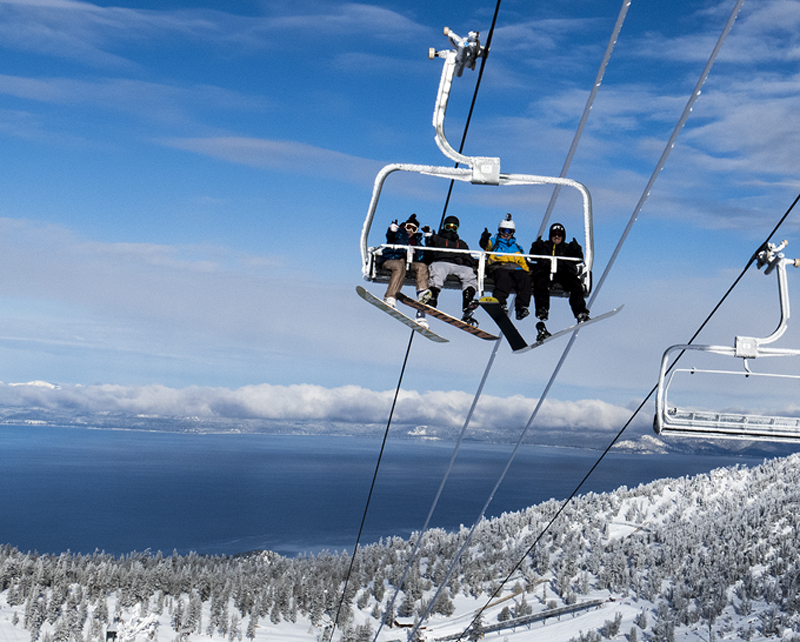
Crowds were minimal first thing Saturday morning at Heavenly. Photo/Carolyn E. Wright

Crowds were minimal first thing Saturday at Heavenly. Photo Copyright 2015 Carolyn E. Wright

The National Weather Service in Reno has placed the Lake Tahoe Basin under a winter storm warning from 4am to 7pm on Sunday.

The heaviest snow is expected to be between 10am and 4pm, with 6 to 10 inches at lake level and 10 to 18 inches above 7,000 feet.

Winds will be the strongest in the morning.

There is a chance of snow into Monday.

Highs through Wednesday will be in 30s, with lows being in the teens or less starting Sunday.

— Lake Tahoe News staff report