Defining rural — mapping out the future of EDC

By Joann Eisenbrandt

PLACERVILLE — “What the hell are you doing? Why would you make El Dorado County like Los Angeles … Are you all crazy? What is your vision? More big-box stores, more dense housing, more people, more traffic? You are supposed to take care of the people who live in your county.”

— Dave Hammond, Shingle Springs                                                                                            Comments submitted for the Dec. 15 El Dorado County Board of Supervisors meeting


Land use planning is often seen as a tedious, technical pursuit, relegated for the most part to obscure planning department offices far removed from most residents’ daily lives. That is, until it directly threatens the things they hold most dear.

On Dec. 15, the El Dorado County Board of Supervisors is slated to approve the Targeted General Plan Amendment/Zoning Ordinance Update (TGPA/ZOU). California law requires counties to develop a General Plan to codify goals and policies to guide how land is developed and to review and update that plan regularly as needed. The TGPA/ZOU is the county’s response. More than a decade in the making, it includes amendments to the county’s 2004 General Plan and an extensive update of the Zoning Ordinance that implements it.

El Dorado County encompasses 1,805 square miles divided into two distinct areas, the Lake Tahoe Basin and the West Slope. The TGPA/ZOU affects only the unincorporated areas of the county and not cities like South Lake Tahoe and Placerville or publicly-owned lands.

Dave Hammond isn’t the only county resident unhappy with the TGPA/ZOU and the process through which it was created.
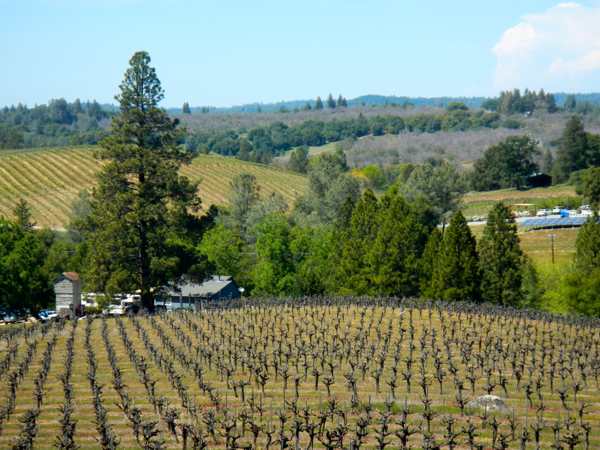
Many people don't want El Dorado County's rural nature threatened. Photo/LTN file

Many people don’t want El Dorado County’s rural nature threatened. Photo/LTN file

The 2004 General Plan states, “It is imperative to balance competing goals in approving the General Plan. The adopted General Plan encourages a balance between population growth, economic development, and the need to protect the environment ….” But as those who live at Lake Tahoe know all too well, the struggle to achieve this balance can be a protracted and emotional one. Even without TRPA, it’s no walk in the park.

The county’s West Slope has been no stranger to this struggle. Just how deep feelings run became apparent during three days of board meetings on the TGPA/ZOU on Nov.10, Nov. 12-13. Opponents of the TGPA/ZOU characterized it as a seriously-flawed, “developer driven” document that would create massive, unneeded and inappropriate rezoning of parcels for more intensive uses, lead to growth that cannot be supported by existing infrastructure or water resources, and create traffic gridlock especially along Highway 50. Most of all, they insisted, it will destroy the rural character of the county and create the Los Angeles that Dave Hammond fears.

County planning staff views it quite differently. Shawna Purvines, the county’s principal planner on the project and Long Range Planning’s main presenter at those meetings, characterizes it as a faithful representation of the views of past county planners and decision makers and the appropriate response to the state’s mandate to provide for growth in the county.

“I’ve heard the concern that the Zoning Ordinance is going to substantially change the character of the county,” Purvines told Lake Tahoe News,” and so I took that to heart and I started digging deeper. I went back to the Area Plans and the 1969 General Plan and to the 1949 Zoning Ordinance to be able to adequately respond …  these are not new policies, this is a new ordinance.”

After an initial two-year review, a General Plan is revisited every five years to compare its original assumptions with reality. The results of that five-year review in 2011 provided the impetus for the development of the TGPA/ZOU. It brings the Zoning Ordinance into conformity with the General Plan as required by state law, but does not, Purvines stressed, “overhaul” the 2004 General Plan, remove important development restrictions, create any new parcels or maximize the density potential of that plan. If the TGPA/ZOU were not implemented, she added, the environmental impacts would be unchanged from those identified in the 2004 General Plan’s environmental impact report (EIR).

An EIR is required by the California Environmental Quality Act (CEQA) for projects initiated by public agencies. It identifies significant environmental impacts the project could create, the mitigation measures to reduce them, and lists those impacts that cannot be mitigated to less-than-significant. If the lead agency, in this case the county, feels the merits of the project outweigh unmitigated impacts, they prepare a Statement of Overriding Considerations, declaring the overall benefits of the project make such potential negative impacts “acceptable.” The EIR prepared for the TGPA/ZOU is a “program EIR,” which means it focuses on general policies and zoning designations, not on site-specific development proposals.

It outlined the project’s objectives to create affordable housing for the moderate income earner, create jobs, stop sales tax leakage from the county and promote and protect agriculture by expanding opportunities there for recreation and rural commerce. It identified “unmitigated adverse environmental impacts” and a Statement of Overriding Considerations was prepared. Impacts include, among others:  damage to scenic resources including historic buildings along scenic routes; loss and fragmentation of wildlife habitat; creation of substantial incompatibilities between land uses; creation of substantial population growth; substantial depletion of groundwater supplies; and, conflict with level-of-service (LOS) traffic standards and travel demand measures.
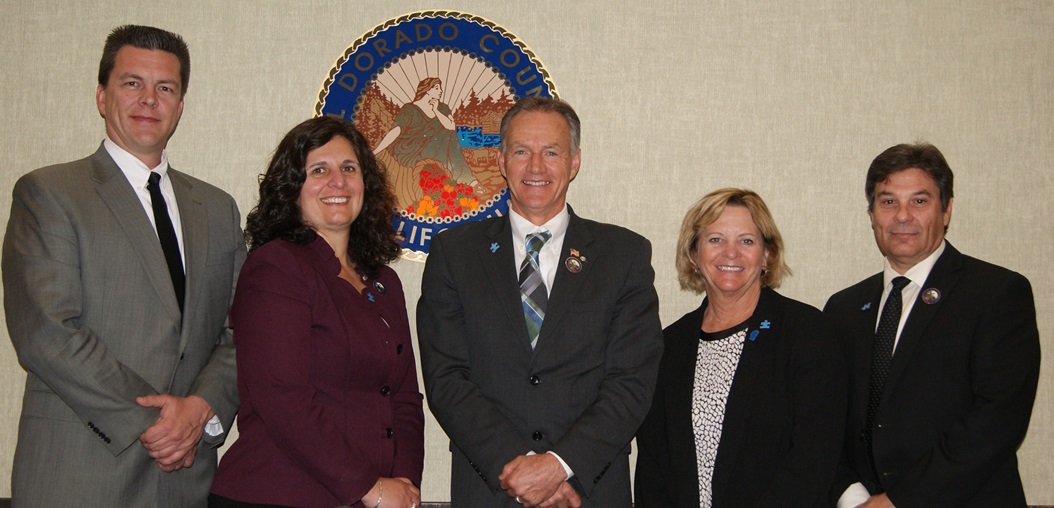
El Dorado County supervisors on Dec. 15 are expected to approve the General Plan documents. From left are, Ron Mikulaco, Shiva Frentzen, Brian Veerkamp, Sue Novasel and Michael Ranalli. Photo/Provided

El Dorado County supervisors on Dec. 15 are expected to approve the General Plan documents. The item will be discussed at 1pm in Placerville. From left are, Ron Mikulaco, Shiva Frentzen, Brian Veerkamp, Sue Novasel and Michael Ranalli. Photo/Provided

Rural Communities United (RCU), an unincorporated association originally formed to help pass the Measure Y initiative in 1998 to prohibit approval of residential developments that could lead to traffic congestion on Highway 50, finds these impacts unacceptable. Another community group, Shingle Springs Community Alliance, agrees. Individually and in concert, they have analyzed and commented upon the TGPA/ZOU throughout its formulation by the county.

Don Van Dyke outlined RCU’s concerns for Lake Tahoe News. “The biggest problem with this update is that it was represented as a very minimal update to the public. The reality is that it is a very major update especially to the building ordinance that will allow for increased density in both community and rural areas and doesn’t take into account our infrastructure like roadways and water to support all the development.”

In her comments to the board on Nov. 10, Monique Wilber, a former El Dorado County Senior Planner and an RCU member, insisted that the mitigation measures in the TGPA/ZOU are “infeasible,” and it relies on mitigations that “have proven ineffective in the past.” Many of the mitigations identified earlier in the 2004 General Plan, she added, have not been implemented at all.

County planning staff says the rezoning of 37,000 parcels, the removal of some zones and addition of new ones, and changes in the type and intensity of allowed uses on others was required to make the zoning maps consistent with the 2004 General Plan. Opponents contend it goes far beyond that. Sue Taylor, longtime land use planning activist, believes the project will, “destroy our rural lifestyle and the quality of life we have here.” Taylor believes the board has not done enough direct study of the project themselves. “They turned everything over to Long Range Planning,” she told Lake Tahoe News, “and have given Shawna Purvines our future.”

Supervisor Ron Mikulaco disputes Taylor’s claim. “I’ve read the documents in there … of course their concerns were taken into consideration. That’s why I put aside the time to go through all the materials.”

Howard Penn, unsuccessful candidate for county supervisor in 2014 and current executive director of the Planning and Conservation League, told LTN, “I don’t blame the county staff as others do. Ultimately, this is not the county staff’s fault. It’s the supervisors’. The direction comes directly from the supervisors and they are directly responsible for land use.” Penn believes the county is planning in a vacuum, and not looking at the impacts their decisions will make on surrounding counties, insisting that, “Land use planning and transportation planning are key issues for the future health of our entire state.”

Bill Center, local businessman and former El Dorado County supervisor, believes the county is repeating the mistakes it made that led to the creation of the Tahoe Regional Planning Agency (TRPA) at Lake Tahoe. “The completion of Tahoe Keys and the planned massive subdivision from Meyers to Echo Summit forced the first nationalization of land use planning in the country. It basically was caused by El Dorado County … by the county’s absolute refusal to recognize that rampant residential growth without any commercial development would kill the goose that laid the golden egg. Over and over, the West Slope has gone through the same kind of pressures, and unlike Keep Tahoe Blue, a simple statement of the environment we have focused on here is, ‘It’s Traffic Stupid’.”
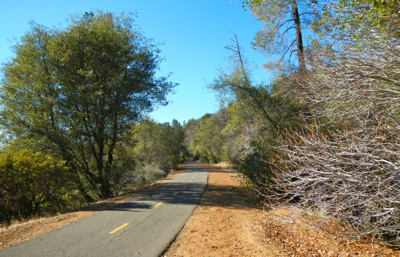
The El Dorado Trail is a reminder even in Placerville the county is rural. Photo/LTN file

The El Dorado Trail is a reminder even in Placerville the county is rural. Photo/LTN file

Center refers to proposed large residential subdivisions on the West Slope, some adjacent to the Highway 50 corridor, and the traffic impacts they will create. While these private developments are not directly addressed in the TGPA/ZOU, some contend the zoning changes it allows will streamline their approval.

Measure Y, the Control Traffic Congestion Initiative, prevented the approval of residential subdivisions that would create level of service (LOS) F on Highway 50. LOS F is the highest congestion level on the traffic measurement scale and essentially represents gridlock. Measure Y expired in 2008 and was reapproved, this time giving the board the discretion to selectively allow projects that create LOS F. According to Center, this was, “an opening they drove a Mack truck through.”

Another key issue is water. As the TGPA/ZOU points out, the majority of the groundwater supply in El Dorado County comes from “underground zones of hard crystalline or metamorphic rock within which there are fractures that provide natural storage for groundwater. The fractures do not form a connected system.” This makes it difficult to determine how much water will be available at a specific location. At the Nov. 10board meeting, Cheryl Langley, a Shingle Springs resident, insisted the county needs to develop a Ground Water Management Plan first as other counties have, and then base their development decisions on the results of those studies.

While the TGPA/ZOU includes the unincorporated areas of the county in the Lake Tahoe Basin, its potential impacts there are more limited. Although 14,500 of the 37,000 proposed parcel rezonings are for parcels in the Tahoe basin, most of these, county staff explained, are primarily name changes to make them consistent with TRPA’s Regional Plan designations since the current county zoning ordinance was adopted before the latest TRPA Regional Plan update. All projects in the Tahoe basin, including the TGPA/ZOU, must be consistent with the TRPA Regional Plan, its Code of Ordinances, Plan Area Statements and other regulations. When reviewing specific applications for land uses in the unincorporated areas at the lake, county planners must apply those TRPA standards. County development regulations may be more stringent than TRPA’s, but not less.

Under the TGPA/ZOU, the county will continue to work with TRPA and local entities in the completion of the Meyers Area Plan and to identify lands in the basin that can support affordable housing. Supervisor Sue Novasel, who was involved in the creation of the original Meyers Community Plan 25 years ago, explained that once the current Meyers Area Plan’s environmental documentation is completed it will need to be approved by the county and TRPA.

Asked why Tahoe residents need to be concerned about the impacts of the TGPA/ZOU on the West Slope, Novasel said, “I think some people forget that El Dorado County encompasses a large part of the Tahoe basin from Stateline to Tahoma and what happens on the West Slope as far as land use will have an impact on the Tahoe basin. The General Plan affects all of our departments and the health of the county in general. If we don’t have growth and the ability of the county to provide the services we need here, Tahoe will suffer.”

There have been years of talk about the TGPA/ZOU, but some say, not enough listening. “The most frustrating thing,” Don Van Dyke contends, “is that the county does not listen to residents. We need a change of culture at the county. We need the county to be working with residents and developers in projects that are good for everyone in the county.”

Many of the hundreds of pages of comments submitted by RCU and others, Van Dyke insists, were not answered at all or were inadequately responded to by the county in the project’s EIR.

“Over the past four or five years,” Van Dyke believes, “residents from mostly community regions who tried to become involved were routinely marginalized and bullied out of discussions with CEDAC.”

CEDAC is the Community and Economic Development Advisory Committee. It grew out of the 2004 General Plan’s desire to “establish a forum for discussion and make recommendations on pending environmental issues that affect the County’s economic vitality.”

Eva Robertson, an attorney and member of the CEDAC board was the only member opposed to certifying the EIR. In her comments to the board on Nov. 10 she said, “Certifying a deficient EIR leaves the county open to a viable legal challenge. My understanding is that the county has been successfully sued for CEQA violations more than once already.”

The 1996 General Plan was successfully sued and remained unimplemented until CEQA inadequacies were corrected to the court’s satisfaction in 2004.

Novasel stands behind the process. She told Lake Tahoe News, “We’ve had years and years of testimony and input from the public on this. What I’ve found is an effort to slow down the process just to slow down the process. I don’t know what happened with CEDAC but the board did not marginalize anyone in our meetings. We listened carefully and then made a decision. I don’t know how we could have done it any better.”

Some impacted property owners believe they didn’t even get the chance to comment because they failed to receive adequate notice about proposed zoning changes on their properties or adjacent ones. Some parcel owners did receive individual notices in the mail, others did not. Those that didn’t were part of the public notification process which included meeting notices, agendas and posting of project documents on the county website, articles and notices in the media and town hall meetings conducted by individual supervisors in their districts.

“The county has an ordinance that tells it how to implement CEQA,” Purvines explained. “The county defaults to the basic CEQA requirements (for notice). If there are more than 1,000 parcels we default to public notification. We believe we did more than the minimums but there is a difference of opinion on who should get a notice.”

Lori Parlin, founder of Shingle Springs Community Alliance, says the county put an inappropriate burden on residents to seek out information. “There were 200 meetings held, and I’ve been to a lot of them, but they did not provide any site-specific information to attendees. I didn’t know they were rezoning property next to me. My back fence is now going to be next to a parcel zoned regional commercial, which would allow for a WalMart or Costco. “

The TGPA/ZOU project was discussed at Supervisor Michael Ranalli’s Dec. 10 town hall meeting in Shingle Springs. In response to similar concerns raised again by Parlin and others, Ranalli said, “We took a pounding for trying to bring the General Plan up to date. There still may be things in there that are not optimum for certain areas. Staff will be asked to review this again in a year.”

Supervisor Shiva Frentzen had her own concerns over the public notification process. She was the lone vote against giving tentative approval to the major components of the TGPA/ZOU at the Nov. 13 board meeting saying, “My struggle is with fairness and doing what’s right.”

In an email to Lake Tahoe News, Frentzen explained, “My concerns with the ZOU are: Altering the rights of the property owners without directly notifying them; altering the neighborhoods without proper notification within a one mile radius; it affects our resources and infrastructure; it has unintended consequences; the economic impact of all these policies and updates are not analyzed.”

If the board approves the TGPA/ZOU on Dec. 15, Rural Communities United is prepared to stop talking and take action. RCU had requested an appeal hearing to go over their concerns, and again at the Nov. 10 board meeting asked the supervisors to postpone a decision and agree to re-examine the project in smaller, more manageable pieces. These were both rejected. RCU attorney Tom Infusino warned the board that if they approve the project, “You should have no doubt left in your mind your actions will be challenged in Superior Court.”

Brian Veerkamp, chairman of the Board of Supervisors, declined to respond to LTN’s questions on the TGPA/ZOU due to this threat of litigation.

After years of discussion, what happens next remains an unknown. Will there be a lawsuit, and if so, what impacts will it have on implementation of all or part of the TGPA/ZOU? How did things get to this point, and where should the finger of blame be pointed? There are no simple answers.

Once again, it’s that tricky balancing act between economy and environment. The fight over the TGPA/ZOU is more than all the individual details. It’s about how El Dorado County envisions itself, now and in the future, and who gets to determine the framework of that future. The 2004 General Plan lists as its objective, “To foster a rural quality of life.” The problem comes with finding agreement on exactly what that rural quality of life looks like. As Supervisor Ranalli put it at his Dec. 10 gathering, “I think rural depends on your point of view, but it’s worth defining. After all, some people who live in El Dorado Hills think they’re rural.”





Opinion: EDC practicing closed government

By Larry Weitzman

Sixty-two years ago Ralph M. Brown, a legislator from Modesto and later Fifth District Court of Appeals Judge, wrote the Brown Act and now called the Open Government Act. Brown in the preamble said, “The people, in delegating authority, do not give their public servants the right to decide what is good for the people to know and what is not good for them to know.”

El Dorado County government acts as a closed system whose main purpose is to help themselves to more power, more salaries and pensions and less of everything else for the taxpayer. When the voters of EDC wake up, most of the administration will be long gone, leaving their destruction in their wake either retired with a big fat pension or moving on to some other county only to suck on the teat of some other unsuspecting county’s taxpayer-funded general account. Sort of like musical chairs with an extra chair always in the game.

Larry Weitzman

Larry Weitzman

Remember Terri Daly? She is now pulling down a nice six-figure income from the Yuba County Water Agency after receiving a severance package of over $150,000 from EDC. This was after as CAO of Amador County spending $20 million on an unnecessary lease which they will pay on until 2028 and as El Dorado County CAO destroying its financial stability with unbridled hiring and raises. Never mind her hiring of failed city of Ione’s city manager, Kim Kerr, as ACAO at over a $150K per. Kerr’s reward as a menacing ACAO was a high ranking position with one of EDC’s insurance vendors who Kerr worked closely with during her tenure of havoc at EDC.

Robyn Drivon was one of Daly’s hires. Unfortunately, we are still saddled with Drivon as EDC’s county counsel. Drivon is part of the problem as she gives bad and incorrect legal advice to the BOS, a bona fide legal illiterate. As to her part in closed government, it was always policy ever since Lou Green that after a closed session to report out a summary of the closed session. Ditto for Ed Knapp. That procedure of informing the public has ended as after every closed session with Drivon, her standard remark “there is nothing to report.” Maybe Edison’s most famous invention has yet to be discovered in EDC. Some open government?

At the most recent EDC board meeting item No. 7 further reduced the taxpayers’ access to the BOS by reducing the number of regular meeting from about 42 to 27. Instead of basically a weekly schedule, for 2016 it will be twice a month. Now you will have to look them up because the schedule is a bit irregular.

Board meetings are already too long, but to double up the calendar means a lot of deliberation and discussion will be left on the table. Longer agendas will mean more items on the consent calendar, a favorite way for the county dictator, Larry Combs, to slip through items that need scrutiny by the BOS. It happened with respect to two items last week, one being limiting BOS board meetings. With longer agendas there will be less time to speak and more time for members of the public to sit and wait for items. However, the BOS members are there earning about $1,500 a week, meeting or no meeting. With meetings already lasting into the night, longer agendas will mean even longer meetings and that equates to a hurry-up in discussions, less vetting and deliberations and a tired BOS. There will be a hurry to end the meeting so the decisions will be rushed. And that means more mistakes will be made. It’s the same reason we don’t allow pilots to fly for more than a limited number of hours or limit a truck driver’s time behind the wheel. We can’t afford decisions to be made under duress or fatigue. Bye-bye open government.

Item No. 5, also on the consent calendar, was an attempt to correct a BOS mistake from 2013 and repeated in 2014 which incorrectly added longevity pay to department heads for out of county service. The mistake was discovered at least six months ago and the BOS asked it to be fixed by a certain date in June or July. Of course, Pamela Knorr – HR director and ex-temporary CA) — didn’t do the two-page fix and neither did Combs until pressured by a BOS member. Instead of a new two-page document that shouldn’t have taken more than half an hour to prepare, the BOS was presented the old resolution with cross outs. They were unintelligible. But the BOS still accepted a cross-out document that may come back to haunt another BOS in the future. At the salaries the administration earns, this kind of product is unacceptable.

But it was the last item of the day, item 31 that looks to be the coup d’grace of the BOS and its administration. It was an item to request that the BOS authorize litigation against the auditor for not paying from a mitigation fee act account $169,859. The auditor rightly claims because a proper five-year Nexus finding wasn’t filed by the Diamond Springs-El Dorado Fire District, it was in violation of the Mitigation Fee Act that says if such a report is not timely filed, the county shall refund the unexpended funds in the account to the property owners of record within the district. That is the law in California by statute and the appellate court case of Walker v. City of San Clemente. As the California Supreme Court refused to hear the case, it is the absolute law in California, although our county counsel continues to tell the BOS otherwise.

Your BOS as a result has authorized the spending of (tens of) thousands of dollars in outside legal fees against the auditor in a case they can’t win. Meanwhile, we have potholes that aren’t being filled and Drivon continues to collect her $200,000 plus a year in salary and benefits. Thanks again Terri Daly.

News flash, Placerville: On the BOS agenda for Dec. 15 is a closed session item (No. 50) for hiring a new county counsel. It looks like Drivon is playing the game of musical chairs before everything hits the fan here. But with Combs and Knorr running the process of recruitment, the likelihood of hiring a lawyer who will be independent of the HR director and the CAO and will bring leadership to the County Counsel Office still remains slim and none.

Larry Weitzman is a resident of Rescue.


Smartphones, Web eating into TV time

By Ryan Nakashima, AP

LOS ANGELES—The use of Internet-ready devices like smartphones appears to have seriously cut into the time Americans spend watching traditional TV, new Nielsen data show, potentially undercutting the notion that mobile devices merely serve as “second screens” while people are plopped in front of the set.

Data provided to the Associated Press show an increase in the number of 18- to 34-year-olds who used a smartphone, tablet or TV-connected device like a streaming box or game console. That grew 26 percent in May compared with a year earlier, to an average of 8.5 million people per minute.

Those devices, which all showed gains in usage, more than offset declines in TV, radio and computers. In the same age group, the demographic most highly coveted by advertisers, use of those devices fell 8 percent over the same period to a combined 16.6 million people per minute.
Nielsen’s inaugural “Comparable Metrics” report for the first time presents data on average use per minute, making it possible to directly compare various devices.

It’s not a one-to-one tradeoff, however. Sometimes people are using smartphones while watching TV, or using them outside the home where it wouldn’t cut into TV time. Some mobile device use is also, well, to watch TV shows. The study counts all apps, Web surfing and game play but not texts or calling.

Still, the trends are strong enough to confirm a trend in other Nielsen data that found viewing of traditional TV—through a cable or satellite connection or an antenna—peaked in the 2009–10 season.

The audience for TV viewing alone fell by 10 percent, to 8.4 million people a minute, in the 18-to-34-year-old category.

The new Nielsen data doesn’t break out time spent specifically streaming TV.

Since Nielsen inaugurated its tracking service in 1949, average daily TV viewing has grown steadily, from 4 hours and 35 minutes a day to a peak of 8 hours and 55 minutes in 2009–10. That increase coincided with growing numbers of TV sets sold and the proliferation of programming on cable.

But viewership has been declining ever since. From late September until mid-November this year, daily TV watching accounted for only 8 hours and 13 minutes, Nielsen said.


2 books that would be wonderful to unwrap

By Kim Wyatt

I’ve read that in Iceland on Christmas Eve, people often exchange books and spend the evening reading. In the spirit of this, I offer a review of two books that recently captivated me and would make fine gifts for the fiction and nonfiction readers in your life. For busy readers, I’ve boiled it down to one line.

All the Light

“All the Light We Cannot See”

By Anthony Doerr

Scribner, 531 pages, $27 hardcover

One line review: I called in sick to finish this book.

“I avoided this book for months, and was finally pressed to read it for a book club. A story of World War II and a pair of plucky children? Perhaps I thought I’d read enough war novels, and I wasn’t in the mood to see young ones forced to be resilient. But the looming book club deadline forced me to read, and about 20 pages in I acquiesced, fluffing my pillow and sinking deeper under the covers. And there I stayed.

Plot, character, setting, beautiful language, this book has it all. There is a reason “All the Light We Cannot See” won the 2015 Pulitzer Prize for fiction. The novel’s inventive father-daughter relationship charmed me, and the language is stunning. It took author Anthony Doerr 10 years to write this book, and it shows. Although it took a while to get into it, by the time “The war dropped its question mark,” I was in love.

Set in Germany and France at the dawn of World War II, the story centers on Marie Laure, a blind French girl who flees when her locksmith father disappears from Nazi-occupied Paris. I won’t give away the creative lengths her father goes to ensure her skills and safety, but it’s a heart-tugging tour de force. Werner is a tech-savvy German orphan who is claimed by the Hitler Youth for his radio skills; he doesn’t mind having a full belly. The youth eventually end up in the coastal village of Saint-Malo, where the tides masterfully turn.

Survival and morality are themes, of course, but so skillfully woven is this tale that you connect with the characters and read on, hoping for the best. There is a subplot about a dangerous jewel, but it was Doerr’s language and characters that cast the spell I’m still under.

If you’ve got a reader in your life, you could do far worse than put this book in his or her stocking. Be warned, they may not come up until they are done.

sixth extinction

“The Sixth Extinction: An Unnatural History”

By Elizabeth Kolbert

Picador, 336 pages, $16 paperback

One line review: A pleasant, engrossing way to learn about our imminent extinction.

There was no better place to read “The Sixth Extinction: An Unnatural History,” than Death Valley; the geologic time in evidence make concerns about humanity seem like folly. It didn’t hurt that the Las Vegas Astronomical Society was there for the annual Winter Star Party. Each night, we’d look through monster telescopes at whorls of colorful galaxies and remark on how small we are.

In Elizabeth Kolbert’s latest book, we don’t seem small at all—in fact, humans seem quite powerful, and wired to destroy everything we touch. (This is weirdly comforting, given the state of our environment. We can’t help it, see?) Whether you believe in climate change or not, things aren’t like they used to be, and the rate of change is unprecedented. While some plants and animals adapt, more and more do not. This book is a compelling documentation of the Anthropocene, the epoch currently influenced by Homo sapiens, and for anyone interested in science, history and our relationship with the environment, it’s a great read.

Kolbert, a staff writer for the New Yorker, has an interesting beat. In this book, which won the 2015 Pulitzer Prize for general nonfiction, she lays out the history of extinctions on earth in a way that is accessible, and strangely not depressing. Fascinating case studies build—mastodons, the auk, innumerable insects, dinosaurs and meteors, too—and the reader is left to connect the dots. By the end of the book, there aren’t many ways out. But Kolbert has a light touch, good humor and smarts; she takes us to noteworthy places, where we meet scientists who are paying attention.

Some claim that the flaw in this book is that Kolbert offers no prescription. But we already know what we could and should do. We already understand the end result of unchecked capitalism on our environment, on the disappearance of our very own habitat. Yet we choose to act against the greater good of all creatures, including ourselves, as if fossil fuels aren’t a dead end, as if our actions have no consequences.

“Right now,” Kolbert writes, “we are deciding, without quite meaning to, which evolutionary pathways will remain open and which will forever be closed … it will, unfortunately, be our most enduring legacy.”

Kim Wyatt is the owner of the independent press Bona Fide Books.


El Dorado County DA, auditor face recall

pierson-harnBy Kathryn Reed

A group of residents is trying to recall El Dorado County District Attorney Vern Pierson and Auditor-Controller Joe Harn.

The county elections department on Dec. 14 expects to give the petitioners approval to move forward with the process.

To start the process 20 valid signatures from registered voters had to be obtained for each elected official. Some of the signees have a history with Pierson and Harn, like Cris Alarcon who was prosecuted by Pierson and Kelly Webb who Harn questioned if she were suitable for the IT job at the county that she no longer has.

Pierson and Harn easily won re-election in November 2014.

Now the groups have 160 days to obtain approximately 10,625 valid signatures. If those are secured, then an election – at the taxpayers’ expense – will be called.

These recalls are in addition the five Board of Supervisors who are being recalled. Signatures are being sought for them.

On the petition against Pierson it says in part: “We the voters are seeking relief from the tyranny of our elected officials who have engaged in malfeasant acts and corrupt practices, including, but not limited to: Abusing the power and resources of office to pursue criminal prosecutions and civil litigation against innocent persons and businesses for personal and political reasons, such as, generating career building publicity and punishing political enemies.”

Harn’s petition says in part: “We the voters are seeking relief from the tyranny of our elected officials who have engaged in malfeasant acts and corrupt practices, including, but not limited to: Failure to make authorized payments for reasons of personal and political motivation in violation of California State Penal Code Sections 424 and 425.”

Pierson told Lake Tahoe News, “This group of imbeciles is costing the taxpayers money for something that has no real likelihood of success. If it is successful, it will cost the taxpayers a fortune.”

Pierson and Harn had the opportunity to write a 200-word response to the petition. Those words have to be circulated with the full petition when seeking the 10,625 signatures.

The DA used most of his allotment to go after Alarcon: “After serving as chair of the county Charter Review Committee, Cris Alarcon was stopped by a sheriff’s deputy. Alarcon gave the deputy an Arizona license and claimed to be an Arizona resident. The plate tag on his car was stolen from his elderly neighbor. His wife admitted he did it to avoid license and registration. My office convicted him of multiple charges, including receiving stolen property, driving on a revoked license and false registration. Last year I was re-elected by a margin of 3 to 1. My opponent, a Placer County resident, claimed to live with Alarcon. Now this vengeful criminal seeks to waste thousands of your tax dollars on this bogus recall campaign. Don’t be conned by this criminal!”

Harn told Lake Tahoe News, “Being county auditor-controller is a lot like being an umpire. I do my best to call the balls and strikes fairly. I don’t vote on the budget. I don’t write county policies. I don’t write state law regarding county spending. I do have a duty to point out cases where the county attempts to spend money in violation of our policies or state law. Occasionally people get mad at the umpire. I am not surprised that there are 20 people who want me out of office.”


Warm room to open for South Tahoe’s homeless

Starting Dec. 18 homeless people in South Lake Tahoe will have a place to sleep other than the outdoors.

The shelter will be open from 7pm to 7am, December to April. It is located at 981 Silver Dollar
Ave., South Lake Tahoe.

There will be 20 beds. Those staying will receive prepackaged foods and hot beverages. The warm room will also provide the adult men and women with information and resource referrals to help them find more permanent housing solutions.

Anyone interested in volunteering may attend the following training sessions:
● Jan. 9 10am -12:30pm
● Jan. 12 1-3:30pm
● Jan. 12 6-8:30pm.

Donations are also needed. Checks should be made out to Live Violence Free (the fiscal sponsor for Tahoe Coalition for the Homeless), with “Warm Room” in the memo, and mailed to Tahoe Coalition for the Homeless, P.O. Box 13514, South Lake Tahoe, CA 96151.

For more info, email tahoewarmroom@gmail.com.


Snippets about Lake Tahoe

stpud·       At the Dec. 17 South Lake Tahoe Public Utility District board meeting the electeds are expected to approve a three-year contract for General Manager Richard Solbrig that will include a 2 percent raise effective July 1, 2016.

·       The Placer County Board of Supervisors proclaimed a local emergency for the high number of dead and dying trees across the county.

·       Sierra Avalanche Center is offering snowmobile specific avalanche education course on Jan. 22-23. For more info and to register, go online.

·       The Community Play Consortium is having a meeting Dec. 15 at 3pm in the board room at Lake Tahoe Community College.

·       Here are the El Dorado-Lake Tahoe and Sierra roadwork schedule for the week.


Winter music series returns to Stateline

On Dec. 17, the FNCTN Winter Launch Party will rock the Lakeview Loft located above Dart Beverage. On Dec. 18, FNCTN returns to Xhale Lounge with live disc jockey’s for Roger That House Parties.

Both venues are in Stateline.

South Lake Tahoe’s Stranger Weather will headline the first show of the second annual FNCTN Winter Music Series. North Tahoe locals Thick Newton will get the party started. Doors open at 9pm and admission will be $10 in advance (mkt.com/FNCTN) and $15 at the door. Admission will be half off on snow days.

FNCTN continues Dec. 18 at Xhale Lounge with Wooshey and Gurbtron. Admission to Xhale is $10.

The FNCTN Winter Music Series at the Lakeview Loft will continue every Thursday starting Jan. 14 through March 17.


Mountain bikers want access to wilderness

By Vernon Felton, Outside

Since 1984, mountain bikes have been banned from all Wilderness areas. That, however, might change soon.

The Human-Powered Wildlands Travel Management Act of 2015, a potential piece of legislation seeking to reverse that prohibition, has begun its journey on Capitol Hill, and, although the draft has yet to gain an official sponsor, it’s already sparking controversy over who should and shouldn’t be allowed in America’s most pristine places.

Mountain biking was in its infancy, back in 1984, when the U.S. Forest Service revised its regulations, banning not only motorized transportation in Wilderness areas, but also “mechanical transport,” a move that has since made mountain bikers persona non grata on nearly 110 million acres of Wilderness.

Opponents of the ban point out that no studies of mountain biking’s environmental impact were conducted at the time and that several independent studies since then have shown that mountain bikers have about the same impact on trails as hikers and less than equestrians—a group that enjoys largely unfettered access to wilderness.

Read the whole story


Donner Summit climbing area accessible to public

The historic 400-foot Black Wall that stands guard on the eastern flanks of Donner Summit, as well as the Peanut Gallery and Road Cut climbing areas are open to the public again.

The Truckee Donner Land Trust and the Access Fund bought the land, which also protects the access trails to the popular Space Wall and Stealth Wall.

Truckee Donner Land Trust will hold the 11.9-acre property, adding it via a boundary line adjustment to the neighboring 65 acres of land they already hold in fee. Access Fund will maintain a permanent conservation easement on the Black Wall property to back up the Land Trust’s long-term commitment and ensure climbing access in perpetuity.

The world-class climbing at Donner Summit features finely textured granite with deep chimneys, low-angle slabs, overhanging test pieces, and splitter cracks.

Climbers have been scaling the walls on Donner Summit for 50 years. But in 2013, the private landowners expressed concerns about liability, putting access to the historic climbing area at risk. After nearly a year of negotiations, they agreed to sell the property.

The climbing community and partners in just seven months raised more than $300,000 to purchase the property.