Aging equipment impacts NDOT crews

By Catherine Van, KOLO-TV

When winter storms hit, the Nevada Department of Transportation works around the clock to make sure roads are safe for drivers, it has a bigger concern than the weather this year. It’s looking at potential problem that could its operations system out of order.

NDOT has up to 25 snow plows in the Reno area and 10 plows at Mt. Rose, working 24/7 before, during and after a snow storm.

“Some plows are from 1970, a handful that are in the 80s and bunch of snow plows and trucks in the 90s,” said Thor Dyson, a district engineer for NDOT. “These trucks never turned off. We had people switch out every 12 hours, a whole new group of people will jump into the trucks and take off.”

Read the whole story


Gaming part of presidential campaign

By J.D. Morris, Las Vegas Sun

Casinos and gambling have been on the minds of presidential candidates at several key moments during the 2016 campaign.

Even when not debating at a big Las Vegas casino-resort, which Republican contenders will do Tuesday night, gambling references have worked their way into the campaign rhetoric multiple times. And there’s evidence that such moments matter, particularly to Nevada voters.

The American Gaming Association touted a poll Monday indicating that 80 percent of Nevada gaming employees were more likely to vote for a candidate who supports their industry. The results of the poll, based on 320 interviews, also suggested that most workers in the state gaming industry are closely following the race and plan to vote next year.

Workers favored Hillary Clinton and Donald Trump, who were seen as understanding the gaming industry better than any of the other candidates. The poll prompted the association’s president, Geoff Freeman, to call gaming employees “an electoral force to be reckoned with” in Nevada.

Read the whole story


Nevada trying to curtail fatal accidents

With there being more fatalities on Nevada roads compared to a year ago, law enforcement wants to change that trend.

The Nevada Highway Patrol is working in conjunction with the Douglas County Sheriff’s Department, Washoe County Sheriff’s Department, Reno Police Department, Sparks Police Department, Carson City Sheriff’s Department and Lyon County Sheriff’s Department to boost enforcement efforts.

Impaired driving fatalities have consistently been the most common cause of motor vehicle accidents resulting in injuries and death in Nevada. While alcohol related crashes and fatalities have decreased 48 percent compared to this time last year, there has still been an increase in overall fatalities to date.

Officers offer these tips:

·      designate a sober driver before drinking;

·      use a taxi, call a sober friend or family member or use public transportation if impaired;

·      take advantage of local sober ride programs;

·      call 911 if a drunk driver is spotted on the road;

·      take the keys or assist in making other arrangements for someone who is about to drive or ride while impaired.


LTCC seeks actors for winter production

Lake Tahoe Community College is looking for actors of all ages and ethnicities to audition for its winter production of “The Musical Comedy Murders of 1940” written by John Bishop.

Auditions will be Jan. 5 at 7 p.m. in LTCC’s Duke Theatre, inside the Fine Arts Building. Performances of the play take place March 11-20.

“The Musical Comedy Murders of 1940” takes place on a dark and snowy night in the library of a mansion in upstate New York. The creative team responsible for a recent Broadway flop has assembled for a backer’s audition of their new show. The house is replete with sliding panels, secret passageways, and a German maid who is apparently four different people—all of whom figure diabolically into the comic mayhem that follows when the infamous “Stage Door Slasher” appears and strikes again—and again. It all gets resolved eventually, but not until the audience has been treated to a thoroughly sidesplitting good time and a generous serving of the author’s biting, satiric and refreshingly irreverent wit.

The play is full of great roles for men and women of ages from 18-65. Copies of the play’s script are available to borrow in the Roberta Mason Library on campus. Auditions will consist of readings from the play, and actors are encouraged to read the script before auditioning.

For more information, call 530.541.4660, ext. 240.


Rotary returns funds to South Shore community

Rotary Club of South Lake Tahoe has approved three community grants.

They are:

  • Drug Store Project – Tahoe Youth and Family Services was awarded a $1,000 grant to continue its annual youth drug awareness and avoidance program in 2016. This is program is designed to reduce future drug experimentation/use/abuse and increase student knowledge about the dangers of drug and alcohol use.
  • Sierra House Elementary Fifth Grade Nature Bridge Request – An award of up to $1,500 was made for three classrooms of 5th-graders to attend educational programs at the Nature Bridge at the Marin Highlands in 2016 to learn science in a completely new natural environment.
  • H.E.R.O. Scholarship Fund Inc. – The board awarded $2,000 to the successful H.E.R.O. Scholarship Fund that was set up 18 years ago as an anonymous donation for those students who have overcome seriously difficult obstacles to graduate high school or community college and continue their education.


SLT trail talks stall; eminent domain likely

By Kathryn Reed

By mid-January South Lake Tahoe is expected to initiate eminent domain proceedings in order to build the El Dorado Beach to Ski Run bike trail.

The city doesn’t want to take the property, but instead is seeking the right-of-way to build the multi-use path.

Based on some of the funding coming with strings per the federal government there is a time line for the money to be spent. If the project is not finished by June 2018, the city could lose about $2.5 million in state and federal funding. The city might also be on the hook for refunding nearly $1 million in grants that have been spent on design and planning if the trail were not to be built.

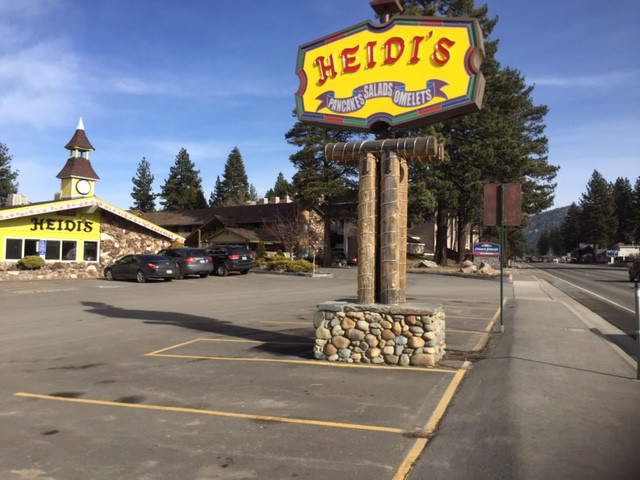
Heidi's in South Lake Tahoe believes losing a couple parking spaces and any change to the sign would hurt business. Photo/LTN

Heidi’s in South Lake Tahoe believes losing a couple parking spaces and any change to the sign would hurt business. Photo/LTN

The bidding process cannot begin until the acquisitions are completed per federal stipulations. The city wants bid documents to be ready this spring.

City staff repeatedly said the clock is ticking and time is of the essence.

While the City Council this month gave the affected properties 45 days to resolve the issue without going down this path, at least two of the properties don’t appear to be willing to negotiate. This comes after the city began the dialogue more than a year ago.

Mary McCall, who owns a tiny slice of the needed property, told the electeds last week she feels pushed and coerced. She is a descendant of the pioneer Johnson family and said her family has given enough already.

A wedding chapel sits on the land. The city needs 126-square-feet of right-of-way. It has a value of $7,500.

She is worried about relocating the sign, wonders why businesses on the other side of the street aren’t affected, and said cyclists can ride in the street.

Don Rosenthal, who operates Heidi’s restaurant, was speaking on behalf of the property owner. However, with a 40-year lease, Rosenthal has a huge stake in what occurs on this parcel at the Bijou Center.

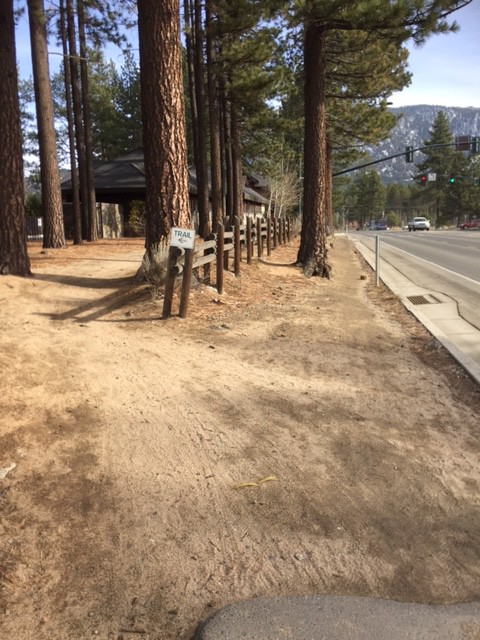
The current trail is dirt and tree roots in places. Photo/LTN

The current trail is dirt and tree roots in places. Photo/LTN

The city wants 966-square-feet of right-of-way; offering $15,000 for it. Safety, loss of parking and sign relocation are Rosenthal’s biggest worries.

The engineering consultant on the project said concessions have been made, such as moving the trail as close to Highway 50 as possible for these people.

McCall and Rosenthal told the council they would try to work things out. Outside the meeting room and out of earshot of the electeds they said the opposite.

The city also needs 1,300 square feet ($48,000) from Urbana Tahoe and 2,700 square feet ($10,250) from Tahoe Beach and Ski Club. The latter is not contentious, but requires eminent domain to satisfy the homeowners’ policy.

The city must offer fair market value, but cannot legally offer more. Property owners can take the city to court once eminent domain filings occur.


Letter: Taxpayer Association upset with EDC expenditure

Publisher’s note: This letter was sent to the El Dorado County Board of Supervisors. The item in question is not included in the county’s budget and would go to the county’s wealthiest fire district. The letter is in reference to item 40 on the Dec. 15 agenda.

The Taxpayer Association requests that this matter be continued. And if not continued, we state that we oppose the granting of $513,000 of EDC taxpayer money to the El Dorado Hills County Water District (EDH Fire) for the following reasons:

1.     While it appears to be a mistake by county administrative staff and the prior BOS, the matter at that time wasn’t properly vetted both by staff and the BOS. Financial records demonstrate that EDH Fire is a wealthy district, while every other county fire district suffers from lack of money. EDC Fire Protection District recently had to close the Lotus Fire Station.

2.     EDH Fire already has the best salary and benefits package of any fire district.

3.     EDH Fire receives a larger proportional share of property revenues of all fire districts.

4.     The Latrobe tax revenues have been already spent by EDC which means taxpayers from all over the county are paying for this gift to EDH Fire.

5.     We request that this matter should be continued until a proper financial study is done so the taxpayers and the BOS are aware of the impact of this grant on every fire district and every taxpayer.

6.     If a vote is to take place, Brian Veerkamp has a conflict of interest and should recuse himself from any vote as he has a pecuniary interest in that vote since he receives substantial benefits directly from EDH Fire and continues to do so.

7.     While we support public safety, this grant should not be made until this it is determined that this is the best place for taxpayer’s money.

Al Hamilton, president El Dorado County Taxpayer Association


Grocery chains leave food deserts barren

By Mike Schneider, AP

As part of Michelle Obama’s healthy eating initiative, a group of major food retailers promised in 2011 to open or expand 1,500 grocery or convenience stores in and around neighborhoods with no supermarkets by 2016. By their own count, they’re far short.

Moreover, an analysis of federal food stamp data by the Associated Press reveals that the nation’s largest chains — not just the handful involved in the first lady’s group — have since built new supermarkets in only a fraction of the neighborhoods where they’re needed most.

The Partnership for a Healthier America, which also promotes good nutrition and exercise in its anti-obesity mission, considers improving access to fresh food a key part of the solution. But the AP’s research demonstrates that major grocers overwhelmingly avoid America’s food deserts instead of trying to turn a profit in high-poverty areas.

Among AP’s findings:

  • The nation’s top 75 food retailers opened almost 10,300 stores in new locations from 2011 to the first quarter of 2015, 2,434 of which were grocery stores. Take away convenience stores and “dollar stores,” which generally don’t sell fresh fruits, vegetables or meat, and barely more than 250 of the new supermarkets were in so-called food deserts, or neighborhoods without stores that offer fresh produce and meats.
  • As the largest supermarket chains have been slow to build in food deserts, the so-called dollar stores have multiplied rapidly. Three chains — Dollar General, Family Dollar and Dollar Tree — made up two-thirds of new stores in food deserts.

The dollar store sector is consolidating, too: Dollar Tree merged with Family Dollar this year, creating the largest dollar-store chain in the nation and in the process, less competition and less incentive to diversify what these stores offer.

“The dollar stores are popping up everywhere in the food deserts, but that doesn’t mean anything if the owners don’t give customers the opportunity for fresh produce,” said Norman Wilson Sr., a food desert activist who is pastor of a Pentecostal church in Orlando, Florida.

  • Excluding dollar stores and 7-Elevens, just 1.4 million of the more than 18 million people the USDA says lived in food deserts as of 2010 got a new supermarket in the past four years.

On top of all that, it’s difficult to say how many more people live in newer food deserts created by recent store closures.

Viola Hill used to walk several times a week to a Schnucks supermarket a block away from her apartment in her struggling north St. Louis neighborhood, until it shuttered last year. Now she can only get to a supermarket once a month, when she pays a friend $10 to drive her to one several miles away.

“I have to get enough food to last me a whole month,” said Hill, a retiree who likes to cook chicken and green beans. “It hurt us really badly when they closed.”

The USDA considers a neighborhood a food desert if at least a fifth of the residents live in poverty and a third live more than a mile from a supermarket in urban areas, or more than 10 miles in rural areas, where residents are more likely to have cars.

The first lady’s group’s 2014 progress report, its most recent, says the companies that made the pledges have opened or renovated 602 grocery stores or other food retail locations, well below halfway toward their collective goal.

The partnership counted companies as having met their commitments if the stores they opened or renovated fell within a mile of a USDA-designated food desert in a city, or within 10 miles of a rural one. The AP analyzed which of the new stores that opened lie directly within food deserts.

Research has shown that a lack of access to healthy foods contributes to health problems, such as obesity and diabetes. Proximity to a supermarket can make a big difference in what people eat, especially if they don’t drive, although other factors such as food culture also play a role.

Supermarkets often build stores close to each other to compete in an area and highlight each store’s niche, said Ira Goldstein, president of policy solutions at The Reinvestment Fund, a Philadelphia-based community development firm that has invested in grocery store construction in low-income neighborhoods. But the stores typically look for neighborhoods that can support their format rather than changing their format to fit the neighborhood.

“That brings choice and variety to the market but it doesn’t necessarily solve the problem in an inadequately served area,” Goldstein said.

Large supermarket chains’ rigid formats often miss the nuances of a community, said Jeff Brown, CEO of Brown’s Super Stores in the Philadelphia area. Stores that succeed generally have other amenities, such as a pharmacy, doctor’s clinic or a bank embedded in the supermarket, he said.

Bigger chains often are “not selling what they should be selling because they don’t understand,” said Brown, whose company has seven stores in underserved neighborhoods.

Building stores in low-income neighborhoods comes with unique complications, according to the Food Marketing Institute, a Washington-based trade group for food retailers. A large customer base on food stamps creates erratic flows with a rush of business in the beginning of the month when the food stamps are issued, but slow business at the end of the month. Insurance and security can be more costly in neighborhoods perceived to be high crime, and workers from neighborhoods with high unemployment sometimes need extra training for basic job skills.

The average supermarket operates on a 1 or 2 percent profit margin and must be sustainable for at least a decade to recoup any profit, so retailers can’t afford to pick unprofitable locations, said David Fikes, vice president of consumer and community affairs for the Food Marketing Institute.

“We would love to have a supermarket in every neighborhood across America, whether if it’s a food desert or not,” Fikes said. “But it’s got to be sustainable for all involved.”


North Shore benefits from NCOT grants

A proposal to create trail maps for North Lake Tahoe and another to produce a television program featuring areas along Highway 50 are among 65 projects approved for funding from the Nevada’s Rural Grants Program.

The Nevada Commission on Tourism has authorized $294,677 in grants for programs and initiatives to deliver more tourists to rural Nevada.

The Rural Grants Program funds are awarded twice a year. A total of $1.4 million was awarded in 2015.

Among the funded projects:

·         A $10,000 grant was approved for the North Tahoe Incline Village/Crystal Bay Visitors Bureau to develop, design and produce a series of trail maps identifying the North Lake Tahoe trail networks. North Lake Tahoe offers an abundance of outdoor activities; the maps will be designed to generate buzz about and raise awareness of the area’s hiking, biking and paddling terrain.

·         A $15,600 award was granted to Pony Express Territory, an organization that promotes tourism along the Nevada’s Highway 50 corridor, to film area adventures and historic sites for use in a half-hour television show promoting the area. The show would run on cable TV, as a looping video in area visitors’ centers, and at travel and trade shows. It also would be posted on the Pony Expresswebsite and on its YouTube channel.

·         A $10,000 grant was awarded to the city of West Wendover to create six 30-second TV spots promoting the West Wendover experience: dining, gaming, entertainment, attractions, activities and events. The spots also can be utilized online and on West Wendover’s social media channels.

·         A $7,200 award was given to Indian Territory, an organization promoting tribal tourism, for Nevada Tribal Tourism Training. The training provides Nevada tribes and tribal members with the opportunity to increase their knowledge of tribal tourism projects and initiatives that exist across the nation.

·         An $8,000 grant was approved for Nevada Silver Trails, an organization that promotes tourism to the state’s central and southern rural areas, to advertise in American Road magazine. Previous advertising in American Road magazine has performed well, yielding thousands of responses, including downloads of itineraries and write-in requests for information. The current slate of ads will run in winter-spring 2015-16.

·         A $1,462 award was given to Las Vegas-based Destination Services Association to participate in a bridal trade show in August. The grant will help the group secure trade show booths, display tables and services; as well as help with the costs of shipping brochures and supplies, and with travel expenses.


Grants are awarded to nonprofit entities for tourism marketing projects that will result in overnight stays, ultimately increasing room tax revenue for the state. Grant recipients must provide a 50-50 match in funds or volunteer hours.


Historic Coloma structure erupts in flames

By Loretta Kalb, Sacramento Bee

The historic Sierra Nevada House in Coloma on Highway 49 erupted in flames Monday afternoon, forcing evacuation of customers and drawing mutual aid from firefighting crews throughout the area, a CalFire spokesman said.

The fire was reported at 3:05pm Dec. 14 and more than an hour later was still actively burning, said CalFire spokesman Brice Bennett.

He said there was no immediate word on how the fire started, and the cause will be part of a upcoming investigation.