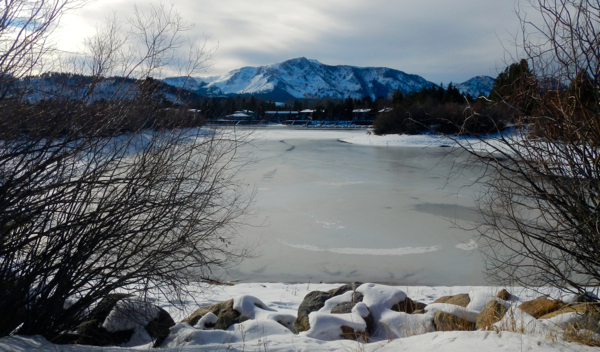
Snippets about Lake Tahoe

truckee·       Truckee is offering free transit on New Year’s Eve. For more info, go online.

·       IVGID will have curbside Christmas tree recycling Jan. 4-8. Trees must be cut into 3-foot or smaller sections.

·       There will be a court hearing Jan. 22 about the California fire tax. The Howard Jarvis Taxpayers Association is asking for the judge’s approval of the class notice. The hearing is in Sacramento Superior Court, 720 9th St., Sacramento at 10am.

·       El Dorado County has updated budget information about special districts. Information is online.

·       International accreditation was awarded to the Washoe County Sheriff’s Office Forensic Science Division’s Breath Alcohol Section.


U.S. women solid in downhill

By USSA

VAL D’ISERE, France – Laurenne Ross (Bend, Ore.) cracked the top 10 as Lindsey Vonn’s (Vail) bid for a record-tying downhill victory hit a bump in the road Saturday.

Vonn, the current overall World Cup leader, was 0.13 faster than Switzerland’s Lara Gut at the first split time when she hit a bump midway down the Audi FIS Alpine World Cup downhill course and briefly became airborne. She eventually landed and skied safely off the course for a DNF. That ended her bid for a record-extending 72 World Cup win and record-tying 36 downhill victory.

Gut moved to within two points of Vonn in the overall World Cup standings after winning for the second-straight day at Val d’Isere. Her countrywomen Fabienne Suter finished second, followed by Canadian Larisa Yurkiw in third. Ross led a solid showing by the U.S. women in 10, followed by Alice McKennis (Glenwood Springs, Colo.) in 12, Stacey Cook (Mammoth Mountain) in 16 and Jackie Wiles (Aurora, Ore.) in 17.


Wiles, the youngest member of the women’s speed team, scored her third career World Cup top-20 downhill result, and continues to gain confidence from her skiing and teammates in her third World Cup season.

“I’m really lucky to be with the group of girls that I’m with,” Wiles said “They’re all amazing skiers. I think we have the best speed ski team in the world right now. So for me to be a teammate of theirs and learn from everything little thing they do and keep growing and learning from them, I’m in a great position right now.”


Business coaching available in El Dorado County

A series of free business planning workshops, for eligible businesses with five or fewer employees (including business owner), will begin in El Dorado County starting the week of Jan. 21.

Qualifying start-up and existing small businesses may attend the workshops at no cost. Businesses must be located in the unincorporated area of El Dorado County and not exceed the following income limits for the following household sizes: one person, $40,050; two people, $45,800; three people, $51,500; four people, $57,200; five people, $61,800; and six people, $66,400.

This seven-week workshop series will provide participants with critical information to help their business grow and thrive. Topics include a wide range of technical assistance areas including writing a business plan, managing business finances, branding and marketing, and access to capital.

In addition to the workshop series, participants will be encouraged to take advantage of free and confidential one-on-one business consulting through the Sierra Small Business Development Center.

Space is limited at the workshop series and pre-registration is required. To enroll, contact Emily Kornhauser at 530.582-.5022 orEkornhauser@sierrabusiness.org.


CTC on track to restore Upper Truckee Marsh

This lagoon at the Tahoe Keys will be filled in when the Upper Truckee Marsh is restored. Photo/Kathryn Reed

This lagoon at the Tahoe Keys will be filled in when the Upper Truckee Marsh is restored. Photo/Kathryn Reed

By Kathryn Reed

It’s possible kayakers using the Upper Truckee River may one day not be able to reach Lake Tahoe. And the landowners are OK with that.

The California Tahoe Conservancy board on Dec. 18 certified the environmental documents for the Upper Truckee River and Marsh restoration project and approved the preferred alternative. Tom Davis, South Lake Tahoe’s rep, was absent.

The soonest any change will come is in 2018. That’s dependent on state approvals and financing for what will be a multi-million dollar project.

Most of the work on this 600-acre swath of land in the middle of South Lake Tahoe will take place on the west side near Cove East. While boardwalks and other amenities had initially been planned for the Al Tahoe side, residents convinced the Conservancy that adding more people to this area would be detrimental for the marsh and the neighborhood.

This marsh is the most sensitive wetlands in the basin.

A big change will be how the river actually flows.

“We are letting the river go and see what happens. We want to see if the old braided channels reappear,” CTC Executive Director Patrick Wright told Lake Tahoe News.

Stu Roll with the Conservancy, said, “This is cutting edge for stream restoration.”

Most river projects in the basin have been massive undertakings to reroute channels, shore up banks and fill in old channels. This is more like a holistic approach to restoration. And, yet, it is still designed to restore the river to its natural meander before the Tahoe Keys was developed more than 50 years ago. At that time various fingers of the river reached the lake instead of one distinct outlet like there is today.

Conservancy staff realizes it may mean kayakers and others who float down the river will not end up at the lake or near an easy take-out location. Wright said a future project not associated with the restoration is being talked about that would provide a spot for non-motorized watercraft to easily get off the river.

Another major change will be getting rid of the lagoon that jets off from the channel that leads from the Tahoe Keys Marina to the lake. Much of the time this is stagnant water.

The path will be altered with this latest project, but it will still form a loop that takes walkers and cyclists out to the lake.

The Conservancy acquired the 22-acre Cove East parcel at the end of Venice Drive in a settlement agreement stemming from the Tahoe Keys development. In 2002, a $10.5 million restoration project was completed that brought back the wetlands that run between the walking path at the end of Venice and the river.


Opinion: Raw realities of ‘Spotlight’

By Kristin Gilger

If your son is a priest and your daughter a journalist, “Spotlight” is a jarring movie.

There are journalists and lawyers aplenty in this recently released movie about the Boston Globe’s investigation of sexual abuse in the Catholic Church, but hardly any priests.

I went to see “Spotlight” to cheer for the journalists. I’m a long-time journalist and journalism professor who raised a daughter who is an investigative reporter.  But I’m also the mother of a Catholic priest. And that made “Spotlight” very difficult to watch indeed.

My son, Patrick, joined the Jesuit order of Catholic priests nearly 12 years ago, a decision that startled us then and still has the power to unsettle us now.

Both my husband and I were raised Catholic. We were married in the church and had our three children baptized Catholic, but when Patrick was 7, we left, unable to reconcile our personal beliefs with church teachings on everything from birth control to women.

That might have been the end of it but for the Jesuits. When Patrick started his studies at Jesuit-run Creighton University in Omaha, he didn’t know what to think of the Jesuits. Who were these men who seemed so worldly and so otherworldly at the same time? They could probe philosophy one minute and dissect basketball scores the next. And they were rebels and reformers: They wanted to change the world.

The risk, the radicalism of it all, appealed to Patrick. These were not men who settled for comfortable lives in suburbia. It made Patrick think of the Paul Simon song “Obvious Child” about a man who chooses a conventional life of fun, money and even love, but finds no meaning in it.

“Who wants to be like everyone else?” he asked.

Since joining the Jesuits after college, my son has been stretched in just about every way imaginable. For three years, he lived and worked on the Pine Ridge Indian Reservation, one of the poorest communities in the U.S. He has been sent into one of the nation’s worst public housing projects, to a remote parish on the edge of a jungle in India, and to a women’s prison in San Francisco. In such places, he has tested the limits of what he can—and cannot—do.

I’m proud of my son and his work, but I’m cautious about telling people he’s a priest. I’m afraid of the question I see in their eyes. “No, he’s not a child molester,” I want to tell them.

Still, I can’t really blame them for wondering. It is estimated that there were more than 10,000 victims of sexual abuse at the hands of Catholic priests around the world from 1950 to 2002.

When I point out to Patrick the all-too-obvious flaws in the church, he agrees with me. The church is sinful, he says. It’s a human institution—so how could it not be?

Patrick believes the Catholic Church, with all its failings, still offers the best option: a moral code built on emulating the way Jesus lived and seeking meaning beyond comfort and self-affirmation. And Pope Francis, the first Jesuit to lead the church, has made it somewhat easier for us tenuous Catholics to realign ourselves with the church.

But not even Pope Francis can alter the past, something I kept thinking as “Spotlight” came to a close. There’s an awful moment when the names of hundreds of cities scroll across the screen, every one of them places where priests were found to have abused children. My husband and I sat slumped in our seats long after that stark and damning list had faded away.

Later, in the car, my husband and I agreed that “Spotlight” is a great movie. It doesn’t glamorize journalism and doesn’t exploit the stories of those who have been abused. That makes it, even more devastating, especially for Catholics and those like me who have been feeling more hopeful about the church.

My son just called to talk about plans for Christmas vacation. He’ll be home for a week, and wants to see a movie or two. I told him we should go see “Spotlight” together, but now I’m hoping he has forgotten the suggestion. If it was hard for my husband and me to watch the movie, how much more so would it be for him?

I think we’ll go to “Star Wars” instead.

Kristin Gilger is the associate dean of the Walter Cronkite School of Journalism and Mass Communication at Arizona State University. She has written a memoir about the Catholic Church and her son’s vocation, which is excerpted here. She wrote this for Zocalo Public Square.



More Americans dining and traveling alone

By Bella DePaulo, Washington Post

When I taught a psychology course on singles in America at the University of Virginia in 1999, one of the assignments was: Go out to dinner alone. One of my students waited patiently as the hostess seated one party after another; the hostess thought my student was waiting for someone else, so she ignored her. Another student got dressed up and headed to an upscale restaurant with several dining rooms. She was ushered into a room with no other diners.

Today, things would be different. Recently, the online restaurant reservation service OpenTable reported that, over the past two years, the fastest-growing party size has been tables for one; one-person reservations have increased 62 percent. Diners are not going to restaurants alone just by chance — they are committing to it ahead of time.

Solo travel has also increased.

Read the whole story


Cleanup from NorCal fires estimated at $243 mil.

By Juliet Williams, AP

Cleaning up from two destructive Northern California wildfires this fall will cost at least $243 million, far exceeding the cost for other recent blazes, state officials estimated Friday as they transferred more money from the state’s rainy day fund to help pay for it.

“The devastation caused by these fires is extraordinary,” Department of Finance Director Michael Cohen said in a letter Friday to lawmakers. “Debris removal must continue expeditiously to enable community rebuilding and economic recovery.”

The letter was to notify the state Legislature that the administration is shifting another $83 million from the state’s rainy day fund to help pay for the cleanup and that officials anticipate another $105 million will be needed in January.

The fire sites in Calaveras, Lake and Butte counties were declared a federal disaster, so state officials expect a large portion of the cleanup costs could be reimbursed by the federal government.

Finance officials estimated in November that cleanup costs would top $100 million.

But Cohen said in the letter that the cleanup is unprecedented in its magnitude and complexity. For example, the state’s share of costs for cleanup from a wildfire in the city of Weed in 2014 was $7.4 million, and cleanup from the 2007 Angora Fire at Lake Tahoe cost the state $7.3 million.

Cohen cited three factors for higher than expected costs from this fall’s fires: more debris than officials anticipated, lot sizes that are larger than expected, and increasing requests from landowners to help with cleanup.

Officials with the California Department of Insurance do not yet have an overall estimate of damages from the two fires.


Army colonel joins LTBMU as No. 2 in command

Joel Suenkel has been hired as deputy forest supervisor for the Lake Tahoe Basin Management Unit.

The position had been vacant since February when Jeff Marsolais, who had the job, became supervisor of LTBMU.

Most recently Suenkel was a colonel in the U.S. Army serving in Germany. He is an expert in strategic planning, process improvement as well as organizational, program and operations management.


Suenkel graduated from the University of Wisconsin as a distinguished military graduate and earned a master’s degree in organizational behavior from the University of Phoenix.

During his career with the military, Suenkel was deployed to numerous countries including South Korea, Bosnia-Herzegovina, Afghanistan, Japan, and Iraq. He was awarded numerous medals including the Bronze Star.


Climate experts say West Coast will see wet winter

By Kurtis Alexander, San Francisco Chronicle

The stormy weather expected to dampen California for the next several days — which holds promise of a wet and even white Christmas some places — is just the beginning of what promises to be a soggy winter ahead, federal climate experts said Thursday.

This week’s monthly report by the U.S. Climate Prediction Center remained bullish in its long-term outlook for precipitation along much of the West Coast, mostly due to the moist atmospheric conditions associated with El Niño.

Lake Tahoe and the northern Sierra, where the bulk of California’s water comes from, stands a 40 percent chance of getting significantly wetter weather. The Bay Area is pegged for a 50 percent chance of significantly wetter-than-average weather in January, February and March — defined as within the top one-third of the rainiest seasons on record.

Read the whole story


U.S. men miss podium in super G in Italy

By USSA

VAL GARDENA, Italy – Coming off a career-best super G result at Beaver Creek, Andrew Weibrecht (Lake Placid, N.Y.) was once again the top American, finishing fifth, at the Audi FIS Alpine World Cup super G Friday.

The winning ways of Norway’s Aksel Lund Svindal continued as the Attacking Viking captured the Val Gardena super G for the fourth time in his career and fourth victory this season. Following Svindal in second and third, respectively, were two of his countrymen, Kjetil Jansrud and Aleksander Aamodt Kilde, marking the third ever Norwegian World Cup podium sweep and first ever in super G. Austria’s Matthias Meyer was fourth.

Carrying serious speed from the top of the course, Weibrecht caught air over a blind roll, pushing him well wide of his intended line on the critical steep-to-flat section of the trail. However, by pushing it on the rest of the course he managed to claw back much of his lost time, leaving those watching to wonder what might have been.

Three other Americans scored World Cup points with Travis Ganong (Squaw Valley) in 19, Jared Goldberg (Holladay, Utah) in 21, and Steven Nyman (Sundance, Utah) in 28. Marco Sullivan (Squaw Valley) was 46 and Tommy Biesemeyer (Keene, N.Y.) was 50.