How did Santa get hooked on cookies and milk?

By Kylie Mohr, NPR

You know the Christmas routine: decorate the tree, wrap gifts and leave out treats for Santa on Christmas Eve.

Marketers and Hollywood reinforce that cookie tradition for us year after year.

This year, in Reddi-Wip’s “I Am Not Your Dad” commercial, a father is caught by his son nibbling cookies. In The Santa Clause, a Tim Allen Santa tells a little girl that he can’t eat fattening treats and then returns the next year to find soymilk instead. Macaulay Culkin, as Kevin in Home Alone, leaves out milk and cookies without his parents around to prompt him.

Clint Black even wrote a Christmas song titled “Until Santa’s Gone (Milk And Cookies).”

But cowboy crooners aside, we got to wondering: How did cookies and milk come to be Santa’s refreshments of choice in the U.S., and around the world?

Read the whole story


Transportation bills change in Calif. Jan. 1

Several transportation related laws take effect Jan. 1 in California.

Here are a few:

  • Driving Under the Influence (SB 61, Hill): This law extends the existing Ignition Interlock Device (IID) pilot project to July 1, 2017 for Alameda, Los Angeles, Sacramento, and Tulare counties. The IID pilot project requires a person convicted of a DUI to install an IID for five months upon a first offense, 12 months for a second offense, 24 months for a third offense, and 36 months for a fourth or subsequent offense.
  • Traffic Amnesty (SB 405, Hertzberg): Among other things, this law amends the criteria for a person to be eligible for the traffic citation amnesty program. The traffic amnesty program was approved through the 2015-16 Budget Act. A person is eligible for the traffic amnesty program if he or she has not made any payments after Sept. 30, 2015, to a collection program for fines or bail already due. The law also indicates that payment of bail, fines, penalties, fees, or a civil assessment is not required in order for the court to remove the civil assessment of up to $300 against any defendant who fails, after notice and without good cause, to appear in court.
  • Earbuds or Headsets (SB 491, Transportation Committee): This law, among other things, makes it unlawful to wear a headset covering, earplugs in, or earphones covering, resting on, or inserted in, both ears, while operating a motor vehicle or a bicycle. This prohibition does not apply to persons operating authorized emergency vehicles, construction equipment and refuse or waste equipment while wearing a headset or safety earplugs.
  • Pedal-Powered Vehicles (SB 530, Pan): This law expands the definition of pedicab to include a four-wheeled device that is pedal-powered, has a seating capacity for eight or more passengers, cannot travel in excess of 15 mph, and is being used for transporting passengers for hire. This law sets requirements related to local authorization, operator qualifications and training, financial responsibility, accident reporting, safety equipment, and inspections. The law establishes rules and standards for pedicabs that allow passengers to consume alcohol on board, if authorized by local ordinance or resolution
  • Consumer Protection – Starter Interrupt Warning (AB 265, Holden): This law requires a “buy-here-pay-here” dealer to make certain disclosures and notices to a vehicle buyer when a vehicle is sold with tracking and starter interrupt technology installed. This law also requires advance warning be given to the purchaser prior to engagement of the starter interrupt technology, if the buyer fails to make timely vehicle payments. A “buy-here-pay-here” dealer is defined as a used car dealer that assigns less than 90 percent of their conditional sales and lease contracts to third party lenders; and therefore provide direct financing to car buyers.
  • Electrically Motorized Skateboards (AB 604, Olsen): This law defines “electrically motorized board,” and restricts their operation on public facilities, requires boards to be equipped with safety equipment, and authorizes cities and counties to regulate their use. It also makes it a crime to operate an electrically motorized board while under the influence of drugs or alcohol. In addition, the law limits the board’s operation to individuals 16 years or older, requires operators to wear a bicycle helmet, wear safety equipment to increase visibility at night, and limits their operation to roads with a speed limit of 35 miles per hour or less. A conviction for violating this law is punishable by a fine of up $250.
  • Electric Bicycles (AB 1096, Chiu): This law adds an entirely new definition of an electric bicycle to the California Vehicle Code. An electric bicycle is defined as a bicycle with fully operable pedals and an electric motor of less than 750 watts. The law creates three classes of electric bicycles. Manufacturers will also need to certify the electric bicycles comply with specified requirements. Electric bicycle riders will be able to use roads similar to other bicycle riders, while providing a measure of local control if safety concerns arise on specific paths or public trails.
  • Transportation Network Companies (AB 1422, Cooper): This new law requires a transportation network company (TNC) to participate in the DMV’s Employer Pull Notice (EPN) Program. TNCs provide prearranged transportation services for compensation using an online-enabled application or platform, to connect drivers using their personal vehicles with passengers. The program will provide each TNC with a report showing a driver’s current public record, as recorded by the department, and immediate notifications of moving violations, accidents, driver license suspensions, revocations, and other actions taken against the driving privilege. The DMV’s EPN program provides employers and regulatory agencies with a means of promoting driver safety through the ongoing review of driver records.
  • California New Motor Voter Program (AB 1461, Gonzalez), creates an automatic voter registration process for qualified individuals who apply for a driver’s license or identification card, or submit a change of address to the DMV. The law will require that DMV implement the New Motor Voter Act no later than one year after the Secretary of State certifies all of the following: the state has a statewide voter registration database that complies with the requirements of the federal Help America Vote Act of 2002 (52 U.S.C. Section 20901 et seq.), the Legislature, has appropriated the funds necessary for the Secretary of State and DMV to implement and maintain the program, and the secretary of State has adopted regulations to implement the law.
  • California Residency Requirement (AB 1465, Gordon): This law will require an applicant for an original driver license or identification card to provide proof of California state residency, starting July 1, 2016, and it will bring DMV into compliance with a federal law requirement. The DMV will need to adopt regulations relating to the procedures for verifying that the applicant is a California resident.


Guided snowshoe trek at Van Sickle park

Celebrate National Winter Trails Day by participating in a free guided snowshoe hike in Van Sickle Bi State Park on Jan. 9 from 10am-1pm.

Participants will learn about Lake Tahoe’s pristine environment while snowshoeing.

There is no cost to participate.  This event is open to first 20 people. Register in advance by calling 530.541.6059 or email: kedwards@cityofslt.us.

Meet at Explore Tahoe An Urban Trailhead Visitor Center located at 4114 Lake Tahoe Blvd.

Bring your own snowshoes, dress in layers, wear hat and gloves, and bring plenty of water. There will be hot cocoa and snacks following the hike at the visitor center.


Kings Beach rec area subject of 2 meetings

There will be two public workshops and scoping meetings early next year regarding the Kings Beach State Recreation Area General Plan Revision and Kings Beach Pier Reconstruction Project

The first is at the North Tahoe Event Center in Kings Beach on Jan. 12 from 6-8:30pm.

A second scoping meeting will be before the TRPA Advisory Planning Commission at TRPA’s offices in Stateline on Feb. 10 beginning at 9:30am.


Low water level allows pipe removal at Tahoe

Boy Scouts take initiative to remove pipe from shores of Lake Tahoe. Photos/Devin Middlebrook

Boy Scouts take the initiative to remove a pipe from shores of Lake Tahoe. Photos/Devin Middlebrook

Publisher’s note: This was first published in Tahoe In Depth and is reprinted with permission.

By Devin Middlebrook

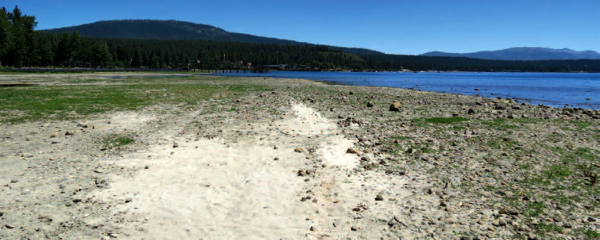
The low water level at Lake Tahoe is the starkest reminder of the current drought, with piers and marinas reaching out over sand and rocks that are normally hidden from view.

But sand and rocks are not the only objects being exposed by the drought.

Near Tahoe City, a long-abandoned, cast-iron pipe sat just below the surface for decades, having only the occasional run-in with a boat propeller or kayaker. Installed in the early 1900s, the pipe originally delivered drinking water to Tahoe Tavern from Watson Lake to the north. With the receding lake level, the pipe, now strewn along the shoreline, was visible to all that visited the area.

That is where Eagle Scout candidate Cyrus Miller, 16, and the rest of Boy Scout Troop 228 from Danville decided to step in. With a large section of the pipe now exposed, the troop wanted to take advantage of the situation.

“This drought made it a unique and once-in-a-lifetime opportunity,” Miller said. “We wanted to complete a project that made a big impact.”

The beach with the exposed pipe.

The beach with the exposed pipe.

With this goal in mind, Miller and his troop developed a plan to remove the pipe and return the area to a more natural state. Working closely with local agencies — Tahoe Regional Planning Agency, California Fish and Wildlife Service, California Division of State Lands, Placer County Museums, property owners, NV Energy, Tahoe Tavern, and Tavern Shores — the troop created a comprehensive plan for safely removing the pipe.

Using a few power tools and a lot of determination, the seven scouts cut the lengthy pipe into manageable sections. They then removed these smaller sections from the lakebed.

The sections were hauled away and recycled with a little help from Hansen Management & Maintenance Company of Tahoe City. The scouts then cleaned the project area, making it as though the pipe was never there.

The beach with the pipe removed.

The beach with the pipe removed.

Over the two-day project, the scout troop removed 700 feet of pipe from the lakebed.

At the end of day two, Miller looked over the project area and said, “It is amazing how much of an impact our troop’s hard work made.”

Several pieces of the pipe were donated to the Placer County Museum; where they will live on to tell the story of Lake Tahoe and its rich history.

Devin Middlebrook is an environmental education specialist with the Tahoe Regional Planning Agency.


Missing Heavenly skier safe, faces fine

A South Lake Tahoe resident was cited last week for skiing out-of-bounds at Heavenly Mountain Resort.

Nicholas Bridges, 28, had been reported missing Dec. 19 at 4:33pm. His friends had not seen him for two hours. It would be another four hours before he was located.

Douglas County sheriff’s deputies said Bridges went under the ski ropes. This is a misdemeanor that comes with a $640 fine.

The resort had little to say about the incident. It’s not known if Bridges will lose his pass as is customary in incidents like this.

“A skier went out of bounds … and was found safe. Guest safety is a priority at Heavenly Mountain,” is all Coop Cooper, spokesman for Heavenly, told Lake Tahoe News.

— Lake Tahoe News staff report


Man survives boulder destroying car on Hwy. 50

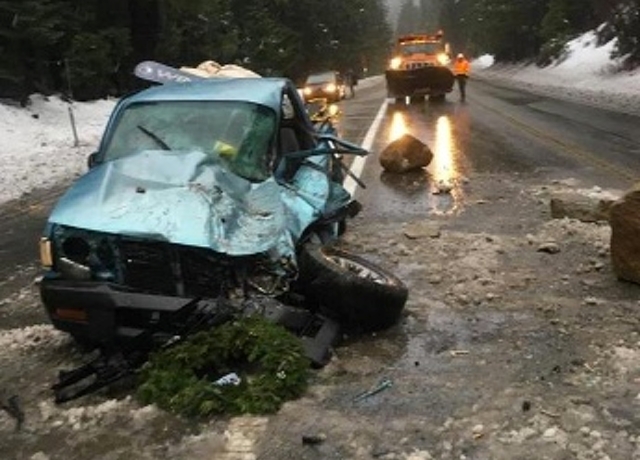
The driver survived a boulder crashing into his vehicle on Highway 50. Photo/Caltrans

The driver survived a boulder crashing into his vehicle on Highway 50. Photo/Caltrans

By Tom Miller, KCRA-TV

A rock slide along Highway 50 caused a massive boulder to land on the front end of a pickup truck, nearly killing the driver as he headed to Lake Tahoe.

The Toyota Tacoma’s driver, who asked to be identified as Mike, didn’t see the cliff breaking apart as he drove eastbound on the highway near Wrights Lake Road around 4:30pm Monday.

The boulder, at least 5-feet high and seven feet long, just missed Mike and his dog Shasta, clipping the front of Mike’s feet.

Mike’s toe was broken by the boulder. He said he is still dealing with the shock.

Read the whole story


Earthquakes, space debris keep people on edge

The earth was moving and the sky was lighting up Tuesday night.

A series of earthquakes rattled the Reno area, with the strongest temblor registering 4.4. The epicenter was 3½ miles north of Galena High School.

According to the U.S. Geological Survey, eight quakes ranging from 2.5 to 4.4 struck Dec. 22 between 6:22pm and 8:29pm.

The light streaking across the night sky was Russian space debris, according to the U.S. Strategic Command. It could be seen on both ends of the states of California and Nevada.

— Lake Tahoe News staff report


Sierra’s cat on the prowl to perfect riders’ experience — especially in terrain parks

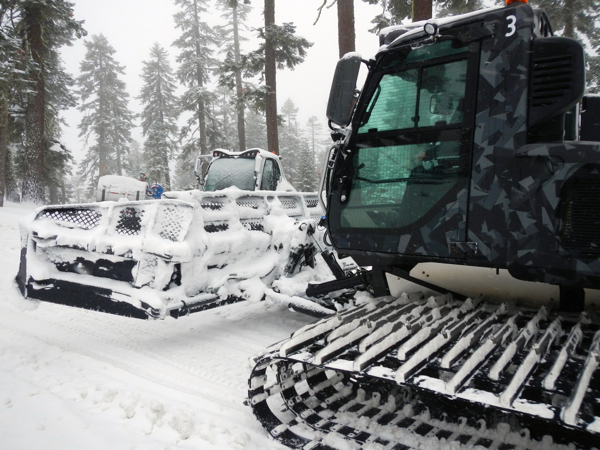
Sierra has a four-year lease on its snowcats so the fleet doesn't get too old. Photos/Kathryn Reed

Sierra has a four-year lease on its snowcats so the fleet doesn’t get too old. Photos/Kathryn Reed

By Susan Wood

TWIN BRIDGES – It’s not your grandfather’s Bombardier.

That’s the impression of Sierra-at-Tahoe’s new addition to its terrain park grooming fleet – the Prinoth Tier 4 Bison X. The workhorse of a machine runs smoothly like a Cadillac, but acts like it has the conscience of a Tesla electric car when it comes to protecting the environment, an underlying goal the ski resort 12 miles west of Meyers has focused on for years.

Benny McGinnis, Sierra’s terrain park manager, has welcomed the new member of the family of 12 grooming machines – some of which like this Bison are geared for the terrain parks. The $200,000 machine comes equipped with more torque, more features and more fuel efficiency – while throwing out fewer emissions. As numbers go, it emits 90 percent less in noxious fine particles compared to past generations, according to McGinnis’ fact sheet.

The output is right in line with Lake Tahoe’s environmental movement.

And if wondering why else this machine is important, one need only look at what in recent winters had not been falling from the sky in Tahoe to understand. California is coming off four years of unprecedented drought. If not for reliable and capable grooming machines and their operators, the ski seasons would not have lasted as long as they did. They can save a season. Think of it this way, in drought, there’s only so much snow that can go around.

Benny McGinnis is a veteran snowcat driver, specializing in terrain park work.

Benny McGinnis is a veteran snowcat driver at Sierra specializing in terrain park work.

“In the wake of the drought, efficiency is key. That means efficiency in on-mountain operations — the way we move and preserve snow and also efficiency in environmental practices. This cat gives us the chance to accomplish all of those while continuing to create progressive terrain parks,” spokeswoman Thea Hardy told Lake Tahoe News.

Progressive terrain parks are breeding grounds for Olympians.

In 2014 Sierra was celebrating the cultivation of three Olympic gold medalists — Maddie Bowman, Jamie Anderson and Hannah Teter. There’s a reason they ski and board here.

“The terrain park has definitely influenced Jamie Anderson in becoming the huge athlete she is today,” said McGinnis, a 14-year veteran terrain park builder who operates heavy machinery for the U.S. Forest Service in the summer months. In winter though, it’s all about Sierra – and all its users.

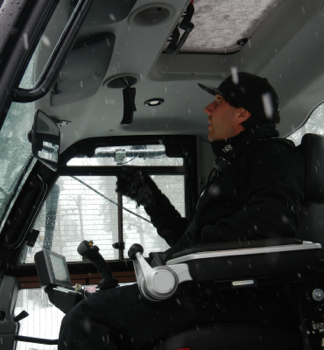
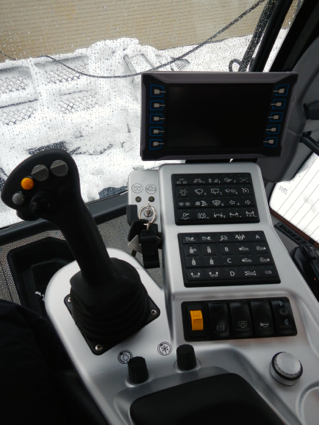
Drivers sit in the middle of the cab with a slew of controls at their fingertips.

Drivers sit in the middle of the cab with a slew of controls at their fingertips.

The Prinoth machine has a smaller cab than older models while maintaining the track size. That helps it maneuver more easily – especially at the “take offs” and “landings” associated with terrain parks.

“I like that this job gives me the opportunity to create something and to let a normal person come up and feel like an Olympic athlete. Tourists want to come up and get out of their lifestyle – to speed up or to slow down, and be an athlete,” McGinnis told Lake Tahoe News.

The Prinoth groomer, clad on the outside with a camouflage design, has more than 30 possibilities to manipulate the tiller and blade through a joystick attached to a panel that resembles an airplane. The blade can even pick up terrain park features.

This machine also provides more visibility with heated wipers and larger windows as well as more comfort for the operator with a Bluetooth sound system and heated seats. McGinnis admitted operators might get work fatigue just like a plane pilot or even someone who operates a computer for eight hours. His crew of six machine operators works two shifts encompassing between eight to 10 hours, the latter if the ski area gets dumped on. The job requires 80 hours of training.

Some are set in their ways and like to stick to the older machinery. But the handful of terrain park builders like the challenge of the new toy. All like to create a culture that embodies play.

“These cats are expensive to run. If we’re not managing the business responsibly, then we as a culture we love can’t exist,” he added as if a poet.

Call them poets of the night, writing the fate of the mountain slopes the next day.

—–

Notes:

What else is new at Sierra-at-Tahoe this year?

·       The Learn-to-Ride program is enhanced for all ages wanting to try their hands and feet on the Burton Backhill snowboard design.

·       The addition of a safety program called Helmets are Cool has come on board.

·       The WiFi has been beefed up in the base area, so guests will be able to connect with family members and friends more easily.


Opinion: How California invented Christmas

By Joe Mathews

Do the good citizens of New Orleans skip town during Mardi Gras? Do proper New Englanders take cruises when their trees display glorious fall colors? Would New Yorkers dare sneak out of Times Square 10 minutes before the ball drops on New Year’s Eve?

Of course not. So why must I leave California this coming Christmas week? Because too many people—including my wife, who is insisting our family spend this holiday in her native Wisconsin—fail to recognize the truth: California is the true home of Christmas.

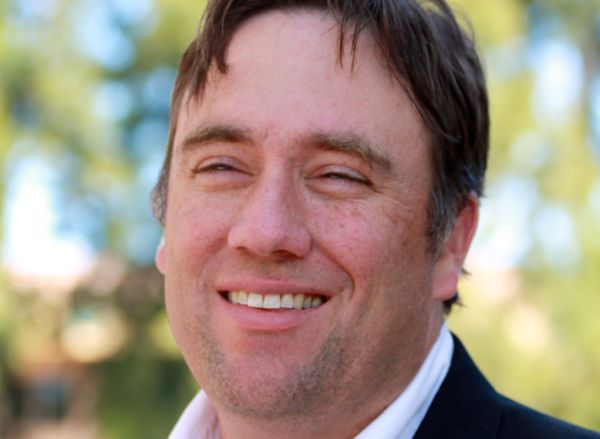
Joe Mathews

Joe Mathews

Yes, I know that California’s status as the headquarters of Christmas is not widely known, especially given the widespread cultural misperception that the holiday should be cold and snow-white. But, like virtually everything else about our 21st-century Christmas, that misperception is itself a California product.

The Golden State popularized the modern Christmas via our entertainment industries, designs it through our toymakers, digitizes it through Silicon Valley, distributes it through our ports, and provides beautiful weather in which to celebrate it. Even the quintessential carol, “White Christmas,” is set in California on Christmas Eve. Here is its mostly forgotten first verse.

The sun is shining. The grass is green.

The orange and palm trees sway

There has never been such a day

In Beverly Hills, L.A.

But it’s December the 24th. And I’m longing to be up north.

Then comes the familiar chorus. Sadly, some fools overlook the key “I’m dreaming” phrase and travel to cold, bleak places to recreate such white Christmases. The dream, for those stranded in airports throughout the Midwest and Northeast, often becomes a nightmare.

What’s more, the song’s writer, Irving Berlin, author of hundreds of hits (including “God Bless America”), bragged that “White Christmas” was both “the best song I ever wrote” and the “the best song anybody ever wrote.” He told a historian that he composed it at the Beverly Hills Hotel. The version sung by Bing Crosby, who gave California the Del Mar Racetrack and the annual golf tournament at Pebble Beach, is probably the best-selling record of all time.

The 1942 recording—and the films and TV that used it and similar tunes—actually redefined the holiday. Berlin, a Russian-Jewish immigrant, has been credited with taking the “Christ” out of Christmas, turning a religious holiday into a unifying national one. Today, 90 percent of Americans—including 80 percent of non-Christians—celebrate Christmas.

Subsequent generations of California creators have updated this tradition. For my money, the best California Christmas film is the original “Die Hard”—an action film set in a Century City skyscraper that ends with snow in Los Angeles—and the best Christmas music came from former Alhambra resident Phil Spector (now in prison after his murder conviction by an L.A. jury) and the Carpenters, the city of Downey’s gift to the world.

And this year, California’s Christmas present to the rest of the world is the long-awaited resurrection of the “Star Wars” movie franchise, courtesy of those California giants of American storytelling: Disney and Lucasfilm.

California’s Christmas leadership goes beyond the screen. It’s impossible to imagine Christmas without Mattel, the toymaker, incorporated in California after the Second World War and based in El Segundo. Its brands include Barbie, Hot Wheels, American Girl, and Fisher-Price. While Mattel faces financial challenges, other toymakers—from the giant Hasbro to smaller firms like Jakks Pacific—have established stronger presences here in recent years, making Southern California Santa’s workshop, or the unofficial capital of toys.

Now, while we all know Santa Claus delivers toys and other gifts to good girls and boys, we should be honest with our kids and let them know that Kris Kringle, who was early to embrace globalization, relies on overseas manufacturers, often in Asia. Many gifts enter the U.S. through our giant ports in Los Angeles and Long Beach, and are distributed via inland California warehouses. It’s only from there that they go to local staging areas where Santa, by some mysterious process, gets them into your home.

Southern California’s Christmas leadership is not purely secular. L.A. is the largest archdiocese in the country, with 4.3 million Catholics. And Orange County hosts the church of this era’s most prominent evangelical Christian pastor, Rick Warren.

But let’s not kid ourselves. The 21st century Christmas is about capitalism and dreams and artifice, and no place does dreamy capitalistic artifice with the skill and gusto of California. Heck, our largest city, Los Angeles, even derives one of its most popular nicknames from a popular Christmas decoration. They don’t call us Tinseltown for nothing.

Joe Mathews is California and innovation editor for Zócalo Public Square, for which he writes the Connecting California column.