Snippets about Lake Tahoe

·      Purchase preferred seating tickets for the Kings Beach July 3 Fireworks & Beach Party before midnight May 27 to be entered into a random drawing for a chance to win a North Lake Tahoe vacation package. Ticket proceeds help to pay for the Kings Beach event.

·      Maryland-based DiamondRock Hospitality Co. bought The Landing Resort in South Lake Tahoe for $42 million. Two Roads Hospitality will operate it.

·      Douglas County Public Library in Minden will be providing free financial literacy programs. For children ages 8 to 12 it will be April 21 at 2pm and will include interactive activities. Teens (ages 13-18) will be taught how to be savvy with money through the Bite of Reality on April 24 at 3pm. Both programs will be presented by Greater Nevada Credit Union.

·      LuLu Hair Design is hosting a St. Baldrick’s event April 21 at Peak inside Harrah’s Lake Tahoe at 6pm. Hair collected helps cancer patients.

·      Scorpions will be at Harveys on Aug. 31 at 7:30pm. Opening will be Queensryche. Tickets range from $69.50 to $149.50.


Expert: Hotel occupancy at record high

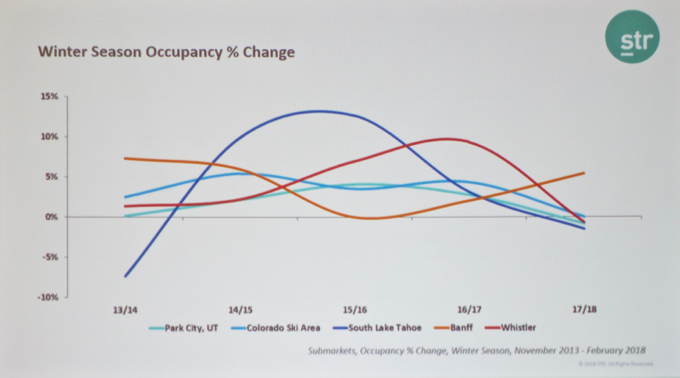
Data from STR analytics firm shows hotel occupancy changes for five winter destinations. Photo/LTN

By Kathryn Reed

STATELINE – Hotel occupancy in the United States is at the highest level it has ever achieved – 66 percent.

Ali Hoyt, senior director of consulting analytics for Denver based STR, was one of the presenters this week at the annual Mountain Travel Symposium. She provided a wealth of information about the hotel industry in the U.S., while briefly touching on metrics for ski towns. The firm studies 647 markets in the U.S., with properties divided into different classes. STR covers more than 70 percent of the hotels in the country, which is about 5 million rooms.

The symposium, now in its 43rd year, is the largest trade show of its kind. This is the first time the South Shore has hosted the weeklong event. It has been on the North Shore before and will return to Squaw Valley in 2020.

Hotel occupancy records have been breaking since 2016, with 2018 continuing in that direction.

“Demand is still outpacing supply. We expect that to level off,” Hoyt said during her April 12 talk.

The growth rate is about 2 percent year-over-year, which is about half of what it was in 2014 and 2015.

What her company does not track is vacation rentals. STR is only collecting data on hotels.

The hotel industry has experienced eight consecutive years of revPAR growth. This is the revenue per available room. Hotels will multiply their average daily rate by the occupancy rate to get the revPAR number.

What Hoyt and her colleagues are finding is the revPAR growth will be driven by rate growth.

The lackluster snowfall this winter has caused the local revPAR and occupancy numbers to be all over the map.

While it’s obvious the only way hotels will make money is if heads are in beds, it also matters what price they get per night. Much like the airline industry, it’s not a consistent price. The same bed on the same floor of a hotel could have a different price based on when it was booked and where it was booked. And it could be more expensive based on the day of week, events going on as well as holidays.

The money collected then has a huge impact on the city or county it resides because of the hotel taxes that are levied. The transient occupancy tax in a tourist area like Lake Tahoe is a huge revenue source for the city and counties in the basin.

When comparing the South Shore to Park City, Utah, Colorado ski areas, and the Canadian towns of Banff and Whistler, locally the occupancy rate had the wildest swing from 2013 to now.

While the whole Lake Tahoe basin, including Truckee, is busier in summer than winter, that is not true of most ski towns.

Hoyt’s data, though, is showing occupancy rates are growing in other destinations. Average daily rates and revPAR are going up, but it’s a bit of a roller coaster for all locations. Still, she sees summer bookings as an opportunity for  hotels in terms of increasing occupancy and revenue.


Opinion: Scripted news could become the norm

By Amanda Lotz, The Conversation

On March 31, Deadspin produced a video showing a chorus of local news anchors delivering the exact same scripted speech to viewers.

The message – denouncing media bias and fake news, calling it a problem that is “neither politically ‘left nor right’” – might seem innocuous enough.

But I study the media industry, and it really does represent a radical departure from how local television news has traditionally operated.

These news anchors all work for the same parent company, Sinclair Broadcast Group, which owns 193 local broadcast stations across the country.

You might think that your local television stations – with names like WXYZ-TV, KXAN or KMOV – are owned by national networks like ABC or Fox. But that’s often not the case; they are merely affiliated with the national network. Most are owned by companies called “station groups” that have purchased a portfolio of stations in different cities with different network affiliations.

Tribune Media, Nexstar and Tegna are examples of station groups. Sinclair is the biggest.

It was once the case that most stations were local, independently owned businesses. But during the 1970s, these individual stations started to be absorbed by station groups, which were able to take advantage of new technologies to achieve economies of scale. Instead of performing all operations at the local level at every station, they found they could save money by centralizing many tasks, from buying and selling advertising, to designing the computer graphics that air during news segments.

Today, owning many stations and centralizing these back-end tasks are common in the broadcast business. What isn’t common is what the Deadspin video shows. As far as I know, no other station group has written news scripts and required local stations to deliver them.

In fact, it’s a practice that directly goes against U.S. broadcast policy, which asserts that local stations should serve their geographic communities and be allowed to refuse content offered by national networks. Sinclair, however, has dubbed these scripts “must runs.” The company also produces complete news stories and commentaries that it requires local stations to air.

The script in the Deadspin video has fueled a partisan backlash, and many have pointed out that Sinclair’s “must-run” content often advances a conservative point of view.

However, the most important part of the story isn’t the question of partisan bias. It’s that a national station group is forcing content on local stations. To many, what Sinclair is doing is precisely what U.S. broadcast policy is supposed to protect against: a single company advancing an agenda to a majority of the country using the public good of broadcast spectrum.

With Sinclair’s pending purchase of Tribune Media’s 42 stations, the company’s reach is only poised to grow.

Amanda Lotz is a fellow at the Peabody Media Center and a professor of media studies at University of Michigan.


Why is it so stressful to talk politics with the other side?

By Melanie Green, The Conversation

People disagree all the time, but not all disagreements lead to the same levels of stress.

Even though people can be passionate about their favorite sport teams, they can argue about which basketball team is the best without destroying friendships. In the workplace, co-workers can often dispute strategies and approaches without risking a long-term fallout.

Political conversations, on the other hand, seem to have become especially challenging in recent years. Stories of tense Thanksgiving dinners and of Facebook friends being unfriended have become commonplace.

Why does this happen?

Our research – and related research in political psychology – suggest two broad answers.

First, our work shows that divisive topics – issues that are polarizing, or on which there’s no general societywide consensus – can evoke feelings of anxiety and threat. That is, simply considering these topics appears to put people on guard.

Second, research on moral conviction by psychologist Linda Skitka and her colleagues suggests that attitudes linked to moral values can contribute to social distancing. In other words, if someone considers their position on an issue to be a question of right versus wrong or good versus evil, they’re less likely to want to interact with a person who disagrees on that issue.

An automatic trigger of anxiety

In our research, we define divisive issues as ones that don’t have a clear consensus.

For example, just about everyone supports food safety; but if you bring up issues like abortion or capital punishment, you’ll see people fall into opposing camps.

People also like to have a general idea of where someone falls on an issue before they start debating it. If you’re talking with a stranger, you don’t know how to anticipate their position on a divisive topic. This creates an uncertainty that can be uncomfortable.

With this framework in mind, behavioral scientist Joseph Simons and I designed a series of studies to explore how this plays out.

In our first study, we simply asked individuals to look at a list of 60 social issues (ranging from safe tap water to slavery) and estimated what percentage of people are in favor of that issue. Participants also rated how much they would feel anxious, threatened, interested or relaxed when discussing that issue.

As expected, people thought they would feel more anxious and threatened when discussing a topic that was generally considered more divisive. (Under some circumstances – such as when people didn’t hold a strong attitude on the issue themselves – they did feel somewhat more interested in discussing these topics.)

In a second study, we investigated the experience of threat at an unconscious level. That is, do divisive topics automatically trigger anxiety?

We conducted an experiment that was based on the psychological finding that people don’t always recognize the source of their emotional responses. Feelings that are evoked by one event or object can “carry over” to an unrelated judgment. In this study, we presented participants with a popular topic (for example, supporting veterans), an unpopular topic (high unemployment) or a divisive topic (stem cell research). They then saw a neutral computer-generated picture of a face and had to quickly rate how threatening the face appeared.

Participants were more likely to see a neutral face as threatening if they were thinking about a divisive topic. (Unpopular topics showed a similar effect.)

A third study replicated these effects using fictitious polling data about direct-to-consumer drug advertising. We told some participants that there was a high public consensus about support for this sort of advertising, and we told others that there was wide disagreement. Specifically, we told them that either 20 percent, 50 percent or 80 percent of the public was in favor of these ads.

Participants then imagined discussing the issue and reported how they would feel. As in previous studies, those who were told there was more disagreement tended to feel more threatened or anxious about the prospect of discussing the issue.

‘Right and wrong’ adds a layer of complication

An additional social obstacle goes beyond mere disagreement. Consider two individuals who oppose the death penalty.

One person may think that the death penalty is morally wrong, whereas the other person may believe that the death penalty is ineffective at deterring crime. Although both individuals may strongly support their position, the first person holds this attitude with moral conviction.

Research by Skitka and her colleagues highlights the social consequences of these “moral mandates.” When it’s a matter of right or wrong, people become less tolerant of others who hold the opposite view. Specifically, individuals with stronger moral convictions tended to not want to associate with those who disagreed with them on certain issues. This social distancing was reflected both in survey responses – “would be happy to be friends with this person” – and even physical distance, like placing a chair farther away from a person with an opposing view.

Of course, no one is ever going to agree on every issue. But it’s important for people to learn about where others are coming from in order to reach a compromise.

Unfortunately, compromise or consensus is more difficult to come by if people start out the conversation feeling threatened. And if individuals feel that someone who holds an opposite view is simply a bad person, the conversation may never happen at all.

In the end, it doesn’t matter if you’re talking to a stranger or friends; the possibility of exclusion or avoidance increases when a divisive topic is raised.

There’s no easy solution. Sometimes raising these topics may reveal irreconcilable differences. But other times, a willingness to approach difficult topics calmly – while truly listening to the other side – may help people find common ground or promote change.

It might also be helpful to take a step back. A disagreement on a single issue – even a morally charged one – isn’t necessarily grounds for discontinuing a friendship. On the other hand, focusing on other shared bonds and morals can salvage or strengthen the relationship.

Melanie Green is an associate professor of communication at University at Buffalo, the State University of New York.



Sustainability includes promoting health, wellness

By Alexandra Spychalsky, Moonshine Ink

Environmental sustainability is a buzzword these days, but when it comes to small businesses, it takes a lot to incorporate sustainable practices. For these business and nonprofit owners/founders, sustainability goes way beyond being good to the environment.

It’s also a boon to the health of employees and customers, as well as a way to support our local economy. They are committed to being green, no matter how much extra green it may cost to uphold those values.

“Some products in hair salons can be rather toxic or cause medical issues for the people who handle them day in and out,” said Christina Bowers, owner of Sacred Salon in Truckee. Before she opened her own business, she saw her fellow stylists becoming sick from some of the chemicals they were forced to inhale day in and out. While she was pregnant Bowers found out her daughter had a serious birth defect, and that was the final motivation it took for her to start a salon that would not just be sustainable for the sake of the environment, but also provide a healthy and safe work environment for her and her stylists.

Read the whole story


Understanding the ‘new normal’ for water in the West

By Tara Lohan, Water Deeply
 
April is often a time of abundance in the mountains of the American West, when snowpack is at or near its peak, and forecasters work to determine how much runoff will course through our rivers and fill reservoirs later in the season.

This year, across much of the West, particularly the Southwest, there’s little in the way of abundance. At Lake Powell, the second-largest reservoir in the West, runoff is predicted to be only 43 percent of average. Arizona is looking at one of its lowest runoff years in history. And in New Mexico, stretches of the Rio Grande have already run dry, months ahead of normal.

The only consolation is that last year was a wet year and reservoirs received a boost. While it’s typical in the West to have big swings in precipitation from year to year, what has concerned scientists lately is that even good years are no longer producing the kind of runoff seen historically.

Read the whole story


Library celebrating Star Wars Day

South Lake Tahoe Library will be celebrating Star Wars Day on May 4.

The public can come meet “Star Wars” characters.

The 501st Legion’s Central California Garrison will be at the library to celebrate reading. Bring a camera to take photos, and check out your favorite “Star Wars” book or movie.

Costumes are encouraged, all ages welcome.

The event is from 3-4:30pm at the library, 1000 Rufus Allen Blvd.


Snippets about Lake Tahoe

·      El Dorado County Air Quality Management District is offering rebates to people who get rid of their old lawn mower. Click here for more info.

·      Carson City Toyota Community Cares campaign celebrated a quarter century of giving to the Boys & Girls Clubs of Western Nevada with a $10,000 check.

·      The Round Hill Square Shopping Center anchored by Safeway is on the market with an asking price of $32.35 million.

·      Tahoe Forest Health System will be providing affordable health screenings on April 13 from 7-9am at Tahoe Forest Center for Health in Truckee and Incline Village Community Hospital in Incline Village. No appointment is necessary.

·      Zephyr Cove Library on April 21 at 2pm is showing “Coco” (rated PG). The movie and popcorn are free. This event is sponsored by the Friends of the Douglas County Public Library. 


Opinion: Cold Truckee, hot development

By Joe Mathews

One of California’s hottest development projects can be found in one of its coldest towns.        

In an era of neighbor-bites-neighbor fights against big developments, perhaps it’s fitting that one antidote should emerge from the Donner Pass. Tiny Truckee—a snowy municipality of 16,300—is doubling the size of its downtown.

Joe Mathews

The Railyard Project—it’s a converted railyard—shows that communities can overcome NIMBYism, environmental litigation, and all the usual California obstacles in pursuit of transformational development. The project also shows just how difficult such transformations have become in a state once famous for dramatic change.

Truckee’s ambition is startling. First, it’s starting with affordable housing—often the last type of housing to be added to a project, given the political and financial challenges. Second, it’s exactly the sort of dense, urban development that draws fierce opposition in the state’s biggest cities.

While the project has gotten little notice outside the Sierra, that seems likely to change as construction continues. The project has used innovative financing mechanisms, including dollars from the state’s cap-and-trade program. It is likely to employ factory-made housing as a way of reducing the sky-high costs of construction. And gubernatorial frontrunner Gavin Newsom has praised Truckee for supporting smart development.

For Truckee, the project is a culmination of a quarter-century journey. While the town dates to the 1870s, it only incorporated in 1993, because residents of the 34-square-mile town wanted control over land-use planning after years of new house-building on its outskirts by Bay Area vacationers. The final straw was the county’s imposition of a K-Mart outside downtown, despite objections to the traffic it would create.

The new town embarked on a general plan for Truckee. And after being asked for ideas, Truckee’s people seized on a vision of smart growth, with a bigger downtown offering more for year-round residents.

The obvious place for expansion was a Union Pacific railyard next to downtown. The town used a state grant to create a master plan for the railyard, then spent years convincing Union Pacific to sell the property. The town also collaborated with a patient Bay Area developer with ties to Truckee, Rick Holliday.         

Over the past decade, the plan has survived blows that have killed other projects. A CEQA lawsuit against the plan—litigation that routinely blocks approval of developments around the state—failed. The Great Recession put the project on ice. Then, in 2011, Gov. Jerry Brown and the courts killed the redevelopment program that Truckee was intending to use to finance the project.

Instead, Holliday secured more than $12 million in cap-and-trade dollars—on the basis that the railyard would be the sort of affordable, infill, higher-density development that means people drive less, and produce fewer greenhouse gases. With other cap-and-trade funds going to projects in more coastal and populated places, Truckee offered the possibility of a rural showcase.

The plan has been tweaked and updated repeatedly, in response to constant input by residents, many of whom have lived there since before incorporation and feel deeply invested in the project.

The operations of the railroad have been relocated, and roads, water and sewers have been put in. Construction on the affordable housing begins this summer.

“This is the most strongly supported project that I’ve ever seen in this community,” said Tony Lashbrook, the longtime town manager who retired last year.

As it goes forward, the project faces questions that could resonate across the whole state. Can California communities really pull off a modern development next to a historic downtown and make it seamless, adding value to both? How well does cap-and-trade perform as a financing mechanism? And will people really gravitate to more urban housing types in places that don’t meet the usual definition of urban?

If the project succeeds, it could be a signal moment for California’s mountain communities, as they struggle to keep and attract new generations of residents. When your thin-blooded Angeleno columnist visited freezing Truckee last December, I was struck by the community enthusiasm, including from millennials who moved to Truckee because they like the outdoors and because their employers let them work remotely. “Isn’t it great that we’re in charge and getting what we want?” one local asked rhetorically.

But others wondered whether people will have second thoughts when they see the four story-affordable housing building—tall for Truckee—go up. More recently, a grocery store that was supposed to be part of the railyard project pulled out after the town council approved a Raley’s outside downtown.

Still, it’s a good bet that the railyard will eventually put Truckee on the map for reasons beyond tourism and snow.

Joe Mathews writes the Connecting California column for Zócalo Public Square.


STPUD schedules meetings regarding budget

The South Tahoe Public Utility District board of directors will be having a meeting May 3 from 6-7:30pm about the next fiscal budget.

It will be in the board room at 1275 Meadow Crest Drive, South Lake Tahoe.

The purpose of the meeting is to review the proposed 2018-19 budget, and 10-year financial and capital improvement plan for the district. No action will be taken.

The proposed budget will be voted on by the board on May 17 at 2pm at the district office.

The public will be able to comment at both meetings.