2 seriously hurt in sledding accident

By Associated Press

Two people sledding near the Mount Rose Highway have been hospitalized after crashing into a parked vehicle.

North Lake Tahoe Fire Protection District says the incident happened about noon New Year’s Eve in the Meadows area that is popular for sledding.

Two people were hurt in the crash and taken to Renown Medical Center in Reno. One person was airlifted and the other was taken by ambulance. Fire department spokesperson Tia Rancourt said their conditions weren’t immediately available.


Missing woman found on roof at Edgewood

April Torres

April Torres

Updated Dec. 31, 4:20pm:

At 3:30pm Thursday, April Torres was located on the roof of the clubhouse at Edgewood Tahoe Golf Course.

She has been transported to Barton Memorial Hospital. Her medical condition is unknown. The investigation continues.

—–

Douglas County sheriff’s deputies are looking for a woman who was last seen Dec. 31 at 3:30am at MontBleu in Stateline.

Officials say she is “believed to be endangered”, but have not said why.

April Torres, 34, was was wearing red jogging pants with a white stripe on the side, and a gray ski jacket with a spider logo. She has a tattoo of a heart between her thumb and index finger on her right hand.

She on foot when her mother last saw her. She does not have a vehicle.

— Lake Tahoe News staff report


Talks to highlight dangers of radon

The University of Nevada Cooperative Extension’s radon education program is offering educational presentations at various locations across the state during January in recognition of it being National Radon Action Month.

Free test kits will also be available at the presentations.

Radon is a naturally occurring, radioactive gas that is colorless, odorless and tasteless. It comes from the ground and can accumulate in homes, raising the risk of lung cancer. The U.S. Environmental Protection Agency estimates 21,000 Americans die each year from radon-caused lung cancer, killing more people than secondhand smoke, drunken driving, falls in the home, drowning or house fires.

In Nevada, one in four homes tested show radon concentrations at or above the EPA action level. According to experts, living in a home with radon concentrations at the action level poses as much risk of developing lung cancer as smoking about half a pack of cigarettes a day.

Scheduled presentations are:

  • Jan. 9 – North Valleys Library, 1075 N. Hills Blvd. No. 340, Reno, at 11am
  • Jan. 12 – Sierra View Library, 4001 S. Virginia St., Reno, at 4pm
  • Jan. 13 – South Valleys Library, 15650A Wedge Parkway, Reno, at 6pm
  • Jan. 20 – Northwest Reno Library, 2325 Robb Drive, Reno, at 5:30pm
  • Jan. 25 – Carson City Senior Center, 901 Beverly Drive, Carson City, at 6pm
  • Jan. 26 – Tahoe Regional Planning Agency, 128 Market St., Stateline, at 6pm
  • Jan. 27 – CVIC Hall, 1604 Esmeralda Ave., Minden, at 6pm
  • Jan. 28 – Incline Village GID Public Works, 1220 Sweetwater Road, Incline Village, at 6pm.


Gaming regulators monitoring Adelson Review-Journal buy

By Howard Stutz, Las Vegas Review-Journal

State gaming regulators are monitoring the issues surrounding the purchase of the Las Vegas Review-Journal by the family of Sheldon Adelson, the majority shareholder in casino giant Las Vegas Sands Corp.

Gaming Control Board Chairman A.G. Burnett cites Nevada gaming regulations and the state’s public policy covering gaming license holders in saying regulators have the right to look into the transaction.

The agency has previously questioned the outside investments of gaming license holders. On 2014, the Control Board ruled that gaming license holders couldn’t become involved in the state’s medical marijuana business because the drug remains illegal under federal law.

Read the whole story


Americans drinking themselves to death at record rates

By Christopher Ingraham, Washington Post

Alcohol is killing Americans at a rate not seen in at least 35 years, according to new federal data. Last year, more than 30,700 Americans died from alcohol-induced causes, including alcohol poisoning and cirrhosis, which is primarily caused by alcohol use.

In 2014, there were 9.6 deaths from these alcohol-induced causes per 100,000 people, an increase of 37 percent since 2002.

This tally of alcohol-induced fatalities excludes deaths from drunk driving, other accidents, and homicides committed under the influence of alcohol. If those numbers were included the annual toll of deaths directly or indirectly caused by alcohol would be closer to 90,000, according to the Centers for Disease Control and Prevention.

Read the whole story


Nevadans target of phone scam

The latest phone scam in Nevada has people posing as officials form the state Attorney General’s Office or U.S. Department of the Treasury.

Callers are trying to collect personal information and money.

These agencies don’t actually call people directly asking for money.

The Attorney General’s Office number is 775.684.1100 if anyone has questions.


Software firms benefit from legalized pot industry

By Daniel Rothberg, Las Vegas Sun

Leaders of Nevada’s emerging marijuana industry say there are few consumable substances watched more closely than the vegetation that goes into cannabis products.

Over the last decade, as nearly 25 states have authorized the use of marijuana in some form, several jurisdictions have imposed rules that require the substance be tracked from seed to sale. For regulators and sellers, it’s a daunting process for a plant that often changes hands and takes on many forms before it becomes a final product — a joint, an edible, a topical cream, etc.

To ease data collection, states and marijuana establishments have turned to niche software providers who have made a business out of organizing data from harvest site to dispensary. Generally, the software works with a system of serial numbers, starting with each plant in a harvest getting one of its own. When the harvest batch is sent for extraction or made into an edible product, each byproduct gets another serial number — known as the child batch. As the plant goes through each stage of production — testing, cooking — it gets new serial numbers to track its process while retaining the old serial numbers to show where it’s been. That data can be translated to a barcode on the product.

Read the whole story


SnowGlobe VIP tent a questionable experience

Not everyone believes the  VIP area at SnowGlobe is worth the extra money. Photo Copyright 2015 Carolyn E. Wright

Not everyone believes the VIP area at SnowGlobe is worth the extra money. Photo Copyright 2015 Carolyn E. Wright

By Kathryn Reed

It doesn’t pay to be a VIP at SnowGlobe. At least that was the opinion of some who were asked about their experience.

A three-day general admission pass with shuttle costs $249. Three-day VIP was $449, which also included transportation. Both sold out. Promoters of the three-day music festival in South Lake Tahoe that ends tonight wouldn’t provide the number of tickets sold.

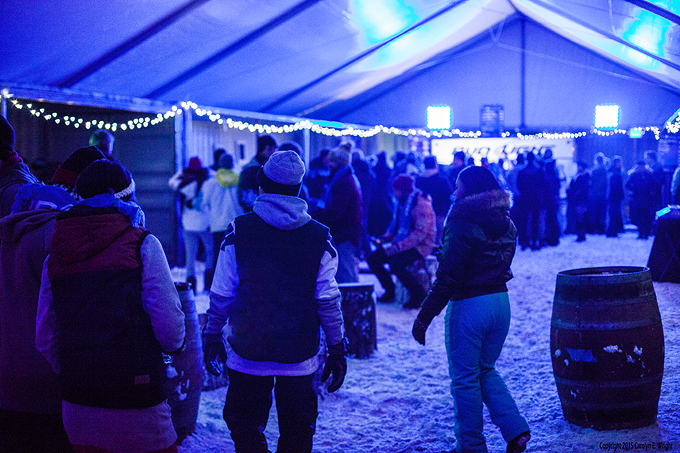
Most people are too busy enjoying the music to worry about the VIP area. Photo Copyright 2015 Carolyn E. Wright

Most people are too busy enjoying the music to worry about the VIP area. Photo Copyright 2015 Carolyn E. Wright

VIP tickets also come with an express line for entrance into the festival, an exclusive lounge, premium view of the main stage, viewing platforms, access to experiential art installations, daily tastings from on-site food vendors, and the opportunity for artist meet and greets, according to the website.

Several people in the VIP area on Dec. 30 told Lake Tahoe News they didn’t believe they were getting their money’s worth and said what was promised was not delivered.

Julia Scheibe, left, doesn't like the changes to this year's VIP perks. Photo Copyright 2015 Carolyn E. Wright

Julia Scheibe, left, doesn’t like the changes to this year’s VIP perks. Photo Copyright 2015 Carolyn E. Wright

“Last year it was double the size, there was better lighting, it was elevated, you could look around. There was a bigger patio,” Julia Scheibe of San Francisco told Lake Tahoe News. “I’m sitting here wondering what I paid for.”

The seat is one thing she paid for. The free warming tents don’t have seating, nor do the two concert tents.

The VIP area is also less crowded. This in turn meant the line at the bar was shorter.

Nick Arbelaez and Stephanie Shamo believe the VIP tent is a quiet spot from the masses. Photo Copyright 2015 Carolyn E. Wright

Nick Arbelaez and Stephanie Shamo enjoy the less crowded spot. Photo Copyright 2015 Carolyn E. Wright

For Nick Arbelaez and Stephanie Shamo of South Lake Tahoe they liked the privacy of the tent – being away from the drugs, fights and crowds, as they put it.

Getting out of the below freezing temperatures (it’s supposed be a low of 8 degrees tonight) was attractive to Ethan Polte and Brittany Fletcher of South Lake Tahoe. The couple had not planned to attend SnowGlobe, but Polte received the two VIP passes as a tip while waiting tables at the Driftwood Café.

Rob Garza keeps his fans warm by creating danceable music. Photo Copyright 2015 Carolyn E. Wright

Rob Garza keeps his fans warm by creating danceable music. Photo Copyright 2015 Carolyn E. Wright

But this isn’t the only venue to get warm. The Igloo Tent in particular with its low ceiling and dancing festivalgoers made it toasty inside. Wall-to-wall people in the two warming tents also provided natural heat beyond the limited heat that was blown in.

Those braving the elements found warmth huddling together in a grove of hammocks. Nearby was a fire art installation that cast off warmth.
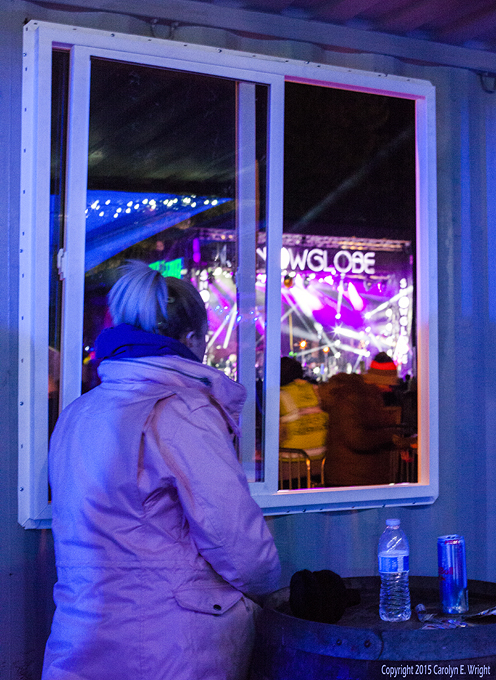
Khloe Layo has a front row seat from the VIP tent to the main stage. Photo Copyright 2015 Carolyn E. Wright

Khloe Layo has an unobstructed view from the VIP tent to the main stage. Photo Copyright 2015 Carolyn E. Wright

This was Khloe Layo’s first experience at SnowGlobe and in a VIP area at any concert. Sitting at one of the three windows she had a direct view to the main stage. It was hard to tell who was on stage, though the music can be heard without any problem. There are no monitors or screens, however, to see what is going on at any of the three stages.

Layo said the best part was having bathrooms out back and not having to wait. What frustrated her was at the entrance she and the other VIP’ers were supposed to have their own line to speed up the process. Instead they were with the throngs of concertgoers.
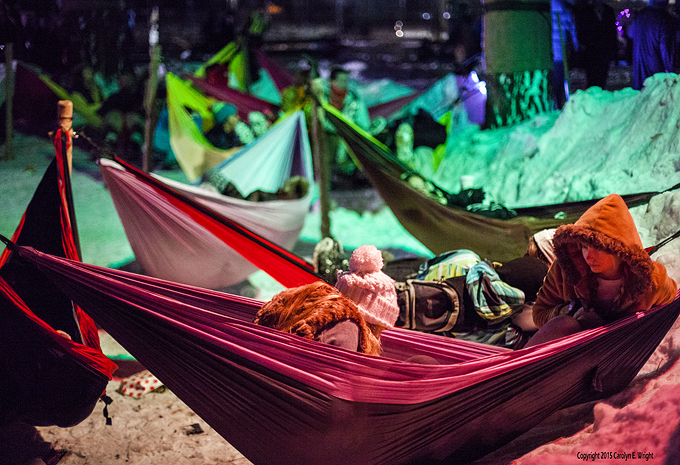
Cozy hammocks are one way to beat the chill. Photo Copyright 2015 Carolyn E. Wright

Cozy hammocks are one way to beat the chill. Photo Copyright 2015 Carolyn E. Wright

One couple from the Bay Area thought they’d be paying extra to have bathrooms beyond regular port-a-potties. Wrong. What they got was a corral of these bathrooms that were not shared with the masses, which meant no lines. They also couldn’t believe how slick the ground was. It wasn’t just the snow. The entranceway and the path to the bathrooms each have a slab of what appears to be metal flooring that is painted. It’s hard to have stable footing on it in wet conditions.

Food was also an expectation of some. Two empty silver serving dishes were next to the bar. When a worker was asked if any food had been served the response at 6:50pm was, “Not yet today.” The event started at 2:30pm.

The VIP area was moved this year to be almost directly behind the main stage. Last year it was on the far side of the field and at a right angle to the stage. There was also a large elevated outdoor area in 2014. This year the crowd penned in at the VIP area was at the same level as the throng of general admission ticket holders.

SnowGlobe officials did not answer Lake Tahoe News’ questions about the VIP area.



Opinion: Legislative concerns for 2016

By Ted Gaines

Jan. 1 marks the New Year and also the day that hundreds of new California laws go into effect. In addition to the changes those laws are supposed to bring, there are other changes on the horizon that could signal a dramatically different state.

2016 is a general election year and numerous initiatives may make it onto the ballot.

Ted Gaines

Ted Gaines

Marijuana could effectively become legal in our state if voters decide to back one of the numerous cannabis-related measures that are in the process of qualifying. I’ve never supported legalizing marijuana or other drugs and think it would be terrible for our state. I’ve heard heartbreaking stories from many of my friends and constituents about how drugs have torn apart their families and ruined young lives. I don’t think we should be doing anything to make it easier for young people to be getting marijuana or any drug, and I’m afraid that’s what would happen if we legalize and culturally normalize marijuana.

From the “I told you so” department, there will also be attempts this year to extend parts of the “temporary” taxes championed by Gov. Jerry Brown in Proposition 30. There is nothing more permanent than a temporary tax, and these efforts to string out Prop. 30 prove that. Remember that the state took in billions in unanticipated revenues last year, but even that isn’t enough to satisfy the big government crowd.

There is yet another initiative that could put more criminals back out onto the street before their sentences are up by changing our Three Strikes law again, which would make our neighborhoods less safe. I opposed Gov. Brown’s “realignment” plan and the pro-crime Proposition 47, and I don’t want to see any more soft-on-crime policies that put our families at risk.

Those are just some examples of big changes that could be coming to our state soon, and it’s not much of an agenda for our state – higher taxes, more drugs and more crime. I know that I’ll be seeing the same set of ideas coming through the Legislature. I will be fighting against it all so that California taxpayers and families aren’t stressed any further.

Last year I tackled a fairly new issue to California that is only going to become more important in the years to come. Drones are amazing tools and toys that have incredible applications that are only now becoming widespread. But they can also do great harm when they interfere with public safety, invade our privacy, or aid in terrorist attacks.

I built a strong, bipartisan coalition for my drone bills last session, bills that would have protected citizens and emergency responders, schoolchildren, and our prison guards and prisoners themselves.

Unfortunately, in spite of the need for these bills and the bipartisan coalition behind them, the governor vetoed them all. But the drone problems are not going away and I’m not giving up. I’ll be introducing those same bills this year and also tackling drone use over critical infrastructure as well as “drone stalking,” where someone uses a drone to harass, stalk or violate a restraining order.

As always, this legislative session I will be fighting to keep taxes down and to keep a tight lid on state spending, and looking for ways to make California the best place for businesses to prosper. A powerful, job-creating private sector will do more for this state than any legislation and I want to make sure that government doesn’t get in the way of prosperity.

Stay tuned for more information on all of these issues this year. Until then, I want to wish each and every one of you a Happy New Year!

Ted Gaines represents the California side of the Lake Tahoe Basin in the state Senate.


Largest national parks hit visitation records

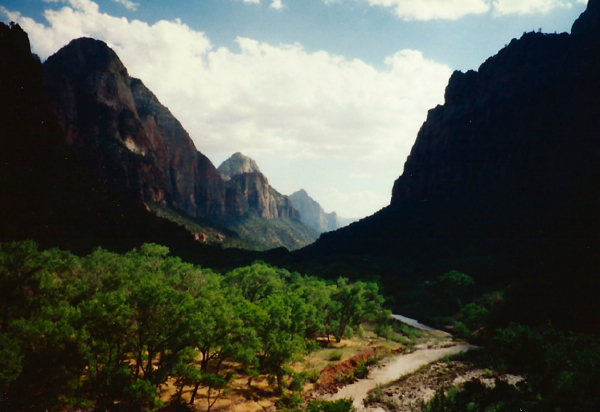
Virgin River in National Park in Utah. Photo/LTN file

Virgin River in National Park in Utah. Photo/LTN file

By Felicia Fonseca, AP

FLAGSTAFF, Ariz. — Many of the country’s most prominent national parks, including Grand Canyon, Yellowstone and Zion, set new visitation records in 2015 and are bracing for what could be an even busier new year.

The National Park Service celebrates its 100th birthday in 2016 and has been urging Americans to rediscover the country’s scenic wonders or find new parks to visit through marketing campaigns that include giving free passes to every fourth-grader and their families.

So the attendance records could be shot lived, with even bigger crowds expected next year.

“Everybody’s getting psyched and ready for it,” said Yellowstone spokeswoman Sandra Snell-Dobert. “We want people to have a good experience when it comes to our national parks. We’re trying to keep that wonderful experience while managing large numbers of people.”

Overall visitation to national parks is on track to hit 300 million in 2015, besting last year’s all-time high of nearly 293 million. Absent December totals, Grand Canyon in northern Arizona hit almost 5.3 million visits. Zion in Utah is over 3.5 million. Yellowstone, which stretches into Wyoming, Montana and Idaho, is nearing 4.1 million. Yosemite in California is about 220,000 visits shy of the 1996 record_4.2 million — with November and December still left to count.

The past year has meant some adjusting for parks as they manage the crowds. Yosemite lowered the entrance fees during the late fall and winter partly to encourage visitors to consider times other than the busy summer. Zion extended its shuttle bus service when the parking lots became too full for people to access the canyon. It also brought in interns to help study peak times.

The Grand Canyon opened up its residential and employee entrance at the South Rim to those who already had passes over holiday weekends and plans to do the same in 2016. It’s also ramped up hiring for entrance gate employees but will move them around jobs so they don’t get burned out, said Grand Canyon revenue and fee business manager Marlon Avantyr.

“We survived this year pretty much unscathed, just tired, but in a good way,” he said. “We have a good plan and a good idea of what to expect, so we’re hoping to stay ahead of the curve.”

More signs around national parks will help direct traffic and officials plan to use social media to help visitors better plan their trips. Park officials say they’ll rely more on seasonal workers, interns and volunteers who might suggest less-busy areas to visit or alternate times. The Park Service’s fiscal year 2016 budget includes $8 million for seasonal employees during the centennial, the agency said.

Some decisions on crowd-management will be made on the fly, said Zion spokeswoman Aly Baltrus.

“We’re constantly looking for what’s needed,” she said. “But at this point we don’t have an influx of funds, so we’re rearranging things as best as we can.”

At nearly 2,000 square miles, the Grand Canyon has plenty of room for visitors to branch out for river trips, backcountry hikes and to dozens of lookout points. However, the South Rim remains the most popular tourist spot. Just this year, the park proposed charging at least $5 for day hikes beyond 5 miles on major trails from the north and south rims to ease congestion.

The upcoming year will bring dark skies programs, a Theodore Roosevelt impersonator and historical steam engines to the Grand Canyon. But it won’t be all about the Grand Canyon. Workers will be talking up other Arizona parks that don’t get as much attention.

“Grand Canyon promotes itself,” said Vanessa Ceja-Cervantes, the park’s centennial community outreach assistant. “We have to do very little to get people to come out to the park.”