EDC taking its time to revamp VHR ordinance
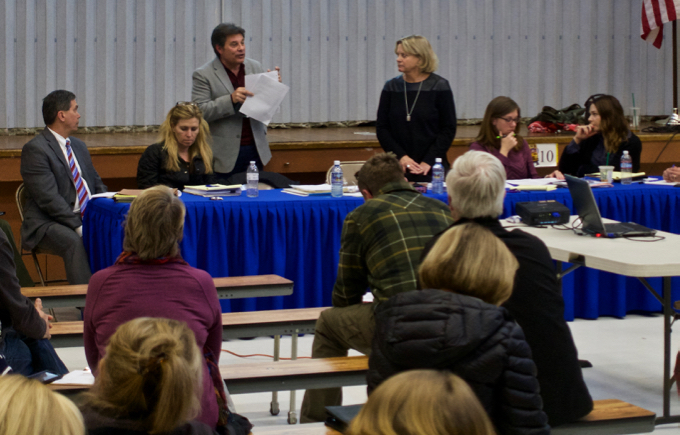
Supervisors Mike Ranalli and Sue Novasel, standing, talk VHRs on April 12. Photo/Kathryn Reed

By Kathryn Reed

MEYERS – At the rate El Dorado County supervisors are dealing with vacation home rentals, it’s possible some of them won’t even be in office before a full ordinance comes up for a vote.

It was more of the same at the most recent meeting on April 12. Supervisors Sue Novasel and Mike Ranalli, who make up the VHR ad hoc committee, and county staff talked and talked; then there were sheets of white paper for the public comment; then those who were still left sitting in the magnet school’s multipurpose room were able to ask questions and express the same concerns they voice every meeting.

Those who are subjected to unruly tourists are fed up and want action now. Those who advocate for these types of rentals worry about what some consider Draconian regulations.

The county has been gathering information about other jurisdictions. Issues being studied include whether events are allowed, quiet hours, limiting overnight guests, having a local contract, fines for owners and renters, and notifying neighbors about a VHR.

The county has an ordinance for short-term rentals for the unincorporated area of the Tahoe basin, but is looking to expand it to the West Slope. The Camino area, which is home to Apple Hill, is the main area with similar issues to Tahoe.

What was disclosed Thursday is the number of permits countywide:

·      November 2017 – 727 active permits, 29 in the process

·      March 2018 – 766 active, 46 in process

·      April 12 – 822 active, 18 in process.

It was noted that whatever changes take place, like the potential of having inspections, this will pertain to future and existing rentals. Having everyone follow the same rules means there is no getting in now to avoid new regulations.

For now, the county is not talking about a moratorium, but it isn’t completely off the table.

According the presentation this week, the goal is to develop a “set of modernized policies and enforcement methods that retain the benefits of VHRs, prevents or mitigates the impact on neighborhoods, and minimizes their impact on public services.” The objectives are to “improve neighborhood compatibility and avoid overconcentration of VHRs and commercialization of neighborhoods.”

What was stressed by the electeds is that enforcement is the critical piece. They don’t want to approve regulations that cannot be enforced.

From July 1, 2017, through March 5, 2018, the county assessed 154 penalties countywide for VHR and transient occupancy tax violations. The cash collected was approximately $37,000, which includes interest.

Increased penalties and fees are something the county is considering. Today the application fee for a VHR permit is $89. This compares to South Lake Tahoe where the fee is more than $400, with an inspection fee close to $150.

The county is looking to have fire districts do the inspections, not building inspectors.

“We have to talk about how we would pay for it,” Lake Valley Fire Chief Tim Alameda told Lake Tahoe News. He attended the latter portion of Thursday’s meeting. He added, “We did a dry run with a couple properties.” His people were looking for “health and life safety types of things.”

The county has had an online survey out for a while asking a variety of questions regarding vacation rentals.

Sue Hennike with the County Administrative Office went over some of the results. Noise was the biggest complaint, with the problem time from 10pm to 2am. However, 40 percent of respondents said noise is never an issue.

—–

Notes:

·      This is the existing ordinance which only pertains to the unincorporated area of the Lake Tahoe Basin.

·      Ad hoc committee meetings:

o   April 23 – meeting in Placerville from 5:30-7:30pm to discuss expanding rules to West Slope.

o   May 9 – meeting in Tahoe from 5:30-7:30pm to talk about parking, traffic and other issues.

o   June 11 – Placerville meeting from 5:30-7:30pm.

o   July 26 – Tahoe meeting from 5:30-7:30pm.

·      Full board of supes to meet in Tahoe on May 2, 6pm at South Tahoe Middle School. VHRs will be the sole topic. Eight recommended changes to the VHR ordinance will be considered then.



Opinion: Taxes won’t solve the CalPERS problem

By Larry Weitzman

Another California city, Santa Cruz, is about to go under. It won’t be from a Pacific tidal wave, but an overwhelming tidal wave of pension costs from CalPERS, which is a direct result of government employee unions and the politicians they buy off.

As reported by the very respected Dan Walters, Santa Cruz pension costs will have risen from 28 percent of General Fund salary in 2004 to 43 percent in 2015 to 58 percent in 2020. It is unsustainable. Most long-term government workers earn more in retirement then they did during their working years.

Larry Weitzman

If you haven’t noticed, the solution has been new and more taxes. El Dorado County is starting to float the idea of a new sales tax and our smaller fire districts have recently done some polling to see if the public would tolerate a sales tax increase to keep those fire districts afloat.

Our fire districts are funded by a portion of our property taxes, about 8 percent, except for the El Dorado Hills Fire District which has a 17 percent property tax funding rate. That rate was set in stone shortly after the passing of Proposition 13 passed in 1978 via a piece of 1979 legislation known as AB8. It turned out the more frugal districts got less of the property tax base and the more wasteful ones got a bigger share as it was based on past history. Typical of wasteful bureaucracy. Consequently, EDH Fire is one fire district that is flush with cash.

A few years ago, in a column, I reported EDH Fire had $13 million of uncommitted cash in the bank. But the other districts rely on funding from the county General Fund to make up their shortfall, which has been a lessening amount. Some “experts” think consolidation is the answer as there are too many chiefs, literally. Also, some feel that there is too much duplication of administration. There might be something to be said for that and perhaps that is part of the answer.

Of course, no small district fire chief wants to lose his/her kingdom or job. Being a fire chief isn’t a bad paying gig. In 2016 for example, Michael Hardy, fire chief of the El Dorado County Fire Protection District had total compensation of about $243,000. Dave Roberts, the retiring, embattled chief of El Dorado Hills Fire earned about $287,000 in 2016 and Robert Combs, chief of the Diamond Springs Fire District, made a paltry $170,000 in 2016. But Combs retired and the new chief, Bryan Ransdell, earned $229,000 for 2016, for a combined $400,000 in fire chief pay for 2016. And the people near the top in our fire districts are not too far behind. Yes, they have a risky, responsible job, but so do roofers.

Instead of fixing the root problem of government pensions running amuck, the easy answer is more and new taxes. That will not fix the problem and neither will new taxes and here is why. The proposals that have been floated by the fire districts are a sales tax increase of about half a percent. For a general sales tax increase it requires majority voter approval. But it would go into the General fund and it would be up to the Board of Supervisors to pass it on to the fire districts of which the board would have no requirement to do so. They could use the money to solve general county fiscal problems or maybe hire another public information officer (spin doctor) to tell its voters why they couldn’t pass it on to the various fire districts. With such a tax there is no guarantee it would benefit the fire districts.

A special sales tax which requires two-thirds voter approval can be earmarked for the fire districts but getting two-thirds voter approval on a new tax is about as likely as Elon Musk flying to Mars next year. Hey, that’s not a bad idea (Musk to Mars).

But there is perhaps a better solution that would protect the fire districts and that is a special parcel (property) tax increase, a flat fee of say $25 on unimproved property parcels and maybe $50 on improved parcels. The money would go directly to the districts and each district would have their own election. Maybe it could be tied to a salary freeze or even reductions of up to 5 percent.

This column is not advocating for a new tax. Fiscal problems should be remedied by eliminating their cause. Until we get a handle on the salary and pension problems in California, new taxes in an attempt to temporarily alleviate the problem does not fix the problem. It only makes it worse by masking the problem. And it is an ugly, scary mask.

Larry Weitzman is a resident of Rescue.


Researchers trying to turn carbon into things they can sell

By Jim Polson, Bloomberg

What if the billions of tons of carbon dioxide pumped out by the world’s power plants could be converted into something that’s more useful? Ten teams will split $5 million to test ways to do just that.

The researchers are developing systems that break down the greenhouse gases to make products ranging from building materials to plastics to chemical feedstocks. They were all named as finalists in the NRG COSIA Carbon XPrize competition, during a session at the BNEF Future of Energy Summit in New York.

The goal is an economically viable system to convert emissions from power plants into commercial product.

Read the whole story


Plan to split Calif. into 3 states may qualify for ballot

By Eric Ting, San Francisco Chronicle
 
Californians may get to vote on a plan to split the state into three smaller states this November.

Venture capitalist Tim Draper, who previously pushed a proposal that would split California into six states, says that his three-state proposal has enough signatures to qualify for the November ballot.

On Thursday, Draper said in a statement that the “CAL 3” initiative has collected over 600,000 signatures from Californians who would like to see the state split into three. An initiative needs 366,000 signatures to appear on the ballot.

Read the whole story


SLTFD offering emergency training for residents

The next South Tahoe Action Team training begins April 18.

South Lake Tahoe Fire Rescue is accepting applications for the four-week disaster training class.

Classes are April 18, April 25, May 2 and May 16 from 5:30-7:30pm.

This program is designed to incorporate trained citizens in the field with SLTFR and other first responders during times of crisis.

Participants will be expected to help in times of natural disaster, large scale emergencies and other times of need in the South Lake Tahoe area. STAT team members will need to be well versed in emergency first aid, lifting/moving techniques, use of extinguishers, flood safety and building collapse.

To register for this free training, contact Capt. Kim George at 530.542.6161 or kgeorge@cityofslt.us.


STHS student recognized as future medical leader

South Tahoe High School junior Alyx Carlson has been selected to be a delegate to the Congress of Future Medical Leaders.

Carlson was nominated by Mario Capecchi, winner of the Nobel Prize in medicine and the science director of the National Academy of Future Physicians and Medical Scientists, to represent California based on her academic achievement, leadership potential and determination to serve humanity in the field of medicine.

This is an honors-only program for high school students who want to become physicians or go into medical research fields. The purpose is to honor, inspire, motivate and direct the top students in the country who aspire to be physicians or medical scientists, to stay true to their dream and, after the event, to provide a path, plan and resources to help them reach their goal.

During the June 25-27 gathering in Lowell, Mass., Carlson will join students from across the country and hear Nobel laureates and National Medal of Science winners talk about leading medical research; be given advice from Ivy League and top medical school deans on what to expect in medical school; witness stories told by patients who are living medical miracles; hear from fellow teen medical science prodigies; and learn about cutting-edge advances and the future in medicine and medical technology.


Variety of events planned for Earth Day in SLT

South Lake Tahoe will be celebrating Earth Day on April 28 at Bijou Community Park.

Earth Day recognizes, celebrates, and promotes the region’s beauty, while educating the public about local environmental issues.

This will be an opportunity to learn about ways to counteract global climate change through recycling and composting, alternative energy, water conservation, sustainability, and reducing one’s ecological footprint.

There will be live music and dance, a kid zone, educational booths and local vendors. Food and local crafts will be available for purchase.

The free event is from 10am-3pm.


Resorts place greater emphasis on snowmaking

By Danny King, Travel Weekly
 
For most of the history of snowmaking technology, the ski industry has viewed it as a plan B effort: filling in bare spots on an occasional warm, dry day in the mountains, especially late in the season. But global warming has changed that view. Increasingly, snowmaking is becoming a ubiquitous component of the ski experience at U.S. resorts large and small.

In announcing its first capital improvement budget since its founding last year, Alterra Mountain Co. made sure to earmark a sizeable part of that budget for snowmaking equipment designed to pick up where Mother Nature leaves off — or has already left off.

Alterra, which owns Squaw Valley and Alpine Meadows, declined to say exactly how much of the $555 million it has budgeted for its dozen North American resorts within the next five years will be dedicated to upgrading the snowmaking systems.

As of today, snowmaking machines can cover about 22 percent of the acreage at U.S. ski resorts, according to the 2016-17 Kottke National End of Season Survey released by the National Ski Areas Association (NSAA).

Read the whole story


Caltrans picks up tons of trash in region

Caltrans is joining forces with state and local agencies, and volunteers across the state to increase public awareness on the volume and cost associated with removing trash along state highways and neighborhood streets as well as in public parks and beaches.

Caltrans District 3 maintenance crews spent Wednesday and Thursday working along highways in Chico, Sacramento, Truckee, Yolo County and Nevada County, collecting 2 tons of old tires and more than 80 cubic yards of litter and debris, enough to fill more than six dump trucks.

Highway litter ranks as the No. 1 complaint by motorists.

Last year, Caltrans District 3 maintenance and Adopt-A-Highway volunteers collected 7,418 cubic yards of trash strewn along 13,314 shoulder miles in Butte, Colusa, Glenn, Sierra, Sutter, Yuba, Nevada, Placer, Sacramento, El Dorado and Yolo counties.

Statewide, Caltrans spent nearly $70 million on litter removal, collecting enough litter, trash and debris from freeways to fill more than 42 Olympic size swimming pools.


Artwork selected for Kings Beach roundabouts

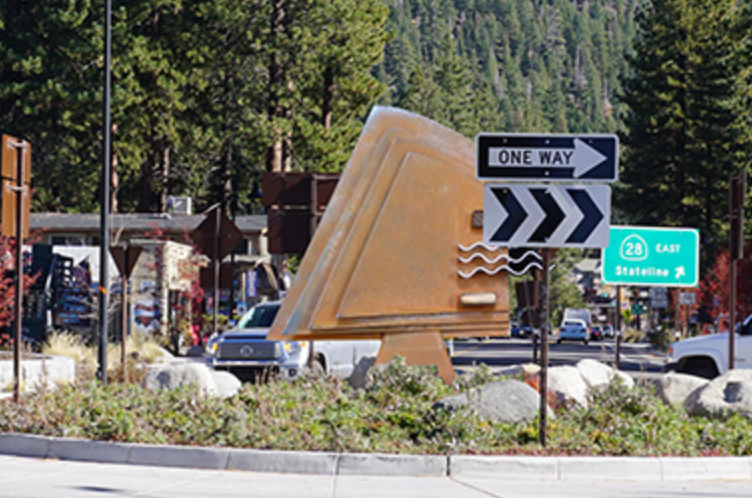
Artist’s rendering of “Daow Aga” that will be placed in Kings Beach

Placer County supervisors this week chose the art for two roundabouts on Highway 28 in Kings Beach.

“Daow Aga” by artist Brett Moten of Reno and “Estrella” by artist Roger Berry of Clarksburg were selected by members of the community through a nationwide search facilitated by Tahoe Public Art.


In June 2017 the Placer County Board of Supervisors approved a grant contract with Tahoe Public Art in the amount of $209,152 to manage installation of the artwork for both Kings Beach roundabouts. The project is funded with transient occupancy tax revenue collected in unincorporated eastern Placer County.

Annual funding of $10,000 for future maintenance will be set aside in the county’s Lake Tahoe tourism and promotions budget.

The project will be submitted to Caltrans for final approval, which expected this summer. Installation is scheduled to be complete by this fall.