New Year’s arrests decline in S. Lake Tahoe

South Lake Tahoe Police Department is reporting fewer arrests this New Year’s period compared to a year ago. No arrests were made in the state line area.

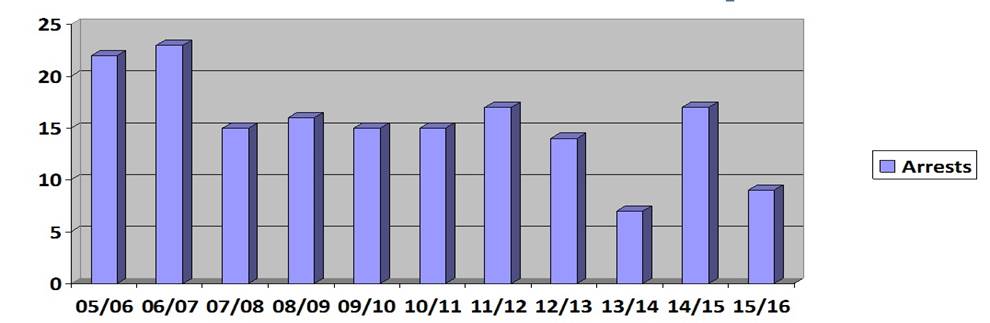
From 12:01am Dec. 31 to noon Jan. 1, officers made nine arrests throughout the city. There were 17 arrests during this same time period last year. Consistent with prior years, the majority of these were for either drunk and disorderly conduct in public or driving under the influence. Some arrests also involved incidents of domestic violence and drug possession.

The totals for all three nights of SnowGlobe:

Arrests:

5 for intoxication

1 for illegal weapon (stun gun)

1 for minor in possession

1 for trespass.

Citations:

104—minor in possession of alcohol

21—ppen container

15—false IDs

4—furnishing alcohol to a minor

3—possession of narcotics

2—minor purchasing alcoholic beverage

1—possession of marijuana

1—parking violation.

There were 19 medical transports from SnowGlobe.

Statistics represent every arrest the South Lake Tahoe Police Department has made, for any type of criminal offense, during New Year’s Eve through New Year’s Day over the past decade.  Source: SLTPD

South Lake Tahoe Police Department arrests for any type of criminal offense from New Year’s Eve through New Year’s Day. Source: SLTPD


Tahoe Donner hosting Winter Festival

Tahoe Donner Cross Country Ski Area will host its inaugural Winter Festival on Jan. 24.

The Tahoe Donner team will introduce participants to the world of Nordic sports and snowshoeing, complete with demonstrations, free equipment demos, discount skiing and live entertainment.

All festival-goers will be treated to:

·         Discounted trail passes to explore up to 100 kilometers of terrain for just $10—regularly $30.

·         Discounted ski or snowshoe rental equipment at $15—regularly $25.

·         Free lessons and tours.

·         Free demo day – cross country ski, snowshoe and fat bike equipment.

Winter Festival is from 11am-3pm at Tahoe Donner Cross Country Ski Area, located at the Alder Creek Adventure Center at 15275 Alder Creek Road, Truckee. To accommodate parking needs, in addition to offering free parking on site, complimentary shuttle service will be provided from The Lodge Restaurant & Pub. For more info, go online.


Dogs face danger in the backcountry

By Benjamin Spillman, Reno Gazette-Journal

For people who love dogs and the Sierra Nevada backcountry it’s tough to imagine a better day than what Don and Polly Triplat planned for one Sunday.

The Truckee couple, two friends and their dog, Scarlet, would spend the day skiing, relaxing and enjoying solitude and views of Lake Tahoe in the Third Creek area near Incline Village.

For the Triplats, both 45-years-old and avid backcountry skiers trained in avalanche safety and wilderness first aid, ski outings with Scarlet and their other dog, Brodie, were rewarding for the whole family.

“It is absolutely a blast to watch your dog slide down a hill in front of you,” said Don Triplat, who is also the executive director of the Sierra Avalanche Center, a non-profit partner with the U.S. Forest Service that provides education on avalanche safety and information on snow conditions in the backcountry.

Read the whole story


Opinion: Why we need to name the dead

By Thomas W. Laqueur

Almost 3,000 migrants have drowned this year trying to cross the Mediterranean Sea from Africa to Europe. Many of their bodies have washed ashore without names. These are bodies of people whose loved ones will never know their fates; they are bodies bereft of the most fundamental attribute of cultural belonging.

A very few have been identified. Italian doctors managed to match a photograph of a young, smiling Eritrean woman dressed in colorful clothes with the teeth of an anonymous corpse, its face frozen in the grin of rigor mortis. This body got back its name and re-entered the order of humanity.

Naming the dead is a great antidote to anonymity and a testament to belonging: Very quickly after the last terrorist attack on American soil—in San Bernardino, California—we got media reports listing the 14 people killed; we’ve built important public memorials in the last 50 years comprised of great assemblages of the names of the dead. Two thousand nine hundred and forty-two of them are at the heart of the National September 11 Memorial and Museum in New York. They are organized into nine broad categories—those who worked in Tower 1, first responders, crew and passengers of United Airlines Flight 175, for example—and within each category by more refined classifications—those who worked together, first responders from a particular agency, the crew of Flight 175. Next of kin were allowed to suggest the proximity of particular names, so that close friends and colleagues could be closer to one another here, too. These naming practices restore the dead to the places they once held in the social world of the living.

Resting beneath the great panels of names are the remains of 1,115 unidentified bodies; 7,930 plastic envelopes of unidentified bone fragments joined them in 2014. The names of the dead are thus as near to the bodies they have lost as forensic science and aesthetic ingenuity allow.

Maya Lin’s stunning Vietnam Veterans Memorial in Washington, D.C., is, of course, centrally about names. These are organized chronologically into the deathly contours of the unfolding of war; the wall is at its tallest for the period of greatest numbers of fatalities. Visitors see themselves reflected in the names; they trace names on paper; they leave gifts and notes in front of particular panels for the person remembered by an inscribed name. The exact locations of the bodily remains of most of these names are known, but 1,626 of the names on the black shiny marble wall represent bodies that are lost—disappeared. The only trace of their existence is the inscriptions of their names on this memorial.

This sort of recuperative attention to the names of the dead is found not only in great public places. It informs smaller and more intimate settings. Woody Guthrie’s last great protest song, “Deportee (Plane Wreck at Los Gatos),” for example, is about the 28 unnamed Mexican workers who went down in flames in Los Gatos Canyon near Coalinga in 1948:

Goodbye to my Juan, goodbye, Rosalita, / Adios mis amigos, Jesus y Maria; / You won’t have your names when you ride the big airplane,/All they will call you will be “deportees”

The names of the pilot and security guards on this tragic flight were printed in the New York Times and other papers; the 28 Mexicans were buried anonymously. These dead, seen as beneath notice, were buried anonymously in a mass grave—“Mexican Nationals 1-28”—in a nearby Catholic cemetery. Sixty years later, through the efforts of the poet and performer Tim Hernandez and an aged cemetery worker, their names were recovered. A proper memorial was built. The site became a place around which the dead hovered: “Abuelo, Tio, estoy aquí” (Grandfather, Uncle, I am here). The nameless had a resting place: “Mi’jo, I can go in peace now that I know where my brother was buried.”

In 2013, Hernandez and the Fresno musician Lance Canales recorded a new version of “Deportee” in which the individuals’ names are all sung.

There have been many such efforts to name the dead in the last few decades, large and small. Advocates for the anonymous dead buried in a potter’s field on New York City’s Hart Island have recovered 63,694 names out of nearly 1 million nameless bodies that have been buried there since 1868. This past summer, as a result of the settlement of a lawsuit brought by the ACLU, relatives of those who think they have kin on the island gained the right to visit and mourn. From 2003 to 2007, Castro Valley police and community groups spent hundreds of hours and tens of thousands of dollars to discover the name of an anonymous Latina found dead on the city’s streets. They succeeded; the body was returned to her family in Mexico.

Our interest in commemorating the dead through the recovery of their names dates back to the 19th century. Before then, soldiers were usually buried anonymously where they fell, and even many private graves were only minimally marked. The American Civil War was a turning point. A great web of emotion—letters, poems, and novels—made the anonymous death of soldiers unacceptable in the public and private spheres. Gettysburg was the first national cemetery in the modern world and was modeled on the one on the site of the Battle of Marathon—where the Athenian soldiers who died defeating the city’s great Persian enemy are buried.

But World War I was an even more decisive moment. The period after the war witnessed the creation of many naming monuments, the largest of which at Thiepval listed 72,195 British soldiers who died in the Battle of the Somme and whose bodies were either nameless—the unknowns—or lost—disappeared into the muck. Starting in the early 1920s, Britain, France, the United States, and other countries erected tombs of an “Unknown Soldier,” a body that in its eternal anonymity represented all such bodies. These memorials became hallowed ground.

An easy answer to why individual names have become so much a part of our commemorative culture is the rise of democracy Every one of us deserves individual remembrance. True enough, but it only gets us so far. More important is the claim, made by more and more groups—descendants of slaves and migrants, families of ordinary office workers and common soldiers—that their dead, too, had lives worth noting and have a right to public recognition, to a place among the living. If the 19th century was the great age of the monument to civic worthies, the 20th is the age of the universal right to a name worth remembering. The state that had conscripted millions of young men to die for its sake recorded their names as evidence of national belonging and sacrifice. But more importantly, beginning with the Civil War, ordinary people began to feel that each and every life has a claim to a denouement—to a known and knowable death.

Thomas W. Laqueur teaches history at UC Berkeley. He is the author most recently of “The Work of the Dead: A Cultural History of Mortal Remains”, which was published by Princeton University Press in October.


Damage from sinking land costing Calif. billions

By Scott Smith, AP

A canal that delivers vital water supplies from Northern California to Southern California is sinking in places. So are stretches of a riverbed undergoing historic restoration. On farms, well casings pop up like mushrooms as the ground around them drops.

Four years of drought and heavy reliance on pumping of groundwater have made the land sink faster than ever up and down the Central Valley, requiring repairs to infrastructure that experts say are costing billions of dollars.

This slow-motion land subsidence — more than one foot a year in some places — is not expected to stop anytime soon, experts say, nor will the expensive repairs.

“It’s shocking how a huge area is affected, but how little you can tell with your eye,” said James Borchers, a hydro-geologist, who studies subsidence and says careful monitoring is necessary to detect and address sinking before it can do major damage to costly infrastructure such as bridges and pipelines.

Land subsidence is largely the result of pumping water from the ground. As aquifers are depleted, the ground sags.

The most severe examples today are in San Joaquin Valley, where the U.S. Geological Survey in 1975 said half of the land is prone to sinking. USGS researchers later called it one of the “single largest alterations of the land surface attributed to humankind.”

A sparse mountain snowpack in California’s driest four-year span on record has forced farmers in the Central Valley, the nation’s most productive agricultural region, to rely on groundwater to irrigate their crops.

Drought has spawned a well-drilling boom with some tapping ancient aquifers 3,000 feet down.

In wet years, groundwater provides about 40 percent of water used in California, but in times of drought, groundwater can amount to 65 percent of the state’s water supply.

Decades of over-pumping have destroyed thousands of well casings and buckled canal linings. To keep water flowing through low spots, irrigation districts raise the sides of sagging canals so they can increase the water level and maintain a gravitational flow.

As a result, at least one bridge now sits below the waterline. Chris White, general manager of the Central California Irrigation District in Los Banos, said replacing it is expected to cost $2.5 million. Rebuilding another canal recently cost $4.5 million.

Putting a grand total on damage from subsidence in California is tricky because irrigation districts don’t often single out repairs required by subsidence from general upkeep, said Borchers, who estimates long-term costs as being “probably in the billions.”

Subsidence has been a problem for decades, and it’s accelerating. Last year near Corcoran, the land sank 13 inches in eight months, researchers at NASA’s Jet Propulsion Laboratory found by comparing images collected over time from satellites and airplanes.

Parts of the California Aqueduct, a massive canal that delivers water 400 miles to Southern California, also sank by nearly 13 inches, the NASA research shows.

This has cost the state of California “tens of millions of dollars” in repairs to the aqueduct in the last 40 years, and officials expect to spend that much in the future, said Ted Thomas, a spokesman for the state’s Department of Water Resources.

California became the last state in the West to regulate groundwater when Gov. Jerry Brown last year signed legislation ending a Gold Rush-era policy that generally let property owners take as much as they wanted. But local agencies have until 2040 to put groundwater management plans into effect.

Farmers and irrigation districts are not the only ones taking note of sinking land. Spokesman Greg Snapper said Pacific Gas & Electric Co. has not sustained any broken natural gas pipelines from sinking land in the Central Valley, but it monitors the lines and this year started using NASA’s satellite research as part of that effort.

A 60-mile stretch of California’s High Speed Rail track, designed to whisk passengers through the Central Valley in excess of 200 mph, will be built on a bed of rocks. This design is more forgiving and easier to maintain and repair if the land sinks than other stretches built on highway-like slabs, said Frank Vacca, the rail authority’s chief program manager.

Sinking land has stopped work on part of a historic project to return water flows to an irrigation-depleted section of the San Joaquin River. Before construction of a passageway for fish can begin, officials need to assess how fast the land will sink in the future, said Alicia Forsythe of the U.S. Bureau of Reclamation.

With a wet El Nino winter forecast, geologists also worry that subsidence in a flood control channel elsewhere on the river may cause water to pool, prompting flooding rather than flow toward the sea.

“We haven’t had to use it for a while,” said Michelle Sneed, a USGS subsidence researcher. “We’ll see how that’s going to perform this year, if it’s called upon.”


Pot industry tries to build brands

By Kristen Wyatt, AP

DENVER — Snoop Dogg has his own line of marijuana. So does Willie Nelson. Melissa Etheridge has a marijuana-infused wine.

As the fast-growing marijuana industry emerges from the black market and starts looking like a mainstream industry, there’s a scramble to brand and trademark pot products.

The celebrity endorsements are just the latest attempt to add cachet to a line of weed. Snoop Dogg calls his eight strains of weed “Dank from the Doggfather Himself.” Nelson’s yet-to-be-released line says the pot is “born of the awed memories of musicians who visited Willie’s bus after a show.”

The pot industry’s makeshift branding efforts, from celebrity names on boxes of weed to the many weed-themed T-shirts and stickers common in towns with a legal marijuana market, show the industry taking halting steps toward the mainstream.

Problem is, those weed brands aren’t much more substantial than the labels they’re printed on. Patents and trademarks are largely regulated by the federal government, which considers marijuana an illegal drug and therefore ineligible for any sort of legal protection. The result is a Wild West environment of marijuana entrepreneurs trying to stake claims and establish cross-state markets using a patchwork of state laws.

The result is that consumers have no way of knowing that celebrity-branded pot is any different than what they could get in a plastic baggie from a corner drug dealer. And people in the business are relying on a patchwork of state-level laws to try to stake claims and establish cross-state markets.

“You can’t go into federal court to get federal benefits if you’re a drug dealer,” said Sam Kamin, a University of Denver law professor who tracks marijuana law.

That doesn’t mean that the pot business isn’t trying.

Hundreds of marijuana-related patents have likely been requested by the U.S. Patent and Trademark Office, according to those who work in the industry. Exact numbers aren’t available because pending patent information isn’t public.

So far federal authorities have either ignored or rejected marijuana patent and trademark requests, as in the 2010 case of a California weed-delivery service that applied to trademark its name “The Canny Bus.”

“They haven’t issued a single patent yet. But generally speaking there is broad agreement within the patent law community that they will,” said Eric Greenbaum, director of intellectual property for Ligand Pharmaceuticals, Inc., which is seeking a patent for a strain of marijuana to treat seizures that it has developed in Minnesota.

Companies like Ligand are betting that if marijuana becomes nationally legal, they’ll be first in line to claim legal ownership of whichever type of marijuana they’ve already developed.

Pot companies are also filing state-level trademarks, thereby avoiding the snag in a federal trademark application: the requirement that the mark is used in interstate commerce, which remains off-limits for pot companies. In Colorado, for example, there are nearly 700 trade names and 200 trademarks registered that include the word “marijuana” or a synonym, Kamin said.

Marijuana producers are also claiming everything they can that doesn’t involve actual weed. So a pot company could trademark its logo, or patent a process for packaging something, without mentioning that the “something” is marijuana.

The marijuana industry certainly has been on the receiving end of legal threats from other companies that do have trademark and patent protection. Cease-and-desist letters aren’t uncommon in the mailboxes of marijuana companies, whether it’s for making a candy that looks like a non-intoxicating brand, or for selling a type of pot that includes a trademarked word or phrase in its name.

The Girl Scouts of the U.S.A., for example, says it has sent dozens of cease-and-desist letters to those selling a popular strain of pot known as Girl Scout Cookies, or another called Thin Mints.

“The use of our trademarks in connection with drugs tarnishes the Girl Scouts name,” the organization says in the letter it says it has sent to pot sellers primarily in California, Colorado and Washington.

And last year, Hershey Co. sued two marijuana companies in Colorado and Washington for selling “Reefer’s” peanut butter cups and “Dabby Patty” candies, which resembled Hershey’s Reese’s Peanut Butter Cups and York peppermint patties. Both pot companies agreed to stop selling the products and destroy any remaining inventory.

But the industry can’t use those same laws to protect its own brands.

“We’re in a new industry, where the benefits of federal protection aren’t open to us,” said John Lord, CEO of LivWell, a 10-store chain of Colorado marijuana shops that recently entered an agreement to sell Leafs By Snoop, the entertainer’s new line of marijuana.

Decades ago, Kamin said, pot smokers simply asked a black-market dealer for marijuana. These days, in those states that allow marijuana sales for either medical or recreational purposes, those smokers now may ask for a calming indica or energizing sativa strain of pot.

Which leads back to the Colorado pot shop selling Leafs By Snoop.

LivWell grows the Snoop pot alongside many other strains on its menu. But it charges up to $175 more an ounce for the Snoop brand, which is sold from behind a glittery in-store display, similar to what you’d see in a grocery store marketing a certain type of soda or soup.

“Brand differentiation is the normal progression of events,” said Lord, who wouldn’t share sales figures on the Leafs By Snoop pot but says its performance has been “outstanding.”

“Consumers will see more and more of this in the future.”


Gaines: Drone rules need to be tighter

By Jacob Pramuk, CNBC

States should take action to regulate drones when federal rules fail to address their concerns, one California lawmaker said this week.

Last week, the Federal Aviation Administration opened its consumer drone registry to keep track of the devices amid some potentially hazardous flights. While the agency has previously set other guidelines and is crafting preliminary rules for commercial use, its regulations remain unclear, contended Ted Gaines, a Republican state senator who represents Lake Tahoe.

“The action that they are taking, I don’t think fully addresses the issue,” Gaines, who has attempted to push multiple drone bills through the California Legislature, said on CNBC’s “Closing Bell.”

Read the whole story


New Year’s Eve not an easy task for cops

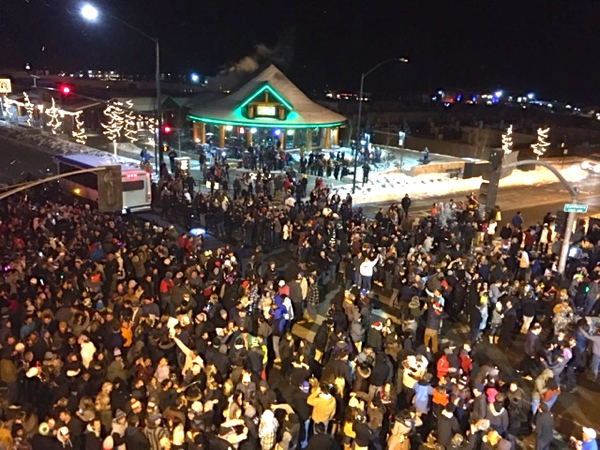
New Year's Eve rvelers take over Highway 50 near the state line. Photos/Kathryn Reed

New Year’s Eve revelers take over Highway 50 near the state line. Photos/Kathryn Reed

By Kathryn Reed

STATELINE – For those who came to the South Shore to party in the streets, the experience may have been a bit anticlimactic on New Year’s Eve.

It took coaxing from less than a handful of instigators to get the crowds that had been pouring out of the Stateline casinos into the sidewalks to actually celebrate in the middle of Highway 50. This was three minutes before midnight. Law enforcement officers were joking among themselves whether this was going to be the first year since 1976 that the highway wasn’t closed.

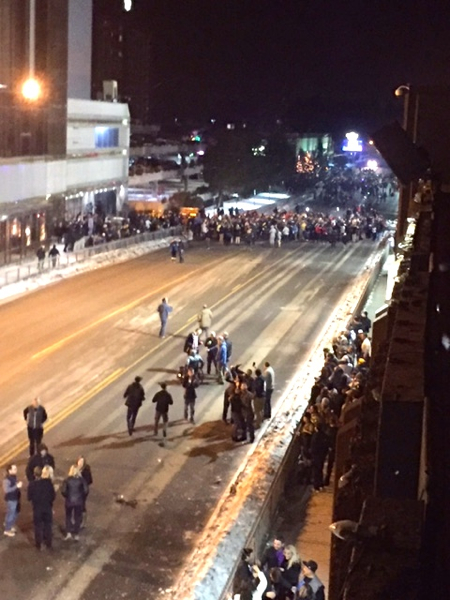
That didn’t come to be. But it was one of the shortest closures. The single-digit temperatures undoubtedly had people seeking shelter moments after ringing in the New Year. Plus, there weren’t that many people. The whole street wasn’t even full. A few people chanted “USA” and then a few counted down from 10 to the New Year.

Douglas County Sheriff Ron Pierini said only a handful of deputies were working on that first New Year’s Eve when the highway was closed by people – not an official act by deputies. The loop road as it is today didn’t exist. People were trying to overturn the cars that got stuck in the sea of humans.

“It really turned into crap,” is how Pierini described 1977.

Crowds are minimal in Stateline for New Year's Eve 2015.

Crowds are minimal in Stateline for New Year’s Eve 2015.

A year later the loop road was built. That allowed officers to deliberately shutdown Highway 50 and still have traffic flow.

“In 1978 there were 2,000 people and we thought that was a lot of people. And we closed the road,” Pierini told Lake Tahoe News from the command post on Dec. 31.

The post isn’t in the same place each year. The non-descript location includes a table with men in uniform. Radios are their lifeline to knowing what is going on outside.

Briefings started earlier in the day and were conducted on the hour as more manpower came on board. New Year’s Eve is one of those all-hands-on-deck events.

The approach to New Year’s Eve has evolved to where it is a coordinated effort between DCSO, South Lake Tahoe Police, El Dorado County Sheriff’s Office, California Highway Patrol, Nevada Highway Patrol, South Lake Tahoe Fire Department, Tahoe Douglas Fire Protection District, and Alcohol and Beverage Control.

“We prepare for the worst case scenario,” South Lake Tahoe Police Chief Brain Uhler told Lake Tahoe News. That includes mass casualties. “We want to be prepared for anything.”

He said it’s normal after a major incident anywhere in the world that the No. 1 problem was lack of communication. The guys in Tahoe aren’t going to let that be true here.

New this year is Lake Tahoe Hard Rock had music out front. A disc jockey was spinning tunes from the balcony as a small crowd danced and others stayed warm by the fire pits.

Officers knew with this being the first year for McP’s Pub to be open at its new, larger location it might become a gathering place for revelers. This year, though, the crowds didn’t materialize there.

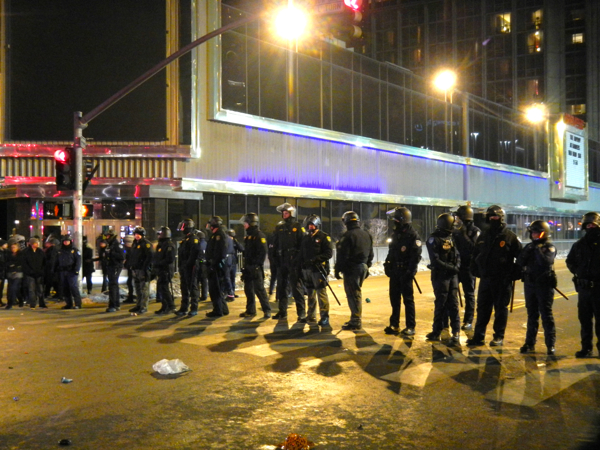
Driving through Stateline before midnight Uhler noticed the berms on the Nevada side. Those chunks of snow would feel like being pelted by rocks if someone starts to throw them. This was one reason some of the officers were in riot gear – it’s all about being prepared for the unexpected.

Officers were out on foot patrol in groups. Others were in plain clothes mixing in with the masses.

“It’s good to have eyes and ears among the crowd,” Uhler said.

A coordinated tactical approach is taken to ensure the safety of celebrants, innocent bystanders and officers.

There’s a place for officers on each side of the state line to get warm, grab some coffee and food.

Officers stand guard before Highway 50 is reopened shortly after New Year's.

Officers stand guard before Highway 50 is reopened shortly after the New Year.

The rowdiness, even on warmer nights, has subsided through the years. A zero tolerance of glass on the street has helped. Casinos serve drinks in plastic containers. Setting up multiple locations to book people saves on manpower being taken away from ground zero.

“The last couple of years the crowds as the casino do their thing and then go back in. It’s an older group of people,” Uhler said. “They are not causing us near the trouble as the past.”

In the 1990s the crowds peaked at 80,000. Last year Pierini estimates it was closer to 30,000. If there were that many in town last night, most stayed inside the casinos. Only a few thousand braved the cold this year.

SnowGlobe is given a ton of credit with helping take people away from the casino corridor.

But SnowGlobe is still a major issue, especially for South Lake Tahoe officers. The three-day event at the community ball field at Lake Tahoe Community College culminates New Year’s Eve. This was the first year people crashed the music festival by knocking down temporary fencing. The main stage ended sooner than the two smaller ones – another first – to allow for a staggered exit. More buses and more security this year helped law enforcement not have to deal with as much.

As the concertgoers are bused back to the transit center most then walk to their hotels in the Stateline area. Law enforcement calls this the “zombie walk” because all aren’t in great shape.

But the night isn’t over for officers after the road closure and SnowGlobe are done with. People tend to keep partying. Officers keep dealing with issues long into the morning of New Year’s Day.


Chamber mixer benefits South Shore charities

The Jan. 14 Lake Tahoe South Shore Chamber of Commerce mixer is all about raising money for Bread & Broth and Christmas Cheer

The 5:30-8:30pm event is at the Riva Grill in South Lake Tahoe.

Guests are encouraged to bring non-perishable food items to receive additional raffle tickets.

The cost is $20 for members, $30 for non-members; which includes one drink ticket and two raffle tickets.


Nev. distillery, winery now a national historic place

By Mike Higdon, Reno Gazette-Journal

The Douglass-Frey Ranch, home of Churchill Vineyards and Frey Ranch Estate Distillery in Fallon, was added to the National Register of Historic Places last month. The National Register is the nation’s official list of properties worthy of preservation.

The Douglass Mansion, the centerpiece of the ranch, was designed by Nevada-architect Frederick DeLongchamps. DeLongchamps is also well-known for designing Reno’s original Main U.S. Post Office, now a retail center, and Second Judicial District Court house in downtown Reno. DeLongchamps designed more than 40 other buildings in the region, most of which are listed in the National Historic Register of Places.

DeLongchamps designed the mansion in the Prairie style, a style of architecture popularized in the American Midwest in the early 1900s by Frank Lloyd Wright. Prairie-style homes are extremely rare in Nevada, according to the historic register, and the Douglass Mansion stands as the only known project of that style completed by DeLongchamps.

Read the whole story