Snowshoe on top of the Sierra Mountains
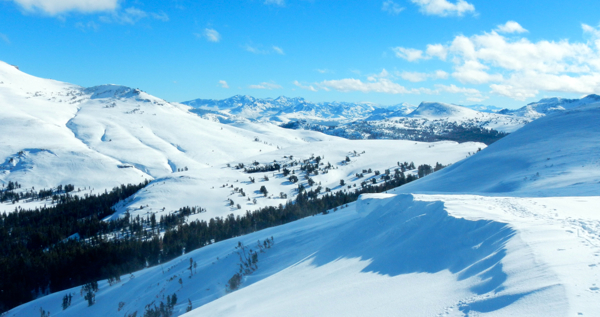
Snowy mountains for as far as the eye can see. Photo/Kathryn Reed

Snowy mountains for as far as the eye can see. Photo/Kathryn Reed

By Kathryn Reed

KIRKWOOD – Temperatures hovering closer to zero than above freezing couldn’t put a chill on the views that spilled forth.

For 360 degrees it was a winter wonderland. It was like being in the middle of the Sierra with mountains as far as the eye could see.
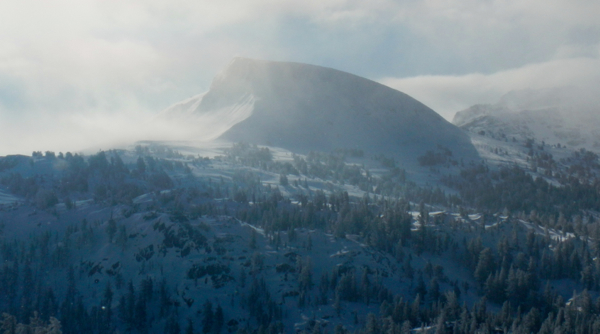
Elephants Back stands out across the other side of Highway 88.

Elephants Back stands out across the other side of Highway 88.

Distinguishable landmarks dotted the landscape – Elephants Back, the runs at Kirkwood, Little Round Top, Round Top, Hawkins Peak and others.

Meiss Meadow didn’t look much different than Caples Lake, which was covered in ice and snow.

The view to the sapphire colored Lake Tahoe may have been similar to what Gen. John Fremont saw when he first laid eyes on this alpine wonder.
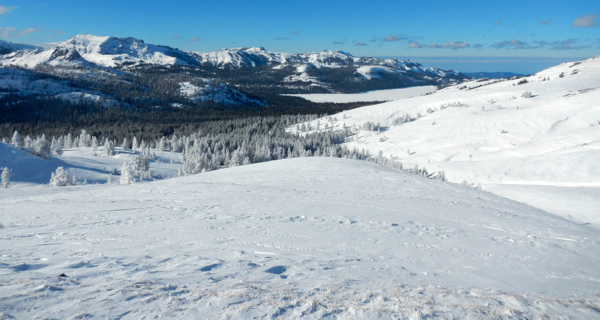
Caples Lake in the distance is popular with ice fishermen this time of year. Photo/Kathryn Reed

Caples Lake in the distance is popular with ice fishermen this time of year. Photo/Kathryn Reed

What a glorious way to welcome 2016.

Five of us spent the morning of Jan. 1 on an incredible snowshoe in the Carson Pass-Kirkwood cross country ski area. Plenty of tracks could be seen, presumably mostly from backcountry skiers. For the most part we were breaking trail. We knew where we wanted to go, but there was no set path to get us there. That just added to the fun.

At the bug station in Meyers it was minus 7 degrees as we drove through. At the starting point it was 10 degrees and had warmed to 22 by the time we were done. What a thermometer would have read on the ridge with the wind howling to the point it seemed to take our breath away, well, it’s probably better we didn’t know.
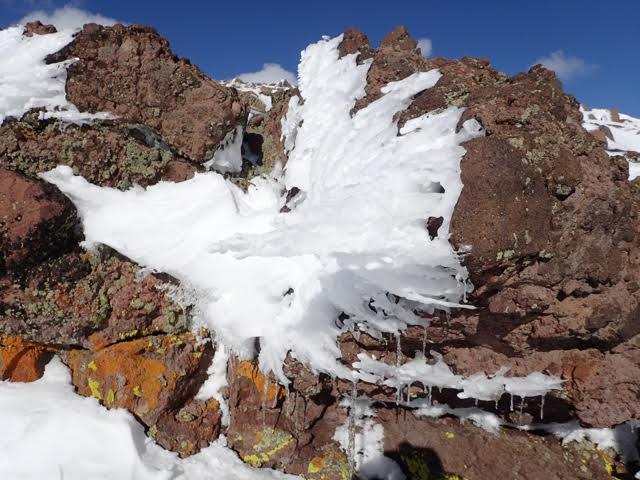
Ice formations on rocks along the ridgeline. Photo/Donna Rockwood

Ice formations on rocks along the ridgeline. Photo/Donna Rockwood

That wind whipped ice formations onto rocks in what looked like works of art, especially with the orange lichen nearby.

At times the snow was so hard our snowshoes made no indentation, while other times it was like floating on idyllic powder, and in other spots it was a crusty layer we punched through.
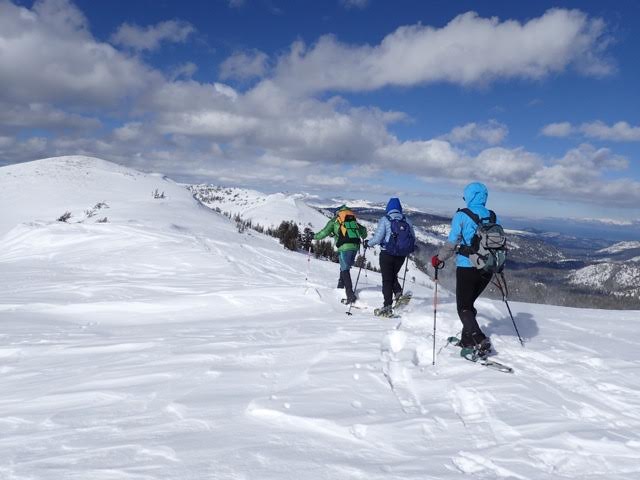
Craig, Carolyn and Kae make their way through what much of the way was a powdery oasis. Photo/Donna Rockwood

Craig, Carolyn and Kae make their way through what much of the way was a powdery oasis. Photo/Donna Rockwood

From the trailhead we headed nearly straight up and then to the left toward the ridge we knew we wanted to trek along. Had we continued, Little Round Top would have added at least another three miles to our journey. We opted to drop down into a bowl.

At the bottom we hooked up with the groomed trails of Kirkwood cross country before we made our way to the maintenance station where we had left a vehicle.

In all, we went 6.55 miles. We started at 8,573 feet and reached 9,444 feet. We gained 1,654 feet in elevation, and descended 2,267 feet.
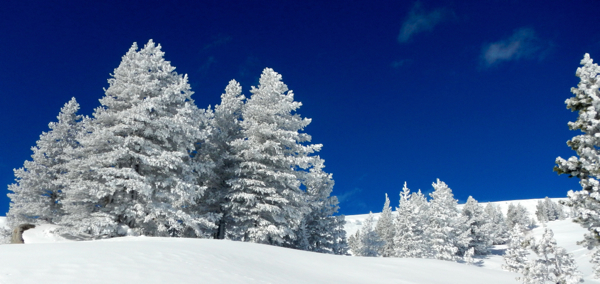
Frosty trees dot the landscape. Photo/Kathryn Reed

Frosty trees dot the landscape. Photo/Kathryn Reed

—–

Getting there:

From South Lake Tahoe take Highway 50 west through Meyers. Turn left onto Highway 89. At Pickett’s Junction, turn right onto Highway 88. Go past the parking area atop Carson Pass. We started at Meiss Trailhead, which is on the right. We left a car at the Caltrans maintenance station farther down Highway 88.


Opinion: Millennials’ spending, values not in sync

By Cherri Senders, Sacramento Bee

If you talk to young people today about issues such as economic inequality or climate change, you will usually hear them profess deep concern. A survey released earlier this yearfound that economic and social inequality topped millennials’ list of concerns, followed by climate change.

But the values embraced by those in their 20s and early 30s are not always in sync with their behavior, especially on inequality.

A case in point is the wild popularity of Uber, Airbnb and other pillars of the “sharing” economy. While millennials are big users, Uber has come under increasing criticism for using independent contractors to avoid providing benefits to drivers, and Airbnb has been assailed for exacerbating the shortage of affordable housing in cities where housing costs are already sky high.

Read the whole story


Men’s version of almost everything is cheaper

By Danielle Paquette, Washington Post

Radio Flyer sells a red scooter for boys and a pink scooter for girls. Both feature plastic handlebars, three wheels and a foot brake. Both weigh about five pounds.

The only significant difference is the price, a new report reveals. Target listed one for $24.99 and the other for $49.99.

The scooters’ price gap isn’t an anomaly. The New York City Department of Consumer Affairs compared nearly 800 products with female and male versions — meaning they were practically identical except for the gender-specific packaging — and uncovered a persistent surcharge for one of the sexes. Controlling for quality, items marketed to girls and women cost an average 7 percent more than similar products aimed at boys and men.

When asked about the price differences of other gendered toys — like the Raskullz shark helmet ($14.99) and the Raskullz unicorn helmet ($27.99) or the Playmobil pirate ship ($24.99) and the Playmobil fairy queen ship ($37.99) — the representative pointed to a company statement, declining to elaborate: “Our competitive shop process ensures that we are competitively priced in local markets. A difference in price can be related to production costs or other factors.”

Read the whole story


Rubio, Cruz vie for Mormon support in Nevada

By Kurtis Lee, Los Angeles Times

Deep divisions among Nevada Republicans over a $1-billion tax increase pushed by the state’s Republican governor are helping to shape the battle between Sens. Marco Rubio of Florida and Ted Cruz of Texas
to win this state’s presidential caucuses — the first nominating contest in the West.

Rubio’s backers are eagerly eyeing Nevada as they look for an early-voting state the candidate could win. Although Rubio is widely seen as one of the leading contenders for the GOP nomination, the early primary states mostly look unpromising for him.

Cruz, by contrast, leads the polls in Iowa, which holds the first contest of the season on Feb. 1, and is well-positioned in several other conservative states that hold early contests.

Read the whole story


New laws in 2016 for Nevadans

By Sandra Chereb, Las Vegas Review-Journal

CARSON CITY — Dozens of new laws dealing with police body cameras and elections to industrial hemp and craft pickling will take effect in Nevada at the stroke of midnight.

Here is an overview of some the 50 new laws that will become effective Jan 1, 2016:

Elections, lobbying

Nevada voters may soon forgo receiving paper sample ballots in the mail. Assembly Bill 94 authorizes local election officials to set up systems allowing voters, upon request, to receive sample ballots electronically, either by email or through website access.

Assembly Bill 462 makes several changes to election law. It raises to 3,000 from 1,500 the maximum number of voters in a precinct and imposes new measures to verify voter identity. If signatures do not match, voters may be asked to answer questions about personal data on their voter registration application or provide other proof of identity.

Read the whole story


What 2016 will do to your checkbook

By Sarah Skidmore Sell, AP

Wondering how you will fare financially in 2016? Below are what experts think next year will hold for financial matters close to home: Raises, rent, gas, food and health.

Will you get a raise in 2016?

Maybe.

Wage growth has been perhaps the job market’s biggest weakness since the recession ended. Pay increases have been both slow and uneven, highly dependent on your field of employment. And for many, it has not been enough to keep pace with the cost of living.

In November, average hourly earnings climbed 2.3 percent from a year earlier, according to the government’s most recent report. But that is only about two-thirds the roughly 3.5 percent typically seen in a strong economy.

Many economists are optimistic Americans’ pay will start growing faster soon because hiring has been good and layoffs have been low. But that’s been the case for a while, and wages haven’t taken off yet.

Joseph LaVorgna, chief U.S. economist at Deutsche Bank, is not expecting major gains ahead. He notes that measures that include a broader mix of compensation beyond hourly wages show there’s even less growth in pay than it seems.

“I’m not convinced things are going to grow as much as I would like them to,” he said.

Will my rent go up?

Yes, most likely.

It’s been a tough few years for U.S. renters because demand has outpaced supply, causing prices to rise.

Rents increased 4.5 percent in October, 5.3 percent in September and 6.2 percent in August, according to real estate data firm Zillow. The median rental payment nationwide was $1,382 in October, roughly 30 percent of the median U.S. family income and high enough for the government to consider it financially burdensome. Over the past decade, that number of renters spending over this threshold on rent has jumped from 14.8 million to 21.3 million, or 49 percent of all renters.

There are more rent increases anticipated ahead.

“Rents are expected to rise in virtually all major cities in 2016,” said Hessam Nadji, senior executive vice president with commercial real estate services firm Marcus & Millichap.

Some small consolation: While rents will still rise, the pace of rent growth will slow modestly from the exceptional levels set in 2015 as new construction creates more housing competition, Nadji says.

Will gas prices stay low?

Yes, most likely.

Oil prices have plummeted over the last year, a result of high global supplies and weaker demand than expected. U.S. drivers are paying less than $2 a gallon on average for the first time since the Great Recession. Seasonal factors and volatile oil prices will push prices up and down throughout the year, but overall prices are expected to remain low compared with recent years.

The Energy Department forecasts an average of $2.37 a gallon next year, which would be the lowest annual average since 2009.

Tom Kloza, head of energy analysis at the Oil Price Information Service, said drivers should expect lower lows and higher highs at the pump in the year ahead, but he doesn’t expect the price of a gallon of gasoline to go over $3 at any time in 2016.

“Nationally we are looking at a year that is very similar to the year we are ending,” Kloza said.

What about food?

New year, same dish.

Food prices should rise at a rate near the historical average, according to the USDA’s forecasts.

The United States Department of Agriculture’s Economic Research Service anticipates the price for food will be up 2 to 3 percent for 2016, same as 2015 and in line with the 20-year historical average of 2.6 percent. That includes food people consume at home and out at restaurants.

Annemarie Kuhns, an economist at the ERS, said that certain food prices were off this year due to unusual events, such as the avian influenza that led to the death of millions of birds and sent egg prices up roughly 15 percent. Looking ahead, she and fellow economists anticipate these prices may level off in 2016 — assuming cooperation from Mother Nature.

Will my health insurance cost more?

Probably.

People buying their own coverage through the exchanges created by the Affordable Care Act should see premiums go up faster in 2016 than in previous years, said Cynthia Cox, associate director of health reform and private insurance at the Kaiser Family Foundation.

According to Kaiser research, if you do not shop around and let your plan passively renew, the premiums for the lowest silver level plan —the most popular on the exchange — will increase 15 percent on average next year. If you are willing to switch, premium increases are expected to be zero to 1 percent. This is because the exchange is set up to encourage shopping around.

These increases apply only to people who are receiving subsidies to help pay for the insurance. For those who do not, the increase is expected to be 6 percent.

Cox added that shoppers should also update any personal information — such as changes to your family size or income — which can impact what they pay.

“It’s very important to go back online and shop every year,” Cox said. “This is still an evolving market — there are new insurers coming in and other insurers leaving. The only way to find (the best price) is to go online or navigate through a broker.”

Employer-sponsored plans premiums increased about 4 percent this year. And while Kaiser does not forecast employer-sponsored plan price changes, it does not anticipate any unusual hikes in health care costs that tend to push up insurance prices. However, employees may end up paying more out of pocket for deductibles, copayments and other expenses they are responsible for, depending on their employer’s plan.


Opinion: Emergency preparedness is critical

By Tracy Franklin

Are you prepared for an emergency? South Lake Tahoe has developed a 12-month emergency preparedness tool to help you prepare.

As part of the city’s continued initiative to increase communications, we will be offering a 12 part monthly series throughout the year highlighting emergency preparedness. Use these tools to prepare yourself for an emergency. More information is available online.

Emergency Preparedness—Month 1 – Create a Family Disaster Plan

Your family needs a plan that tells everyone: where to meet if you have to evacuate; who you’ve identified as an out-of-state “family contact”; how to get emergency information in your community; and how to take care of your family pets.

When preparing for an emergency, plan on having enough supplies to get you and your family through at least the first 72 hours. After a major emergency, there’s a good chance that traditional emergency response teams will be too busy to take care of you and your family. You need to prepare your home and neighborhood.

·        Stock up on at least a three-day supply of food, water, clothes, medical supplies and other necessary equipment for everyone in your family.

·        Make sure everyone knows where to find them.

·        Decide where and when to reunite your family should you are apart when a disaster strikes.

·        Choose a person outside the immediate area to contact if family members are separated. Long distance phone service will probably be restored sooner than local service. Do not use the phone immediately after a major emergency.

·        Know the policies of the school or daycare center your children attend. Make plans to have someone pick them up if you are unable to get to them.

·        If you have a family member who does not speak English, prepare an emergency card written in English indicating that person’s identification,   address and any special needs such as medication or allergies. Tell that person to keep the card with him/her at all times.

·        Conduct Earthquake: Duck, Cover and Hold drills every six months with your family.

·        Practice Stop, Drop and Roll drills for fire, as well as emergency exit drills in the house regularly.

·        Know the safest place in each room because it will be difficult to move from one room to another during an earthquake or explosion.

·        Locate the shutoff valves for water, gas and electricity. Learn how to shut off the valves before an emergency. If you have any questions, call your utility company. Remember not to shut off utility valves unless directed to do so by your utility company.

·        Make copies of vital records and keep them in a safe deposit box in another city or state. Make sure your originals are stored safely.

·        Before a major emergency occurs, call your local Red Cross chapter and Office of Emergency Services to find out about their plans for emergency shelters and temporary medical centers in case of a disaster.

·        Establish all the possible ways to exit your house. Keep those areas clear.

·        Know the locations of the nearest fire and police stations.

·        Take photos and/or videos of your valuables. Make copies and keep them with a friend or relative in another city or state.

·        Include your babysitter and other household help in your plans.

·        Keep an extra pair of eyeglasses and house and car keys on hand.

·        Keep extra cash and change. If electricity is out, you will not be able to use an ATM.


Sign up to receive emergency notifications online.

Tracy Franklin is the public information officer for South Lake Tahoe.


San Quentin: Inside California’s death row

By Howard Mintz, San Jose Mercury News

SAN QUENTIN — A dozen years ago, state prison officials opened up this infamous death row for a tour to demonstrate the crumbling, overcrowded cells housing the 600 killers then awaiting execution.

Puddles of water sat on the cold, dank floors, as California leaders worried that the nation’s largest death row would run out of space.

Prison officials unlocked death row for media inspection once again in December — and it seemed time had stopped.

There are now 745 condemned killers, with no realistic projection for when San Quentin’s lethal injection chamber might reopen for business.

Joseph Michael Nissensohn, sentenced to die two years ago for the murder of two Monterey County teen girls and a Lake Tahoe girl, captures the irony of California’s death row. Even if the state resumes executions, Nissensohn, beginning a 25- to 30-year trip through the appeals process at 64 years old, knows he’s unlikely to die by lethal injection.

“By the time they get to me, I’ll be long gone,” he said through his cell bars.

Read the whole story


Snippets about Lake Tahoe

soroptimist·      Soroptimist International of Tahoe Sierra is accepting applications that support programs and projects that align with the mission to “strengthen the lives of women and youth in our community and the world”.  The deadline to submit an application is Jan. 31. The application packet is available online.

·       The South Lake Tahoe Fire Department will be hosting a blood drive on Jan. 19 from 9am to 1pm at Fire Station No. 3, 2101 Lake Tahoe Blvd. There will also be a coats for kids drive. All donated coats will be given to local youth. To schedule an appointment, contact Kim George at 530.307.9596.

·       The 7th annual Ullr Fest to raise funds for the Diamond Peak Ski Team is Jan. 22-24. For more info, go online.

·       Here is the Caltrans roadwork schedule for the Sierra for the coming week.

·      Registration is open for a three-day mountain bike event that will take place in Carson City in June. Carson City Off-Road will be June 17-19. Races will be 15 35 and 50 miles. For more info and to register, go online.


Fire safety rules citations lag during drought

By Don Thompson, AP

SACRAMENTO — Amid the most destructive wildfire season in more than a decade, California’s firefighting agency amped up its warnings to thousands of property owners who weren’t doing enough to protect their homes by clearing brush and other flammable materials.

But it rarely put any muscle behind the threats: Violators were fined just 4 percent of the time, down from 10 percent when the drought was declared four years ago, according to CalFire statistics requested by Associated Press.

State law requires property owners in wildfire-prone areas to clear combustible materials near buildings and allows citations starting at $100 for those who fail to do so. A third offense brings a misdemeanor charge and a $500 fine.

The latest statistics show the number and rate of citations issued in the year ending June 30 were lower than when California’s drought began. The rate of homeowners disobeying the law also increased during that period.

“There are people out there that won’t do it unless they are forced to,” said Mike Warren. A firefighter for 40 years, including seven in California as Sequoia National Park’s fire management officer, Warren wants more aggressive enforcement to protect firefighters. “Not getting the clearance done puts firefighters at risk.”

CalFire recorded about 29,000 violations last year, but imposed just 1,136 fines. Four years ago, there were 12,000 violations and just under 1,200 fines.

CalFire spokeswoman Janet Upton said inadequate protection was a significant factor in the loss of homes this fall in a wildfire that burned through in Amador and Calaveras counties in the Sierra Nevada foothills.

More violations were found there than in any other CalFire unit last year. While more than a third of inspections found poorly protected properties, CalFire issued citations there at less than half the statewide rate.

“The worst penalization of a homeowner who chooses not to comply is if their house burns down,” Upton said. “If you have been living in these areas and don’t think it can happen, you haven’t been paying attention.”

CalFire Director Ken Pimlott said the general approach is to educate homeowners rather than issue citations.

“We need that tool, because there are just those individuals, for whatever reason, (who) aren’t interested in complying,” he said. “I would rather have those individuals understand what we’re doing and now become the messenger for their community.”

He also defended policies that mean enforcement varies dramatically from county to county.

For instance, the Kern County Fire Department writes a citation for every violation it finds, by far the most of any county. By contrast, Los Angeles County writes no citations for property owners who fail to clear brush. After months of repeated warnings and inspections, Los Angeles County may eventually clear the brush and bill the property owner.

With the tougher punishment, homeowners in Kern County were 10 times more likely to comply with the rules than in Los Angeles County, statistics show.

Promoting compliance is “absolutely a priority,” Pimlott said. But, he said, resources and conditions vary widely across the state, and methods of enforcement should as well.

In a bid to increase enforcement, CalFire hired more than 50 inspectors last year to aid firefighters. Both spend part of their time doing the repeated property checks that are required before homeowners can be cited for ignoring multiple warnings, but the actual citations must be written by arson investigators because they have law enforcement powers.

Inspections increased last year, but not as much as was anticipated, Upton said. She said the program “didn’t pan out as well as expected” because firefighters were busy fighting drought-driven wildfires, arson investigators were seeking the causes, and inspectors were often helping homeowners with drought-related tree deaths and tree-killing bark beetles.

The department is considering adjustments to get better results, Pimlott said.

The inspectors were hired using $900,000 from a fee imposed on rural properties to help offset firefighting costs, drawing criticism from several state lawmakers who oppose what they call an illegal tax.

“It just angers me to see that money is being spent in an inefficient way,” said state Sen. Ted Gaines, R-El Dorado Hills, who represents a large swath of rural California. He said money spent on additional inspectors should instead go to programs helping homeowners comply with the law.

Assemblyman Frank Bigelow, R-O’Neals, who represents the area burned in the Sierra foothills fire, said the money should go to thinning forests and removing brush that contributes to the spread of wildfires.

Gaines, Bigelow and Assemblyman Don Wagner, R-Irvine, said CalFire should set the same standards for issuing citations statewide. If not, lawmakers should consider requiring equal enforcement, Gaines said.

“It’s one state with one challenge of wildfire statewide,” Gaines said. “Everybody ought to be treated in the same fashion.”