Dry La Niña might follow soggy El Niño

By Kurtis Alexander, San Francisco Chronicle

Beyond all the hype over a possible drought-busting El Niño this winter is a much grimmer prospect for California: a dry La Niña come fall.

The National Oceanic and Atmospheric Administration joined international forecasters recently in predicting the potential rise of El Niño’s sister phenomenon, La Niña — a similar shift in Pacific Ocean temperatures, but in the opposite direction with far different repercussions for global weather.
While no one can be certain what a La Niña might mean for California, especially this early, the pattern has generally correlated with drier conditions, particularly in the southern part of the state. How much this will even matter is also unknown as El Niño is expected to soon ease the state’s water crisis with a blast of wet weather.

“It’s still too far out to reach any conclusions about La Niña,” said Dave Rizzardo, who helps track the state’s water supplies as chief of snow surveys for the California Department of Water Resources. “But it would be unfortunate to know that, hey, we had a great year, we bailed ourselves out of the drought, and then we fall right back in.”

Read the whole story


NHP working to curb number of fatalities

Nevada traffic deaths rose in 2015 over the previous year. Preliminary data shows that 321 traffic fatalities occurred on Nevada roads in 2015, an increase of 30 deaths compared to the previous year.

When compared with the number of miles driven in Nevada, though, traffic deaths have dropped from an average of 1.54 deaths per every 100 million miles traveled in 2008 to 1.13 fatalities per 100 million miles in 2013. Statewide, traffic fatalities reached an all-time high of 432 in 2006.

Washoe County saw 36 traffic fatalities in 2015, compared to 38 deaths in 2014. Pedestrian fatalities dropped 33 percent, while bicycle fatalities decreased more than 66 percent in Washoe County.


Traffic safety partners across the state updated the Nevada Strategic Highway Safety Plan with enhanced enforcement, engineering, emergency medical and educational strategies in six emphasis areas: pedestrian, intersection, seatbelt and motorcycle safety, as well as reducing impaired driving and limiting lane departure crashes by focusing on distracted driving. The goal is cutting the yearly traffic fatality average in half by 2030, with an ultimate goal of zero fatalities on Nevada roads.

Nevada lawmakers established laws prohibiting U-turns or passing other vehicles in school zones and school crossing zones, additional pedestrian crossing signals have been installed and many other traffic safety enhancements made. The Nevada Highway Patrol and Nevada Department of Transportation have also partnered to place additional troopers and vehicles to enforce safe driving through road work zones. In addition, zero fatalities public education campaigns have reached 97 percent of Nevadans with traffic safety education.


EDC teen wins statewide essay contest

An El Dorado County teenager won the California Department of Fish and Wildlife and the Wildlife Officer Foundation’s essay contest.

Brian McCoard, a 13-year-old hunter from Cool, will be awarded a lifetime hunting license at the International Sportsmen’s Exposition in Sacramento on Jan. 23.

Entrants explained what “Passing on the Tradition” of hunting means to them in 500 words or less.

McCoards’ winning essay emphasized that his father, Jared McCoard, is his role model in hunting in specific and life in general.

“I took my hunter safety course with three of my cousins. I was very nervous to take the test because I really wanted to pass it, but I have dyslexia and reading and taking tests are very difficult for me,” he wrote. “Through my dad’s hands-on lessons about hunting and gun safety, I was able to pass the written test. My dad is also dyslexic, and since he passed his test when he was my age, it gave me hope that I could pass my test also. My dad is not just my hunting mentor, he is my hero.”

The second place winner is Tyler Benedetti, 16, of Morgan Hill. Two competitors tied for third place: Ty Bauer, 12, of Eureka, and Joseph Lee, 16, of Hayward.


SLT snow removal issues may be reported online

South Lake Tahoe is providing a new way to report snow removal and public works related concerns.

It can be done online.

Primary routes are plowed first when generally 3 inches of snow accumulates throughout the city. Initially, one lane is plowed to create a travel lane throughout the entire route. Plows will return to continue to push
the snow off the street. The city would like people to wait until the plows return for the final pass before contacting the city about any concerns regarding snow removal.

There is no way to avoid berms. The size of the berm fluctuates depending on conditions; number of driveways on the street, density of the snow, the amount of snowfall and snow drifts.

For concerns within the city, call 530.542.6030 and within the county call 530.573.3180.


Heavenly at 60 — a ski resort for the ages

Heavenly started out small 60 years ago, but has grown to be one of the largest resorts in United States. Photo/Heavenly Mountain Resort

Heavenly started out small 60 years ago, but has grown to be one of the largest ski resorts in the United States. Photo/Heavenly Mountain Resort

By Susan Wood

It’s taken more than divine intervention to keep Heavenly Mountain Resort operating and successful for the last 60 years.

It’s taken a group of dedicated, resilient, ambitious individuals – some as ski bums in other lives – who have overcome tragedy and embraced triumph. They reflect fondly on this dual-state South Shore ski area. All have things in common: They love to ski and are willing to go the extra mile or extra effort to make it a memorable and family-filled experience.

“I’m always nostalgic about Heavenly. I always think about when my dad ran the resort,” said Bill Killebrew, who at age 23 took over as chief for his father, Hugh, when the elder Killebrew was killed in a plane crash on Echo Summit with three others in August 1977.
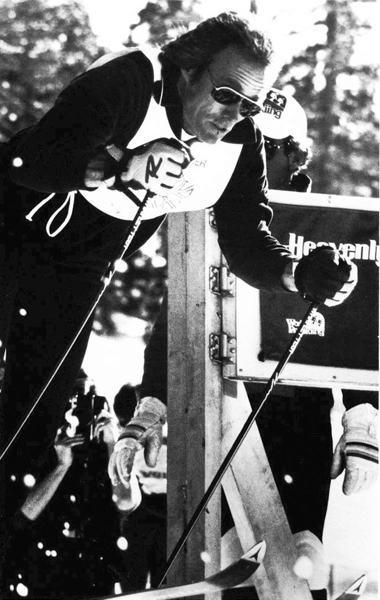
Clint Eastwood competes in the John Denver Celebrity Ski Classic. Photo/Heavenly Mountain Resort

Clint Eastwood competes in the John Denver Celebrity Ski Classic. Photo/Heavenly Mountain Resort

It was the heyday for Heavenly, ushered in by Hugh Killebrew’s zest for fun, showmanship and racing – most often on World Cup.

When he perished, the young Killebrew had to fill a tall order: get the ski area out of debt, deal with losing his father and take care of the employees.

“None of us knows how we’re going to react in these times. For me, when I saw my dad’s airplane on the road, it was real. I knew he was dead. I put aside my emotions and drove to the nearest telephone. I spoke to my dad’s secretary (current day executive assistant Nancy McCoy) and arranged to talk to the managers,” Killebrew told Lake Tahoe News from his Stateline office. He had a steely resolve that thrust him into autopilot.

“And I wanted to be the one to tell my mother,” he said of Eleanor, who as a consummate hostess ran many of the major events at Heavenly throughout the 1960s and ’70s.

Killebrew, who essentially grew up with Heavenly, worked as a ditch digger, heavy equipment operator and in lift construction. He raced in the winter. In summer, he hiked with his father as a teenager and learned about the constellations. To this day, Milky Way Bowl, Big Dipper, Little Dipper and Orion on the Nevada side that opened in 1968, serve as a fitting tribute to those cherished father-son outings.
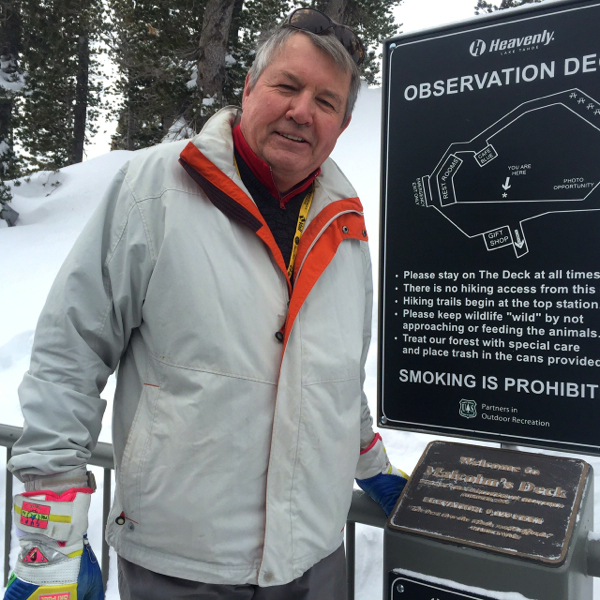
Malcolm Tibbetts' contributions to the resort are memorialized at the midstation of the gondola. Photo/Susan Wood

Malcolm Tibbetts’ contributions to the resort are memorialized at the midstation of the gondola. Photo/Susan Wood

The UC Berkeley graduate felt driven to carry on his father’s plans for snowmaking, operations that have saved many a season at this mid-town ski area. Countless explosions and engineering ingenuity later, pipe was laid on Maggie’s, Patsy’s and World Cup runs.

But since Mother Nature has the last say, the snow melted in snowmaking’s infancy. And there went the money.

In 1978 around Thanksgiving, Killebrew made the last payroll, exceeded his credit card limit, laid off most of the staff and made an appointment to file bankruptcy papers. But one Sunday brought about a milestone when the rain turned to snow. He got a brilliant idea to mark the end of drought with two days of free skiing. The daring gamble paid off. He burned the bankruptcy papers and called the media. Reservation lines were slammed, and 6,000 skiers showed up the first day and another 7,000 on Thanksgiving Day. The major networks showed up, and Heavenly made a mound of cash from meals and rental equipment.
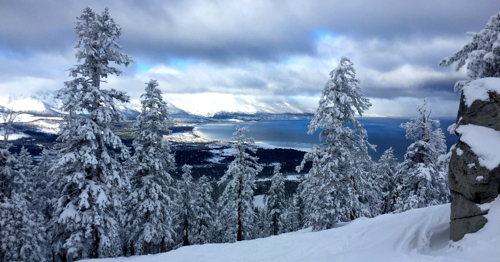
Incredible views have always been a selling point for Heavenly. Photo/Kathryn Reed

Incredible views have always been a selling point for Heavenly. Photo/Kathryn Reed

Lessons learned and passed on

Heavenly’s origin had humble beginnings. In 1947, Lee and Daisy Miller built a warming hut in Bijou Park where skis and boots could be rented near a rope tow that transported skiers up 1,000 feet. At times, they even erected floodlights for night racing.

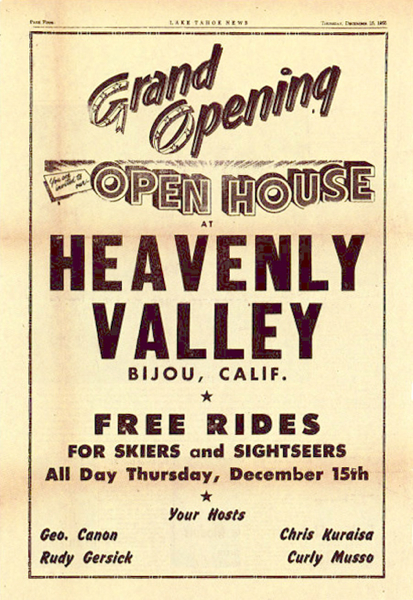
In 1951, Miller leased the Skiway to Bill Sutherland. Four years later, Miller turned over the operation to George Canon, Rudy Gersick and Curly Musso – who with Chris Kuraisa, a local casino owner who arrived in December 1953, had visions of promoting South Lake Tahoe as a winter destination for tourists. As hotel operators, Rudy and Trudy Gersick pitched the idea of visitors staying at the Ski Run Lodge and skiing with local instructor extraordinaire Stein Eriksen. In only a year, the Olympic gold medalist and world-renowned skier ran the ski school. (Eriksen died last week at age 88.)

No one was particularly wealthy at the time, but the early players were rich with dreams of placing South Lake Tahoe on the ski map for good. They were visionaries – a theme that carried on with subsequent owners, operators and planners.

Take Kuraisa, the founder. Not only did he lose his son in a fatal bicycle accident two days before opening, he endured immense financial challenges and hardships, but came out ahead in the end.

First, Kuraisa placed his life savings in the Tahoe Sport Center store when he arrived and got into the ski industry with a rope tow. Sutherland sold the rope tow to Kuraisa for $1,950 in cash, with a $50 option attached to the property Sutherland was originally selling for $3,750. Dorothy Kuraisa was nervous about living on the edge with her husband spending the last of their grocery money. But according to Heavenly’s chronicled history, Chris Kuraisa pledged the investment in what become to be known as Heavenly Valley would produce a return because of snow in the forecast the night of the deal day. The next day, the two feet brought out skiers spending $483 on lift tickets and sandwiches.
heavenly

Heavenly Valley opened in December 1955 with a double chairlift on Gunbarrel, several rope tows and the Pioneer Warming Hut.

Building from the early investment in the mid- to late 1950s, the aerial tram was constructed in 1962. This opened up the mountain to year-round sightseeing from the ridgetop that provides Heavenly’s sweeping, signature view and took skiers to the backside of the mountain.

The site has transformed into various hang out eateries and watering holes. (In 2003, the Monument Peak restaurant at the top of the tram was the setting for a party honoring founding partners Patsy Gilman Wood and husband Bob, who were instrumental in getting the tram off the ground.)

There’s even a funny account of Patsy delivering dozens of doughnuts for one of the races and losing several of them as they rolled down the Face.

The 1960s and ’70s at Heavenly Valley established a reputation for celebrities and contests honoring beauty and speed.
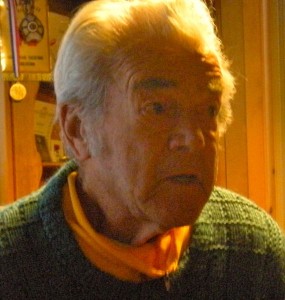
Martin Hollay

Martin Hollay

Martin Hollay, who is in his 90s and still lives within walking distance to the tram, skis most every morning. He remembers with affection the early days of his 30-year career with Heavenly. A glove maker from Budapest, Hollay has worked as a groomer and patrolman. For years, he’s made custom ski gloves for the Heavenly patrol. He was honored for his work in 2002 by skiing the Olympic torch down the World Cup run before it made its way to Salt Lake City.

“Skiing may be more crowded, but it really hasn’t changed to me. It’s just as it was before,” Hollay told Lake Tahoe News recently.

He sticks to Heavenly, and in particular the tram, as his method for getting on the mountain for good reason.

“It takes me almost an hour to drive anywhere else. In that time, I’ve already made turns already,” he said.

The Killebrew years

It took a former submarine commander in World War II, airplane pilot since a teenager and San Francisco lawyer to steer the ski area into the generation of Heavenly dreams.

Hugh Killebrew took over Heavenly Valley at a time when “skies the limit” fell over the world of skiing. Being a visionary, he knew that being at the mercy of Mother Nature meant making other arrangements to keep visitors and locals interested in paying for the sport that was growing in popularity.

Pop culture in the 1970s spawned the John Denver Celebrity Ski Classic and Chevrolet Freestyle Championships, among other races. The Heavenly Blue Angels, the first alpine ski club, provided growing interest in many skiers improving their skills.

The 1970s also brought about what has become known as the Hot Doggers of Heavenly.
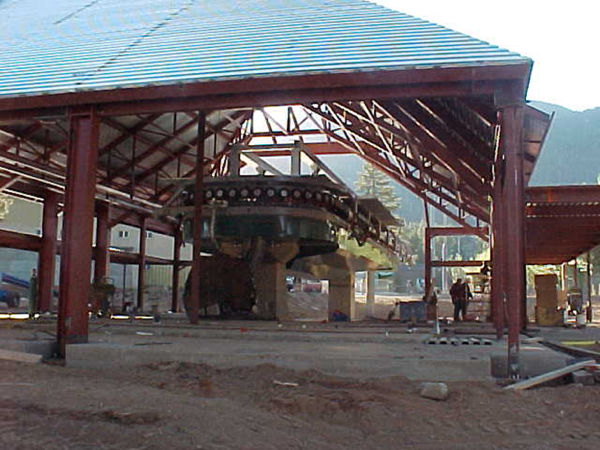
The gondola under construction. Photo/Heavenly Mountain Resort

The gondola under construction. Photo/Heavenly Mountain Resort

Malcolm Tibbetts, former vice president of mountain operations, was one of them.

At age 23, Tibbetts started with Heavenly as a ski patroller in 1971. He’s held posts as the assistant director, ski patrol director and mountain manager. Tibbetts was so instrumental to Heavenly’s growth, an honorary plaque was installed at the midstation of the gondola to commemorate his contributions to snowmaking, designing the midstation and getting the gondola off the ground in 2000.

Tibbetts, 66, grew up and later served in the military in Germany on skis – having never missed a winter in 60 years. He hails from New Hampshire and plans to return to the East this spring to hike the Appalachian Trail, which sits on his bucket list. Along the way, he’ll be thinking about completing his memoirs – much of the life story about his tenure at Heavenly.

After serving in the Armed Forces, he packed a Volkswagen van and traveled the country.

“All over, I heard about Tahoe and had a friend here,” he told Lake Tahoe News.

Money was lacking at the time, but Camp Richardson provided a free spot to camp if he cleaned the bathrooms and collected fees. Hollay gave Tibbetts his first job at $1.77 per hour.

“I came here for a year of ski bumming,” he said. After a year of “hot dogging” at Heavenly over gigantic jumps, he broke his back doing a flip. Even that didn’t keep him from hitting the slopes.

He skied with the likes of Eriksen, having to race against him in the World Cup. There were races, parties, events and challenges.

“I had a great career. Who can claim to have an office over 22 square miles,” he said. “I met my wife Tere here and raised two kids.”

Even after knee surgery, Tibbetts went out skiing recently and shared feelings of nostalgia.

“I look all around and see things I built,” he said at the base of the Comet chairlift.
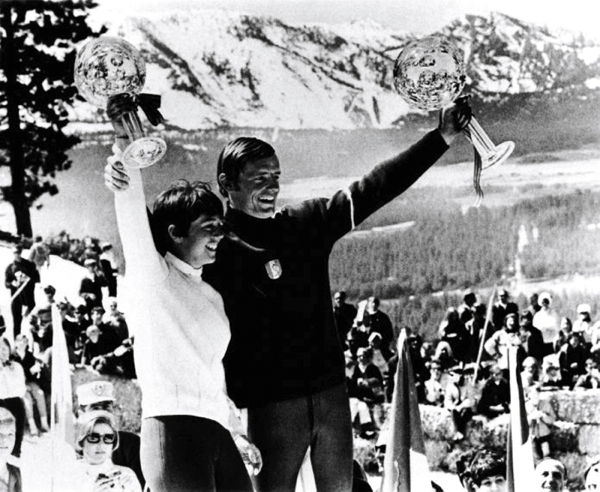
Jean Claude Killy and Nancy Greene on World Cup. Photo/Heavenly Mountain Resort

Nancy Greene and Jean Claude Killy when World Cup races were held at Heavenly. Photo/Heavenly Mountain Resort

Tibbetts commended the younger Killebrew for getting Heavenly out of debt in the late 1970s and having the foresight to make snowmaking a priority after the elder Killebrew died.

“The plane crash was the saddest time. There are certainly events in life you remember where you were. That was one of them for me. The ski area was in ruins when Bill took over. He was incredibly lucky,” Tibbetts said of the good fortune bestowed on Bill at his time of need.

At the time, a lift ticket was $3.50.

“Now you can’t buy a cup of coffee for that,” he said.

Snowmaking didn’t come without its challenges. Tibbetts recalled renting pumps and closing off Keller Avenue’s fire hydrant to get snow to fly on the World Cup run.

“We were babes in the woods and learned the hard way,” he said.

One pipe blew out and temporarily blinded him. He was forced to count the numbers on a rotary-dial phone to call his wife.

With snowmaking and all things Heavenly, what a ride it was.

How has the ride changed?

Tibbetts thinks back on the Killebrew days as a period where he could waltz in the office and give his two cents on Heavenly operations. He didn’t always see eye-to-eye with the Killebrews, but he said they always respected his opinions.

Heavenly is now a year-round resort with ropes courses available in the summer and more activities coming soon.  Photo/LTN file

Heavenly is now a year-round resort with ropes courses available in the summer and more activities coming soon. Photo/LTN file

In 1990, the Kamori Kanko company bought the ski resort from Killebrew – taking the first step in Heavenly’s transformation into an international company. The Japanese investor was known for taking good care of the employees, according to Tibbetts. A year later, the Mott Canyon chairlift on the Nevada side opened. The year after that, the top of the mountain Sky chairlift made its debut as an express lift.

By that time, Kamori under the direction of chief Dennis Harmon had bragging rights to 65 percent of snowmaking coverage and lifts dotting two states.

Owner Katsuo Kamori endured his own tragedy when he lost his son in a fatal accident.

In 1997, Kamori turned over the reins to Les Otten of American Skiing Company – a corporation with roots in the East.

The following year, Sonny Bono, the entertainer and congressman, was killed when he hit a tree while skiing.

Despite the ups and downs of Heavenly’s history, ASC pursued Kamori’s tireless efforts dealing with government agencies on a $4 million master plan for the resort amid environmental regulations, one of the resort’s largest challenges.

The gondola opened in 2000 due to ASC’s efforts – with employees taking part in the physical end of laying the cables. When it opened, Tibbetts recalled it as “the scariest day of my whole career because of my decision to run that thing” since the spotlight was on the ski area. The gondola was finally the link between the casinos at Stateline and the high part of the mountain.

“We had (wind) gusts of 70 miles per hour,” he said.

The gondola may have been a blessing to the town, but it came at a price for ASC. Its stock was so low – less than $1 — by the time it sold Heavenly to Vail Resort, it was delisted on the New York Stock Exchange.

Vail leads the way

The Broomfield, Colo.-based company has invested tens of millions of dollars in Heavenly, launching the South Shore ski area into the corporate arena in 2002.

Most stakeholders and observers see the change in atmosphere as “different.” Many of the ski resorts from the 1950s to 1980s were run by families. Now the ski industry has gone corporate, with stockholders to satisfy, as well as cash to improve tired infrastructure.
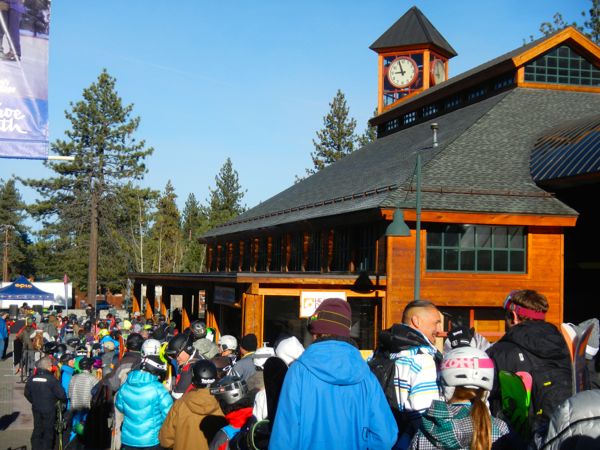
The Heavenly Village with the gondola links the town to the mountain. Photo/LTN file

The Heavenly Village with the gondola links the town to the mountain. Photo/LTN file

And Heavenly was special to this Colorado company. Having a resort in California helped it diversify its regional portfolio in case other areas where it owns resorts have tough times. Take a look at its first Chief Operating Officer Blaise Carrig, who moved from running Heavenly to being in charge of western mountain operations at corporate before retiring last summer.

Heavenly has spawned many a ski industry career.

Former Vice President of Planning and Governmental Affairs Stan Hansen started as a ski instructor and patroller in 1966 before retiring in 2001.

“I used to say I degreed in Hugh Killebrew,” he said from his Puerto Rico home where he relishes the retirement life. “Heavenly’s come a long ways.”

Hansen embraced working with Tibbetts during Heavenly’s growth years.

“Malcolm could build anything,” Hansen said, adding the gondola was “a destiny”. The early pioneering Heavenly stakeholders thought about the benefit to hooking the town with the upper mountain. Kamori wanted it. Marriott stepped aside from the ground level, but built its two hotel condominium projects at Heavenly Village at the base in 2002. Vail swooped in when it saw the promise of having the eight-person cars whisking skiers and boarders up the mountainside.

Even former President Bill Clinton endorsed the idea. Upon his visit for the Lake Tahoe Environmental Summit in 1997 he mentioned the lift specifically.

“I’ll never forget all of us sitting around in a meeting, and Clinton said: ‘I think you should build a gondola from the town to the top’,” Hansen said, snickering. The governmental affairs guru looked over at Andrew Strain, who worked for the Tahoe Regional Planning Agency – the regulatory agency tasked with keeping projects in line the region’s lake clarity mission.

“He rolled his eyes and said: ‘You got to him’,” Hansen said of Strain, who now works for Heavenly as the vice president of planning.

“It’s been an interesting ride,” Hansen said.

Don Evans, Heavenly’s marketing manager, also placed the gondola construction in 2000 on the top of the list of pivotal moments for the ski resort.

“What hit me is I knew all the people building it, and they got in such good shape, they looked like body builders. I barely recognized them,” Evans said.

Evans said he has thoroughly enjoyed his tenure at Heavenly. He arrived in 1974 after leaving Pennsylvania, where he taught skiing.
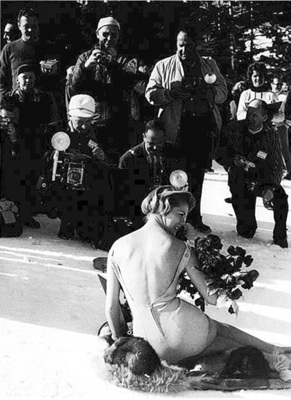
Miss Snow used to be an annual event at the resort. Photo/Heavenly Mountain Resort

Miss Snow used to be an annual event at the resort. Photo/Heavenly Mountain Resort

“The first day I went out on Heavenly I didn’t know much about the place,” he said. “We all went out. It was a cloudy day with fresh snow. When I skied the California side, I thought ‘I’m skiing with the big boys.’ I realized I was in a pretty special place.”

Through the years of promoting it, he’s learned about and embraced Heavenly’s storied past.

“We’re lucky to live here. I’ve felt such a sense of community,” Evans told Lake Tahoe News. “I look at where I am now and where the mountain is now – there’s been a real organic connection between the mountain and the town.”

Even those who move away get the connection.

“I started skiing there in the seventh grade,” said Linda Jahn, daughter of South Lake Tahoe’s resident historian Betty Mitchell. The 69-year-old got nostalgic about being a member of the youth ski club – the Heavenly Blue Angels.

“Everybody knew everybody back then,” she said. “I skied every day after school. This was such a memorable time.”


Opinion: Can books build community?

By Cati Porter

Ahtziri and I are sitting on a stone garden bench outside the church in Riverside where my children take piano lessons. In her hand is a stack of papers—typed forms for me to sign, neatly handwritten manuscript pages, and sketches of fictional characters with names and biographical information.

I have been asked to mentor Ahtziri, a 17-year-old high school senior, through the process of writing a novel for her AP English class. I am not a novelist, but I am a poet, and I direct a nonprofit—the Inlandia Institute—whose mission is to support literary activity, in all of its forms, throughout inland Southern California, aka the Inland Empire or I.E. The Inland Empire has been in the news a lot lately, with the most recent mass shooting and largest terror attack on U.S. soil since Sept. 11 taking place here. But we are far more than a news headline.

Until the recent shootings in San Bernardino, the Inland Empire was largely unknown, and until the Inlandia Institute was formed, it lacked a cohesive literary identity, unlike Los Angeles or other major metropolitan areas, despite its long history of literary excellence. I was drawn to Inlandia because its mission so closely meshes with my own priorities: as a writer who calls this place home, as a mother who wants to see more opportunities for young people to engage their creativity, and as a locavore reader who wants to read and support local writers. I want more people to know and understand this region that I love, and the best way I know to do that is by seeing it through the eyes of the people who live here.

Which is why I’ve agreed to mentor Ahtziri. And why the Inlandia Institute wants to build community by supporting creative literacy—fostering creative thinking and problem solving through narrative and storytelling—throughout inland Southern California.

Like any other group, a community of readers and writers doesn’t spring up overnight; it grows gradually over the decades as people with a similar mindset find one another and begin to lay a foundation. But sometimes a catalyst comes along, and suddenly there is momentum. In the case of Inlandia, that catalyst was the publication of an anthology that recognized the depth and breadth of the literary writing by and about this region: “Inlandia: A Literary Journey through California’s Empire”, which Heyday published in 2006.

“Inlandia” stacks greats such as Joan Didion and John Steinbeck and Norman Mailer alongside local jewels like novelist Susan Straight, who sets many of her stories in the fictional Rio Seco, a doppelgänger of Riverside; American Book Award winner Juan Delgado, whose poems evoke and celebrate the lives of the Mexican-American residents of San Bernardino; and Gordon Johnson, a Native American newspaper columnist for Riverside’s Press-Enterprise who writes with frank humor and grace about life on the reservation. The anthology elevated the lives of the people here, and put the Inland Empire, quite literally, on the “map”—now anyone around the country can pick up this book and gain an understanding of what it’s like to live here, and what the region is like.

The nonprofit Inlandia began as a collaboration of the Riverside Public Library and Heyday to create cultural and literary events that celebrate the region’s writers and offer creative literary enrichment opportunities for people of all ages. Early projects included an ongoing series of writing workshops, programs in the schools, workshops for seniors on writing their life story, seminars on the “Business of Being a Writer,” and book readings and signings. By 2009, the program was so successful that it became an independent organization. A mission statement was drawn up to clearly define its footprint as the entire inland region (including Riverside and San Bernardino counties and parts of neighboring Imperial and Inyo counties), and to focus on five core programs: adult creative literacy, publications, public literary events, children’s creative literacy, and a literary laureate program.

That was the year I got involved with Inlandia. I was invited to present my work for an Inlandia author series at the library downtown, where I met Marion Mitchell-Wilson, the nonprofit’s first executive director. Marion thought my writing, publishing, and literary event experience would be a good fit for Inlandia. Soon she created a part-time coordinator position for me, which expanded over time, from founding a literary journal and running events to facilitating book publication, grant writing, and managing daily operations. When Marion was diagnosed with breast cancer, she asked if I would keep everything running until she got better. I couldn’t say no.

Marion underwent treatment, came back, found the cancer had returned, and left again; she came back one last time before learning that the breast cancer was back yet again and had metastasized to her bones, liver, and brain. Within a matter of months, she had succumbed. But before she died, she called some of the people involved with Inlandia into her home and made a dramatic request: She wanted us to found an endowment in her name to ensure the continuity of the organization for decades to come. We raised $100,000 in six weeks.

Building a literary community is not just about reading and writing; like any community, it is only as good as its people. People tend to unite in celebration of a cause they feel passionate about. That’s what I believe happened with the endowment.

The people are also the reason I keep working with Inlandia. Over the past few years, I have had the privilege of collaborating with UC Riverside professor and current U.S. Poet Laureate Juan Felipe Herrera (who coined the term “Inlandia” in the first place) on a variety of projects, including a guerrilla-style poetry reading on the downtown Riverside pedestrian mall during the lunch hour, and an event at the Smiley Library in Redlands to collect poems for his unity poem.

Inlandia serves a vast swath of inland cities, from the Salton Sea to Temecula, from Wrightwood to Mecca. I am very attached to this region, where I’ve spent the better part of my adult life, even after living in places where the arts have deeper roots. But what the region lacks in deep roots it makes up for in diversity—both ethnic and socioeconomic—and its residents have a great appreciation for that. We are not San Francisco or Los Angeles, but we, too, have world-class museums and cultural events and spacious, beautiful libraries. And we have pride.

As I write this, I am surrounded by poems submitted to our “Poetry Box” during Riverside’s Long Night of Arts and Innovation, an event downtown and sponsored by the city of Riverside every two years. The event brings together innovators in technology alongside arts and cultural organizations to showcase what Riverside has to offer. (Riverside’s tagline is the “City of Arts and Innovation.”) The Poetry Box was a space for people to play with words—to cut up and rearrange them into poetry on a large felt board, to add to a collaborative poem in a single notebook, or just to write with pens on blank paper. It was surprising to see how many people stopped, sat down, put pen to paper, and wrote a poem, some for the first time. The Poetry Box got to the core of what Inlandia is all about—building community, one word at a time.

I love who we are, we Inlandians—and I revel in all of the places we’ve come from or have yet to go. I think of Ahtziri—wonder whether or not she will finish her novel. But you know what? The finishing doesn’t matter. It’s the starting that counts, and I don’t just want to see how the story ends. I want to see where it takes her.

Cati Porter is author of the poetry collections “Seven Floors Up” and “My Skies of Small Horses”, founder and editor of “Poemeleon: A Journal of Poetry,” and executive director of the Inlandia Institute.

“Living the Arts” is an arts engagement project of Zócalo Public Square and The James Irvine Foundation.


Study: Fewer people using home broadband because of cost

By Associated Press

More Americans are shunning costly home broadband and using their cellphones to get online, a survey shows.

Eighty percent of U.S. adults had Internet access this year, whether through a smartphone or a home Internet connection, up from 78 percent two years ago, according to the survey published by the Pew Research Center.

But after years of home broadband growth, slightly fewer adults in 2015 got Internet from providers like home phone or cable company, mostly because it’s too expensive for them. The number dropped to 67 percent from 70 percent in the center’s 2013 survey.

Meanwhile, the number of people relying on cellphones alone for Internet rose to 13 percent this year from 8 percent in 2013.

That plateau in home broadband use comes as the Obama administration has pushed for greater broadband access and criticized the lack of competition among home Internet providers.

The dip in home Internet use could just be temporary, said Pew researcher John Horrigan. Adoption also flatlined five years ago before picking up again, which he said likely had to with economic difficulties in the aftermath of the recession.

For those without home Internet, 33 percent say the biggest reason is the monthly cost is too high, while 10 percent say a computer is too expensive.

But 12 percent say they don’t need it, a smartphone is sufficient.

Of those only getting access through a smartphone, the increase is biggest among low-income Americans. But a smartphone isn’t as easy to use as a home computer when it comes to applying for jobs and is often limited by data caps.

Only 5 percent of people who don’t have home broadband access say that it’s primarily because it’s not available or the speed is too slow, underscoring the growth of broadband networks throughout the U.S. over the past 15 years.

Nearly half of people who don’t have broadband at home have never had it and aren’t interested. That’s partly tied to age: 39 percent are 65 or older.

The Pew report drew on a September 2013 survey of 6,020 U.S. adults and several polls conducted in spring, summer and fall of 2015 that included, in total, 6,687 adults.

The margin of error for the home adoption finding was plus or minus 1.3 percentage points in 2015 and 1.4 percentage points in 2013.


Waking up often can cause bad moods

By Sumathi Reddy, Wall Street Journal

Good sleep isn’t just about how long you sleep. Continuity may be equally important.

Getting up in middle of the night multiple times to soothe a crying baby or go to the bathroom impacts your mood and cognitive abilities the next day, research has found.

In a study published last month in the journal Sleep, researchers from Johns Hopkins University School of Medicine found that individuals forced to awaken multiple times during the night showed a greater decline in positive mood than those forced to go to bed later. They also had less slow-wave or deep sleep, the third stage of non-rapid eye (NREM) movement sleep.

Research from the University of Pittsburgh has shown that the cognitive performance of elderly individuals was impaired when their sleep was disrupted, but not when they slept a shorter amount of time straight through. And a study done in Israel published last year found that a fragmented night of sleep for a full eight-hours impacted mood and attention as much as sleeping just four hours a night.

Read the whole story


Unused sick time, vacation boosts retiree compensation

By Brad Branan, Sacramento Bee

Thirteen local government employees in the capital region received lump-sum payments of more than $100,000 in 2014, the Sacramento Bee found in an analysis of data from the State Controller’s Office. The analysis included city and county governments in Sacramento, El Dorado, Placer and Yolo counties and did not include special districts.

The payments provide a big boost to an employee’s final-year salary and also increase their retirement benefits.

Lump-sum payments totaled $31 million in the region, the Bee analysis found.

Read the whole story


McClintock not only Calif. lawmaker not living in district he represents

By Javier Panzar, Los Angeles Times

It was the spring of 1998. Then-Assemblywoman Grace F. Napolitano was in the middle of a heated battle with fellow Democrat Jamie Casso.

With the primary to fill the House seat opened up by the retirement of Casso’s father-in-law, Democratic Rep. Esteban Torres, approaching, Napolitano and her advisors zeroed in on what usually amounts to a throwaway issue. Casso, a longtime Torres aide, did not live within the boundaries of the congressional district he sought to represent.

Tom McClintock

Rep. Tom McClintock represents the California side of Lake Tahoe. Photo/LTN file

Napolitano won that primary by 618 votes.

Some state and local lawmakers have been prosecuted for not living in the districts they ran to represent — a requirement under California law. When it comes to Congress, federal law only requires members live in the same state as the district.


Rep. Tom McClintock, R-Elk Grove, faced attacks from opponents in 2008 when he sought to represent a Northern California district hundreds of miles away from his state Senate district in Ventura County.

As he announced his bid for the 4th Congressional District on the steps of the historic Auburn courthouse in Gold Rush country, a U-Haul truck drove around the building carrying a sign reading “Termed out Tom All the way from L.A,” according to a report in the Ventura County Star.

Former Rep. Doug Ose, one of McClintock’s rivals for the GOP nomination that year who also lived outside the district boundaries, was responsible for the truck, the Star reported.

Read the whole story