How El Niño is impacting the wine industry

By Cale Weissman, Kyle Frischkorn, and Logan Brenner, Eater

In 1998, heavy rains hit California mid-winter in what was described as one of the strongest El Niños to date. It caused flooding, abnormally high waters, and multiple storms that led to substantial damage. That year, the wine was different, too.

Winemakers at the time prepared for what they knew was going to be a rough year. Vineyards, indeed, do need rain. But extreme, uncontrolled, and prolonged showers are hard on any crop — especially so for wine grapes. Sure enough, after the 1998 vintage was bottled and sampled, critics furrowed their brows: The wine was different, less bright, and simply not as good as years past. The likely scapegoat was the strong El Niño, but was this climate phenomenon really to blame for a lackluster vintage?

In 2016, the West Coast faces a similar reality. Yet again, ’tis the season of El Niño, aptly named with a Spanish flair for its arrival’s proximity to the birth of the central figure of Christianity. The impending severe weather may be welcomed with more open arms than in the past, due to the drought in California. But the change in weather patterns will yet again affect how crops develop and transform into consumable goods.

The effects of an onslaught of winter rain are hard to predict for this year’s wine crops. Harsh weather conditions could forever besmirch 2016 vintages, or rains could revive parched soils. We asked the leading wine and climate experts what havoc this winter could wreak.

Read the whole story


St. Theresa selling tickets for crab fundraiser

St. Theresa Catholic Church’s 22nd annual Crab Dinner is Feb. 12.

Doors open at 6pm. The dessert auction starts at 7:45pm.

Tickets are $45 in advance or $50 at the door. Purchase tickets at the Rectory Office at 1041 Lyons Ave. or Religious Education Office at 1081 Lyons Ave., both in South Lake Tahoe.

Proceeds benefit religious education programs and parish building maintenance.

Must be at least 21 to attend.

For more info, contact Danette Winslow at 530.544.4788 or the church office at 530.544.3533.


Placer County taking steps to regulate pot

Placer County Board of Supervisors this week voted to enact a placeholder ordinance asserting the county’s authority medical marijuana sales and cultivation.

This comes on the heels of December’s decision to move forward with regulating medical marijuana in unincorporated areas of the county. At that time staff was directed to develop comprehensive regulations for their consideration.

The California Medical Marijuana Regulation and Safety Act set a March 1 deadline for jurisdictions to assert local authority over medical marijuana regulation. If they don’t, the state assumes control.

The Jan. 5 vote affirmed that the county’s permitting process will mirror the state’s and established the Agricultural Commissioner’s Office as the lead county agency for medical marijuana regulation.

The goals for staff to consider as it moves forward with developing the framework include:

  • Promoting public health and safety
  • Reducing the size of the illicit market for cultivation and retail sale
  • Preventing non-medical access and use by youth
  • Reducing environmental harm to water, habitat and wildlife
  • Providing clear criteria for responsible businesses and patients who wish to operate within the law
  • Developing a fair system of regulation and taxation that supports public purposes
  • Providing flexibility and authority for modification or adoption of additional measures into the regulatory process to ensure effective implementation

Future public meetings will seek community input on the regulations.

— Lake Tahoe News staff report


Brown’s budget helps schools, poor; saves for rainy day

By John Myers , Melanie Mason and Christine Mai-Duc, Los Angeles Times

By now, it could easily be called Gov. Jerry Brown’s budget doctrine — an insistence on only modest expansions in state services but liberal payments for one-time expenses and accumulated government debt.

In his new $170.7-billion budget proposal to legislators, Brown is again staying consistent with his creed.

The plan provides a sizable boost to public education and only modest help to low-income families, but its most important component may be how much money would be stashed away for future budget deficits.

Brown proposes making an additional $2-billion payment into the state’s rainy-day fund, growing the size of the reserve account by next summer to almost two-thirds of its legally mandated goal. That would be significantly ahead of schedule, but a decision the governor insisted is essential.

Read the whole story


Preparation, safety key to winter driving

By Tia Rancourt

The Tahoe Fire and Fuels Team would like to remind all travelers that extra precautions need to be taken while driving in Northern Nevada and California mountain areas with snow and ice. Along with potential hazardous road conditions, motorists can expect extreme delays due to snow conditions or accidents. We recommend following these tips to ensure a safe trip to your destination.

● Ensure your vehicle is stocked with extra warm clothing, food, water, medications, cell phone, a shovel, and other survival supplies in the event you become stuck on a mountain road. Check your vehicle’s battery, tire tread, windshield wipers, and anti-freeze. Tires should be properly inflated. Keep windows clear and put no-freeze fluid in the window washer reservoir. Carry snow melt, Jonny Cat, or sand in the event you become stuck in the snow.

● Make sure your vehicle’s gas tank is full before leaving on any trip. Keep the tank at least half full to avoid gas tank freeze-up.

● If your vehicle has on-demand four-wheel drive, make certain all drivers are familiar with engaging the four-wheel drive function.

● Practice cold weather driving. During the daylight, rehearse maneuvers slowly on ice or snow in an empty lot. Steer into a skid. Know what your brakes will do. Use steady constant pressure on ABS equipped vehicles and pump non-anti-lock brakes.

● Check road conditions before leaving. (The state icons on Lake Tahoe News’ home page go the respective departments of transportation.)

● Plan your route and leave early if necessary for weather conditions. Be familiar with maps and directions and let others know your route and arrival time.

● Leave headlights on while driving in snowy conditions to increase vehicle visibility. Drive carefully. Even when the roads appear dry, patches of ice tend to accumulate on curves and bridges even when the rest of the roadway appears clear. Increase distance between your vehicle and those ahead for safe stopping.

● If you are driving slower than the traffic around you, use turnouts so others may pass.


Winter weather drivers must consider their personal needs, as well as making sure their automobile is ready to face unforeseen conditions. Avoid driving in known hazardous conditions if possible, but when driving is necessary, time spent in preparation is the best defense. Being prepared can help you make good choices if incidents occur.


Tia Rancourt works for North Lake Tahoe Fire District.


Snippets about Lake Tahoe

tryp logo·      TRYP is having a networking mixer Jan. 13 from 6-9pm at Casey’s in the Round Hill Center and one on Jan. 19 from 5:30-8pm at Azzara’s restaurant in Incline Village. They are free to members, $10 for others.

·      Lake Tahoe-based High Fives Foundation has helped 100 athletes in recovery from life-altering injuries since it was established in 2009.

·       Truckee will host the second in a series of public meetings on the proposed Donner Pass Road streetscape improvement project known as Envision DPR on Feb. 3 from 5-7pm at Truckee Town Hall. The goal is to create a more pedestrian and bike friendly thoroughfare and to help improve traffic flow. The first phase, which includes connecting sidewalks and improved pedestrian crossings, will be built in 2017.

·      Here is information about El Dorado County’s third quarter sales tax collections.

·      Northstar’s 2016 Burton Mountain Festival is Jan. 8-10.


Greenway trail in South Lake to expand by 2020

By Kathryn Reed

Bridging the neighborhoods of South Lake Tahoe is one of the primary goals of the Greenway bike path.

By 2020 the residential areas of Bijou and Sierra Tract should be linked so the need to travel on Highway 50 or Pioneer Trail can be avoided.

“By minimizing the number of streets you cross it makes it easier to choose not to be in your car,” Sue Rae Irelan said Thursday night at an open house at Lake Tahoe Community College about the project.

Irelan, who works for the California Tahoe Conservancy, has been leading the charge on this multi-use trail that one day will go from Meyers to Stateline. For now, the project is approved from Sierra Tract to Van Sickle Bi-State Park.

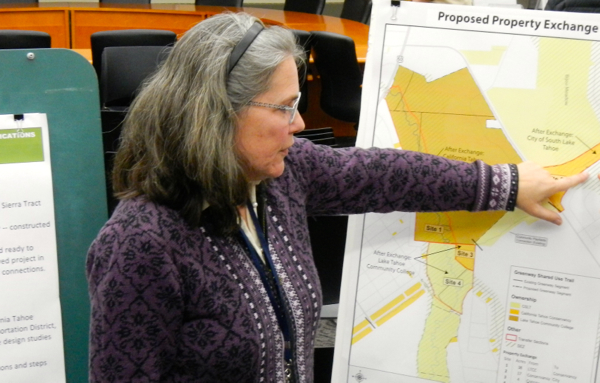
Sue Rae Irelan with the California Tahoe Conservancy talks about the next phase of the Greenway trail. Photo/Kathryn Reed

Sue Rae Irelan with the California Tahoe Conservancy talks Jan. 7 about the next phase of the Greenway trail. Photo/Kathryn Reed

“Winter access is really important in Tahoe,” Sue Rae Irelan said.


This year the Conservancy, South Lake Tahoe and Lake Tahoe Community College are expected to complete a land swap that will allow the next phase of the project to go forward. No money will be exchanged.

The next segment, which should break ground in 2019, will be one mile of trail that starts at Bijou Meadow and connects to Bijou Community Park, and crosses Al Tahoe Boulevard to connect to Lake Tahoe Community College and the community ball field.

The one mile that will be built in the next few years has a $4 million price tag.

Money for this phase comes from:

·      CTC — $1 million

·      LTCC Measure F — $700,000

·      Tahoe Transportation District — $400,000

·      State grant — $1.9 million.

“This is the most expensive part of the project because of the bridge,” Irelan said.

A 150- to 175-foot span will cross Trout Creek. Then boardwalk will be in the meadow to protect the sensitive terrain.

Much of the trail follows user created trails. The new trail is 10 feet wide, meets ADA requirements and is paved.

Flashing lights will be installed on Al Tahoe, and at Martin and Barbara avenues to make it safer for cyclists and pedestrians to cross those streets to continue on the path.

Winter use of the trail remains uncertain.

“The Conservancy doesn’t plow. We are actively talking to the city about how to cooperatively maintain all of the trails,” Irelan said. “Winter access is really important in Tahoe.”

The challenge is how to pay for it.

In 2015, 0.42 miles of the Greenway was built between Herbert Avenue and Glenwood Way.

Future sections include going from Herbert to Ski Run Boulevard, and then from Ski Run to Van Sickle. When those are completed the trail will be 3.86 miles long.

Funding is the obstacle that must be overcome in order for the next phases to commence.

Because there has been a change in the alignment since the project was initially approved there needs to be an amendment to the environmental documents. The revised CEQA document should be released this month for a 30-day public comment period.


Opinion: Why does the media ignore high school activism?

By Aaron G. Fountain Jr., Al Jazeera America

Student activism has made a comeback. With recent campus demonstrations against alleged racial discriminationand in favor of free college tuition, America may be facing a wave of student protest to a degree not seen since the 1960s. But while the media focuses on college campuses, very few journalists are acknowledging the activism that has been occurring at the high school level. Just in the past year, high school students across the country have protested against racist police brutality, curriculum changes, budget cuts, the expansion of charter schools, standardized tests and other youth-related issues.

After the white police officers responsible for the 2014 deaths of unarmed black men Michael Brown and Eric Garner were not indicted, high school students across the country organized solidarity protests in Seattle; New York; Denver; Oakland; Minneapolis and Boston. In February, about 250 high school students in Santa Fe, New Mexico left school to protest constant testing and the state’s new mandated exam. In June, Milwaukee high school students walked out of class to protest against the county executive takeover of low-performing schools. And this fall, high school students in Allentown, Pennsylvania, organized a district-wide student walkout demanding the resignation of the superintendent, the inclusion of a student representative on the school board and summer youth employment opportunities. There were also student walkouts in Chicago; Berkeley, and Philadelphia that occurred this fall.

High school activism is not limited to disruptive activities. Numerous youth organizations operate around the country to tackle issues concerning school closures, at-risk youth and the school-to-prison pipeline, among others.

Read the whole story


Critters a menace to U.S. power grid

By Katherine Shaver, Washington Post

U.S. electric utilities are battling a bushy-tailed, nut-loving menace that has wreaked havoc on far more Christmas tree lights, TVs and cellphone chargers than any terrorist plotting against the power grid.

That’s right. Beware the squirrel.

Even as utilities have spent millions on “wildlife protection,” squirrels routinely outsmart plastic animal guards on energized equipment, gnaw through rubbery insulation and squirm into power substations, zapping electricity to thousands of homes and businesses while meeting an untimely death.

Storms still tend to cause the longest and most widespread outages, experts say. But the American Public Power Association, which represents municipal electric utilities and uses a “squirrel index” to track outages nationwide, says the critters remain the most frequent cause, even if those outages are more limited than storms.

Read the whole story


Film to showcase couple’s athletic prowess

“From Big Walls to Big Hills, Emily Harrington and Adrian Ballinger’s Big Year” focuses on the couple’s 2015 quest to free climb Yosemite’s El Capitan and ski the 8,000-meter Himalayan giant Makalu together in one calendar year.

Their quest will be showcased Jan. 28 at 7pm as part of Alpenglow sports Winter Film Series at the Olympic Village Lodge at Squaw Valley.

Harrington’s life goal of free climbing El Capitan in Yosemite and Ballinger’s dream to ski Makalu, the fifth tallest peak in the world, presented some of the greatest challenges they’ve faced in their relationship together. Their experiences were rife with struggle, frustration, and failure that tested their partnership, but also poignant moments of intense joy and satisfaction that brought them closer together.

The event is free.