Calif. schools benefit from Powerball jackpots

By Joseph Serna, Los Angeles Times

There’s no way of telling how many people might lay claim to a $900-million Powerball jackpot Saturday night, but lottery officials insist that California schools will be among the winners.

Thanks to a California law that requires at least $1 billion of the state’s education funding to come from lottery revenues — or about 1 percent of the state’s spending — a monster-sized jackpot can inject significant cash into the education spending plan.

With each $2 Powerball ticket purchased in California, about 80 cents goes toward education. The money is divided among K-12 schools and community colleges and universities. Powerball is played in 44 states and three U.S. territories.

Read the whole story


Vonn ties World Cup downhill record

By USSA

ALTENMARKT, Austria – Lindsey Vonn (Vail) made history again, tying Annemarie Moser-Proell’s World Cup downhill victory record with win number 36 in a two-run Audi FIS World Cup sprint downhill Saturday.

“I’m really happy to tie Annemarie’s record with 36 wins,” Vonn said after the two-run event.

Canada’s Larisa Yurkiw was second, followed by Austria’s Cornelia Huetter in third.

For the Americans it was a great day as Stacey Cook (Mammoth Mountain) grabbed a top-10 spot, finishing eighth, while Laurenne Ross (Bend, Ore.) was 18 and Alice McKennis (Glenwood Springs, Colo.) was 26.

The sprint downhill format featured two runs on the same 25-gate course, with a flip of the top 30 for the second run. The format not only offered a change of pace, but a change of tactics as well.

“I like the two-run downhill – it’s nice to do something different,” said Vonn, who was the only athlete on the start list to have ever competed in a sprint downhill race. “I think the classic format is the best, but it’s nice to do something different. It’s nice to challenge yourself and there’s definitely a lot more pressure when you’re leading the first run.”

Vonn won the first run by 0.91, and extended her winning margin to a full second despite skiing a bit more conservatively in the second run.

“I definitely didn’t expect such a big advantage going into the second run. I skied a little more conservatively in the second run,” she said. “It was bumpy and a lot of girls were having trouble.”

Saturday’s victory pulled Vonn to within 58 points of overall World Cup leader Lara Gut of Switzerland, who did not finish the first run of Saturday’s downhill. Vonn also leads of the downhill World Cup standings by 50 points over Huetter.

Up next, Vonn goes for World Cup win number 73 as she chases Ingemar Stenmark’s record of 86 World Cup victories in Sunday’s super G.


Snippets about Lake Tahoe

usfs·       U.S. Forest Service employees completed 553 prescribed fire projects in 2015 that treated 36,289 acres of national forests in California.

·      Reservations are being taken for the Placer County Sheriff Office’s Community Awareness Academy. The deadline to apply is Feb. 15. To reserve a spot, contact Kim Rivera at 530.889.6922 or krivera@placer.ca.gov.

·       Caltrans is installing retro-reflective signs, which the agency says provides a double bonus for the public – they’re illuminated by motorists’ headlights, making them more visible than traditional signage, and don’t require electricity. This reduces costs and staff time in the field, and increases safety for everyone.

·      Bill Dietz, president of Tahoe Luxury Properties, closed 2015 as the area’s top real estate agent, with $75,609,700 in sales in California and Nevada, according to dollar volume reported by Tahoe Sierra MLS and Incline Village MLS data.

·      Want to find out details about bike maps in the basin? Click on this link.


El Niño expected to stay strong, finish wet

By Kathryn Reed

STATELINE – To the untrained eye the three images looked practically they same. They showed the El Niño pattern from 1982-83, 1997-98 and 2015-16.

The first two brought crazy weather to Northern California and Northern Nevada. It’s usually the first quarter of the year where the moisture really starts to fall.

“So far we’ve got out of this event exactly what we expected,” Sasha Gershunov, climate and meteorology researcher at Scripps Institute of Oceanography in San Diego, said of this winter’s weather phenomenon.

He was one of the speakers Jan. 8 at the annual Operation Sierra Storm conference, a gathering of television meteorologists hosted by Lake Tahoe Visitors Authority.

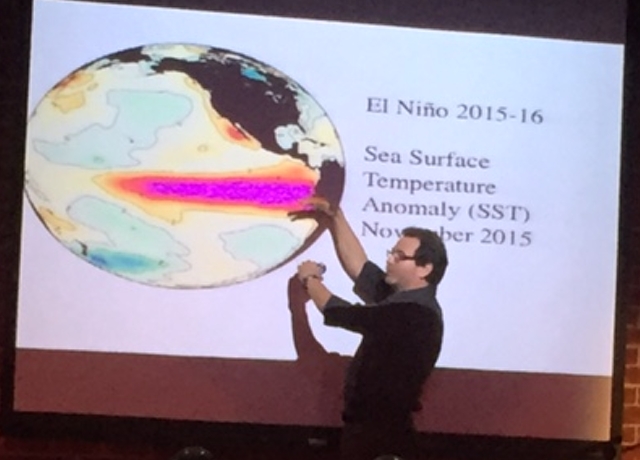
Sasha Gershunov points to the pink are that is El Niño. Photo/Kathryn Reed

Sasha Gershunov points to the pink area that is El Niño. Photo/LTN

A difference this go-round compared to the last two significant El Niños is that the world is a warmer place. This could make for a nasty situation if in March the moisture in the Sierra becomes rain on top of the snowpack. It could cause flooding as well wash away the white stuff that is needed to fill reservoirs downstream.

It’s especially concerning because the signals are for the snowy season to end on a particularly wet note, he said.

For now, the models point to this being one of the strongest El Niños on record, with no sign of slowing down any time soon.

Much of Gershunov’s talk focused on the formation of El Niños, which start off the coast of India. Warm ocean water is pushed toward Peru. He believes as long as the Earth has been in its current configuration there have been El Niños.

“It’s a dance between the atmosphere and the ocean,” he said. “Unless they act in unison, an El Niño cannot happen.”

They are cyclical, occurring about every two to seven years.

The warming of the Pacific Ocean near the equator is where an El Niño is strongest. California and Nevada are essentially experiencing the ripple effect.

“El Niño is just one thing that is going on in the atmosphere. There are several configurations a storm track can take,” Gershunov said.

When the 1982-83 El Niño hit it took weather and climate experts by surprise.

“We didn’t have the models or observations. People realized we better learn how to predict these things,” Gershunov said.

Fifteen years later the science and technology got it right, the same with this season’s El Niño.

While the science has improved through the years, there is room for improvement.

“Unless there is some sort of breakthrough, there is a prediction barrier in the spring,” Gershunov said. That’s why it isn’t until summer that meteorologists are able to forecast an El Niño for the coming winter.


Calif. budget has CTC looking for cash elsewhere

By Kathryn Reed

California’s nearly $700 million investment in Lake Tahoe is slowing down as evidenced by the governor’s proposed budget. The California Tahoe Conservancy is left out of any new funding.

“Overall, the state of California has been historically — and will continue to be — committed to the restoration of Lake Tahoe, including meeting our share of commitments to the Environmental Improvement Program,” Nancy Vogel, deputy secretary for communications for the California Natural Resources Agency, told Lake Tahoe News. “Specifically regarding the $475 million in the Proposition 1 Settlements Pot, the governor’s 2016-17 proposed state budget does not allocate additional funding for Lake Tahoe at this time since Lake Tahoe already benefits from other existing resources available in Proposition 1.”

Gov. Jerry Brown released his proposed budget this week. Haggling between those on the receiving end as well as lawmakers will occur between now and when the May revise comes out. The next fiscal year starts July 1 and requires the Legislature to approve the budget.

CTC officials were warned before the budget came out that it was being cut out of the $475 million pot it was supposed to share with four other entities. This money came from the November 2014 voter approved water bond called Proposition 1 that provides $7.5 billion for water quality, water storage, flood protection and watershed protection and restoration projects.

Brown allocated the California Natural Resources Agency funds to:

· Klamath River Agreement: $250 million

· Central Valley Project Improvement Act: $90 million

· San Joaquin River Settlements: $45 million

· Salton Sea Restoration: $80 million

· Tahoe Environmental Improvement Program: $0.
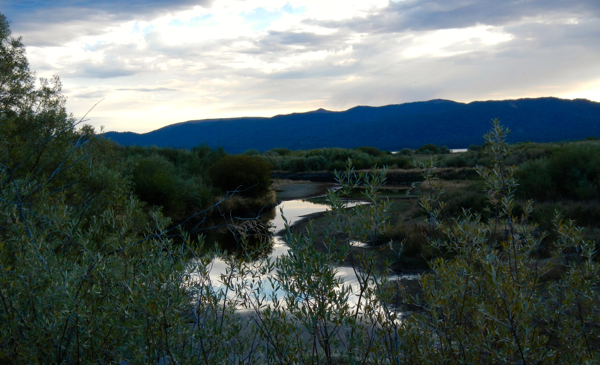
Funding for the Upper Truckee Marsh project in South Lake Tahoe is not included in the state's 2016-17 proposed budget. Photo/LTN

Funding for the Upper Truckee Marsh project in South Lake Tahoe is not included in the state’s 2016-17 proposed budget. Photo/LTN

While the Conservancy was shut out this round, it still has money – operating an annual budget of more than $20 million. It also has received Proposition 1 dollars at other times. In fact it has nearly $15 million to spend this spring. When the board meets in March it will be tasked with deciding how to spend that cash on the more than $30 million in proposals that were submitted. This money will be used to help partner agencies and won’t be money used on actual CTC property.

Chris Mertens with the CTC isn’t worried about the latest turn of events. He said there are other revenue sources for his agency – cap and trade dollars, Department of Fish and Wildlife, and CalFire to name a few.

CTC has received millions of dollars for planning and acquisitions through Propositions 12, 40 and 84, the Habitat Conservation Fund, Lake Tahoe Conservancy Account, Federal Trust Fund and  U.S. Bureau of Reclamation.

Mertens said this one source for dollars that has dried up would not mean any layoffs. He is also confident the agency will be able to secure funding for the Upper Truckee Marsh project, which is on the top of the list of needed environmental improvements.

Vogel with Natural Resources acknowledged this is a critical project, but said the Conservancy is bound to find money for it.

“The bottom line is the state has been a huge supporter of the lake and we are optimistic we will be competitive in the future,” Julie Regan with the Tahoe Regional Planning Agency told Lake Tahoe News.

Nevada a few years ago pledged $100 million for the EIP. The bond market has been such that it has not been able to sell much so those dollars have not come to fruition for the most part.

Since the EIP’s inception in 1997, about $1.8 billion has been invested in Tahoe in 450 projects:

·       $593 million from the federal government

·       $693 million from California

·       $118 million from Nevada

·       $77 million from local governments

·       $328 million from the private sector.

“It’s unfortunate that Lake Tahoe hasn’t been slated to receive funding in the governor’s proposed budget. It’s heartening to see that the proposed budget allocates $475 million to address good and vital work for the San Joaquin River, the Salton Sea, and the Klamath Basin, areas currently underfunded, but this news increases the importance of passing the Lake Tahoe Restoration Act and identifying other sustainable funding mechanisms for efforts critical to protecting and preserving Lake Tahoe,” Darcie Goodman Collins, executive director of the League to Save Lake Tahoe, told Lake Tahoe News.

One mechanism may be the federal Lake Tahoe Restoration Act. It has passed through a key House committee and now heads to a Senate committee. It would funnel $415 million to Tahoe for environmental programs.



Opinion: Racial attitudes divide political parties

By Sean McElwee, Al Jazeera America

Barack Obama’s presidency has been marked by heated debates about the Republican Party’s racial attitudes. Many liberals have noted the dog whistles —subtle cues that play on stereotypes and may trigger taboo sentiments — employed in Republican attacks on the president. Former House Speaker Newt Gingrich, for instance, famously called Obama a “food stamp president,” former Sen. Rick Santorum accused him of giving welfare to “blah people,” and many conservatives have claimed Obama couldn’t have been born in the United States.

For the most part, the public abhors and condemns such blatant racism. But recent data on public sentiments suggest that many Americans hold beliefs affirming subtler, structural racism and that the popularity of these believes divides sharply along party and political lines.

I began my examination of whether there is a partisan divide on racial issues with the American National Election Studies 2012 survey. The first set of questions I examined measures racial stereotyping, asking respondents whether they believe that black people are “hard-working” or “lazy,” “intelligent” or “unintelligent” and whether they have “too much influence” or “too little influence” in politics — in other words, questions measuring explicitly racist attitudes.

Read the whole story


Defendant in bear killing wants venue change

Gilbert Wetenkamp, the South Lake Tahoe man accused of killing a bear in July, is seeking to have the trial moved to the West Slope.

He was in court on Jan. 8. El Dorado County Superior Court Judge Suzanne Kingsbury said she is not inclined to grant the motion, but told Wetenkamp’s public defender that he has the right to fill out the requisite paperwork.

The trial date has been set for March 11.

In September, Wetenkamp pleaded not guilty to one misdemeanor count of unlawful taking of an animal. He is accused of shooting a black bear to death on July 9. The 2½-year-old bear was shot in the backside with buckshot from a shotgun.

The maximum penalty, if convicted, is one year in jail and a $1,000 fine.

— Lake Tahoe News staff report


Nevada casinos tally more, lose less in 2015

By Associated Press

Nevada casinos collected almost 3 percent more revenue in fiscal 2015 than a year earlier, but logged an overall loss in income for a seventh straight year, according to state Gaming Control Board data released Thursday.

The $24.6 billion that casinos statewide collected in gambling and non-gambling revenues in the 12 months ending June 30 represented a net loss of almost $662 million.

But that was less than the $744 million loss reported in fiscal 2014, when casinos took in $24 billion.

Board analyst Michael Lawton called the overall trend upward, with revenues almost back to the $25 billion last seen in 2007 and 2008.

“We’re only 2.6 percent below those peak levels,” he said. “It’s an increase in revenue, but it still resulted in a net loss.”

The comprehensive annual report, dubbed the Gaming Abstract, includes nearly 250 pages of data about number of employees, room occupancy rates and gambling revenue per square foot of casino space.

It said Nevada has 271 casinos statewide grossing more than $1 million in gambling revenues, including 155 in Clark County — home to the Las Vegas Strip.

Washoe County’s 37 casinos reported total revenues of almost $1.5 billion, and a combined net loss of $7.4 million. Six Lake Tahoe-area casinos reported a net loss of $150 million. Elko County’s 19 casinos reported just under $45.5 million in combined net income.

The report highlighted another continuing trend — revenues tilting away from the tables and slot machines and toward restaurants, retail, entertainment and rooms.

Casino gambling-only revenues were $10.6 million stateside in fiscal 2015, down 0.2 percent from 2014. The more than $5.8 billion from the Las Vegas Strip was more than half the total, and a 2.5 percent decrease year-to-year.

That marked a historic low in gambling as a percentage of overall revenue, at just under 35 percent, said David Schwartz, director of the University of Nevada, Las Vegas, Center for Gaming Research.

“It’s a sign of the changing market,” Schwartz said. “Food is growing and gaming as a percentage is shrinking. What I’m hearing from people is they spend more on food and entertainment than gambling. This is what the visitors seem to want.”

Lawton noted that the last time gambling revenue from the Las Vegas Strip represented more than 50 percent of the overall total was 1998.

Today, room rentals, food, beverage and other revenues make up 57 percent, according to the data.


Federal guidelines seek to curb sugar intake

By Tara Duggan, San Francisco Chronicle

For the first time, the federal government is recommending a specific limit on Americans’ sugar intake, making waves in the food industry and public health community with its 2015 Dietary Guidelines for Americans released Thursday.

Every five years, these federal guidelines impact spending on school lunch, military, food stamp and other government programs, so there’s money in the game — even though only 57 percent of Americans follow the recommendations.

The biggest change since 2010 is new specific guidance that added sugar — not the kind naturally found in food, but sugar added to foods during processing or at the table — be limited to 10 percent of calories. Other nutrient recommendations, such as a daily limit of 2,300 mg of sodium and keeping saturated fats at only 10 percent of calories, remained the same as in previous versions of the guidelines.

Read the whole story


‘Cinderella’ to be performed at STHS

South Tahoe High School’s drama students are putting on Rodgers & Hammerstein’s “Cinderella” this month.

It is the same fairytale with a few new twists. This contemporary take on the classic tale still features the classic music, plus some new songs. The show includes new characters, transformations, a pumpkin coach, and glass slippers.

Directed by Nannette Niven and choreographed by Marcia Sarosik, the cast includes Stephanie Hernandez as Cinderella and Zane Brady as the charming prince, with Aurora Gooch as the fairy godmother, Zoe Greco as the stepmother, and Kristen Harnett and Serenity Sanchez as the stepsisters. Rounding out the cast of more than 40 students and a whole group of singers and dancers.  Conducting the 20-piece orchestra is Casson Scowcroft, with vocal music direction by Alyssa Little, sets by Drake Niven, and assistant direction by Ethan Niven.

Performances are Jan. 15, 16, 22, and 23 at 7pm and Jan. 17 and 24 at 2pm in the South Tahoe High School TADA Theatre. Tickets are $15, $10 for those younger than 18. Children under 4 are not permitted.

There will be a gala on Jan. 22 from 5-6:45pm to raise money for the South Tahoe High School Performing Arts Booster Association. Despite its name, this is a dress-as-you-please event in the Student Union preceding that evening’s performance of “Cinderella”. Refreshments will be provided by the STHS culinary students, a photo booth will include a glass slipper, and there will be a silent auction.

Tickets to the gala are $40; $50 for the gala, plus a discounted $10 general admission ticket to the performance; and $75 for the gala, discounted ticket and preferred seating.

Tickets may be obtained by emailing sthspaba@gmail.com or calling 530.545.2307.