USFS giving free tours at Heavenly

The U.S. Forest Service Lake Tahoe Basin Management Unit’s Ski with a Ranger at Heavenly Mountain Resort begins Jan. 22.

Tours are every Monday and Friday beginning at 1pm, last approximately one-hour and continue through April 1, weather permitting.

Participants must be intermediate level skiers/boarders or above and provide their own lift ticket. No reservations are required. Attendance is on a first-come, first-served basis and participants should meet at the top of the Heavenly gondola.

These conservation education programs are offered to educate the public about the mission and role of the Forest Service in ski area management, to improve public understanding of natural resource processes and issues, and to promote environmental literacy and stewardship. Programs are led by U.S. Forest Service Conservation Education staff and volunteers, and operate through a cooperative effort between Heavenly Mountain Resort and South Lake Tahoe.

For more information, contact Reanna Suela at 530.543.2656 or rsuela@fs.fed.us


Racism expert to give talk at LTCC

UC Berkeley Professor Ian Haney-Lopez will give a talk Feb. 8 at Lake Tahoe Community College titled Trumpeting Racism: Race, Politics, and Economic Jeopardy for All.

The free event will be in the Duke Theatre starting at 6:30pm.

Haney-Lopez will also be signing his book and answering questions.

Haney-Lopez is one of the nation’s leading thinkers on the evolution and economic consequences of racism.


Brown pushes big water project amid drought

By Sharon Bernstein, Reuters

Gov. Jerry Brown warned on Thursday of near-apocalyptic water shortages if his $15 billion plan to divert water from a Northern California river for use elsewhere gets bogged down in political and environmental disputes.

The plan to remove water north of the Sacramento-San Joaquin River Delta, the fragile source of much of the state’s drinking water, is opposed by many environmentalists, but Brown insisted it was crucial in shoring up water supplies in the drought-plagued state.

The plan calls for digging a pair of tunnels under the delta. They would carry water from the Sacramento River to the state’s agricultural breadbasket as well as cities in the central and southern parts of America’s most populous state.

Read the whole story


State Parks, CTC exchanging land in Tahoe

By Kathryn Reed

MEYERS — State agencies are in the process of swapping land on the South Shore in an effort to be more efficient.

“Our hope is the pubic won’t notice anything,” Marilyn Linken, supervisor of the Sierra District of California State Parks, told Lake Tahoe News.

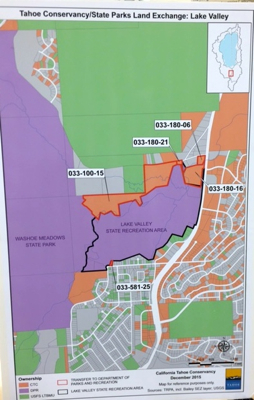
The California Tahoe Conservancy is giving nine parcels totaling about 79 acres to State Parks. Twenty-seven acres will become part of Washoe Meadows State Park and 52 acres will be added to Lake Valley State Recreation Area.

This land is in Meyers. The swap is expected to be finalized by fall 2016.

In a separate deal the Conservancy will be receiving parcels in the Rubicon area of the West Shore from State Parks. That should occur in the spring or summer.

No money is being exchanged.

land swap mapThe change in ownership is a result of the 2012 California Budget Act that tasked the CTC and State Parks with finding a way to better manage state land. By having each agency own parcels that are contiguous instead of randomly isolated, it makes things more efficient.

In the future the Conservancy intends to transfer its rights/ownership/responsibility of Van Sickle Bi-State Park near the state line to State Parks. However, just as when that park opened in 2011, State Parks is in no financial position to take over that South Shore park, even with Nevada State Parks’ help.

The other parcel State Parks will inherit from the CTC is the Cascade property near Emerald Bay. That, too, is being held up because of the Parks’ finances.

The property near Lake Tahoe Golf Course, which is part of the recreation area, was supposed to go to State Parks decades ago based on a settlement agreement from the mid-1980s. No one from either state agency could explain why it took so long for the exchange to come to fruition.

Linken said the acreage being absorbed by State Parks will be treated the same as the land already categorized recreation and parks.

Washoe Meadows still doesn’t have a master plan governing the uses there. Litigation is stalling that process.


Letter: Azul Latin Kitchen gives back to SLT

To the community,

Azul Latin Kitchen was the Adopt A Day of Nourishment sponsor for the Bread & Broth dinner served at St. Theresa Church Grace Hall on Jan. 4. It is a great fit to have the Tahoe restaurant join with B&B to provide meals to local individuals who are in need of hot nutritious food along with a warm and secure place to spend an hour or two during Tahoe’s very cold winters.

“It is so fulfilling to bring a group from our restaurants. We all truly enjoyed helping prepare for and serve dinner tonight,” said Danny Scott, Azul Latin Kitchen’s manager.

Also volunteering with Scott were Emilie Kapp, server; Natashia Nielson, host; and bartenders Rachel Ervin and Chris Arnold.

“It is very important that we are able to give back to our community.  We can’t wait to do it again,” added Scott.

Azul Latin Kitchen has formed a unique and very much appreciated partnership with B&B. In addition to sponsoring Adopt A Day dinners, Azul team members donate their time to come and serve on B&B’s dinner cleanup crew three to four times a month. It might not be glamorous, but helping to clean up after the Monday evening dinner is just as important as any other part of the pieces necessary to provide meals to about 100 folks every Monday.

A big thank you to Tahoe Restaurant Group’s management and Azul Latin Kitchen team members for bringing their food serving and customer service expertise to provide a wonderful evening for our dinner guests.

Carol Gerard, Bread & Broth


Sierra experiencing rare avalanche conditions

By Benjamin Spillman, Reno Gazette-Journal

Unusual snowpack conditions in the Sierra Nevada are contributing to a type of avalanche problem that in the past decade has rarely been widespread in the region.

That’s according to the Sierra Avalanche Center, a nonprofit organization that partners with the U.S. Forest Service to observe and analyze snow conditions in the Lake Tahoe area and beyond.

“There could be avalanches in places that have never seen avalanches before,” said Brandon Schwartz, lead forecaster for the center.

The biggest contributor to unstable conditions is buried surface hoar which leads topersistent slabs.

Read the whole story


EDC faces lawsuit over general plan/zoning update

By Joann Eisenbrandt

PLACERVILLE – Rural Communities United, an El Dorado County unincorporated citizens group, filed a lawsuit Jan. 13 in El Dorado County Superior Court asking the court to void the Board of Supervisors’ Dec. 15 approval of the Targeted General Plan Amendment/Zoning Ordinance update and certification of its environmental impact report.

The base of the lawsuit is because of “violations of zoning law, general plan law, the California Environmental Quality Act (CEQA), and constitutional protections for procedural due process, substantive due process, and equal protection.”

This is not a surprise to those involved.

RCU’s attorney, Tom Infusino, had threatened as much at the board’s Nov. 10 meeting where the plan’s components were laid out and discussed.

The TGPA/ZOU is the product of more than a decade of planning and includes amendments to the county’s 2004 General Plan as well as a comprehensive revision of the Zoning Ordinance that implements that plan’s land use policies. Views on where it will lead the county have varied widely throughout the process, with some seeing it as embodying changes needed to accommodate El Dorado County’s inevitable growth and others seeing it as a “developer-driven” roadmap to a proliferation of high density land uses that will destroy the county’s rural character.

District 2 Supervisor Shiva Frentzen was the only board member to vote against approval of the plan’s major components.

RCU believes its concerns, written comments, and input at public meetings during the TGPA/ZOU process have been largely ignored. The lawsuit contends that the group has “met the requirement that it exhaust administrative remedies prior to filing this action,” as is required by CEQA law.

The lawsuit alleges that the TGPA/ZOU EIR does not adequately describe the project or properly examine its adverse environmental impacts as required by CEQA, does not adequately analyze the other alternatives to the project outlined in the EIR, offers insufficient or unclear mitigation measures to these impacts, was approved by the board with inadequate notice to many of the property owners of the 37,000 parcels rezoned under the zoning ordinance update, is inconsistent with provisions of the 2004 General Plan and the El Dorado Hills Specific Plan, does not adequately address the plan’s cumulative impacts or account for the regional impacts on traffic congestion, fire danger and wildlife habitat. RCU contends in the lawsuit that the EIR was not an objective document, but was conceived and engineered, “to promote a project rather than to inform the decision-making process.”

The county board clerk’s office confirmed that the lawsuit was served on the board this week. Lake Tahoe News reached out to individual supervisors for comments, but did not receive any response. Creighton Avila, a principal analyst in the CAO’s office, responded on behalf of the county, saying, “We are aware of it, but we do not comment on ongoing litigation.”

The board and then-County Counsel Robyn Truitt Drivon clearly indicated the county’s view of the adequacy of the TGPA/ZOU and its accompanying EIR during the Nov. 10 board meeting at which it was presented. At that time, Drivon told the board, “I have been reviewing this for the last year. I have talked to staff and consultants and I am confident in the product being brought forward. It meets legal sufficiency …. Everything brought to you at this point is as thorough and vetted as possible.”

District 1 Supervisor Ron Mikulaco, now chairman of the board, responded at that same meeting to concerns from RCU members and other members of the public by saying, “Our General Plan says we are a rural county but along with that certain things have to occur like growth and infrastructure and policies to deal with them. I met with RCU … their attorney says they’re going to sue us (but) I don’t comment on litigation. … The California Supreme Court says local governments have an implied duty to keep their General Plans current. I’ve heard comments from the public that we’re doing this as a conspiracy, some nefarious thing, but this is required.”

Ellen Van D yke of Rural Communities United told Lake Tahoe News after the lawsuit had been filed, “We have been participating in the planning process for this project for the last three years. Some of us remained hopeful up until that very last day when the supervisors gave their final approval. This lawsuit was truly a last resort for us. The process is completely and utterly broken when well-informed well-intentioned citizenry can be so entirely disregarded by their elected officials. We’re confident we are on the right side of this issue, but just sorry we have to go there.”


Comments sought on Tahoe transportation plan

In its capacity as the Tahoe Metropolitan Planning Organization, the Tahoe Regional Planning Agency this week released a draft active transportation plan for public review and comment.

The plan is designed to help local, state, and federal agencies continue to develop multiple-benefit projects to improve transportation options for bicyclists and pedestrians in the Lake Tahoe Basin.

The Linking Tahoe: Active Transportation Plan identifies high-priority locations for transportation infrastructure upgrades, discusses challenges to project implementation and potential solutions, highlights best practices for roadway design and maintenance, and offers an assortment of actions communities can take to enhance bicycle and pedestrian mobility.

The goal is to build a multi-modal transportation network around Lake Tahoe, connecting trails, sidewalks, bike lanes, and public transit routes so people can safely and efficiently get to school, work, shopping centers, and recreation sites without having to drive a motor vehicle.


This draft is online. TRPA will accept comments about the plan until Feb. 16. Send comments to Morgan Beryl by mberyl@trpa.org.

There will also be public hearings:

·         TRPA Advisory Planning Commission, Feb. 10, 9:30am at TRPA offices in Stateline, 128 Market St.

·         North Tahoe Regional Advisory Council, Feb. 11, 6pm at the North Tahoe Event Center in Kings Beach, 8318 North Lake Blvd.

·         Tahoe Transportation Commission, Feb. 12, 9:30am at the TRPA offices in Stateline, 128 Market St.


History of Sierra alpine sports runs deep

By Jim Sloan, Tahoe In Depth

Many point to the 1960 Winter Olympics at Squaw Valley as the event that kickstarted skiing in the Sierra and the Tahoe region. The event, only the eighth Winter Games ever held, was the first Winter Olympics ever televised.

But the truth is that skiing had been an established, vibrant industry in the area for nearly 30 years before the Olympics arrived at Squaw Valley. There were mechanized rope tows, cutting edge ski lifts, professional ski instruction, innovative equipment designs, ski lodges, destination resorts, celebrity sightings and travel packages all along the snowy Highway 40 corridor from the western foothills to Tahoe and the eastern Sierra above Reno.

49ers raced on skis

But even before that Golden Age of T-bars and rope tows, California gold miners were strapping on boards – really long boards – for ski races in places like La Porte and Johnsville. They developed ski waxes, 12- to 15-foot skis, and a one-pole technique that had some of them reaching speeds of 100 mph. According to writer Patricia Fox, writing in a 2007 issue of Sierra Heritage magazine, the first organized ski race in the U.S. was held in La Porte, in the mountains west of present-day Graeagle, in February 1867, 14 years after informal racing had started in the town of 3,000 miners.

Of course, everyone’s heard of Snowshoe Thompson, who was not a snowshoer but actually a skier who traversed the snowy Sierra on skis for 15 years, bringing mail back and forth from Genoa to Placerville. Thompson gets a lot of credit for pioneering the sport of skiing in the Sierra, but the first ski resort didn’t open at Tahoe until the mid-1920s. Olympic Hill, it was called, and it was opened for guests of the Tahoe Tavern. Later, the ski area’s name was changed to Granlibakken.

Granlibakken joins sport

According to Jeffrey Weidel, a former newspaper reporter in Roseville who has been writing about Tahoe skiing for about 20 years, Granlibakken was the third ski resort to open in the U.S., behind Howelsen Hill in Steamboat, Colorado, and Eaglebrook School in Massachusetts. Soda Springs was the second California resort to open, hauling its first skier to the hills above Lake Van Orden in 1935.
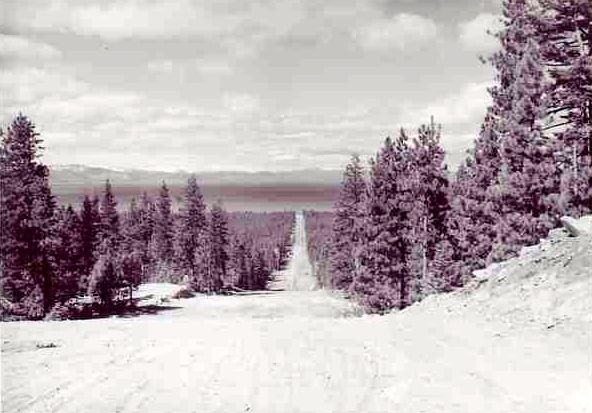
What is now a road was once an actual ski run. Photo/Stephen Gennerich collection

What is now Ski Run Boulevard was once an actual ski run. Photo/Stephen Gennerich collection

Driving to ski

According to historian Mark McLaughlin, in his book “Skiing at Lake Tahoe,” the first ski lift in the United States was a “pullback lift” built in 1910 in the Hilltop area of Truckee (the present-day finish line for the annual Great Ski Race from Tahoe City to Truckee). According to McLaughlin, the lift was initially built for toboggan riders but skiers also used it.

McLaughlin says skiing was already popular in the California mountains in 1930, where the Rainbow Lodge on Highway 40 was a magnet for winter sports enthusiasts. By 1936, there were a handful of popular skiing and sledding areas between Cisco, where the Auburn Ski Club built a ski jump and winter park, and Donner Lake to the east. Skiers either drove into the mountains, strapping their skis and poles to the roofs of their cars, or they rode the train into the Sierra and took horse-drawn sleds from the railroad depot to ski lodges.

By 1940 the “ski business was booming” in the Donner Pass region. Rope tows had replaced the original practice of hiking to the top of mountains to ski down. Ski schools imported experts from Switzerland and Austria to introduce and teach the latest techniques and equipment. You could stay at the Soda Springs Hotel for a dollar a day, paying 25 cents to a $1 for a meal. Donner Ski Ranch opened up the road in 1937, and work began on Sugar Bowl across the highway a couple of years later. It opened with great fanfare — and a fantastic $39,000 ski lift that allowed skiers to ride to the top.

Galena Creek Ski Hut

About this same time, Galena Creek Ski Hut was being built near Mount Rose. According to the Nevada Historical Society, the ski hill at Galena Creek hosted an annual Intercollegiate Winter Sports Carnival where college teams came to compete against the hometown favorites at UNR. One of those UNR skiers was Wayne Poulsen, who would become a major landowner in Squaw Valley. One of the first significant resorts in Nevada was Sky Tavern, completed in 1945 near Mount Rose. Farther south, near Spooner Summit, the White Hills ski area opened in 1949 with a T-bar lift and a ski jump. The resort closed five years later after several dry winters.

At the south end of Lake Tahoe, highway crews rarely completely cleared snow from Highway 50 between Placerville and Lake Tahoe. One of the first rope tows was installed at Twin Bridges, where the snow removal usually stopped.

Edelweiss on Echo Summit

Then in 1941 Edelweiss resort opened near Echo Summit, according to “Skiing at Lake Tahoe.” The resort operated for about 20 years before closing. The nearby Sierra Ski Ranch opened five years after Edelweiss and continues to operate today as Sierra-at-Tahoe resort. During the 1940s, other family-owned resorts opened along Highway 50, including Echo Lakes, Nebel Horn, Echo Summit, and, in the lake basin itself, Bijou Skiway Park in 1947. The park would soon be sold and renamed Heavenly Valley.

Poulsen, meanwhile, was scouting Sierra terrain for a major new ski resort. He settled on Squaw Valley. Although he worked as an airline pilot half the year, he and his wife, Sandy, purchased 2,000 acres of Squaw Valley with an eye toward finding investors to help build a ski resort over the five peaks surrounding his land. The Poulsens eventually partnered with Alex Cushing, but the partnership was short-lived, and Cushing went on to develop the alpine resort on his own while the Poulsens developed their valley land.

The wildly successful 1960 Winter Olympics in Squaw Valley ushered in a new era of large ski area development, as Alpine Meadows, Kirkwood, Ski Incline (now called Diamond Peak) and Homewood all came online in succeeding years. Some smaller resorts also emerged, like the Powder Bowl ski area in Alpine Meadows, but smaller areas couldn’t compete with the new mega resorts and either closed or merged with a neighboring establishment. Sierra Ski Ranch, Heavenly and Mount Rose all underwent large expansions to accommodate more skiers and to open up more challenging terrain. Over time, many resorts began adding snow-making equipment so they could open during low-snow winters.

This story first appeared in Tahoe In Depth.


Foreclosure filings climbed in Nev., fell across U.S.

Nevada has been a leader in foreclosures for years. Photo/Brendel

Nevada has been a leader in foreclosures for years. Photo/Brendel

By Eli Segall, Las Vegas Sun

Nevada homeowners were slapped with a rising tally of foreclosure filings last year, bucking a nationwide drop as the state remained among the hardest hit in the country.

A total of 16,533 properties, or 1.4 percent of homes statewide, received a foreclosure-related filing in 2015. That’s up 6.6 percent from 2014’s tally, according to a new report from RealtyTrac.

The housing-data firm counts default notices, scheduled auctions and bank repossessions.

Read the whole story