The other Kirkwood ski area going strong
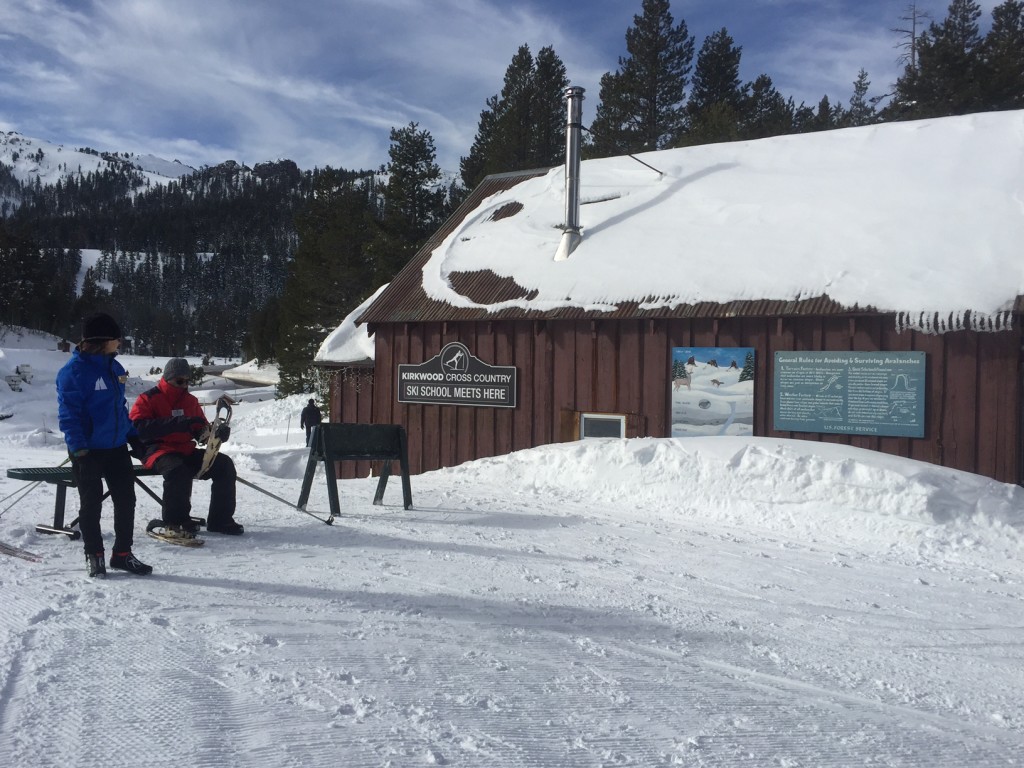
Kirkwood cross country is expanding programs. Photos/Susan Wood

Kirkwood cross country is expanding programs. Photos/Susan Wood

By Susan Wood

KIRKWOOD – Based on the reaction of skiers and snowshoers venturing this year to the land of deep snow and simple needs, it’s almost as if the one trail not open at the start of season at the Nordic center should have been.

Ecstasy, one of four black-diamond trails, is the operative word to describe how those who love the human-powered winter sports feel about the crisp, soft and plentiful snow conditions at the Kirkwood Cross Country and Snowshoe Center after the last few years of drought.

The 2,000-plus acre ski area, which started inconsistently in 1972 and full time about five years later,  looks a lot different this year compared to the last three winters. The snow completely covers the 24 trails and beyond, and the cats and groomers are out in full force – working eight to 10 hours on most days and 18 to 20 after snowstorms.
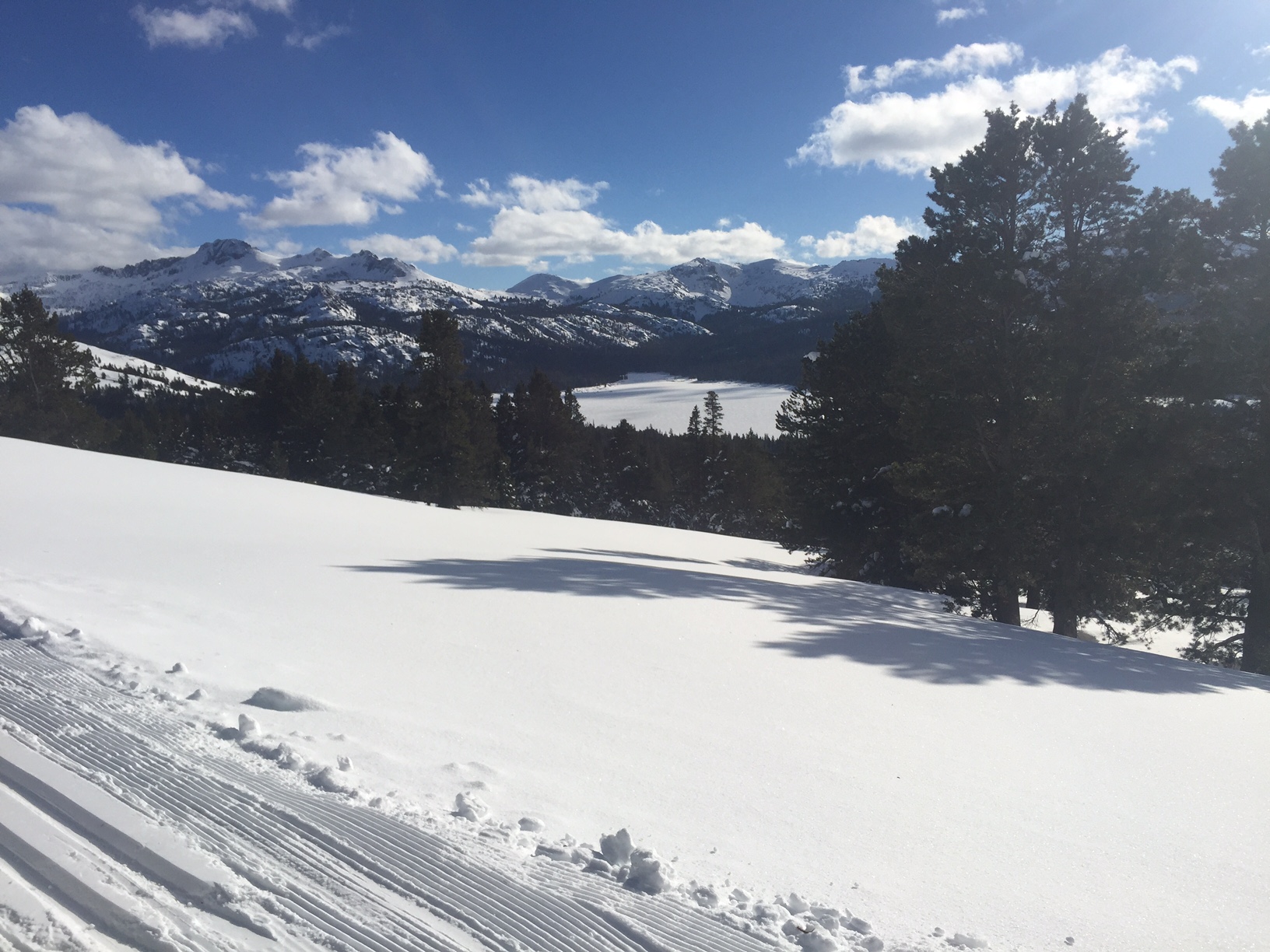
IMG_3455

The Upper Kirkwood Outpost trail has magnificent views.

But even inside, one may gather it’s a new year just from going into the lodge to buy lift tickets and merchandise. The holidays were bustling with visitors and locals wanting an escape from downhill skiing and a look into nature’s back door. The Nordic center averages 20 guests a day and peaks at three times that when the place is hopping. Still, it’s easy to escape here.

With only the wind in the trees and the occasional bird chirping, it’s hard to imagine another world across Highway 88 where party music and riders whooping it up over the snow conditions represent the norm.

Albeit satisfied with recent conditions, Debbi Waldear — the Nordic center’s director and a champion racer — remained cautiously optimistic about the booming start of the winter season.

“Everybody’s pretty cautious how winter’s going to go,” she told Lake Tahoe News last month.
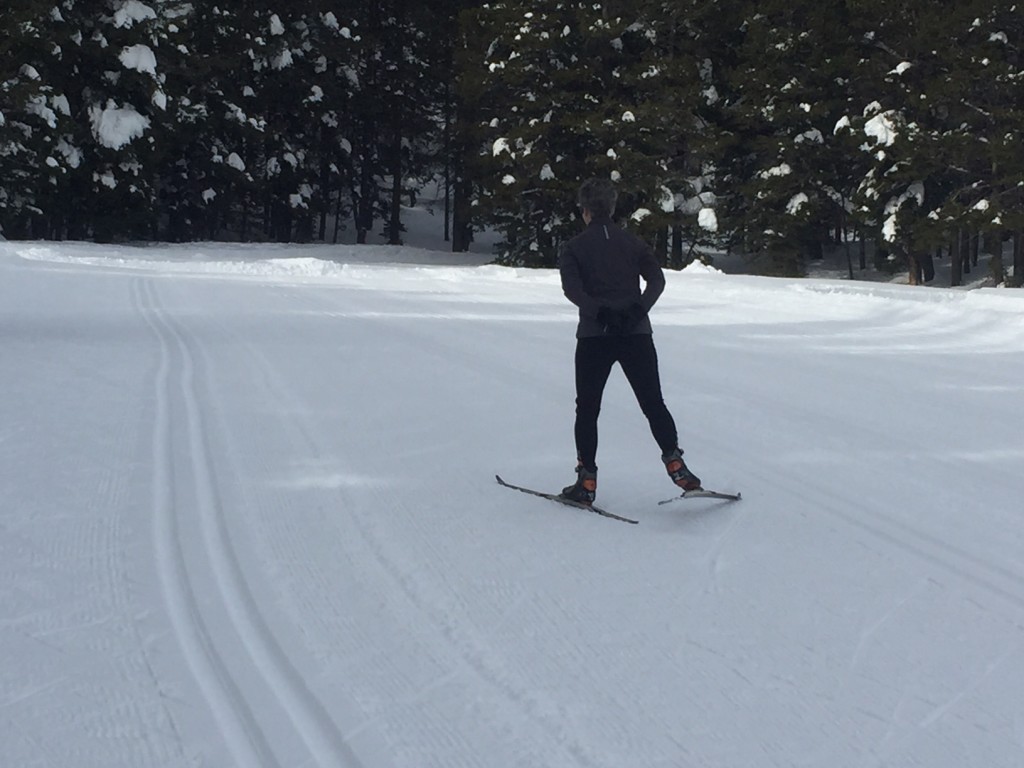
Laura Cabral makes skate skiing look effortless.

Laura Cabral makes skate skiing look effortless.

Most of the trails were set right at Christmas.

In her 35 years of working there (her tenure as old as today’s lodge), Waldear has seen it all. She recalled how in the prior year snow came early, then completely dried up. She referred to staying open last year as “miraculous,” with the meadow (one of two trails allowing canines) and one upper trail to offer her guests. In winter 2013-14 Kirkwood was only open between January and April.

And this is why the owner, Vail Resorts, diversifies the locations of its ski areas.

“When they have bad years, they have other resorts to rely on,” she said of the Colorado-based ski giant.

This season California is king.

And there are a few new features this year to make Nordic enthusiasts of all ages feel like a queen.

A “Kiddie Kilometer” is groomed for the youngsters.

“It’s pretty popular. We get a lot of people renting sleds and pulling their kids,” she said.
Debbie Waldear has been the face of Kirkwood's Nordic center for years.

Debbie Waldear has been the face of Kirkwood’s Nordic center for years.

Guests seeking a double reward of exercise and food can now partake in the “soup and shoe” – but not in that order. The $35 package, which is slated every Sunday afternoon, includes an easy-going snowshoe hike followed by hot soup at the Kirkwood Inn located next door.

“Snowshoeing is really taking off,” Waldear said, while watching customers filing out of the lodge and onto their skis and shoes. She estimated about 40 percent of the business involves walking with claws.

“We tell people you can be an expert in 10 steps,” she said of the ease in learning.

Waldear encourages her customers to enjoy the outdoors every step of the way, herself relishing her office per se because “not many people can say they manage a ski center” for a living.

“Where you headed?” Waldear asked Jaime Levy of Oakland at the trailhead.

Levy replied that she sought intermediate terrain, and Waldear urged her to check out Jobe’s Jaunt. The popular route is sprinkled with signs providing the history of Snowshoe “John” Thompson’s 20-year mail runs from Placerville to Genoa, which he started in 1856 carrying a 90-pound bag on 11-foot skis with a balancing pole. The 90-mile journey presumably took him through the Schneider Trail system of El Dorado County.
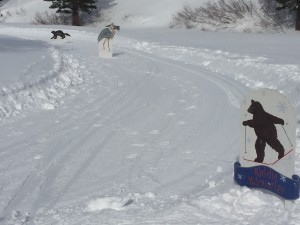
A special route has been created for youngsters.

A special route has been created for youngsters.

In the spirit of Thompson’s three-day solo journeys, Levy insisted she would find some peace and quiet.

“I like the idea of being by myself. I engage with people a lot (all other days),” she said.

Nordic Center employee David Wise can relate. The South Tahoe High School graduate and former ski team racer traded the cerebral for the physical, leaving an engineering degree from the concrete jungle at MIT for an escape back to Tahoe’s natural environment.

Wise, 23, is very encouraged by this year’s ski conditions and has noticed a surge in his age group taking up skiing.

All ages take the Bay Area ski bus up for the day at 4:30am for $85 and get dropped off at the Kirkwood Mountain Resort downhill area. From there, some cross country ski across the meadow to access the upper trails. Others take the shuttle hopper from one area to the other.

Mark Becksteadt, a Kirkwood second homeowner from Los Altos, is skipping the meadow this year. He noticed the flat area where many take their dogs skijoring was getting crowded. He brought his skate skis over to the main lodge to hit the Agony trail to skate ski.

Laura Cabral of Santa Clara was working on her skills on the learning track located at the bottom of the trailhead.

She cautiously worked on the smooth motions, enjoying having the track to herself. There’s definitely a learning curve with skate skiing, characterized by quad burns with short, skinny skis.
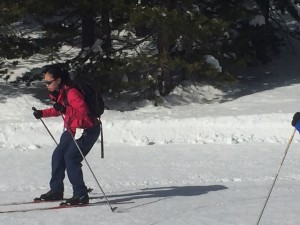
Veronica Tan of Singapore taking lesson.

Veronica Tan of Singapore taking lesson.

“I’m trying out my moves. I took a lesson six years ago and struggled,” Cabral said, adding how jealous she is of a friend who’s mastered the sport. “She skies in a jog bra.”

Veronica Tan of Singapore just wanted to get the hang of staying upright on skinny skis. She took a lesson offered by the Nordic center in the hopes of remembering her former snow days living and going to college in Minnesota.

The Kirkwood Cross Country and Snowshoe center offers beginning and skate lessons, as well as ski skills and tour packages for $58 a day. Equipment rentals cost $27, the going rate of the ski pass.

The ski area hosted a Winter Trails Day on Jan. 9 and has scheduled full moon snowshoe treks on Jan. 23 and Feb. 20. Sunset seekers can view the colors on guided hikes on March 5 and 12.


Opinion: Affordable housing a middle-class crisis in Calif.

By Christopher Thornberg

Debate about California’s housing crisis typically revolves around low-income households. More than 90 percent of California families earning less than $35,000 per year spend more than 30 percent of their income on housing.

This isn’t new; that percentage has been stubbornly high for years. Nor is this an exclusively Californian problem—the comparable figure for the U.S. is 83 percent.

What is new and disturbing is that the crisis is now spreading to middle-income households, families earning between $35,000 and $75,000 per year.

In 2006, 38 percent of middle-class households in California used more than 30 percent of their income to cover rent. Today, that figure is over 53 percent. The national figure, as a point of comparison, is 31 percent. It is even worse for those who have borrowed to buy a home—over two-thirds of middle-class households with a mortgage are cost-burdened in California—compared to 40 percent in the nation overall.

The social costs of this middle-class housing crisis are not sufficiently appreciated. Middle-income families have less money to spend on other goods and services—and that creates huge losses across the economy. It forces California employers to pay higher wages than elsewhere in the nation, raising costs for California consumers and diminishing the state’s competitiveness. Some middle-class households leave California in search of affordable housing, depriving the state of young, skilled workers who represent the state’s future.

The housing crisis is a classic problem of supply and demand. The state doesn’t build enough housing to accommodate its population growth. California is home to roughly 13 percent of the nation’s population, and has slightly greater than average population growth. Yet, over the last 20 years the state has accounted for only 8 percent of all national building permits.

To put the shortage in context, consider the amount of housing that would need to be built in order to move the state to national norms for housing stock, vacancy rates, and crowding: California would need to expand its stock by between 6 and 7.5 percent—that’s between 800,000 and a million additional residential units. In Los Angeles County, where the situation is far more acute, the state would need to add 180,000 to 210,000 units, between 12 and 14 percent of the total.

These figures dwarf the meager efforts policymakers are proposing to fix the problem. The bill known as AB35, recently vetoed by Gov. Jerry Brown, would have raised $1.5 billion over five years—to build a mere 3,000 affordable housing units.  Another piece of legislation, AB 2, proposed a new form of tax-increment financing to partially replace the redevelopment agencies the governor closed. The redevelopment system only managed to build 10,000 affordable housing units in a decade.

Why is it so hard to build? The state has stiff regulations regarding construction quality, high labor costs (in part because construction workers also need to handle their own high housing costs!), higher land costs, and fees and expenses charged to developers by local governments. But taken together, these obstacles do not provide a complete explanation for the shortage of housing.

If you were to compare the same newly built house in California and Texas, the California house would typically sell for twice as much as the one in Texas. If you were to add up all the additional costs of building that house in California—land costs, permit fees, construction code—the number would not fully explain the gap in prices. The gap is much wider. In other words: builders make a lot more profit building a house in California than they do in Texas.

What’s different here? The state has erected two giant barriers to entry:  Proposition 13 and the California Environmental Quality Act, known as CEQA.

Proposition 13 limits the value of housing to local governments by keeping property taxes much lower than in other parts of the United States. So California’s local governments—at least the ones that are fiscally wise—do not encourage residential investment, since it produces less in taxes.  The state’s CEQA law imposes similar costs on growth. It forces developers to mitigate excessive disruptions they might create in the natural or urban environment. The problem is that “excessive” is being interpreted to mean “any” in the current application of the law.

Is there any conversation about reforming CEQA in Sacramento? None. Any chance of reforming Proposition 13? Very little.

And so, California families continue to face a very real housing crisis. And the state leaders are not helping.

Christopher Thornberg is the founding partner of Beacon Economics LLC and the director of the UC Riverside School of Business Administration Center for Economic Forecasting and Development. Thornberg previously worked on the UCLA Anderson Forecast and received his doctorate from UCLA. He wrote this for Zocalo Public Square.


Cancer now No. 1 killer in 22 states

By Associated Press

Cancer is becoming the No. 1 killer in more and more states as deaths from heart disease have declined, new health statistics show.

Nationwide, heart disease is still the leading cause of death, just ahead of cancer. While death rates for both have been falling for nearly 25 years, heart disease has dropped at a steeper rate.

As a result, cancer moved up to the top slot in 22 states in 2014, according to the latest government figures.

It’s also the leading cause of death in certain groups of people, including Latinos, Asians, and adults 40 to 79.

The trend is noted in the American Cancer Society’s latest annual report.

The cancer death rate has fallen 23 percent since its peak in 1991. The decrease is attributed to declining smoking rates and advances in cancer detection, treatment and prevention.

The heart disease death rate fell 46 percent in that time.

The cancer society predicts there will be nearly 1.7 million new cancer cases this year, and nearly 600,000 deaths.

Government figures for 2014 show cancer was the leading cause of death in Alaska, Arizona, California, Colorado, Delaware, Idaho, Kansas, Kentucky, Maine, Massachusetts, Minnesota, Montana, Nebraska, New Hampshire, New Mexico, North Carolina, Oregon, Vermont, Virginia, Washington, West Virginia and Wisconsin.


Former TRPA leader to read from his latest book

Author Bill Morgan will share his newest book “Morgan’s Tahoe” on Jan. 23 at 1pm at the South Lake Tahoe Library.

This book is a memoir of his time with the U.S. Forest Service at Lake Tahoe and, later, of his experiences as executive director of the Tahoe Regional Planning Agency during one of the most tumultuous times in that Agency’s existence.

It has been said that Morgan’s ideas resolved many of the long standing issues at Tahoe and led eventually to a spirit of cooperation among the various interest groups that survives to this day.

His book also has tales of arson, plane crashes, a fatal ski lift accident, a trans-Sierra highway and other stories.

The talk is free. The library is at 1000 Rufus Allen Blvd.


Genoa hosting two history talks

Rangers from Mormon Station State Historic Park in Genoa will be giving two free guided history talks coming up.

Mormon Pioneers in Nevada is the topic of the Jan. 23 talk. Mormon pioneers were some of the first people to settle in Nevada. This talk will cover the history of Mormon settlement in the northern and southern regions of Nevada.

The other talk, Nevada’s Historic Trails, is Jan. 24. Nevada is the driest state in America, while also being the seventh largest state by total land area. This made navigating across the state a tricky journey for many early pioneers. This historic talk will cover a brief history of three major historic trails through Nevada. These trails include the California Trail and Pony Express Trail in the northern part of the state, as well as the lesser known Old Spanish Trail in Southern Nevada.

Both talk starts at noon inside the wagon shed at Mormon Station State Historic Park. Meet at the museum.


Tensions mount between Nev. ranchers, feds

By Molly Hennessy-Fiske, Los Angeles Times

Gerald “Jerry” Smith grew up in Nevada and went to work for the Bureau of Land Management right after college. As a local, he figured he was uniquely suited to work with the ranchers who have long resented the federal government’s role in land management here.

It didn’t quite work out that way.

Now retired from a job as district manager for the BLM, Smith knows all about the tensions that have long defined relations between ranchers in the rural West and the federal government, which manages much of the region’s land. Those tensions have boiled over in recent days at a wildlife refuge in Oregon and are at a perpetual simmer here.

Now it is Smith’s successor as district manager, Doug Furtado, who has become the enemy for many people in the region.

Although there have been no violence or threats here, the risk is real. Federal employees in Nevada have been attacked in the past over land-use disputes — shot at, their offices and cars bombed.

Read the whole story


Controlled burns in basin next week

Tahoe Douglas Fire Protection District, California State Parks and the California Tahoe Conservancy may continue prescribed fire operations beginning Jan. 19.

To view a map with project locations and details, go online.

Residual smoke may be seen in locations where operations have taken place over the last several weeks.

Before conducting prescribed fire operations, agencies post road signs around areas affected by prescribed fire, send email notifications and update the local fire information line at 530.543.2816.  To receive prescribed fire notifications, send an email to pa_ltbmu@fs.fed.us.


Full moon hike at Washoe Lake

Washoe Lake State Park is offering a full moon hike along the Deadman’s Creek Trail on Jan. 23.

People will get to explore the park by the light of the full moon on this moderate, one mile, round-trip hike to the gazebo overlooking Washoe Lake.

Participants should wear sturdy hiking shoes, wear warm clothes and bring a flashlight.

Meet at the Washoe Lake State Park Maze Parking Lot at 5:30pm. Take Exit 44 off of Interstate 580, drive four miles north on Eastlake Boulevard and the park’s entrance is on the left. Turn left past the fee booth and it is the first parking lot on the right.

This hike is free after the park’s entrance fee of $7 per vehicle; there is a $2 discount for Nevada residents.

For more info, contact Kim Zuch at 775.687.4319 or washoelake@hdiss.net.


Prom benefits High Fives Foundation

The Squaw Valley Prom is a notoriously high-energy event attracting 1,100 partygoers grooving to the sounds of San Diego-based electro hip hop soul collective Vokab Kompany.

The event will take place at Squaw Valley’s Olympic House on Feb. 20 at 8pm. The 12th annual prom is themed a luau, with guests hula-ing their way through the night.

Tickets for the premier High Fives Foundation event of the season are $100 per couple and $200 stag. Ticket are available online.

This year’s prom will feature world-class musical performers, a bigtruck headwear “Sew-on-Site” store, Elevated Image photo booth, video and entertainment from GoPro as well as drink specials.

Vokab Kompany is the high energy linguistic duo of Rob Hurt and Burke Baby. The two MC’s are accompanied by a four-piece band to bring sounds of funk and rap layered with creative electro-beats to the Squaw Valley “O” House. DJ Silver Boombox Thief, Mary Poppin’ and DJ Carlo will all be spinning tracks accompanying the “Hula” theme.

“This year marks 12 consecutive years of throwing the best party in Squaw Valley,” said CHARITYSMITH and Squaw Valley Prom Founder, Brooks Rohlen. “We look forward to seeing everyone shining bright and having the time of their lives with the ‘Lu’au’ theme.”


Photos show casino life behind the scenes

By Jenny Kane, Reno Gazette-Journal

In the late 1970s and early 1980s, Jan Aphelin paid her way through college by working as a “camera girl” snapping commissioned photos of the high rolling gamblers and highfalutin clients of Reno’s swankiest casinos and clubs.

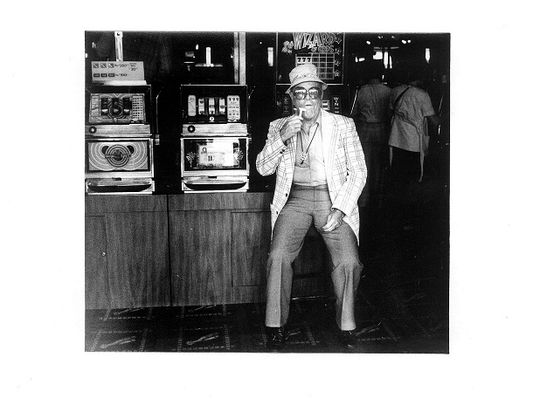
"All Nighter" is one of the Jan Aphelin's black and white photographs shown in her "Black and White Risk" exhibition at the Nevada Historical Society. (Photo: Courtesy of the Nevada Historical Society)

“All Nighter” is one of Jan Aphelin’s photographs being exhibited at the Nevada Historical Society. Photo/Courtesy of the Nevada Historical Society

She photographed the elite – some of them celebrities, including actress Debbie Reynolds and singer Tom Jones – gambling, drinking and hobnobbing. She earned a commission from her employer, a Las Vegas-based photography company, and charged the subjects $200 to $300 for a package of mostly posed glamour shots that took an hour to process and were delivered in a velvet folder.

But at the end of her shifts, she did not put away her cameras.

Read the whole story