Calif. has ‘a shot out of the drought’ if El Niño rain persists

By Joseph Serna, Los Angeles Times

With a couple of weeks of rain and snow behind them and more on the horizon for the Sierra Nevada in Northern California, state water officials expressed cautious hope that this El Niño season could lift California out of its historic drought.

“The recent rains have put us on a good trajectory to perhaps have a shot out of the drought if it were to continue at the current rate,” said Doug Carlson, a spokesman with the California Department of Water Resources.

As of Wednesday, the northern Sierra Nevada had received 114 percent of the average rainfall typical during strong El Niño years, while the central Sierra Nevada in the San Joaquin basin was doing even better, having received 122 percent of average rainfall typical during big El Niño years.

Read the whole story


Loop road subject of multiple meetings

There will be a meeting about the proposed loop road on the Shore Shore on Feb. 10 from 4:30pm-7pm at the South Tahoe Middle School multipurpose room.

It will feature a presentation of the project, and include a question and answer session.

Questions about the project are being taken in advance. Submit them to Tracy Franklin at tfranklin@cityofslt.us. Questions must be received by 5pm Feb. 8. Questions may also be asked at the meeting.

This meeting is spearheaded by the city to once and for all have all questions about the project answered.

This is in addition the Tahoe Transportation District’s scheduled meeting on the same topic on Jan. 26 from 5-7pm at Lake Tahoe Resort Hotel.


Study: Snow soaks up toxic air pollutants

By Jacqueline Howard, Huffington Post

A team of scientists recently revealed that snow in urban areas can absorb the same toxic and carcinogenic pollutants that come from car exhaust. The interaction of pollutants with cold elements and freezing temperatures in snow might even cause the release of new compounds, according to Parisa Ariya, professor of chemistry and atmospheric sciences at McGill University in Canada, who led the research.

“Snow flakes are ice particles with various types of surfaces, including several active sites, that can absorb various gaseous or particulate pollutants,” she told the Huffington Post. “As a mother who is an atmospheric physical chemist, I definitely do not suggest my young kids to eat snow in urban areas in general.”

The researchers analyzed how snow interacts with exhaust-derived particles and pollutants by putting both snow and exhaust fumes in a chamber. After examining the chemical reactions that took place, the researchers discovered that snow was efficient at removing pollutant particles from the air.

Read the whole story


Federal money to help reduce Tahoe’s fire risk

The latest round of funding through the U.S. Bureau of Land Management’s Southern Nevada Public Land Management Act includes more than $3 million for projects to help reduce wildfire risk in Lake Tahoe communities.

Projects include:

  • U.S. Forest Service Lake Tahoe Basin Management Unit: $1.094 million to reduce hazardous fuels on 2,300 acres between Crystal Bay and Incline Village, south to Spooner Summit and Zephyr Cove, and another $470,000 to prepare a plan to remove hazardous fuels from urban lots it manages.
  • Lake Valley Fire Protection District: $290,490 to reduce hazardous fuels on 93 acres in its service area.
  • Tahoe Douglas Fire Protection District: $308,760 to reduce hazardous fuels on up to 100 acres around Kingsbury Grade communities so firefighters can more safely protect life, property, and the environment in the event of a wildland fire.
  • Nevada: $120,500 to reduce hazardous fuels on approximately 70 acres of urban lots and open space in communities on the East Shore.
  • California State Parks: $261,940 to reduce hazardous fuels on 107 acres  and restore and improve forest and watershed resources at D.L. Bliss State Park.
  • North Tahoe and Meeks Bay fire protection districts: $450,000 to reduce hazardous fuels on up to 514 acres of private and local government-owned land in Kings Beach, Tahoe Vista, Carnelian Bay, and Meeks Bay. The two fire protection districts will also host educational workshops with local students and community members about the importance of fuel reduction projects and creating fire adapted communities.
  • North Lake Tahoe Fire Protection District: $200,000 to reduce hazardous fuels on up to 544 acres of local government owned land in Incline Village. The fire protection district will also host educational workshops for community members to learn more about the importance of fuel reduction projects and creating fire adapted communities.


Caltrans seeks 5,000 motorists for mileage fee pilot program

By Dan Weikel, Los Angeles Times

Caltrans is seeking 5,000 volunteers for an experimental program that will charge motorists a fee based on how far they drive — a proposal that could replace the state gas tax as a way to fund highway maintenance and repairs.

Volunteers will participate in the California Road Charge Pilot Program, which was created by the Legislature in 2014 to test the feasibility of so-called mileage-based user fees.

The dry run is scheduled to begin this summer and last for nine months. Participating motorists will test various mileage reporting methods, but they won’t be charged fees for the distances they drive.

Read the whole story


Snippets about Lake Tahoe

vail·       Vail Resorts has acquired Wilmot Mountain in Wisconsin near the Illinois state line.

·      Lake Tahoe South Shore Chamber of Commerce’s annual Connect for a Cause mixer at Riva Grill raised more than $800 for Bread & Broth 4 Kids. Attendees donated more than 10 bags of food for Bread & Broth and Christmas Cheer. And the chamber donated almost $1,200 to the nonprofits from door sales.

·      Lake Tahoe Chapter of the Antique & Classic Boat Society’s 2016 South Tahoe Wooden Boat Classic will be at the Tahoe Keys Marina in South Lake Tahoe on July 29-30. This year vintage race boats will be featured. For more info, go online.

·       Lake Tahoe Hard Rock presented the Tahoe Fund with $29,310. The money came from $1 donations from hotel stays during the resort’s first season of operation through a program called Green Bucks.

·       Douglas County has selected interim Human Resources Director Wendy Lang for the permanent position.


Tahoe Fund tasked with defining next generation of visitors’ centers

By Kathryn Reed

What will the visitors’ centers of the future look like and will they even exist?

Those questions are expected to be answered by next summer after the Tahoe Fund delves into what might suit Lake Tahoe’s needs the best.

There are various centers around the basin from chamber operated entities to U.S. Forest Service run outlets to municipality led enterprises like Explore Tahoe in South Lake Tahoe.

Visitors’ centers have been losing their appeal because these days people are more likely to look up information on a smart phone or tablet. But they still have a role to play because the brick and mortar location usually has someone who can answer questions in a way that a Google search might not be as responsive, and they have other resources to disseminate. Plus, they are often at a central location people want to explore.
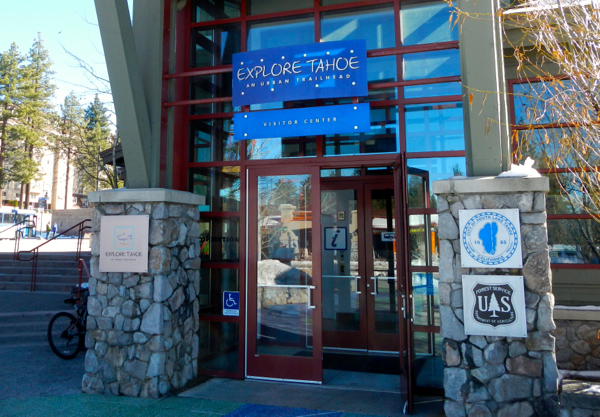
Explore Tahoe opened in 2007 Explore Tahoe, a collaborative effort between South Lake Tahoe, California Tahoe Conservancy, U.S. Forest Service and Tahoe Heritage Foundation. Photo/LTN

Explore Tahoe opened in 2007 as a collaborative effort between South Lake Tahoe, California Tahoe Conservancy, U.S. Forest Service and Tahoe Heritage Foundation. Photo/LTN

“The goal is to see what works best for Tahoe,” Patrick Wright, executive director of the California Tahoe Conservancy, told his board.

The board agreed to allocate $85,000 to the visitor information and environmental interpretation project. The nonprofit Tahoe Fund is putting in $10,000.

The idea has in large part morphed from Bonnie Turnbull’s idea of creating a discovery center on the South Shore. The South Lake Tahoe resident was at the CTC meeting last month and expressed her support for how things are evolving.

Jeff Marsolais, supervisor for the Lake Tahoe Basin Management Unit and non-voting member on the CTC board, welcomes the study, noting his agency will have a big stake in the outcome. He also expressed how expensive it is to maintain and operate visitors’ centers.

The staff report highlights how things got to this point: “… after an extensive series of discussions, the group concluded that they first needed a thorough assessment of the needs and desires of both residents and visitors for new or expanded facilities, and to explore alternative approaches to meeting those needs, given the enormous cost of building and maintaining educational and interpretive facilities.”

Wright pointed out how Tahoe is unique in that there is not one point of entry like most national parks. He said California State Parks is looking at creating mobile centers. There is also the option of pop up centers.

It will be up to the Tahoe Fund to reach consensus, if possible, on what is best for the basin. Initial planning will begin soon. Public workshops and vision planning are likely to occur in March. A design charrette and final report are expected in June.


Letter: How to curtail Tahoe gridlock

To the community,

Here is a possible temporary solution to the traffic gridlock that we currently experience every Sunday afternoon here at South Lake Tahoe.

From Meyers to Twin Bridges:

On Sunday afternoon: only westbound traffic would be allowed on both lanes at 1, 3 and 5pm — and eastbound traffic allowed only at 1:30 and 2:30p, and then normal after 6pm.

Yes, it would require lots of signage, traffic guidance personnel by Caltran, and public education by Caltrans and other local papers. And of course a pilot car — with front crash rigs equipped — to lead the lane closures as required.

It would be a lot less expensive than an undesirable four-lane highway all the way in. A long-term solution would be to limit the number people in the Tahoe basin at one time, but that will only come a long time after I’m gone.

Jim Hildinger, South Lake Tahoe


OD’ing propels rise in death rates of young whites

By Gina Kolata and Sarah Cohen, New York Times

Drug overdoses are driving up the death rate of young white adults in the United States to levels not seen since the end of the AIDS epidemic more than two decades ago — a turn of fortune that stands in sharp contrast to falling death rates for young blacks, a New York Times analysis of death certificates has found.

The rising death rates for those young white adults, ages 25 to 34, make them the first generation since the Vietnam War years of the mid-1960s to experience higher death rates in early adulthood than the generation that preceded it.

The Times analyzed nearly 60 million death certificates collected by the Centers for Disease Control and Prevention from 1990 to 2014. It found death rates for non-Hispanic whites either rising or flattening for all the adult age groups under 65 — a trend that was particularly pronounced in women — even as medical advances sharply reduce deaths from traditional killers like heart disease. Death rates for blacks and most Hispanic groups continued to fall.

Read the whole story


Uber, Lyft expand service to Reno airport

Uber and Lyft can now pick up and drop off passengers at Reno-Tahoe International Airport.

Prior to the Jan. 20 announcement the drivers picked up their fares outside the airport or dropped them off nearby.

About 3.4 million use the Reno airport each year.

Uber and Lyft are also operating in the Lake Tahoe area.

— Lake Tahoe News staff report