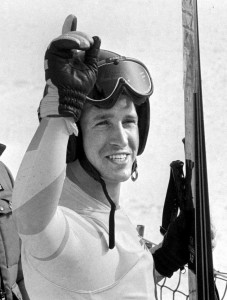
Weibrecht second in Hahnenkamm super G

By USSA

KITZBUEHEL, Austria – Andrew Weibrecht (Lake Placid, N.Y.) grabbed his second, and most prestigious, super G podium result of his career finishing second in Friday’s Audi FIS Ski World Cup on the classic Hahnenkamm track.

“I couldn’t be happier. It’s awesome,” said Weibrecht. “Growing up everybody thinks about getting on the podium at Kitzbuehel. Today is a dream come true.”

Norway’s Aksel Lund Svindal won the race, and scored his 15 career World Cup super G victory. Austria’s Hannes Reichelt was third. Friday’s super G also served as the first leg of the alpine combined and is followed with an afternoon slalom race.

“I thought I was close today, but Aksel skied a great run,” Weibrecht said. ”I’m a little disappointed that he beat me, but it’s an amazing feeling. This is a dream come true to take home one of the Kitzbuehel trophies.”

Wiley Maple (Aspen, Colo.) was 25, and Steven Nyman (Sundance, Utah) was 26. Thomas Biesemeyer (Keene, N.Y.) was 31, Bryce Bennett (Squaw Valley) 34, Drew Duffy (Warren, Vt.) 50 and Tim Jitloff (Reno) 53.

Weibrecht dedicated his performance to 1994 Olympic Downhill Champion Bill Johnson, who passed awayThursday afternoon.

“He really jump started American downhill racing,” Weibrecht said of Johnson. “Nothing really happened up until 1984 when Bill came and put down that fantastic run in Sarajevo. He really revitalized the sport and paved the way for guys like Tommy Moe, AJ Kitt and Kyle Rasmussen … and those guys paved the way for our generation. It’s really important to recognize where we have come from as a country in this sport, and Bill was a big part of that.”


Former Olympic downhill champ Bill Johnson dies at 55

FILE - In this Feb. 16, 1984 file photo, American skier Bill Johnson smiles after he won the gold medal in men's downhill competition at the Winter Olympics games on Mt. Bjelansnica near Sarajevo, Bosnia-Herzogovina.  The U.S. ski team says the former Olympic downhill champion has died after a long illness. He was 55. Megan Harrod, a spokeswoman for the U.S. Alpine team, says Johnson died Thursday, Jan. 21, 2016  at an assisted living facility in Gresham, Ore. (AP Photo/File)

In this Feb. 16, 1984, photo, Bill Johnson smiles after he won the gold medal in men’s downhill at the Winter Olympics on Mt. Bjelansnica near Sarajevo, Bosnia-Herzogovina.  Photo/AP

By Eric Willemsen, AP

Bill Johnson, the brash American who became the first U.S. skier to win an Olympic downhill title, died after a long illness, the U.S. ski team said Friday. He was 55.

Megan Harrod, a spokeswoman for the U.S. Alpine team, said Johnson died Thursday at an assisted living facility in Gresham, Ore.

Johnson’s health had been on the decline for several years after a series of strokes.

Johnson won the downhill at the 1984 Sarajevo Olympics, the first American to capture gold in Alpine skiing’s marquee event. He was also the first American male to win an Olympic gold in any Alpine event.

He became an iconic figure to many Americans by predicting he would win Olympic gold.

“They related to Billy — that brash, throw-it-in-your-face type attitude,” Phil Mahre, who won the Olympic slalom in 1984, said in 2012. “When you tell people you’re going to go do something and then you go out and back it up like in Sarajevo, it’s pretty impressive.”

Johnson tried to make a comeback ahead of the 2002 Salt Lake City Olympics at the age of 40, but crashed in a downhill training run in 2001 at the U.S. championships at the Big Mountain near Whitefish, Mont. He sustained a traumatic brain injury that erased nearly a decade of memories. He had to learn how to walk, talk and eat again.

Johnson made steady improvement over the years, even returning to the slopes for recreation. But his health deteriorated again because of strokes, and he spent his last years in the assisted living center near Portland.

“Bill was an unbelievable fighter since his injury. He went through a lot. It’s sad,” Olympic super-G silver medalist Andrew Weibrecht said Friday. “He was the guy that really jump-started American downhill racing. Nothing had really happened much up until ’84 when Bill came and had that fantastic run in Sarajevo and that same year he won Wengen.

“He really paved the way for guys like Tommy Moe, A.J. Kitt and Kyle Rasmussen to realize that it’s possible. In turn these guys paved the way for our generation,” Weibrecht said after finishing second in a World Cup super-G in Kitzbuehel.

Weibrecht’s teammate Steven Nyman also paid tribute to Johnson.

“He didn’t care what anyone said, he did it his way. And he did really good,” Nyman said. “There was a couple of years where he was really good and he kind of paved the way for us. For some reason, Americans have done well in Olympic downhills, with him, Bode (Miller) and Tommy Moe. Hopefully I can follow in his tracks.”

Nyman, who met Johnson a few times, recalled how he and teammate Marco Sullivan sent Johnson a short video to congratulate him on his birthday last spring.

“He sent us a message back and really appreciated it. It meant something,” Nyman said.

“It’s really sad,” Lindsey Vonn, winner of the 2010 women’s Olympic downhill title, said Friday. “He’s had a rough couple of years and it’s been sad to watch him deteriorate like that. But you know when you’re in a state like that I think it’s a blessing sometimes. He was an incredible legend in our sport so I just hope he rests in peace and my condolences to his family.”

Johnson, who was born in Los Angeles, grew up racing at Bogus Basin, Idaho, and Mt. Hood, Ore.

Caught stealing cars as a teenager, the judge gave him a choice: Attend ski school or head to jail. So he went to Mission Ridge Ski Academy in Washington, where he developed his talent.

Johnson established himself on the global scene when he won the Lauberhorn downhill in Wengen, Switzerland, in 1984 in his second year on the World Cup circuit.

A month later, Johnson went to Sarajevo and cockily predicted that he would win, annoying his European rivals. He came through, beating silver medalist Peter Mueller of Switzerland by 0.27 seconds.

“What he did that day was amazing at the time,” said Bill Marolt, former president and CEO of the U.S. Ski and Snowboard Association. “In retrospect, it’s still amazing.”

Johnson won twice more on the World Cup circuit in 1984 in Aspen and Whistler, but never stepped on the podium again. He went through knee and back injuries that curtailed his career and prevented him from defending his title at the 1988 Calgary Olympics.

“He was just a legend,” American speed racer Travis Ganong said. “He used to be a pioneer for American downhill skiing. … He was an amazing skier and was a legend of the sport. He will be dearly missed for sure.”

Vonn and Tommy Moe are the only other American skiers to win Olympic gold in downhill.

Vonn, who was competing in downhill training Friday ahead of a World Cup race in Cortina d’Ampezzo, Italy, said Johnson was a trailblazer for American downhillers.

“He was definitely a pioneer — first American to win an Olympic downhill gold medal,” Vonn said. “So for sure, an inspiration and for Americans definitely a legend in the sport.”

AP sports writer Andrew Dampf in Cortina d’Ampezzo, Italy, contributed to this report.



Why some people drop dead while shoveling snow

By Brady Dennis, Washington Post

Each approaching blizzard brings warnings about the dangers of shoveling snow, an activity that sends thousands of Americans to emergency rooms each winter. Don’t tackle the walkway if you aren’t in good enough shape, say the experts. You can get hurt or, even worse, trigger a heart attack or stroke.

Medically speaking, a person is indeed more likely to keel over while heaving snow than, say, jogging on a treadmill. But why?

“Physically, what happens when you get really cold is you have constriction of the blood vessels,” says Lawrence Phillips, a cardiologist at NYU Langone Medical Center. “It decreases the blood supply you’re getting to your vital organs.”

Read the whole story


Sierra Colina project in Stateline resurrected

By Kathryn Reed

STATELINE – Similar, yet different. That’s one way to describe what the latest version of the Sierra Colina subdivision in Stateline looks like.

“The original Sierra Colina project was going to be the premier project in the entire Lake Tahoe Basin. It’s unfortunate it ended up in litigation. Everyone lost,” Douglas County Commissioner Nancy McDermid said.

She singled out how the previous project included nine moderate-income deed restricted single-family residences that would have been ideal for local workers.

The property borders Lake Village, Highway 50 and the commercial area with Sushi Pier and Azul restaurants. Today it is vacant land.

Commissioners on Jan. 21 unanimously agreed to subdivide the 18-acre parcel into 47 parcels on which 13 single-family residences and 34 duplexes will be built. They will be smaller units – the smallest being 1,546-square-feet – than what was proposed more than six years ago. All will be built to LEED standards. There will also be a homeowners’ recreation building and trails. The road through the development will be private.

“We are gratified with the votes cast by the Douglas County Board of Commissioners (Thursday) in support of the Sierra Colina project. Because the county approval process is still ongoing, out of respect for that process, we reserve further comment until it is completed,” Gail Jaquish told Lake Tahoe News.

Jaquish with her husband, Steve Kenninger, who live locally, acquired the property in 2005 in a foreclosure sale. Four years later they obtained approval from the Tahoe Regional Planning Agency to build 50 units.

Soon thereafter the League to Save Lake Tahoe filed a lawsuit that ultimately derailed the project. The appellate court in 2012 sided with the environmental group, which had challenged TRPA over the coverage issues for the Sierra Colina project. Coverage is a TRPA creation dictating how much land can be paved in order to contend with erosion issues.

Since that decision came out Jaquish and Kenninger have been deciding how to go forward. Neither attended this week’s meeting.

The six members of the public who spoke at Thursday’s meeting were all in favor of the project. Many pointed out how the couple has put more time and money into this project when someone less determined would have walked away.

The project will be built in four phases. The first will be to put the utilities underground.

Before the second phase begins improvements to the intersection of Lake Village Drive and Highway 50 will be made. These include left and right turn lanes onto the highway, and an accelerator lane on the highway for those turning left.


Opinion: Corporate grab behind Yosemite trademark clash

By Michael Hiltzik, Los Angeles Times

If you’re a lover of U.S. national parks in general and Yosemite National Park in particular, you’ve probably been moved to outrage over reports that a New York corporation has claimed the trademark rights to several names associated with the park.

These include the historic Ahwahnee Hotel, Curry Village, and conceivably Yosemite National Park itself. As a response to a pending lawsuit over the issue, the National Park Service will erase some of the disputed names as of March 1; the Ahwahnee will become the Majestic Yosemite Hotel and Curry Village will be known as Half Dome Village. The park’s name will stay the same…for now.


The dispute over the names is part of a broader legal fight, though not one that necessarily makes either the company or the government look good.

Read the whole story


Writing therapy can help create a brighter future

By Perry Garfinkel, Los Angeles Times

British author Graham Greene, in his 1980 book, “Ways of Escape,” put into words what most writers know: “Writing is a form of therapy; sometimes I wonder how all those who do not write, compose or paint can manage to escape the madness, melancholia, the panic and fear which is inherent in a human situation.”

Academicians trace the idea of writing as therapy to the time of Egyptian pharaoh Ramses II, about 1,200 BC. The entrance to his royal library declared: “House of Healing for the Soul.” American Unitarian minister Samuel Crothers coined the term “bibliotherapy” in 1916. In the late 1980s, James Pennebaker, psychology professor at the University of Texas at Austin, led the modern writing therapy movement in a landmark research study that showed the potential health benefits of “expressive writing” about emotional upheaval.

In the last two decades, writing therapy has joined dance and art therapy as a legitimate therapeutic tool. And that has triggered growing interest in a type of writing that focuses on the healing power of putting feelings down on paper or screen — as evidenced by the burgeoning popularity of the memoir, as well as the use of journaling in businesses and American schools.

Read the whole story


Nichols leaves Douglas with 6 month’s pay

By Kathryn Reed

Jim Nichols is walking away from his job as Douglas County manager with a check for more than $115,000 – the equivalent of six month’s pay, plus sick and vacation pay.

At the Jan. 21 meeting it was stressed that Nichols neither resigned nor was he fired. Instead it was a mutual agreement between Nichols and the commissioners for him to leave his position after 16 months on the job because there was a belief he could not longer be effective.

Jim Nichols

Jim Nichols

Had he been let go by the board, Nichols’ contract stated he would have been given two month’s notice, at which time he would have remained on the job, and then been entitled to six month’s pay.

He practically got that – except he didn’t have to work those two months. Nichols has not been on the job since Jan. 12, but is on the payroll through Jan. 29.

There was no discussion about the payout, just the vote.

A few letters opposing the deal were submitted, but no one from the public spoke.

Discussion then ensued about what happens next.

Commissioners on a 4-1 vote agreed to ask Larry Werner to be the interim county manager. Commissioner Steve Thaler said no. He preferred to seek an interim from within the county. It is the commission’s desire Werner would work for a year, giving the county time to find someone suitable for the indefinite future.

Werner was the interim county manager before Nichols was hired. At that time he made $12,500/month.

The board then voted to have Mimi Moss, community development director, be acting county manager until a long-term interim is selected. She has filled in before as county manager.

Christine Vuletich, who is the assistant county manager, was bypassed for the short-term chief spot because she is tasked with putting together the next fiscal budget.

It was pointed out that with three of the commissioners’ being up for re-election this year it may make it difficult to easily find a county manager. Plus, many residents and employees are less than satisfied with how the current board is doing business, so the semblance of dysfunction could be a turn off.


Reno’s Guldemond 3rd in slopestyle at Mammoth

By USSA

MAMMOTH MOUNTAIN – Hometown boy Brandon Davis led a U.S. sweep in slopestyle at the first U.S. Snowboarding Grand Prix of the 2016 season Thursday at Mammoth Mountain.

Davis (Mammoth Lakes) topped the field with a pair of 1260s, as Eric Willett (Breckenridge, Colo.) was second and Chas Guldemond (Reno) was third. Thursday was originally slated for just slopestyle qualifications, but due to an incoming storm the qualifications and finals were held all in one day.

“It means the world to me,” Davis said of the win in front of a hometown crowd. “I just felt so comfortable being here at home surrounded by all my friends and family and I just couldn’t have asked for it to go a better way.”

The American women also fared well, with two U.S. team members earning spots on the podium: Jessika Jenson (Rigby, Idaho) was second and Karly Shorr (Milford, Mich) was third. Anna Gyarmati of Hungary took the victory.

Jenson rode with solid style, stomping back-to-back 540s on the jumps to earn the second spot on the podium.

Other top-finishing Americans: Ryan Stassel (Anchorage), fifth; Chandler Hunt (Park City), sixth; Nik Baden (Steamboat Springs, Colo.), seventh; Chris Corning (Arvada, Colo.), eighth; Eric Beauchemin (Grand Blanc, Mich.), ninth; Hailey Langland (San Clemente), fourth; Hailee Mattingley (Sandy, Utah), fifth; Kirra Kotsenburg (Park City,), sixth; Ty Walker (Stowe, Vt.), eighth.


FAA approves ski-video drones at Tahoe

By Bart Jansen, USA Today

Commercial drones are about to get a lot closer to the action.

The drone startup Cape Productions follows skiers down the slopes with remote-controlled aircraft to record video of their runs. The San Francisco company announced Wednesday that the Federal Aviation Administration gave it approval to fly hundreds of feet closer to people than previously allowed.

The FAA typically requires commercial drones to stay at least 500 feet away from people who aren’t associated with the flight, as a safety precaution. The exception for years has been for aerial photography as part of a closed movie set because the participants are expected to know the risks.

The company will initially offer the service in the U.S. at Squaw Valley and Homewood Mountain Resort, where it has been testing its operation.

Read the whole story


Ski maps painter owns a niche market

By Matt McCue, 99U

Chances are you’ve seen a James Niehues painting before, but you didn’t know it. His canvas is the ski trail map, which is often overlooked for its artistic value. But since 1986, Niehues has created more than 240 different maps for resorts on five continents including Aspen Highlands, Sun Valley, Vail, Whistler Blackcomb, and Big Sky.

For this ski season, the 70-year-old has designed the trail map for the newly-combined Park City and Canyons ski areas, now America’s largest ski mountain.

Niehues’s mastery of a single métier may sound familiar. One day you design something relatively obscure for a client, and they recommend you to a colleague. The referrals snowball until pretty soon you’re the go-to book jacket, wedding invite, or font designer, whether or not that was your intent.

The referrals snowball until pretty soon you’re the go-to book jacket, wedding invite, or font designer, whether or not that was your intent.

Read the whole story