Wild, natural beauty abounds in national parks

Publisher’s note: This is one in a series of stories about the National Park Service, which is celebrating its 100th anniversary in 2016.

Battling Male elk engage in ritualized mating behavior during the rut - antler wrestling or sparring. Photo Copyright 2016 Carolyn E. Wright

Male elk engage in ritualized annual mating behavior during the rut in Colorado’s  Rocky Mountain National Park. Photo Copyright 2016 Carolyn E. Wright

By Carolyn E. Wright

I had visited Rocky Mountain National Park many times to hike, bike, and photograph the beautiful landscape. This time was different. With my new husband in tow, we were in search of the elk rut, also known as the mating season, when the males fight for a harem of cows and their calves. The bull elk also will bugle during this time to attract the females and to intimidate other bulls.

Carolyn E. Wright photographs elk in Denali National Park. Photo Copyright 2016 Carolyn E. Wright

Carolyn E. Wright photographs elk in Denali National Park. Photo Copyright 2016 Carolyn E. Wright

We started our afternoon drive from Estes Park where we were staying in the famous Stanley Hotel, which was the inspiration for the movie “The Shining.” We followed the main road through the park, stopping to enjoy several overlooks, as this was my husband’s first visit to the park. It was getting late and I knew we had to get to the Poudre Lake area where the land is flat and water abundant. There, we should find our goal.

The layers of Canyonlands National Park in Utah. Photo Copyright 2015 Carolyn E. Wright

The layers of Canyonlands National Park in Utah. Photo Copyright 2015 Carolyn E. Wright

We rounded the corner and saw herds of elk. I couldn’t gather my camera equipment fast enough. Fortunately, we were rewarded with several young bulls fighting and other interactions. It’s an incredible opportunity to witness nature at work.
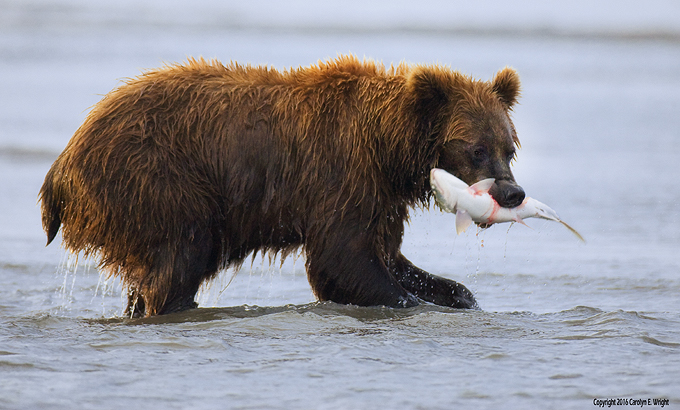
A grizzly finds its salmon dinner in Alaska's Denali National Park. Photo Copyright 2016 Carolyn E. Wright

A grizzly finds its salmon dinner in Alaska’s Lake Clark National Park and Preserve. Photo Copyright 2016 Carolyn E. Wright

This is one of my many wonderful experiences at our national parks. These memories started as a youngster growing up in Tennessee, where my family and friends made several trips to nearby Smoky Mountain National Park. My family enjoyed the outdoors and camping, so I soon started to document the beauty with my camera.

Harbor seals chill on glacier ice in Kenai Fjords National Park in Alaska. Photo Copyright 2016 Carolyn E. Wright

I later added the goal of visiting every national park to my bucket list. While I could spend lots of time and money traveling all over the world, it is much easier and cheaper to enjoy the incredible diversity and beauty of our park system. I don’t have to worry about language barriers, passports, or currency exchanges. I also had to travel for work, so it was easy to add a weekend visiting a nearby park to my business trip.

Smoky Mountains Creek flows through the Great Smoky Mountains National Park in Tennessee. Photo Copyright 2016 Carolyn E. Wright

Smoky Mountains Creek flows through Great Smoky Mountains National Park in Tennessee. Photo Copyright 2016 Carolyn E. Wright

We have 59 national parks, plus many more national monuments and recreation areas. I’ve been to 33 national parks (some of them several times), from the Everglades in Florida, to Denali in Alaska, Acadia in Maine, and Sequoia in California. Each park has unique and varied features. Rocky Mountain National Park is my overall favorite because of its combination of extreme mountains and wildlife. Kenai Fjords (sea life, including whales, otters, and sea lions) and Lake Clark (coastal brown bears, aka grizzlies) offer the closest access to animals. Great Sand Dunes provided the most fun, running and rolling down the dunes. Yellowstone presents the most diversity of landscape and animals.

Great Sand Dunes National Park and Preserve in Colorado if full of contrasting terrain. Photo Copyright 2016 Carolyn E. Wright

My experiences during my visits have ranged from elation to fear. During a backpacking trip in the Smoky Mountains, a wasp stung me, we had to cross a fast running creek seven times, and we got lost for several hours. I’ve watched a mother bear nurse her cub within feet of me in Lake Clark. I’ve seen the rare blossoming of fields of wildflowers in Death Valley. The Denali mountain provided the most spectacular view, but it is one of the most difficult areas to hike because there are no trails in the park. I fought hypothermia during a backpack trip there. An alligator approached us in the Everglades. I hiked to the bottom and back up the steep Grand Canyon. Deer ate berries next to me in Olympic.

A sow nurses her cub. Photo Copyright 2016 Carolyn E. Wright

A sow nurses her cub at Lake Clark National Park and Preserve. Photo Copyright 2016 Carolyn E. Wright

All of our national parks bestow a plethora of scenic opportunities and a sense of grounding at a low price. Great thanks to President Theodore Roosevelt who started the National Park Service and to those who continue to preserve these national gems.


Opinion: Calif. schools want more money

By Dan Walters, Sacramento Bee


Gov. Jerry Brown’s new budget would boost spending on K-12 schools by several billion dollars, but the California School Boards Association says that’s a small fraction of what’s needed to adequately prepare the state’s six million students for jobs and higher education.

Dan Walters

Dan Walters

The CSBA released a report Wednesday asserting, “California is underfunding K-12 schools by as much as $42 billion per year.”

That would be an extra $7,000 per student on top of the $10,591 that Brown’s 2016-17 budget projects will be spent on each from state and local funds and push California’s per-pupil spending to one of the nation’s highest levels.

Read the whole story


Why gear costs so much

By Graham Averill, Outside

I’m a sucker for thumbholes. Those little empty spaces on the cuffs of hoodies and base layers that showed up maybe a dozen years ago—those things make me swoon. And I’m not the only one.

According to a recent Nike investor meeting, Nike’s customers are willing to pay a premium for clothing with seemingly benign features like thumbholes. During the past several years, Nike has performed analyses that looks at the value customers attribute to specific features on technical clothing in hopes of getting more “scientific” about its pricing.

“[We] had them tell us, what do you think this one’s worth versus this one? What details on the shorts make it worth more?” explained Jeanne Jackson, president of product and merchandising at Nike, to investors during the meeting. “We discovered in tops that if a top has a thumbhole in it, the consumer perceives it as a premium top. So we’re getting a little bit more scientific about what those features and benefits are that the consumer will perceive as worth more money.”


We reached out to Nike and a handful of large outdoor brands, all of which refused to comment about their pricing strategies or any internal consumer analysis.

Read the whole story


U.S. dominates Mammoth Grand Prix halfpipe

By USSA

MAMMOTH MOUNTAIN – It was a highly successful day for the American halfpipe riders at the first stop of the U.S. Grand Prix in Mammoth on Sunday.

American women swept the podium with Kelly Clark (West Dover, Vt.) taking the win, Chloe Kim (La Palma) finishing second and rookie team member Maddie Mastro (Wrightwood) earning her first pro-level podium with third. The U.S. men took four of the top-five positions including a pair of podium finishes: Chase Josey (Hailey, Idaho) grabbed second and Gabe Ferguson (Bend, Ore.) finished third; Ryo Aono of Japan topped the field for the win.

Mammoth Mountain has seen snowy, stormy conditions since the Grand Prix began on Thursday, which affected several competitions, including the cancellation of qualifications for the snowboard halfpipe.

“I’m glad that we were able to get the contest off today,” Clark said. “It’s been a challenging week of weather.”

The four-time Olympian used her veteran knowledge to approach the competition, landing a “safety” run on her first pass and then bumping it up by adding her signature 1080 on the second pass, which earned her the win. “We had an early start,” she said. “I just tried to make the most of my practice because we didn’t really have any this week.”

Fifteen-year-old Kim, who broke Clark’s five-year winning streak at X Games Aspen in 2015, also landed what she called her “back-up plan” to land in second. “I’m just happy that I had a back-up plan,” said Kim, who wanted to throw a relatively new tailgrab 1080 she first landed at the U.S. Open in 2015. “I was really excited to maybe throw one today, but unfortunately that wasn’t able to go down.”

Mastro, a member of the U.S. Snowboarding rookie halfpipe team and Mammoth Mountain team, was thrilled to earn her first pro podium in front of family and friends. The 15-year-old will hopefully use the momentum rolling into her first X Games appearance in Aspen this week.

Idaho native Josey earned his first Grand Prix podium with a similar mindset to that of the ladies.

“There was definitely strategy going into the first runs, just wanting to land a run and then kind of see where you can go from there,” he said. “The weather got better and the second run I just stepped it up and went for two more double corks, and that’s what got me my score. It’s my first Grand Prix podium and it really means a lot to U.S. Snowboarding and USSA, so I’m stoked.”

Young Gabe Ferguson not only topped most of the field to earn his first Grand Prix podium, he also topped his fellow U.S. Snowboarding teammate and older brother, Ben Ferguson, who finished 24th. “This is my first Grand Prix podium and I’m super excited,” Gabe said. “It’s been tough with all the weather that’s come through the last couple days so I’m just happy we’re out here having fun today.”

Rounding out the men, Jake Pates (Eagle, Colo.) was fourth, Ryan Wachendorfer (Edwards, Colo.) fifth, Toby Miller (Truckee) ninth, Joshua Bowman (Mammoth Lakes) 12th, Nathan Jacobson (Bend, Ore.) 17th, Robert Pettit (Aspen, Colo.) 20th, Chase Blackwell (Longmont, Colo.) 22nd, Dru Brownrigg (Bend, Ore.) 23rd and Ben Ferguson (Bend, Ore.) 24th.

For the women, Elena Hight (South Lake Tahoe) was fifth, Hannah Teter (Meyers) sixth, Zoe Kalapos (Vail) seventh, Jenna Dramise (South Lake Tahoe) 12th, Hannah Merson (Stowe) 16th, McKinzie Johnson (Park City) 19th, Autumn Inouye (Hood River, Ore.) 20th and Madison Taylor Barrett (West Chesterfield, N.H.) 22nd.


Casinos bankroll effort to preserve Nev. taxes

By Associated Press

LAS VEGAS — The vast majority of the money used to defend Gov. Brian Sandoval’s new $1.1 billion tax package is coming from major casinos.

An expert says that’s likely because the governor’s plan spreads the tax burden broadly across a range of businesses and doesn’t single out the gambling industry.

The Las Vegas Sun reports that most of the $242,000 donated to the Coalition for Nevada’s Future in 2015 came from five gambling giants, according to reports filed earlier this month with the Nevada secretary of state.

Wynn Resorts, MGM Resorts International and Caesars Entertainment each gave $38,000, while Station Casinos and Boyd Gaming contributed $28,500 apiece. The South Point casino and Affinity Gaming donated $4,750, and some casinos in Reno offered smaller amounts.

The coalition is funding attorneys who are trying to stop several efforts to repeal the tax.

Coalition lawyers won a court fight against a proposal backed by conservative activist Chuck Muth to repeal all three parts of the tax package.

But they lost a battle to stop a potential ballot measure, backed by Republican state Controller Ron Knecht, to repeal just the new Commerce Tax that affects large businesses. A judge cleared the way for supporters to gather the more than 55,000 signatures they’ll need to qualify the petition for the November ballot.

Backers say taxing a range of businesses will help Nevada’s revenue stream hold steady when individual industries are struggling.

“The precipitous decline in state revenues during the Great Recession was due in large part to the reliance on a very narrow tax base,” said Nevada Resort Association President Virginia Valentine, whose group represents the state’s largest casinos. “The Commerce Tax should reduce volatility while providing long-term growth, especially as the Nevada economy becomes more diverse.”

Observers say the casinos also have a personal stake in the tax surviving a ballot challenge.

“If that gets gutted, the easiest fix would be to try to go for gaming again (for additional tax revenue),” UNLV political science professor David Damore told the newspaper. “For gaming, (the Commerce Tax) was a win because, yeah, their taxes went up — but everyone else’s taxes went up, too.”


Tahoe medical personnel win wilderness race

Staff and physicians from the Tahoe Center for Orthopedics won the MedWAR Challenge this month in Mesa, Ariz.

MedWAR, which stands for Medical Wilderness Adventure Race, is a contest that combines physical challenges and wilderness medicine in a daylong race. Competitors participated in a multi-sport race — canoeing, mountain biking, trekking, and orienteering their way through an adventure course. Along the adventure, they were expected to address and treat patients in mock wilderness medicine scenarios. Some of the “incidents” they encountered were a bear bite and a potential spine injury.

Two teams of providers from Tahoe Center for Orthopedics volunteered their time to compete against other teams from across the nation. Lauren Hansen, Chris Kozlowski, and Alby Dean finished in first place.  The second team comprised of Terry Orr, Khristy Gavigan, and Caitlin Robinson, placed fourth.

MedWAR is tentatively scheduled to take place in the Lake Tahoe area in September.


Joints benefit from exercise, healthy eating

By Molly Hucklebridge Coolidge

Want to do right by your joints? A low-impact exercise regimen can keep them strong and limber and prevent them from being overburdened by excess weight.

“Low-impact exercise is beneficial for all joints, especially knees and hips,” says Kyle Swanson, orthopedic surgeon at Barton Health’s Tahoe Center for Orthopedics. “Cartilage and soft tissues respond well to exercise by strengthening the joints and maintaining their range of motion. If you don’t exercise and cartilage damage occurs, arthritis, which is cartilage breakdown, can develop.

“Strengthening the muscles around the joints is important, too,” Swanson adds. “Muscles act as shock absorbers, and if they’re strong and healthy, they will help take the load of the body off the joints.”

Low-impact exercises—activities that don’t include weight bearing—are ideal for joint health. Some examples include cycling, swimming, rowing, and walking. If you enjoy running, do so on a pliable surface, such as a dirt trail, rather than asphalt.

“The worst thing you can do is keep your joints immobile,” says Alison Ganong, physical medicine and rehabilitation physician subspecializing in sports medicine and spine health at Barton Health. “Frequent movement promotes the development of protective synovial fluid in the joints.”

Consumption for healthy function

Exercise alone isn’t enough to keep weight off and joints healthy. Following a heart-healthy diet – eating fruits, vegetables, lean meats, whole grains, fish, nuts, and low- or nonfat dairy products, while limiting fats, sodium, and sugar—is equally essential.

Not only does eating healthfully affect your weight, it’s an important part of preventing diabetes, which is linked with joint problems. “We have found that the cartilage and soft tissues that make up joints are weaker in individuals with diabetes than in the general population,” explains Swanson.

Bones, joints, and surrounding soft tissues also need adequate amounts of vitamin D and calcium, according to Swanson. Good sources of vitamin D include cheese, mackerel, and salmon; the fish also includes beneficial omega-3 fatty acids. Pack in the calcium by enjoying leafy greens, such as spinach and kale.

Planning surgery? Prepare for success

If you’re considering joint replacement surgery, your surgeon may recommend a structured program of preoperative exercise to help prepare your body for surgery and ease your recovery.

“This ‘prehabilitation’ may include flexibility training to maintain or restore range of motion in the affected joint, as well as stretching exercises and physical therapy to work on stabilizing the joint with muscle control,” Ganong says. “Patients typically experience atrophy in the joint after surgery, so we want to increase strength as much as possible beforehand to decrease weakening following the procedure.”

Postoperative physical therapy will begin in the hospital just hours after surgery and will continue with outpatient rehabilitation after your discharge.

Molly Hucklebridge Coolidge works for Barton Health.


Bay Area clay artist coming to LTCC

The Art Club at Lake Tahoe Community College is hosting Bay Area artist Mark Jaeger for a two-day artist-in-residence event.

Jaeger, who primarily works with clay, will talk Feb. 5 at 6pm in Room F101. A hands-on demonstration will be given Feb. 6 at 11am in Room F104. Both rooms are located in the Fine Arts building.

These are free events, but space will be limited.

Jaeger developed his artwork while studying ceramics at UC Davis, and he continues to evolve his techniques while teaching ceramics in Marin County. He also operates a private studio in San Anselmo. Jaeger has already solidified himself as a significant figurative artist, and his work has been acquired by notable art collectors such as Clinton Reilly and the late Robin Williams.


Golf course provides tranquil cross country ski

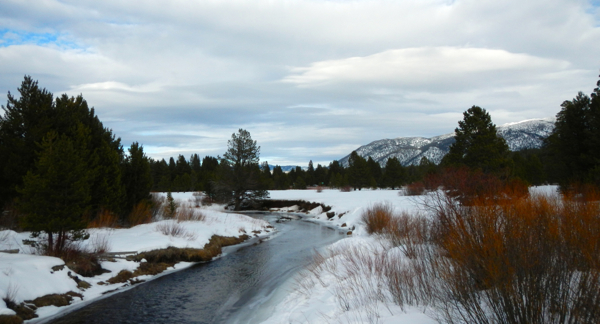
The Upper Truckee River meanders through Lake Tahoe Golf Course. Photos/Kathryn Reed

The Upper Truckee River meanders through Lake Tahoe Golf Course. Photos/Kathryn Reed

By Kathryn Reed

MEYERS – Golf courses offer some of most wonderful cross country skiing opportunities. They are flat, scenic and go on for miles.

And while golfers might think the trees are close together, winter recreationists find these plots of land to be wide-open.

Such is the case with Lake Tahoe Golf Course. This is an 18-hole course for much of the year. In winter a snowmobile concessionaire operates there. To the right of the clubhouse is the way to get away from the motorized fun. We started to the left of hole 10.

On the first Saturday of the year people were farther off to the right playing in the snow – building snowmen and just enjoying the white stuff.

Plenty of virgin snow to ski through.

Plenty of virgin snow to ski through.

The noise from the sleds dissipates quickly. The exhaust, though, is noticeable as we return. It clearly was stinking up the fresh mountain air.

One of the nice things about this trek is that it doesn’t take long to glide into a serene landscape. Plenty of people had been there before us. Snowshoe and cross country tracks crisscross each other.

Some of the tracks are so worn it’s as if they’ve been professionally laid. The slight slickness to them makes for easy gliding.

But the snow was perfect this particular day so breaking trail was no big deal, and in many ways was more fun. The give to it made it relatively easy to push through and a bit more of a workout than going where others had already gone.

Barriers across the bridges keep snowmobilers out. It means either having to gingerly step over them or taking off the skis. Some cross the Upper Truckee River, others Angora Creek.

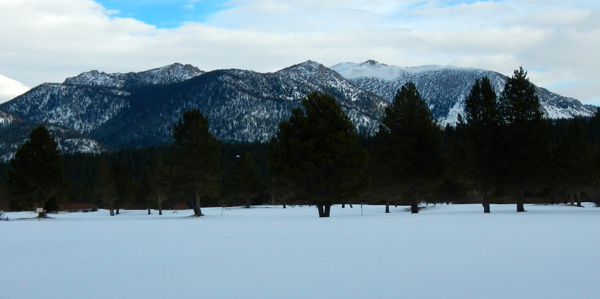
The Angora burn area is visible just below Mount Tallac.

The Angora burn area is visible just below Mount Tallac.

Many of the South Shore’s more recognizable peaks make themselves known as we go farther – Freel, Jobs, Mount Tallac and of course Twin Peaks is right there.

The golf course sits on state land – Lake Valley State Recreation Area. It abuts Washoe Meadows State Park. There are several access points to both. The golf course provides the most parking, especially on days when parking on a street could be problematic because of snow removal.

—–

Getting there:

From South Lake Tahoe, go west on Highway 50. The golf course is on the right before hitting the heart of Meyers.


A campfire cookbook for real outdoorspeople

By AC Shilton, Outside

Just-add-water stroganoff is a convenient and light dinner option when you’re backpacking, but that’s where the “pros” list ends. Cons, on the other hand, range from “mushy” to “tasteless” to “can this legally be called stroganoff?”

You can do better. In fact, you deserve better. And a new book promises that with a few key techniques and recipes, you’ll never give freeze-dried food a second glance.

Author Nikki Fotheringham is a longtime adventurer and travel writer. She grew up in South Africa, where outdoor cooking over built-in fireplaces is the norm. She says that no one there cooks with gas when barbecuing; cooking over fire is a proud South African tradition that she’s happy to pass on to readers.

Read the whole story