Nevada follows national trend in families seeking alternatives to public schools

By Ian Whitakern, Las Vegas Sun

It’s National School Choice Week, which seems like an appropriate time to take stock of how the school choice movement is doing in Nevada.

In two words: Pretty good.

School choice activists, buoyed by local conservative advocacy groups like the Nevada Policy Research Institute, have been particularly muscular in the Silver State recently following the state’s adoption of education savings accounts, which provide state funds for students to attend private schools. Similarly, enrollment and demand for charter and magnet schools also has been high.

Read the whole story


Douglas County grapples with solar regulations

By Anne Knowles

GARDNERVILLE — Douglas County is revising its ordinance for solar facilities after two large-scale projects failed to gain approval last year amidst public protest.

County officials this week wrapped up a series of 10 meetings with participants from the county’s towns and general improvement districts as well as business associations including the Carson Valley Agricultural Association.

The goal is to gather feedback to craft an ordinance that reflects the county’s different constituents who are at odds over the issue, including ranchers who want the option of selling or leasing their land to plant developers and some county residents who say they don’t want Carson Valley’s pristine landscape spoiled by acres of solar panels.

The county, like all in Nevada, is required by state law passed in 2013 to allow, with reasonable restrictions, solar energy installations like the two applied for and rejected last year.

Those projects were the 320-acre plant on Bentley Ranch land proposed by E.On Climate and Renewables, which was denied a special use permit by the county’s Planning Commission, and a 20-megawatt operation on 260 acres off Muller Lane.

The latter project was granted a special use permit, but it was appealed by Muller Lane homeowners Steve and Mary Walker to the Board of County Commission, which upheld the appeal.

Greenstone subsequently sued the county and the case is making its way through the court.

After reviewing the feedback, Douglas County planners will rewrite the ordinance and post it to the county web site by Feb. 2. The ordinance then goes to the Planning Commission on Feb. 9 and before the county commission at its March and April meetings, according to Hope Sullivan, planning manager.

Sullivan and Cynthea Gregory, deputy district attorney, led the recent public and private meetings, including the final gathering Jan. 25 at the Douglas County Community Center here.

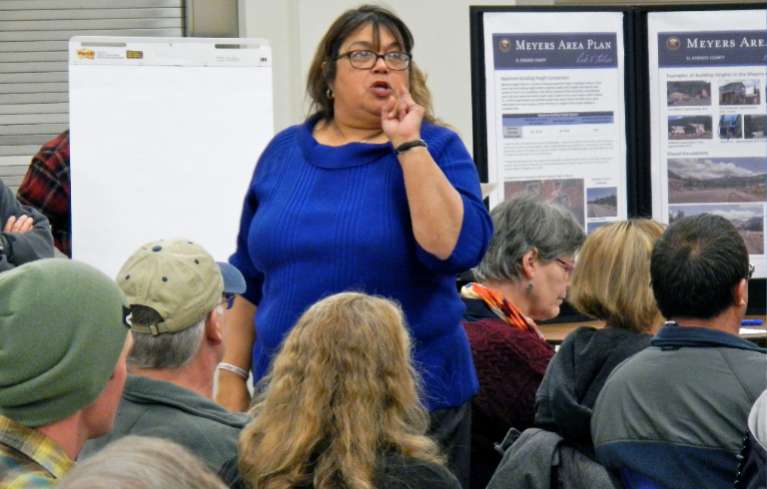
About 40 people, all residents, attended the meeting, which included background on the issue, but focused on hearing public comment.

Nearly everyone spoke and there was broad consensus on a few ideas, while others were shot down as infeasible.

Several people suggested an ordinance so cumbersome that it would deter any solar development in the valley.

“We must request the BOCC to make this so difficult that it never happens,” said one woman. “We can’t allow solar companies to come in and ruin this beautiful valley.”

But state law prohibits “unreasonable restrictions,” and any ordinance must be legally defensible, meaning it would hold up under court scrutiny.

“Any restriction must have a rationale,” Gregory told Lake Tahoe News after the meeting.

Jim Slade, a county resident, suggested the utility selling the power generated by the solar installation be required to sell to Nevada customers and not to consumers in California.

The idea that developers are trying to exploit Nevada’s less onerous environmental regulations to serve customers in California came up often during last year’s battles over the projects.

But Gregory said that was unconstitutional. The dormant commerce clause, a clause implied by the Commerce Clause that gives the federal government the power to regulate interstate commerce, says states cannot discriminate against one another.

“I support solar and renewable but they do need an (special use permit),” said Slade. “I think it should not be in RA-5, RA-10 or A-19. It should be in FR-19. It shouldn’t be within half a mile of homes. Others would say one to two miles. I like a lot of things Churchill did. We should use that as a template.”

There was broad consensus at the meeting to exclude the three zones Slade mentioned, which are all designations for agriculture.

Currently, photovoltaic solar facilities are allowed with an special use permit in those zones as well as in LI for light industrial, PF for public facilities and FR-19 and FR-40 or forest and range.

Churchill County has the most restrictive ordinance of surrounding counties, according to Sullivan. It says studies and environmental assessments including effect on wildlife and water, and plans for closure and removal may all be required.

Sullivan said the Planning Commission and BOCC will receive all of the public comment before the revised ordinance is voted on, most likely at the BOCC’s April meeting.


Opinion: California’s big housing dilemma

By Dan Walters, Sacramento Bee

It’s time once again for some fun with numbers, in this case the data on California’s serious – and worsening – housing crisis.

Dan Walters

Dan Walters

Since 2010, the state’s population has risen by 1.8 million to 39 million human beings who live – most of them, anyway – in 14 million units of housing of all types.

That translates into an average of 2.78 persons per dwelling, implying that since 2010, we’ve needed about 650,000 new units to keep pace with population growth, or about 130,000 a year.

However, the Great Recession clobbered housing construction, which fell to as low as 44,000 units in 2010 and has averaged only 70,000 a year during the decade so far, half the demand.

Read the whole story


DEA hired TSA to take cash from luggage

By Nick Wing, Huffington Post

A Department of Justice watchdog officially condemned the U.S. Drug Enforcement Administration this month, following a report that the agency had recruited a Transportation Security Administration security screener to search bags for cash that the DEA could confiscate.

The very existence of such a partnership highlights much broader concerns about the controversial legal practice known as civil asset forfeiture, which critics say contorts law enforcement priorities and props up a system of policing for profit.

In a summary of its investigation, the DOJ’s Office of the Inspector General concluded that the agreement “violated DEA policy” on a number of levels. While the OIG determined that the TSA informant never provided any actionable information to the DEA, it concluded that the plans to pay the agent out of the cash he or she helped seize “could have violated individuals’ protection against unreasonable searches and seizures if it led to a subsequent DEA enforcement action.”

Read the whole story


Girl survives fall from Sierra-at-Tahoe chairlift

A young girl on a school trip to Sierra-at-Tahoe fell from the Grandview chairlift on Wednesday morning.

The skier was taken by ambulance to Barton Memorial Hospital after the 11:30am incident on Jan. 27.

“From everything we understood she is in good health,” Steve Hemphill, spokesman for the resort, told Lake Tahoe News.

He did not know if the safety bar was in use at the time of the fall. The girl fell between towers three and four. The height between the varies. The exact distance she fell is unknown.

She was riding with someone else on the four-seater express lift. What led to her falling is being investigated.

Ski patrol responded immediately and the lift continued to operate. The incident was treated like an on-mountain injury.

— Lake Tahoe News staff report


Exercise key to preventing back pain

By Gretchen Reynolds, New York Times

Lower back pain is an almost universal if unwelcome experience. About 80 percent of those of us in the Western world can expect to suffer from disruptive lower back pain at some point in our lives. But if we begin and stick with the right type of exercise program, we might avoid a recurrence, according to a comprehensive new scientific review of back pain prevention.

Lower back pain develops for many reasons, including lifestyle, genetics, ergonomics, sports injuries, snow shoveling or just bad luck. Most often, in fact, the underlying cause is unknown.

For most people, a first episode of back pain will go away within a week or so.

However, back pain recurs with distressing frequency. By most estimates about 75 percent of people who have had one debilitating episode of lower back pain will have another within a year.

Read the whole story


Nev. company revolutionized ski, snowboard tricks

By Benjamin Spillman, Reno Gazette-Journal

Most of skiing and snowboarding fans have never heard of Frank Wells.

But if they’ve ever watched their halfpipe heroes crush a freestyle competition during the X-Games, Burton Rail Tour, Burton Peace Park, Dew Tour or other major events they’re familiar with the quality of his work.

“A really good halfpipe, basically, there’s no resistance,” said Wells, a former professional snowboarder who has been designing and building terrain features since 1999. “There are no curbs, or kinks, it is just very, very smooth.”

Wells is a senior project manager and snowcat operator for Snow Park Technologies, a Verdi, Nev.,-based company that’s come of age with the Gen X and millennial age skiers and snowboarders who transformed snow sports in the past 20 years.

Read the whole story


Calif. snowpack deepest in five years

By Veronica Rocha, Los Angeles Times

California’s current snowpack is the deepest it has been in five years — a modest, yet encouraging milestone in a period of prolonged drought.

Readings of the Sierra Nevada snowpack on Tuesday showed water content statewide was 18.7 inches, or 115% of the historical average for that date, according to the California Department of Water Resources.

Water officials say the good news is that California’s snowpack and reservoirs have benefited from El Niño rainstorms. But they warned that it was too soon to determine whether winter rains were enough to make any major dent on the California’s drought.

Read the whole story


EDC denies settlement with Santiago, Briggs

By Kathryn Reed

Norma Santiago and Ron Briggs, the former El Dorado County supervisors who think they should have been paid more when they were in office, could not reach an agreement this week with their former employer.

Ron Briggs

Ron Briggs

Norma Santiago

Norma Santiago

The Board of Supervisors in closed session on Jan. 26 turned down their settlement offer.

The former electeds believe they are owed cost of living adjustments and money for not taking time off as a manager, which individually could equate to nearly $100,000.

The county’s stance is that per the state Constitution a salary increase for the board must be done by ordinance. This never happened.

Santiago and Briggs have combined their cases into one, with both using the same attorney. Both left office in January 2015.

The county is being represented by outside counsel.

Judges in El Dorado County have recused themselves, so Judge Charles Wachob in Placer County has been assigned the case.

Both sides have February and March deadlines to file necessary documents, with a hearing set for May 13.


Nevada may expand gun background checks

By Megan Messerly, Las Vegas Sun

Advocates of gun control raked in $3.6 million over the last two years to place an initiative to tighten background checks for gun purchases and transfers in Nevada on the November ballot and ensure it passes.

The initiative is part of a broader national push to establish universal background check laws state by state after an effort to do so on the federal level failed in 2013. Mostly recently, Washington passed an expanded background check law through the ballot initiative process in 2014, and Oregon’s legislature approved a similar law last year.

In total, 18 states have enacted background check laws that go beyond what federal law requires. Nevada is poised to become the 19th.

Read the whole story