
Alkalinity of stormwater a concern on West Slope

Stormwater in the area of El Dorado Trail near the end of Stage Court in Placerville has tested for high levels of alkaline.

The county has placed a warning sign and temporary caution tape at the site. In addition, a temporary fence has been erected to deter the public from coming into contact with the water.

The water source in question is a seasonal drainage that flows northwest under the El Dorado Trail where it continues in a northerly direction. The tests that have produced pH levels between 12 and 12.8 are located in an overflow area adjacent to the drainage where there is ponding. Field measurements conducted farther down the drainage, approximately 200 feet downstream, have produced pH levels of about 7, which are within the normal range for stormwater runoff.

The source of the higher levels of alkaline in the ponding area is currently being investigated.

— Lake Tahoe News staff report


Anderson grabs silver in X Games slopestyle

Jamie Anderson of Meyers duplicated her 2015 X Games accomplishment by taking home of the silver Friday in snowboard slopestyle.

This is her 11th X Games and her 11th medal.

Anderson, who rides for Sierra-at-Tahoe, scored a 89 Jan. 29, two points behind winner Spencer O’Brien of Canada. Taking third at the Aspen, Colo., competition was Hailey Langland of San Clemente with a score of 88.

— Lake Tahoe News staff report


Audit: Feds should shift firefighting burden in Calif.

By Michael Doyle, McClatchy Washington Bureau 

WASHINGTON — The U.S. Forest Service apparently overpaid for fighting some of California’s biggest wildland fires and was saddled with too many of the toughest areas to work in, federal investigators now say.

Citing expenditures that “may have been questionable and unreasonable,” the Agriculture Department’s Office of Inspector General questioned more than $4.5 million in administrative costs that the federal agency paid to local firefighting agencies within California.

“There was no assurance these costs were reasonable and accurate,” the investigators noted.

More broadly, investigators said an agreement with the state left the Forest Service shouldering an unequal share of areas where wildlands meet urban areas, the costliest to protect.

Read the whole story


Malcolm Pribyl — 1946-2016

Malcolm Pribyl

Malcolm Pribyl

Longtime Lake Tahoe resident Malcolm Pribyl died Jan. 19, 2016. He was 69.

Pribyl graduated from Tracy High School and UC Davis.

After serving in the military he move to South Lake Tahoe. During his years in Tahoe he worked as a casino employee, an executive with the Lake Tahoe Visitors Authority, and as an independent insurance agent.

He is survived by three siblings, brother in-laws, sister in-law, and numerous nieces and nephews.

He was preceded in death by his wife, Cindy.

A celebration of life is planned for this summer.

In lieu of flowers, donations in Pribyl’s name may be made to the Alzheimer’s Association, 2290 North First St., Suite 101, San Jose, CA 95131 or the charity of choice.


10 dancers set to compete in TAP fundraiser

Amateur dancers have five weeks to prepare for the annal Dancing with the Tahoe Stars fundraiser for Tahoe Arts Project.

Much like the TV show, the locals are paired with professionals. The event is March 5 at 6:30pm at MontBleu in Stateline.


The dancers are:

  • Physician Kelly Shanahan and Rainer Herm — disco.
  • CrossFit trainer Iris Kamm with Jorge Favio Orozco — salsa.
  • Retired UPS worker Michelle Ludiker and Wolfgang Reichstine — fox trot.
  • Physician Mandi Weavil and Gerzon Chaves — cumbia.
  • Whittell High School teacher Lindsay Wines and Bob Truesdale — two step.
  • South Tahoe High School Principal Chad Houck and Robyn Lindner — swing.
  • TechTastic owner Zion Fink and Rhonda Keen — Broadway.
  • South Lake Tahoe police Sgt. Travis Cabral with Rebecca Lincoln — ChaCha.
  • OneTrust Home Loans owner David Greco with Anjela Zajic — hip hop.
  • Lakeland Village Resort’s Jerry Bindel and Angela Smith — waltz.

Tickets will be available online starting Feb. 1.


Reno’s Wise 8th at X Games

By Chris Murray, Reno Gazette-Journal

An injured shoulder kept Reno’s David Wise from making a legitimate run at another X Games gold.

Wise, competing with a grade II AC joint sprain/separation in his shoulder that he suffered a week ago, wasn’t able to get in his groove Thursday night in the Ski SuperPipe in Aspen. The three-time X Games gold medalist, who also won Olympic gold in 2014, finished eighth in this year’s X Games out of 12 competitors, the biggest event of the year.

Wise lost his skis high on the pipe on his first run and scored a 13.66 (out of 100).

Read the whole story


Calif. adopts first energy standards for household LEDs

By Associated Press

SACRAMENTO — California on Wednesday became the first state to set energy efficiency standards for household LEDs and smaller track-lighting-style light bulbs — a move that could save consumers billions in utility bills and prompt lawmakers and manufacturers to adopt them nationwide.

The California Energy Commission approved new requirements for general purpose light-emitting diodes — the LEDs used in household lamps and chandeliers — and directional lamps that have a diameter of 2.25 inches or less. They often are used in track lighting by stores, hotels and museums.

In addition to being more energy efficient than halogen and incandescent bulbs, the bulbs sold in California beginning in January 2018 will have to meet certain color requirements and have minimum lifetimes: 10,000 hours — the equivalent of 10 years of household use — for the LEDs and 25,000 hours for the small-diameter directional lamps.

The commission said using lights that meet the new standards will save consumers more than $4 billion in utility bills over 13 years, conserve enough electricity to power about 400,000 homes and reduce the amount of carbon dioxide emissions from power plants by about 10 million metric tons between 2017 and 2029.

There already are bulbs on the market that meet the new standards. But the LEDs cost more than their incandescent counterparts — even though they last up to 20 times as long — and consumers have been slow to adopt them.

In 2010, LEDs comprised only 1 percent of the 600 million general-purpose light bulbs in California, according to commission figures. There were about 16 million of the small-diameter directional lamps.

The commission was ordered to come up with lighting standards under 2007 state legislation that called for reducing home lighting energy use by 50 percent and business use by 25 percent by 2018.

The standards were backed by the Sierra Club and other conservation groups. They were opposed by the National Electrical Manufacturers Association, which argued that they would raise the cost of LED bulbs and thus make it less likely that Californians would buy them to replace inefficient incandescents.

The commission disagreed.

“The standard will save consumers money compared to products that are already on the shelf,” Commission Chair Robert B. Weisenmiller said in a statement. “The standard pushes the entire market toward more efficient products with higher quality. It will reduce the overall cost to consumers.”

The standards were adopted after considering whether they were feasible and cost-efficient, commission spokeswoman Amber Beck said.

Because California is a huge market, it is likely that the federal government and manufacturers will adopt the new standards as they have with other consumer products, she said. “Manufacturers change their products to comply with California standards, and oftentimes they end up shipping to the entire United States,” Beck said.


Tahoe travel company focuses on creating experiences beyond typical tourist attractions

A woman spends her day making pottery on Majuli Island in northeast India. Photo/Toni Neubauer

By Jessie Marchesseau

A World War II memorial would never have made the list of places Jan Potter wanted to see while visiting India. It probably wouldn’t have even made the list of things she knew existed in India. But it does, and when she visited it in the small northeastern village, she was surprisingly intrigued.

“We all have different backgrounds and different cultures, but they are more interwoven than we think,” she said.

The memorial was just one of many new and unexpected experiences on Potter’s four-week trip to northeastern India and Bhutan. Potter, a retired school teacher, and her husband, Gil, made the trip last November along with a photographer from Texas and the founder of Incline Village-based adventure travel company Myths and Mountains, Antonia “Toni” Neubauer.

 2.Bhutanese children from the eastern part of the country sitting on the local farm produce. Photo/Toni Neubauer

Bhutanese children from the eastern part of the country sit on the local farm produce. Photo/Toni Neubauer

“In northeast India, I really knew nothing about it, and now my mind is so interested in learning about the background of that area,” Potter said of her trip.

The group traveled in private cars with local drivers who were adept at avoiding the never-ending procession of cars, buses, people, elephants and cows clogging up the roadways as well as rattling off the history of nearly every small village they came to. They visited a town in the middle of a river, slept in bamboo beds, ate authentic cuisine and visited community libraries.

They didn’t hit a single tourist attraction and saw less than a dozen American or European people in the entire four weeks.

The trip was designed and booked through Myths and Mountains. The itineraries the company offers travelers are not just about snapping pictures; they’re about interaction. Rather than hitting up the common tourist attractions and booking people in Holiday Inns, Myths and Mountains takes people inside the true culture of a country. Travelers have the opportunity to visit small communities, sit with local artisans, tour area businesses, and stay in boutique hotels or even the homes of local residents.
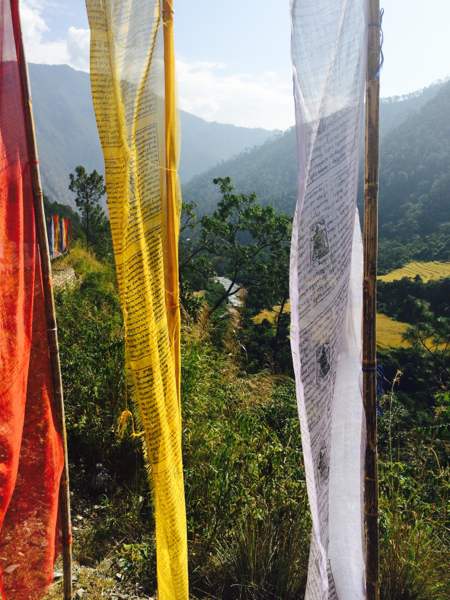
Bhutanese prayer flags flutter in the wind. Photo/Toni Neubauer

Bhutanese prayer flags flutter in the wind. Photo/Toni Neubauer

Neubauer calls Myths and Mountains more than an adventure travel company; it’s also an educational travel company.

“We live in a world today where people don’t understand each other; they’re afraid of each other,” she told Lake Tahoe News. “Travel provides that understanding we so desperately need.”

The company books pre-designed and custom trips featuring nearly a hundred itineraries in Asia, Southeast Asia and South America that can be divided into four categories: cultures and crafts, religion and pilgrimage sites, environment and natural history, and natural healing and traditional medicine.

If you would rather learn the finer points of Guatemalan cooking than take photos of the Eiffel Tower or make a mandala with monks instead of joining the throngs of tourists at the Vatican, then Myths and Mountains may have just what you’re looking for.

Neubauer says for Myths and Mountains there is no such thing as a “typical trip.” They have designed numerous custom trips over the years including one for a couple who wished to explore the art of puppetry in Vietnam and another focused on shamanism in Ecuador for the students of Emory University.

Neubauer’s passion for educating doesn’t end with travelers. Her background in education, a doctorate in educational administration to be exact, inspired her to form READ Global in 1991, just three years after she founded Myths and Mountains. An acronym for Rural Education and Development, READ was Neubauer’s way to give back to the rural communities in her travel destinations.

A dancer at the Trashigang Tsechu Festival in Bhutan. Photo/Toni Neubauer

A dancer at the Trashigang Tsechu Festival in Bhutan. Photo/Toni Neubauer

She saw how tourism could create a village of beggars, how schools and hospitals built with the best intentions would fail because the villages hadn’t the means or the knowledge to manage and maintain them once the organizers were gone. Instead, READ builds rural library community centers and helps form for-profit local businesses to sustain them, along with providing training to local residents so the centers can be maintained long after READ leaves. Since its inception, the organization has built 85 rural library centers.

READ has since branched off from Myths and Mountains, though Neubauer is still on the board. However, it still receives a great deal of support from Myths and Mountains and its clients.

It’s this way of giving back which recently earned Myths and Mountains the 2015 Tourism Cares Legacy in Travel Philanthropy award. The award recognizes travel companies with outstanding philanthropic efforts which have had a positive impact for more than 15 years.

However, it’s their outstanding knowledge of the regions they travel that earned Myths and Mountains numerous other awards and designations including being named a Trusted Travel Expert on Wendy Perrin’s 2015 WOW List for five different countries, a Conde Nast Nepal Top Travel Specialist and one of National Geographic Traveler’s 50 Tours of a Lifetime among others.

But the Potters didn’t choose their Myths and Mountains trip because of an award or something they read in a magazine. They chose it because they believe in the READ program and because this particular trip enabled them to visit READ libraries in India and Bhutan while exploring a new country in an intimate way.

“My favorite part,” Potter told Lake Tahoe News, “is how it makes you want to learn more about the world.”


Opinion: When political discussion brings despair

By Sam Daley-Harris

When the nation’s political discussion drives one to despair it helps to find a quote that puts the craziness into perspective.  This quote from a New York Times column by Frank Rich eight years ago does that for me:

Last weekend a new….poll found that the Democratic-controlled Congress and Mr. Bush are both roundly despised throughout the land, and that only 24 percent of Americans believe their country is on the right track.  (That might mean that 76 percent believe the country is on the wrong track.)….

Wrong track is a euphemism. We are a people in clinical depression.  Americans know that the ideals that once set our nation apart from the world have been vandalized….

A Real Clear Politics six poll-average from early January found the right track number virtually unchanged at 24.7 percent. So reread the quote with the updated number and insert Republican-controlled Congress and Mr. Obama and you still land at: “We are a people in clinical depression who know our ideals have been vandalized.” If we change the players and still end up at the same grim place, how do we respond?

The remedy is to come off the sidelines and get involved using our voices as citizens, but that’s easier said than done. Where do we start? Most nonprofit organizations don’t acknowledge the toxicity into which they send their volunteer advocates. Consequently, they don’t create a deep enough structure of support, one that can serve as an antidote to all the toxicity. Instead they offer mouse-click activism and other kindergarten-level actions, thin gruel for anyone hungry to make a difference. Combine the toxic environment with rampant civic illiteracy and you have a dangerous brew that results in abysmal levels of voting and a paucity of thoughtful civic engagement between elections.

I first confronted the civic illiteracy more than 35 years ago when I spoke to 7,000 high school students on ending world hunger after reading statements from a National Academy of Sciences report calling for the “political will” to end hunger. Less than 3 percent of the students could name their member of Congress and 35 years later only 10 percent of students I polled on 15 college campuses could answer correctly.

There is great joy in being in action and knowing that your voice matters, but only a small number of organizations work to heal the break that exists between people and government. Here are some examples of groups that do.

The anti-poverty lobby RESULTS and the US Fund for UNICEF are committed to reaching the sustainable development goals agreed to by 193 nations of the U.N. in 2015, which include global goals such as: 1) eliminating preventable child deaths by 2030 (currently 16,000 children die every day from preventable malnutrition and disease), and 2) eliminating extreme poverty by 2030 (currently 700 million people live in extreme poverty).

The climate agreement in Paris sends hopeful signals but progress will require groups like Citizens’ Climate Lobby whose growing team of volunteers in the U.S. and Canada have had 3,474 letters and op-eds published last year, up from 56 published in 2010, all in support of a steadily rising fee on carbon 100 percent refunded to the public.

Friends Committee on National Legislation focuses on addressing mass incarceration while the Peace Alliance supports a bill that would fund violence prevention programs throughout the U.S.

What’s unique about these groups is the deep citizen empowerment each provides. An Iowa volunteer with FCNL described the fear around writing her first letter to the editor and how she hoped no one she knew would read it. “I was out of my comfort zone, but now I’ve had four published and it feels like a celebration.” A Citizen Climate Lobby volunteer in Virginia spoke about starting with “climate trauma” but after 18 months and visits to 20 Congressional offices described the experience as “sacred and profound.”

When the country’s political discussion is enough to bring one to despair, it helps to find a quote that puts the craziness into perspective, but it’s even more powerful to find an organization that will support you in making the difference you’ve always dreamed of making.

Sam Daley-Harris founded the anti-poverty lobby RESULTS, co-founded the Microcredit Summit Campaign, and now heads the Center for Citizen Empowerment and Transformation. He is author of “Reclaiming Our Democracy: Healing the Break between People and Government” (Camino Books, 2013).


Vineyard’s dirt affects what’s in your glass

By Dave McIntyre, Washington Post

“Let’s go dig a hole!”

Ernest “Bubba” Beasley grabbed an auger and led the way along the vine rows. We were at Pollak Vineyards in Greenwood, Va., west of Charlottesville, on a sweltering summer day last July. Beasley, a geologist, and Lucie Morton, a viticulturist, wanted to show me their research on the relationship of vineyard soils to wine quality. And that meant a “dirt tasting.”

Then Beasley led us about 50 feet up the row and repeated the process. Here, the soil was visibly different: clay on the top but a gravelly loam farther down, an assessment verified by matching the soil’s colors to the chart.


To wine lovers, the vineyard’s effect on a wine’s quality seems self-evident. Yet “terroir” is many things, including sun exposure, microclimate, even the personality of the winemaker.

Read the whole story