Heavenly chairlifts back in operation

By Kathryn Reed

Investigators determined that the chair that fell off the North Bowl chairlift at Heavenly Mountain Resort was the result of collar screws that attach the chair to the cable splitting and shearing in half.

“There was nothing found that pointed to why the screws failed,” Lisa Herron with the U.S. Forest Service told Lake Tahoe News.

Because the same system is used on the Boulder lift, that chair was also taken out of service to be inspected. Both lifts are now operating.

On Jan. 3 a chair on the downhill side fell from the North Bowl lift. No one was injured, but about 60 people had to be evacuated.

Resort officials would not answer whether this could have been prevented.

“At Heavenly, the safety of our guests and employees is our No. 1 priority and we maintain the highest standards of quality in terms of equipment and maintenance,” is all spokesman Coop Cooper told Lake Tahoe News.

The incident was reviewed by the Forest Service, Heavenly and two third-party inspectors – Tram Support Inc., and Gmuender Engineering, which are an engineer and a parts supplier that services these types of lifts.

They could not find a reason why the screws sheered.

The Forest Service wrote a letter to Heavenly saying bimonthly inspections of the clip and hanger head are required, as well as set other inspection time lines for the collar.


Genoa Cowboy Festival embrace Western culture

The seventh annual Genoa Cowboy Festival will be April 28-May 1.

This year’s event will feature performances by some of the best-known entertainers in Western music and cowboy poetry, including Ian Tyson, Wylie & Wild West, Mike Beck, Richard Elloyan, Trinity Seely, Andy Hedges, Larry Maurice, and many more.

Other festival events include: Chautauqua performances; a birding nature walk at the River Fork Ranch; a Birds and Buckaroos in the Carson Valley photography show at the Nature Conservancy’s Whit Hall Interpretive Center; and a festival tour special at the Dangberg Home Ranch Historic Park throughout the weekend.

The Genoa Cowboy Festival is a blend of entertainment, heritage and Western culture.

This year’s event is free to the public and also features cowboy mercantile crafts and clothing, Western art exhibits, pioneer and Old West living history re-enactors, and a variety of food from popular local eateries.

For tickets to evening concerts and more information go online.


STPUD close to meeting state water cutbacks

By Kathryn Reed

Customers in South Tahoe Public Utility District have done a good job in conserving water, but cumulatively have not met the state’s 20 percent reduction goal.

This week officials announced that the restrictions would remain in effect through October. In April 2015, Gov. Jerry Brown said combined water districts in the state must reduce consumption by 25 percent from 2013, with the individual district cuts ranging from 4 to 36 percent.

STPUD started water rationing in 2007, so it was harder to make substantive inroads last year. Customers were already limited to three days a week for outdoor watering. This initially led to a usage reduction of 25 percent.

From June through December 2015 the district reduced water use by 18.4 percent from 2013 numbers. It was easier to make cuts in the summer via irrigation, whereas in the winter in Tahoe it is harder to find ways to lessen what comes out of the spigot.

The change announced Feb. 2 gives the district a 3 percent credit for a drier climate than the coastal areas during the summer. This in turns lowers the target water use reduction compared to 2013 to 17 percent for 2016 instead of 20 percent.

Statewide, consumers have reduced water use by 25.5 percent since June. This equates to almost 1.1 million acre-feet of water saved. The goal was to save 1.2 million acre-feet through the end of this month.

In December, the statewide conservation rate was 18.3 percent, down from 20.4 percent in November, compared to the same months in 2013.

Districts can face fines if they don’t meet the state rules. To date, South Tahoe PUD has not been fined, but a warning letter has been received from the state.

“Since cumulatively we’re within a couple percent, the letter was more of an urging to step up our efforts. Since most of the suggestions had to do with outside watering, for us, it was rather meaningless,” Richard Solbrig, STPUD general manager, told Lake Tahoe News. “Since we’re trying, the next letter may require us to provide more detail on exactly what conservation efforts we have been pursuing.”

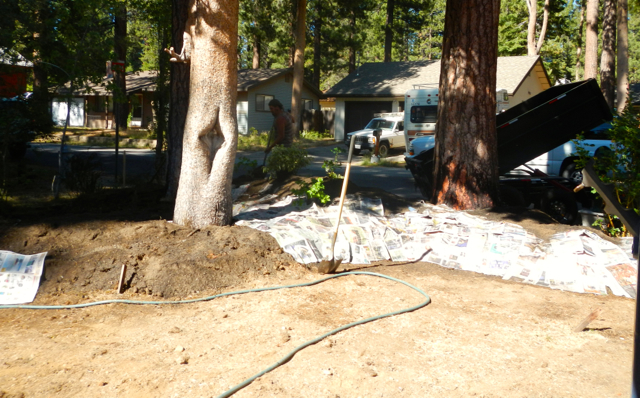
Removing sod is one way South Tahoe PUD customers are saving water. Photo/LTN

Removing sod is one way South Tahoe PUD customers are saving water. Photo/LTN

Month-by-month STPUD data from 2015 compared to 2013:

·      June – 24.6 percent reduction

·      July – 27. 5 percent reduction

·      August – 21 percent reduction

·      September – 15.8 percent reduction

·      October – 7.3 percent reduction

·      November – 3.5 percent increase

·      December – 14.4 percent reduction.

The increased use in water in November was from Heavenly Mountain Resort’s snowmaking, according to Solbrig. December tapered off because of the cold temps not requiring as much of the fake stuff.

The district also has the authority to fine residential and commercial customers. In 2015, STPUD fined Safeway and Shell gas station for excessive water use.


Opinion: Redefining the Millennial generation

By Troy Matthews

How would you describe Millennials? Until recently I found myself apologizing for my generation as if I were ashamed to be part of the group of people that grew up with the Internet, cell phones, electric toothbrushes, and CGI, and therefore didn’t know what it meant to struggle. But I’ve come to realize that perhaps this isn’t true.

I read once about the attitudes of the various generations of the 20th century. The Greatest Generation tended to be “civic minded.” They grew up with the great depression and therefore felt a sense of community and drive to serve. This attitude allowed them to bring this county out of the depression and through World War II because they cooperated first before they argued.

Now the Millennial’s attitudes have come full circle once again to a “civic minded” generation. Perhaps it was growing up in the shadow of 9/11; two wars, one of which that lasted longer than Vietnam; the Great Recession; the disappearing middle class; crippling student debt; stagnant wages; healthcare costs at criminal levels; and a world more connected than at any time in history, for better and worse. For the first time in history, we won’t be better off than our parents.

But difficult times can bring out the best in us. The first thought of my generation is to cooperate. To think “civic.” To serve. To blur the lines regardless of race, gender, politics, sexual orientation, religion, and, dare I say, nationality. Where we can come together and move things forward regardless of the old biases and good ol’ boys clubs of the past. Where we can stop fighting with each other and start listening to one another. I am blessed to be part of two local organizations that want to move things forward, Tahoe Regional Young Professionals and Leadership Lake Tahoe. In each you will find the greatest minds in Tahoe of my generation who are thinking of nothing but how to make Tahoe work for all of us, for our generation and those before us and those to come. I belong to a great generation. Not because of our music, or technology, or lifestyle, but because we genuinely care about each other and care about this community.

The greatest thing about this attitude of cooperation and service is that once it takes root it will spread regardless of age. We are leaders who are connecting this city and this basin in a way that it has never been before. We are working to retain young professional talent who want to live and work here, not leave. We are networking, and pushing for new ideas, and lending each other a helping hand. We are striving for redevelopment of old systems. We can protect the beauty of this place and grow the economy. We can make Tahoe work by working in Tahoe. Service is an attitude not an age. Come join us. They say Tahoe is a great place to visit, but not a great place to live. We can change that. We can change the world. Please attend the Make Tahoe Work Leadership Summit in May to see the greatest Tahoe minds of this generation at work.

Troy Matthews is a grant writer for Tahoe Youth & Family Services. 


Waving goodbye to the lumberjack

By Wilson Ring, AP

In the snowy woods of northern New England and other forested parts of the country, the lumberjack is an endangered species.

As high-tech machinery replaces chain saws, which themselves replaced the ax, a generations-old way of life is disappearing, one that historically saw fathers pass on to their sons their love and knowledge of the woods and the independence that came from working for oneself.

Ken Davis feels this keenly as he reaches retirement age after a half-century career with no one to pass the torch to.

Davis once employed 19 people full-time to cut the wood, haul it and then truck it, sometimes to his log yard, other times directly to the now-disappearing mills across Vermont, New Hampshire, Maine and upstate New York that would turn it into lumber or process it into paper. He now employs seven, and has no sons. His daughter and son-in-law tried it for a while, but they didn’t keep at it.

“I’ve got the sawdust in my veins, and they don’t make a dialysis machine to get it out, so I’m still here,” Davis said recently at his log yard in the town of Hardwick, in an especially rural region Vermonters call the Northeast Kingdom.

None of Davis’ employees are showing interest in taking over his business. It’s the same story across the region, said Michael Snyder, commissioner of theVermont Department of Forest, Parks and Recreation.

“It’s dangerous, it’s hard to make a living and everybody hates you,” Snyder said of logging. “Who’s signing up for that?”

The arguments for not becoming a logger are solid.

For one, there’s just not as much demand for paper and other wood products because of low commodity prices and international competition, making it less secure than it once was. It’s physically and — yes — intellectually demanding work that increasingly requires special skills to run hugely expensive, high-tech machinery. And because of that machinery, capital investments needed to get started can be prohibitive.

The renaissance that farming has undergone in recent years, with an emphasis on food systems and sustainable agriculture, hasn’t brought the same energy to logging. In many quarters, loggers are still seen as despoilers of the land. But Snyder noted that while forests can do just fine on their own, logging can support their health by weeding out infestations and invasive species.

Logging entails a number of jobs, including fallers, who cut down trees by hand — essentially, lumberjacks; operators of machinery used to fell trees; and graders and scalers, who check the amount and quality of the wood. The number of all logging workers is expected to fall only 4 percent from 2014 to 2024, from 53,700 to 51,700, according to Bureau of Labor projections.

Nationwide, the number of fallers is projected to decline 17 percent over the same period, from 8,200 in 2014 to 6,800 in 2024.

With the industry becoming more mechanized, the number of equipment operators is expected to stay about the same, with graders and scalers declining 2 percent and all other logging workers falling 7 percent.

“We need forest operations technicians; we don’t need loggers anymore,” said Dana Doran, executive director of the Professional Logging Contractors of Maine.

“Today you are running a half-million, $600,000 machine, and not only do you need to operate it, you’ve got to read GPS and computer-based technology equipment, you’ve got to be able to service and maintain that equipment, you have to know forestry, environmental law, best management practices, tree identification,” Doran said.

Across the region, efforts are underway to bring along young loggers. The Vermont Technical College in Randolph helps train forest technicians. In Maine, the industry is backing a plan to train logging technicians in community colleges.

In the Northeast Kingdom, one of Davis’ workers, 31-year-old Aaron Martin, said he likes the freedom of working outside in different places. He has been logging for 10 years, but few of his friends have been drawn to the life, he said: “They don’t like being out in the cold.”

But as much as he likes his work, he has no interest in being the boss.

“With that comes its own headaches,” he said. “It’s nice to be able to work for somebody else and not deal with all the stress that comes with paying all the bills and everything that goes with it, finding the next job.

“I just go to work and do what I’m told. It’s a lot simpler that way.”


SLT library seeks donations for book sale

South Lake Tahoe Friends of the Library is requesting donations of books and audio/visual materials for an upcoming book sale.

Materials in good condition and with a copyright date no earlier than 2006 will be accepted. Especially needed are recent children’s books and children’s DVDs, as well as items in Spanish.

All donations are tax deductible, with receipts available from the front desk. All proceeds from the book sale go to Friends of the Library to support various library programs and events for children and adults.

The South Lake Tahoe Branch Library is open Tuesday and Wednesday from 10am to 8pm, and Thursday through Saturday 10am to 5pm.

For more information, call 530.573.3185.


Free tuition proposed at Calif. community colleges

By Mike Luery, KCRA-TV

There’s a big push in California to offer free tuition to all community college students in the state.

But offering free tuition for California’s more than 1 million full-time community college students is expensive.

California community college tuition fees are in the $1,100 range per year — among the lowest in the nation. But, adding in housing, transportation and books can bring the bill to $18,000 or more.

Read the whole story


Nonprofit to certify organic Nevada foods

By Andi Guevara, KTVN-TV

Recently the Nevada Department of Agriculture closed the program that certifies organic produce for our state, leaving questions as to where and how farmers and others would get that certification. Now a local, nonprofit organization has received accreditation to take over the process.

Knowing where their food comes from and how it is raised is important to the Andelins. Just off Pyramid Highway in Spanish Springs is the Andelin family farm, where chickens, goats and pigs are given plenty of love and attention.

The Andelin family farm uses both organic and traditional methods and they’re dedicated to sustainable farming.

Read the whole story


Once free Burning Man now costs big bucks

By Jenny Kane, Reno Gazette-Journal

Can you believe Burning Man used to be free?

Not anymore. Burning Man ticket prices are here, and Burners will have to dish out extra dollars—some more than others – to attend Burning Man 2016. Tickets will cost between a minimum of $207 apiece and a maximum of $1,308 apiece, including taxes.

Burning Man announced Wednesday evening that tickets would increase in cost due to Nevada’s recently amended live entertainment tax and the increasing cost of operating the annual, weeklong event in Northern Nevada’s Black Rock Desert.

Read the whole story


Watercolorist to give demo in South Lake Tahoe

Gina Lijoi will give a demonstration in watercolors at the Tahoe Art League’s Feb. 10 meeting.

Lijoi, a signature member of the California Watercolor Association and member of numerous watercolor societies throughout the country, grew up in West Virginia and spent many summers in Italy. She now resides in Reno. She has studios in Reno and Italy.

Lijoi’s paintings emphasize the importance of shadows, incorporating color and interest without overpowering her art. Her skills in composition, combined with interesting shadow effects, make her paintings come alive.

The Tahoe Art League meets the second Wednesday of each month at 6pm at the South Lake Tahoe Senior Center.