Record heat expected in Lake Tahoe Basin


Mount Tallac at Fallen Leaf Lake will be a great place to bake in the sun. Photo/LTN

Fallen Leaf Lake will be a great place to bake in the sun. Photo/LTN

By Lake Tahoe News

Put away the fleece this week, a bit of a heat wave is going to hit the Lake Tahoe Basin.

Forecasters at the National Weather Service in Reno are predicting record highs may be broken, with Tuesday the mostly likely day for this to happen.

The record high for South Lake Tahoe on Feb. 9 is 55 degrees. It was set in 2012. The forecast is for the thermometer to hit 59.

Shane Snyder, meteorologist with the Weather Service, said his agency is likely to revise the forecasted highs for Wednesday and Thursday. As of Monday morning they were 56 and 55, respectively. He expects the actual numbers to be higher once the easterly flows move out on Tuesday.

The records for Feb. 10 and Feb. 11 for South Lake are 58 set in 1996 and 54 set in 2015.

“We should have not have a problem tomorrow beating the record,” Snyder told Lake Tahoe News.

He said the high pressure is just to the west of the basin, but will soon be directly overhead. This will mean warm temps and no moisture for the week.

Snyder added there is a minimal chance of precipitation on Saturday, but said the system is weak. Looking toward next week it also looks more like spring than winter.


Future of Kings Beach events center up in the air

The North Tahoe Public Utility District is exploring a potential public-private partnership with Laulima Development to renovate and manage the North Tahoe Event Center in an attempt to become financially stable.

Three public meetings in February and March are planned to discuss the potential partnership and to solicit community input.

“As a whole the district is in a strong position financially, but we continue to face challenges with the recreation department,” said Duane Whitelaw, general manager of the district, said in a statement. “If this project proves feasible, it could bring a new building to Kings Beach that the community can be proud of, and continue to access, without our taxpayers shouldering the burden of the cost of the ongoing operation and maintenance and anticipated necessary upgrades.”

Laulima Development is in escrow on the Ferrari Crown Motel in Kings Beach. The idea is for Laulima to manage the center as an asset for its guests while also making it available for public and community events.

There will be a  public workshop Feb. 18 from 6 to 7:30pm at the center, the district’s Recreation and Parks Commission will meet Feb. 25 25 at 5:30pm at the center, and the NTPUD board workshop will be in March.


Calif. vintners want Cubans to be wine drinkers

By Andrea Rodriguez, AP

The 3.5 million tourists who flooded Cuba last year downed oceans of mojitos, lakes of daiquiris and rivers of thin, sour beer. Only an odd few accompanied their ropa vieja and croquetas with wine — mostly overpriced, low- to mid-grade vintages from Chile, Argentina and Spain.

That may be about to change, at least around the margins of Cuba’s once-dismal dining scene. Some of the United States’ largest vintners want to turn this island of sweet rum and flat state-brewed beer into a haven for robust California zinfandel, oaky chardonnay and powerful cabernet sauvignon.

Thousands of private restaurants have cropped up around Cuba in recent years under economic reforms designed to soften the shock of cutbacks in the troubled state-controlled economy. Particularly on the high end, those restaurants’ clients are increasingly American, part of a 76 percent surge in U.S. tourism — to 161,174 last year — that followed Presidents Raul Castro and Barack Obama’s declaration of detente at the end of 2014.

Hoping to ride both trends, about 100 California wine producers, distributors and exporters descended on Havana this week for a two-day symposium to reintroduce Cuban restaurant owners and managers to their products.

The California Wine Symposium was organized by the California Wine Institute, associations of Napa and Sonoma valley wine producers and Sonoma-based U.S. Cava Exports, a 2-year-old company founded to export California agricultural products to Cuba. The event featured tastings, talks on California’s vineyards and one-on-one meetings between U.S. business people and Cuban restaurateurs and state officials.

“This is a spectacular meeting,” said Orlando Rodriguez, owner of Waoo!!, a 3-year-old, 20-employee restaurant in Havana’s trendy Vedado neighborhood. “It arouses interest, which prompts business, which creates profits.”

Some 50 private restaurants, or paladares, and hundreds of sommeliers and buyers for state-run restaurants attended the conference, whose participants included representatives of the E&J Gallo and Francis Ford Coppola wineries.

It’s been legal for Cuba to buy wine and other agricultural products from the U.S. for years but Cuban officials say they stopped importing California wine in 2005 because the U.S. trade embargo prohibits American producers from selling agricultural goods to Cuba on credit. Obama allowed sales of most goods to Cuba on credit through executive action last week but lifting the ban on credit for farm products would require an act of Congress.

Cuba has never been a big wine-drinking country, but it imports some 360,000 cases of wine a year from countries that allow sales on credit.

Darius Anderson, head of U.S. Cava Exports, said he hopes to be shipping California wine to Cuba by the end of the year.

“We’re working on the shipping, we’re working on the financing, and we hope to have them all solved by mid-year, have two or three containers on the water and get them here by the holidays,” he said.

Only a small number of Cuban government agencies are allowed to import goods, creating a chokepoint of inefficiency and bureaucracy that makes it virtually impossible for private businesses to bring in large quantities of goods from other countries. Paladar owners depend on black-market goods, items bought at retail stores or supplies brought in the suitcases of people paid to “mule” products from the U.S. and other countries. The lack of a legal wholesale market is widely seen as one of the main hindrances to the efficient development of private enterprise in Cuba.

“It doesn’t matter to me if a private person or the state does the importing. What matters is that there’s somewhere to buy this wine,” said Julio Valdes, a representative of the Five Corners Trattoria in Old Havana. “It’s important for us to have a variety for our clients. Right now we have Chilean, Italian and Spanish wine that we buy in stores bit by bit.”


Tahoe Tails — Adoptable Pets in South Lake Tahoe

Cyrus

Cyrus

Cyrus is a special 2-year-old black Lab mix, and he’ll need a special new home. His previous family loved him very much, but fell on hard times and wasn’t able to keep him any longer.

Cyrus arrived at the shelter very shy and confused, and avoided any contact with people. With lots of gentle attention from staff and volunteers, Cyrus is starting to come out of his shyness and even wags his tail sometimes. He is still not comfortable at first with strangers, but warms up eventually. Come take Cyrus for a walk and watch him start to look for pets. He loves other dogs and would be happiest in a home with another dog to play with.

Cyrus is neutered, microchipped, tested for heart worm, and vaccinated. He is at the El Dorado County Animal Services shelter in Meyers, along with many other dogs and cats who are waiting for their new homes. Go to the Tahoe animal shelter’s Facebook page to see photos and descriptions of all pets at the shelter.

Call 530.573.7925 for directions, hours, and other information on adopting a pet. For spay-neuter assistance for South Tahoe residents, go online.

— Karen Kuentz


Invasive species a constant threat in the West

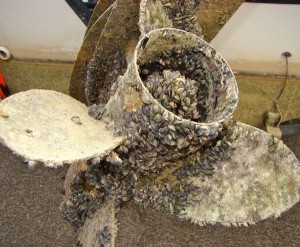
Quagga mussels like these on a boat prop leaving Lake Mead are what officials want to keep out of uncontaminated lakes. Photo/TRPA

Quagga mussels like these on a boat prop leaving Lake Mead are what officials want to keep out of uncontaminated lakes. Photo/TRPA

By Anne Knowles

Invasive species cost the country $3 billion every year and none more so than the fast-growing quagga mussel.

“The quagga mussel is the most costly invasive in U.S. history,” said Matt Morrison, chief executive officer of the Pacific Northwest Economic Region, during a webinar last week titled Critical Habitat and Invasive Species hosted by the Western Governors’ Association.

Morrison said the tiny, fingernail-sized mussels, which can reproduce up to a million offspring annually, are in everywhere except the Pacific Northwest.

They latch onto any hard surface and not only affect fish such as salmon, but agriculture and water infrastructure as well, including hydropower operations like the 60 located throughout the Pacific Northwest.

And once the mussels enter a system, they are there to stay.

“They’ve never been eradicated,” said Morrison. “That’s just not an option.”

That’s why agencies in Lake Tahoe do all they can to prevent the tiny mussels from ever entering its waterways.

Every boat entering Lake Tahoe is required to be inspected, unless it bears a Tahoe-only tag that certifies the lake is the only water the boat enters, said Chris Crookshanks, native aquatics staff specialist with the Nevada Department of Wildlife.

“As soon as the mussels were discovered in the lower Colorado (in Lake Mead) the Lake Tahoe basin spent a lot of money to implement measures to prevent them,” said Crookshanks.

Research done last year by UNR and the Desert Research Institute found that quagga mussels could thrive in Lake Tahoe despite the lake’s low calcium levels.

Crookshanks spends time on recovery of Lahontan cutthroat trout, which are threatened by nonnative fish species, including rainbow, brown and brook trout that were introduced into water bodies throughout the west, including Lake Tahoe.

Crookshanks said other threats to the native trout in Nevada are water diversions, feral horses, cattle, fire and drought.

He said the key to success in the trout’s recovery are cooperation between various entities such as the Bureau of Land Management, U.S. Forest Service, area Native America tribes and non-governmental organizations such as Trout Unlimited as well as private landowners through safe harbor agreements.

Those successes don’t include Lake Tahoe.

“It is so big we’ll never see recovery of Lahontan cutthroats there,” said Crookshanks. That has not stopped agencies on the California side, though, from trying to bring back the native species.

Technically, a useful method has been to start at the top of a water system, install temporary barriers, work to control nonnative fish populations, then remove the barriers and work on the next stretch of the system, said Crookshanks.

“That’s a great strategy, but there are some systems where the temporary barrier has to stay because the next piece can’t be done,” said David Sweet, Yellowstone Lake special project manager with Wyoming Trout Unlimited.

Sweet has worked for years on the effort to restore Yellowstone cutthroat trout, which are preyed upon by nonnative lake trout.

The U.S. Park Service, Yellowstone Park Foundation and NGOs spend about $2.3 million annually on the work, and in the last four years have been able to half the lake trout population and triple the number of Yellowstone cutthroat.

He said the primary methods are netting operations and telemetry to identify lake trout spawning areas and then do alternative suppression.

“Eradication is a term we rarely use, we use suppression,” said Sweet. “Eradication is impossible in a system like a lake or with something like mussels. We reduce the populations and give the cutthroat a chance to survive. … In the future we may be able to talk about eradication through genetic engineering.”




Opinion: Nevada’s solar bait-and-switch

By Jacques Leslie, New York Times

When President Obama proclaimed in his State of the Union address last month that “solar is saving Americans tens of millions of dollars a year on their energy bills,” he clearly wasn’t talking about Nevada.

In late December, the state’s Public Utilities Commission, which regulates Nevada’s energy market, announced a rate change drastic enough to kill Nevada’s booming rooftop solar market and drive providers out of the state. Effective Jan. 1, the new tariffs will gradually increase until they triple monthly fees that solar users pay to use the electric grid and cut by three-quarters users’ reimbursements for feeding electricity into it.

More startlingly, the commission made its decision retroactive. That means that the 17,000 Nevada residents who were lured into solar purchases by state-mandated one-time rebates of up to $23,000 suddenly discovered that they were victims of a bait-and-switch.

Read the whole story


Bettors make late run on underdog Broncos

By Matt Youmans, Las Vegas Review-Journal

A dominant defensive performance by the Denver Broncos helped send Peyton Manning into the sunset as a winner, if indeed it was the final game of the legendary quarterback’s NFL career.

The Panthers, who received overwhelming wagering support early, closed as 5-point favorites at most Las Vegas sports books.

But bettors made a late run on the underdog Broncos, who cashed at around plus-180 on the money line.

Read the whole story


Calif. orders inspections at all gas wells

By George Avalos, Bay Area News Group

SAN BRUNO — State regulators, alarmed by a non-stop leak of a gas well in Southern California, have issued emergency regulations and orders for inspections of all gas wells in California, including those owned by PG&E, which said Sunday that it is in compliance with most of the new rules.

The inspections will include wells in three gas storage centers owned and operated by PG&E, all in Northern California.

“These regulations are in effect immediately and require all gas storage companies to complete enhanced inspections and testing at every gas well in California,” said Ken Harris, state oil and gas supervisor with the California Department of Conservation.

Read the whole story


Beefed up Nev. traffic enforcement results in 275 citations

The Washoe County Sheriff’s Office issued 131 speeding citations during a three-week, multi-agency Joining Forces traffic safety campaign in January.

From Jan. 5-21, the sheriff’s office joined with the Reno Police Department, Sparks Police Department and Nevada Highway Patrol for speed enforcement campaign as part of ongoing efforts by Nevada law enforcement agencies to increase public safety on the roads.

The total number of violations cited and warnings issued during this event was 275, these include:

  • 131 speeding
  • 16  cell phone use/distracted driving
  • 31   motor vehicle registration violations
  • 26   failure to show proof of insurance
  • 19   driver’s license related violations
  • 4     violation for running a red light
  • 3     vehicle equipment violations
  • 2     failure to yield right of way
  • 1     seat belt violations
  • 3     other violations
  • 39   warnings.


Personal-income recovery heats up in Nevada

By Jennifer Robison, Las Vegas Review-Journal

Nevada’s lukewarm income recovery turned hot in 2015.

After nearly a decade bringing up the nation’s rear in personal-income growth, the Silver State shot to No. 3 for gains in 2015, according to a new report from the Pew Charitable Trusts.

Personal income matters because federal agencies use the number to allocate funding for social services, while state governments check it to set budgets. But personal income is an important private-sector measure too: Growing incomes put more money into consumers’ pockets for spending that spurs the broader economy, Gordon said.

Read the whole story