Tahoe National Forest hires top guy from within

The former deputy forest supervisor for the Lake Tahoe Basin Management Unit is now the leader of the Tahoe National Forest.

Eli Ilano has been the deputy on the Tahoe since 2010 and acting forest supervisor since the beginning of the year after Tom Quinn retired. He also had a stint as acting supervisor for LTBMU.

Prior to being hired by the U.S. Forest Service, Ilano worked for the Bureau of Land Management, and in the nonprofit sector focusing on natural resource issues.


Nevada could lose its first-in-the-West caucus

By Seth A. Richardson, Reno Gazette-Journal

Nevada’s first-in-the-West status could be in jeopardy barring an abnormally high turnout compared with previous years, according to national reports and in-state experts.

Several reports have stated the theory recently, especially regarding the Republican caucus and a potential move to another state. Turnout for the Republican caucuses was below 45,000 in both 2008 and 2012 compared with about 120,000 for the Democrats in 2008, the last time they had a competitive race.

Republican National Committee spokeswoman Sara Sendek said any decision about the caucuses is far from finalized.

Read the whole story


High-energy physics to be discussed at LTCC

“Recent discoveries on the frontiers of science: Higgs boson and gravitational waves” is the topic of an upcoming discussion at Lake Tahoe Community College.

James Brau is the Knight professor of Natural Science at the University of Oregon in Eugene, where he also directs the Center for High Energy Physics. He has spent the last several decades specializing in experimental high-energy physics.

Brau will explain in easy-to-understand terms about new discoveries in elementary particles, such as the Higgs boson, and what its discovery might mean for science in the years to come. He’ll also discuss what gravitational waves are, and explore brand-new evidence that just may prove their existence.

The free talk is Feb. 16 at 6pm in the Aspen Room at Lake Tahoe Community College.


Class to focus on benefits of homemade broth

Victoria LaFont, certified nutritional therapy practitioner, will teach Skillshare – Bone Broth for Optimal Health on Feb. 27 at the Tahoe Food Hub Farm Shop.

Slow Food Lake Tahoe is hosting the class. Attendees will discover how easy it is to make a variety of broths and stocks, how to use them and the nutritional benefits of incorporating them into one’s diet.

The $20 tickets may be purchased online. Ticket costs cover all materials for this Skillshare.

The class will be from 4:30-6pm at 150 Alpine Meadows Road, Alpine Meadows, Truckee.


Movies big part of Alpenglow Mountain Festival

The Alpenglow Mountain Festival, a nine-day celebration of human-powered mountain sports, kicks off with the critically-acclaimed 5Point Film Festival’s “On the Road” series on Feb. 20 at 7pm at Squaw Valley’s Olympic Village Lodge.

The 5Point Festival, one of four distinct film nights during the Mountain Festival, is a collection of adventure film shorts films curated specifically for Lake Tahoe. The films are chosen from the flagship 5point Film Festival event in Carbondale, Colo.


Other film events during the Alpenglow Mountain Festival include the Winter Wildlands Alliance Backcountry Film Festival on Feb. 23, the fourth installment of Alpenglow’s Winter Film Series with alpine climber and author Kelly Cordes on Feb. 25, and a screening of Jeremy Collins “Drawn, the Art of Ascent” on Feb. 27.

Tickets are $10. Doors open at 630pm and the show begins at 7pm. For more information on the films and all other events during the Mountain Festival, go online.


Calif. drought adds $2 billion in electricity costs

By Dale Kasler, Sacramento Bee

It’s one of the lesser-known costs of California’s drought: the drying-up of the state’s normally abundant cheap hydroelectric power.

A hydro shortage has raised California’s electricity costs by a combined $2 billion the past four years, according to a report released Tuesday by the Pacific Institute, a water policy think tank based in Oakland. In addition, the institute said the drought has contributed to climate change: California’s fossil-fuel power plants have increased greenhouse gas emissions by 10 percent to make up for the hydro shortage.

The financial impact on individual consumers hasn’t been huge.

Read the whole story


Western States ultrarun keeps Armstrong out

By Blair Anthony Robertson, Sacramento Bee 

With news that disgraced cyclist Lance Armstrong may have designs on competing in the grueling 100-mile Western States Endurance Run, the race’s board of trustees met Saturday to draft a new policy that makes clear how welcome Armstrong is to enter the race.

Not now. Not ever.

That policy, Performance Rule 18, also could be called the Armstrong Amendment. It essentially bans the ex-cyclist and others like him who have been caught using performance-enhancing drugs from competing in Western States. That race travels over mountainous, heavily wooded terrain from Squaw Valley to Auburn and is considered the most prestigious event in the niche sport of ultrarunning.

Read the whole story


Tesla urges Nev. regulators to nix solar rate hike

By Daniel Rothberg, Las Vegas Sun

An executive for Tesla Motors is calling on the Public Utilities Commission of Nevada to reconsider a decision that increased the fixed service fee solar customers pay NV Energy.

Tesla’s statement comes at a sensitive time, with the three-member regulatory commission scheduled on Friday to revisit a controversial decision to increase bills for solar customers.

In a letter filed with the commission Tuesday, the company’s vice president of business development said the higher fee was an impediment to developing an electricity grid that used on-site generation technologies, such as rooftop solar panels and home storage.

Read the whole story


TRPA attempting to get handle on commodities to foster redevelopment throughout basin

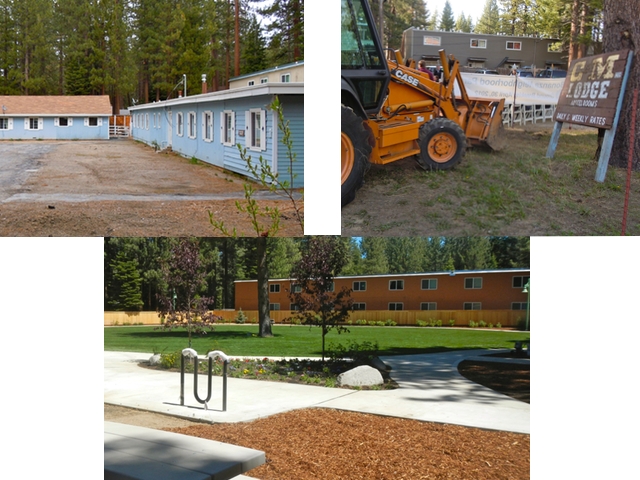
In order for the Edgewood Lodge to have enough tourist accommodation units the company bought an old hotel in South Lake Tahoe. A stipulation was for Edgewood Companies to turn the property into a park. Photos/LTN

In order for the Lodge at Edgewood to have enough tourist accommodation units the company bought an old hotel in South Lake Tahoe. A stipulation was for Edgewood Companies to turn the property into a park. Photos/LTN

By Kathryn Reed

A 30-year-old policy that is unique to Lake Tahoe is proving its ineffectiveness by having a pronounced detrimental impact in the basin.

The Tahoe Regional Planning Agency created a policy where commercial floor area (CFA) and tourist accommodation units (TAUs) have a value unto themselves. The purpose was to curtail development. It worked. Some might say a little too well because it also curbed redevelopment that might bring environmental and economic gains.

With hotel units essentially having a price tag, it means a lodging property owner wants more for the parcel than the appraised value. Perspective buyers aren’t likely going to pay that added cost. That leaves many dilapidated hotels scattered about the basin, but mostly in South Lake Tahoe. And with there being a limited number of TAUs allowed, it means places like Placer County that has so few hotels in the basin is scrambling to acquire them.

It would be up to the Governing Board to abolish this policy that stifles the free market, creates an inflated value for properties and doesn’t allow zoning to regulate development.

For now the bi-state regulatory agency is loosening the rules a bit by creating a three-year pilot program involving these commodities. The Regional Plan update that was adopted in December 2012 created bonus units based on certain criteria, mostly having to do with moving development out of sensitive areas like stream environmental zones and into town centers.

The pilot program has 80,000-square-feet of commercial floor area and 61 tourist bonus units. This means only a couple projects will likely come to fruition during the pilot. Interested parties have until March 28 to apply. The Governing Board will rank them and then decide who gets to participate in the pilot.

The program will be evaluated on an annual basis to assess its effectiveness.

“We plan to do quite a bit of monitoring to evaluate the program. We have a proposed monitoring plan that includes looking at how much SEZ is restored and how much coverage was reduced,” Jennifer Cannon, TRPA senior planner, told Lake Tahoe News. She said other criteria would also be used to assess the effectiveness of the pilot.

In 2008, the TRPA tried a different plan called the Community Enhancement Program to try to spur redevelopment. Nothing got built, though the Homewood Mountain Resort and Boulder Bay projects are still on the table. TRPA officials say the recession had a lot to do with the CEP’s not being effective. A difference with the pilot program is that there is an end date.

One of the agency’s strategic initiatives also involves looking at the commodities program to see if more substantive, long-term changes should be made.

Tom Lotshaw, spokesman for TRPA, said the initiative is designed to look at “what some of the strengths are and what some of the weaknesses are and how it can be improved so it protects the lake and facilitates the kind of redevelopment we need in our community.”

At today’s TRPA Advisory Planning Commission meeting a presentation will be made about what the findings have been from interviewing more than 50 stakeholders. The themes coming out of those discussions are: people don’t understand the system, the system needs reviewing, it doesn’t adequately support redevelopment, access to the commodities is constrained, and that it is impacting housing.

—–

Notes:

·      The APC meets Feb. 10 at 9:30am, 128 Market St., Stateline.



Opinion: The different meanings of love

By Kim Kilgore

According to psychologist Abraham Maslow’s Hierarchy of Needs, it is essential for people to feel love and belonging to reach optimal health and wellness. Valentine’s Day, whether you celebrate the holiday or not, reminds us of love. The word “love” can be confusing and have different meanings for everyone.

Kim Kilgore

Kim Kilgore

Gary Chapman, the author of “The Five Love Languages”, writes that “some of my encounters with couples through the years that brought me to realize that what makes one person feel loved does not necessarily make another person feel loved. For a number of years, I have been helping couples in the counseling office discover what their spouse desired in order to feel loved. Eventually, I began to see a pattern in their responses. […] Their answers fell into five categories. I later called them the five love languages.”

So what is your love language? Below is a brief explanation of the five love languages. Take a few minutes and contemplate how you express love and how you like to be loved.

  • Words of Affirmation Language: Love is expressed by simply telling one another positive aspects about each other. For example, words of affirmation can include statements such as, “You are a beautiful person,” and “You are my best friend.”
  • Quality Time Language: Couples share their love for one another by spending quality time together. This aspect requires the individuals to focus their attention on one another in ways such as open communication, both listening and speaking, and spending time with one another doing activities that are enjoyed by both individuals.
  • Receiving Gifts Language: Another language of love that individuals can share is the concept of receiving gifts. Some individuals see the act of providing one another with material objects, regardless of their cost, as an act of love. Without these acts of giving and receiving individuals who use this type of love language will feel deprived in their relationship.
  • Acts of Service Language: Individuals who express love via the acts of service language are prone to seeing such tasks, like chores and various household tasks, as acts of love. In order for two individuals to experience the acts of service language together, both individuals need to be willing to step outside of their typical household routines and perform one another’s tasks for the sole purpose of being kind to one another.
  • Physical Touch Language: The physical touch language is simply the idea that individuals feel loved and comforted by being in close physical contact with one another in various ways, such as holding hands, hugging, kissing and sexual intercourse. Physical touch between couples can vary depending upon what each individual in the relationship is comfortable with.

You may notice you like to give and receive love in different ways. This Valentine’s Day consider investing some energy into giving and receiving love or developing a deeper understanding of your loved ones in order to increase your well-being and satisfaction within your relationships. If you are interested in finding out more about your love language, take a free assessment on Chapman’s website.

Kim Kilgore is a medical social worker who sees patients with mild to moderate mental health issues at Barton Community Health Center and Barton Family Medicine.