Daylight saving time could end in Calif.

By Jeremy B. White, Sacramento Bee

Springing forward and falling back would be reserved for gymnasts under a California bill seeking to eliminate daylight saving time.

If you’ve ever awoken an hour early, showed up to work an hour late or groaned at having to reset all your clocks because of the biannual time shifts, Assemblyman Kansen Chu, D-San Jose, feels your pain.

“I heard some complaints last year from some of the senior citizens (in my district) and their care providers who say this one-hour difference really impacted their lives,” Chu said.

Assembly Bill 2496, which would end the practice in California, undoing a law that voters approved back in 1949 via Proposition 12.

Read the whole story


Snippets about Lake Tahoe

landing resort·       The Landing Resort in South Lake Tahoe has been named by Outside magazine as one of the best new hotels in ski country.

·      There will be a statewide marrow drive for California Highway Patrolman Keith Meter on March 12 from 10am-3pm. On the South Shore it will be at the Meyers office on Hopi Avenue. People are being asked to sign up for the marrow registry, which involves a cheek swab process. For more info, call 530.577.1001.

·       On March 10, Fish out of Water will be at the Lakeview Loft above Dart Liquor in Stateline at 9pm. In addition to live music, the event will feature live art from local artist Will Eichelberger. Must be 21 to attend. Cost is $10.

·       The Sugar Pine Foundation is having a fundraiser at Lake Tahoe Paint and Sip on March 15 at 6pm. Cost is $40; call 530.600.0662.


Appeals court upholds limit on sharing of tips

By Sudhin Thanawala, AP

SAN FRANCISCO — Businesses cannot collect tips given to waiters, casino dealers or other service employees to share with support staff such as dishwashers even if the tipped employees are receiving minimum wage, a federal appeals court ruled Tuesday.

The 2-1 decision by the 9th U.S. Circuit Court of Appeals upheld a 2011 U.S. Labor Department rule.

The 9th Circuit said the rule was “reasonable” and consistent with Congress’ goal of ensuring tips stay with employees who receive them.

The court overturned district courts in Nevada and Oregon. The 9th Circuit ruling would largely apply to states that require workers to get the state minimum wage on top of any tips. Seven states fall into that category, according to the labor department’s Wage and Hour Division: Alaska, California, Minnesota, Montana, Nevada, Oregon and Washington.

It was not immediately clear what the impact would be on backend workers in those states.

The labor department has previously banned employers who use tips to fulfill their hourly minimum wage requirements from distributing those tips to employees who don’t regularly receive tips.

“The premise is the tip is never the employer’s,” said Reuel Schiller, a labor law professor at the University of California, Hastings in San Francisco. “The employer doesn’t have the power to take that from the waiter and give it to a dishwasher because it’s not the employer’s money.”

Supporters of the rule would say the employer should pay the dishwasher higher wages or charge customers to pay the dishwasher instead of having other staff subsidize the dishwasher’s pay, Schiller said.

The 9th Circuit considered two lawsuits in its ruling — one brought on behalf of plaintiffs including restaurant and lodging associations in Washington, Oregon and Alaska and the other by two casino dealers against Wynn Las Vegas.

The casino dealers said Wynn was taking their tips to share with other employees. The restaurant and lodging associations said the federal rule would prevent back-end staff from sharing in tips.

Paul DeCamp, an attorney for the restaurant and lodging associations, said there was a decent chance one of the plaintiffs would appeal.

“The real world impact of this sort of regulation that the Department of Labor has issued is important for people to understand,” DeCamp said. “The people who are hurt most by the 9th Circuit ruling are the people in the kitchen, the cooks, the dishwashers, the prep cooks and so on.”

Michael Weaver, a spokesman for Wynn Resorts, said Wynn was studying the ruling to decide its next steps.


Calif. gas prices expected to jump overnight

By James F. Peltz, Los Angeles Time

The slide in California’s gasoline prices could abruptly end Friday, with prices possibly jumping 30 cents a gallon due to seasonal changes in the state’s refinery operations, a consumer advocacy group predicted Thursday.

Prices often climb in California this time of year because refineries switch from the winter blend of fuel to the more expensive summer blend required in the state.


The average price of regular unleaded in California was $2.306 a gallon Thursday, down 24 percent from $3.03 a year ago, according to AAA.

Read the whole story


Sandoval withdraws name from high court consideration

By Michelle Rindels, AP

Nevada Gov. Brian Sandoval said Thursday he is not interested in being considered for the U.S. Supreme Court at this time, and he has told the White House so.

The Republican governor issued a statement the day after the Washington Post reported the White House was considering him as a potential replacement for the late Justice Antonin Scalia.

Senate Republicans have said they will not consider a nominee from President Obama during an election year.

“Earlier today, I notified the White House that I do not wish to be considered at this time for possible nomination to the Supreme Court of the United States,” Sandoval wrote. “The notion of being considered for a seat on the highest court in the land is beyond humbling, and I am incredibly grateful to have been mentioned.”

He offered no reason for his decision but said he also expressed his position to senators Harry Reid, Dean Heller and Mitch McConnell.

The Senate’s vetting process for any nominee is expected to be viciously political, if hearings take place at all. Sandoval’s mention was thought to be a way around Republican senators’ resistance to considering an Obama nominee.

Republican Sen. Dean Heller of Nevada last week suggested the next justice could be a Nevadan. He said Thursday he hopes Sandoval’s name will come up again later.

“As a friend and former colleague of Governor Sandoval’s, I believe he is eminently qualified for this position,” Heller said. “But, I support his decision to withdraw his name from consideration for the Supreme Court vacancy. I hope the next president will consider him in the future.”

Sandoval, 52, is a former federal judge and popular second-term governor.


Lake Tahoe wedding vendors honored

Borrowed & Blue, an source for locally inspired weddings, has named the Lake Tahoe winners of the Best of B&B Awards, the industry’s only awards voted on by the wedding vendors.

Borrowed & Blue works with more than 400 Lake Tahoe-area wedding vendors.

The Best of B&B Awards covers 18 different categories. Vendors picked gold, silver, and bronze awards in each category. Below is a list of the Gold winners in some of the categories:

  • Best All-around Wedding Venue:  West Shore Cafe & Inn
  • Best Wedding Photographer: Theilen Photography
  • Best Wedding Planner: Blue Sky Events
  • Best Wedding Caterer: D’Lish Catering
  • Best Wedding Florist: Thran’s Flowers
  • Best Wedding Cakes and Desserts: Flour Girl Wedding Cakes.

The entire list of Lake Tahoe’s winners may be found online.


Caesars cuts net loss in fourth quarter

By Howard Stutz, Las Vegas Review-Journal

Caesars Entertainment Corp. said Tuesday the casino company’s net loss declined in the fourth quarter but the Strip gaming giant termed the year a success following the bankruptcy filing of its largest operating division.

The company, which operates nine resorts on or near the Strip, said net revenue for quarter that ended Dec. 31 was $1.12 billion, an increase of 8.7 percent. The company’s net revenue for all of 2015 grew 14.7 percent to $4.5 billion. Caesars said its net loss in the quarter was $76 million, compared with a loss $262 million a year ago.

Caesars CEO Mark Frissora said in a statement the company had its best full-year of operating results since 2007.

Caesars Entertainment Operating Co., which the company placed into a Chapter 11 bankruptcy reorganization 13 months ago, was excluded from the reported results. The operating unit includes nearly two dozen regional casinos, including Harrah’s Lake Tahoe and Harveys in Stateline.

Read the whole story


McClintock to face Democrat challenger

By Christopher Cadelago, Sacramento Bee

Rep. Tom McClintock, a longtime lawmaker and favorite of conservatives in California, has repelled repeated challenges – the latest in 2014 from a fellow Republican.

McClintock, of Elk Grove, easily overcame an intraparty showdown with military officer Art Moore. Now, he faces a more traditional opponent in Democrat Bob Derlet, a professor emeritus at UC Davis who formally launched his uphill campaign Monday

Derlet, 66, is new to politics, and the 4th Congressional District’s lopsided Republican registration likely will make things difficult for him.

Read the whole story


Battlefields a hallowed reminder of the past

Publisher’s note: This is one in a series of stories about the National Park Service, which is celebrating its 100th anniversary in 2016.
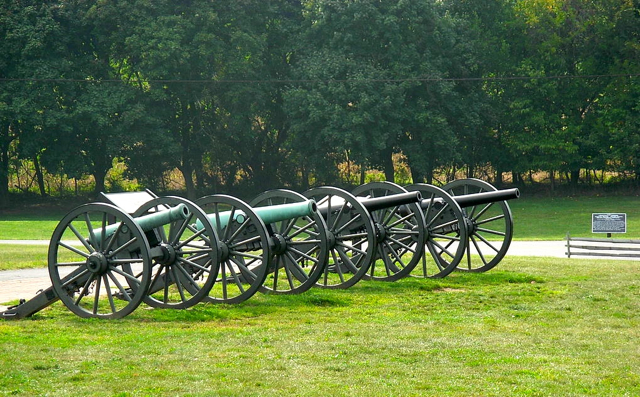
The single bloodiest day in U.S. history was the Battle of Antietam on Sept. 17, 1862.

The single bloodiest day in U.S. history was the Battle of Antietam on Sept. 17, 1862.

By Linda Fine Conaboy

Little did I know on that pleasant and tranquil day in the fall of 2003 I was headed for a moving and intense experience—an event more weighty than I had bargained for. That was the day my friends and I visited Antietam National Battlefield, the site of the bloodiest single day of the Civil War—some say the bloodiest day in all of American history.

At that time in my life, I knew little about the Civil War, had only vaguely heard of this battlefield called Antietam and really didn’t think it made much of a difference in my life.

As my friend drove, I quickly scanned the brochures we received from the man at the entry, and making a decision to drive instead of walk the route because of a time constriction, we headed off, our real anticipation being the Appalachian Trail where we were to hook up with other friends for a few days of hiking.

However, the brochures (which I still have) were absorbing. We learned that Antietam, in Sharpsburg, Md., on bright and sunny Sept. 17, 1862—maybe somewhat like the day we were there—provided the setting for the destruction of nearly 25,000 souls—they were either killed, wounded, captured or simply ended up missing.

Mostly young men and maybe a few women, died on the slopes of Sharpsburg ridge, an area consisting then of mainly farms, fruit trees and bridges.

As we drove, our anticipation of the place heightened. Out our car windows, we marveled at the farm buildings, still there after all these years—oh, that these structures could talk, think of the story they would tell. Surprisingly, one of these buildings is still privately owned and occupied.

Imagine, living in a building that was privy to so much death. I’ve always wondered if this has an effect on the current residents of that building. As a journalist, I would very much like to interview them and ask if their day-to-day lives are in any way tinged by the killing and all the spilled blood. Blood that has since vanished, but nevertheless is still there somewhere, maybe in some way fertilizing the healthy trees that mark this battlefield today.
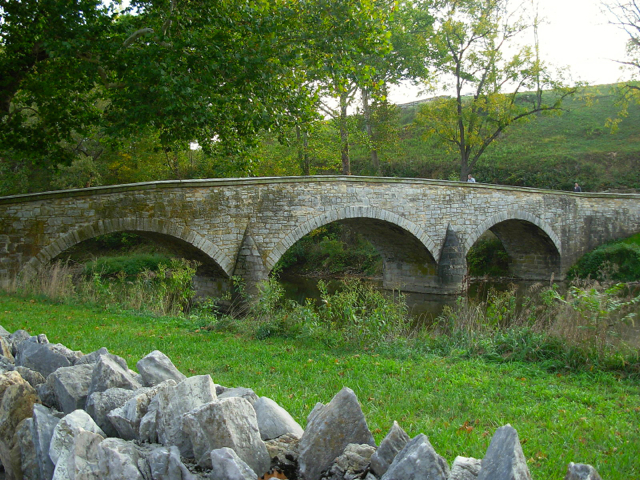
Burnside's Bridge at Antietam National Battlefield in Maryland

Burnside’s Bridge at Antietam National Battlefield in Maryland.

A review of the history of this battle states that Gen. Robert E. Lee’s Confederate forces stretched across the angle formed by the junction of the Potomac River and Antietam Creek. Gen. George McClellan, the Union leader, intended to attack both of the Confederate flanks and then assault the middle of Lee’s line.

According to the brochure, “There was no cohesion, no unified command, no definite objective, and at the climax of the battle Gen. George McClellan, leader of the Union forces, was unwilling to commit his reserves in the center. Antietam was in fact, a soldier’s battle, waged by separate units with little direction from above.”

History tells us that this gory battle was fought for nothing and it was determined to be a draw.

Forgetting for a while that the Appalachian Trail awaited, we pulled the car over to the side of the road and stood on a bridge crossing Antietam Creek, a beautiful and simple bridge that still stands just the way it did in 1862.

We walked up the dirt road away from the bridge called Bloody Lane. Viewing brochure pictures of all those people sprawled on the ground on Bloody Lane with their arms and legs akimbo, thoughts of death hit me like a hammer. Here we were, traipsing along in the warm sunshine, on sacred ground.

On this trip with my friends, my first since my husband died a few months earlier, death here and death at home seemed to be stalking.

It seemed unworldly that we could be walking along a road that was the scene of so much human destruction—and as a parallel to the thoughts Antietam evoked, it was amazing to me that I could be walking along this road without my husband of so many years. The poignant feelings evoked by this surreal event somehow served to bring to climax all of those despondent emotions I had about the passing of Tom. In some unimaginable way, they put it all into perspective in one simple moment of clarity.

This is why Antietam will forever be a place of beauty to me as well as a place of ultimate sadness.

I have the same feelings when I visit Valley Forge National Park. The feelings that are evoked thinking about all of those young, courageous and innocent people who fell for their cause, sometimes to no avail, are heartbreaking.

The headquarters of George Washington at the Valley Forge encampment. Photo/RevolutionaryPA.com

The headquarters of George Washington at the Valley Forge encampment. Photo/RevolutionaryPA.com

In summer, the rolling hills and lowlands of Valley Forge are grassy and beautiful, but on Dec. 19, 1777, when the Continental Army staggered in, weary from long marches, the prospect of wintering there was bleak.

Housing consisted of roughly built, drafty wooden huts—replicas of which are now strewn about the grounds, reconstructed as nearly as possible, on their original sites. The huts served as home to the troops as they froze and starved their way through that vicious winter, waiting for marching instructions from their commander, Gen. George Washington, although marching in the snow would be a difficult proposition as few of them had shoes.

Washington, however, did not live in the drafty huts with the men. His home, formerly the Isaac Potts house, still standing today, appears to be much more storm worthy and capable of warding off the cold. In fact, a recent tour of the Potts home indicates there were real beds, with perhaps down comforters for warmth, fireplaces and utilitarian but useful furniture.

Historians estimate that somewhere between 10,000 and 12,000 men bivouacked at Valley Forge a post about 20 miles from Philadelphia, with about 2,500 of them dying from disease and exposure, not once fighting a battle during that winter, except the battle for survival.

Fortunately, or unfortunately, depending on your outlook, with winter setting in, the prospect of confronting the enemy greatly diminished and never came to fruition. Washington’s army left Valley Forge on June 19, 1778.

Just as the battlefield at Antietam evokes wonder and heartache at the heroism people endure, display and confront during war, Valley Forge is a monument to the human condition, available in living color to anyone willing and able to make the trip to experience it.

I think it takes visits like these, to our national parks and other sites of extreme and natural beauty (although some are not beautiful, but just as interesting), to add the grounding so necessary to living our everyday lives. I think we all come away better people for allowing ourselves to be drawn into the history of what these places preserve.

I recommend you immerse yourself in as many of the national parks, national monuments, wilderness areas, ghost towns—anywhere you can experience our past, unfettered by the bounds of everyday life. They’re available and some are not too far home; you owe it to yourself.


Opinion: Isolationist stances on the campaign trail

By Andrés Martinez

Is America great now?

The answer in the presidential campaign is a resounding “Hell no!” And, surprisingly, there seems to be bipartisan consensus on this misguided assessment. (Spoiler alert: America still rocks.)

On the Republican side, the ostensibly self-financed frontrunner is raising money selling “Make America Great Again” caps. For Donald Trump, America’s former greatness was traded away by “loser” politicians hoodwinked by those crafty Mexicans, Chinese, and Japanese, not to mention the terrorists and their politically correct apologists.

None of his fellow Republican competitors push back with Reaganesque optimism—they’re all eager to match Trump’s grim outlook and blame on Barack Obama. Sen. Marco Rubio accuses the president of destroying the military; Sen. Ted Cruz talks of the Constitution as if it were some banned relic from our suppressed past; and doctor Ben Carson compares the U.S. to a patient in critical condition. The Republicans all talk about the nation’s moral fiber and social indices in apocalyptic terms.

On the Democratic side, the country is also going to hell, though in the Sanders-Clinton narrative the culprits are different: Wall Street banks, those heartless 1 percent folk and their enablers in the Republican Senate and the Supreme Court.

For Bernie Sanders, things are so bad we need a revolution. Then there’s Hillary Clinton the most intriguing doomsayer in the race. If anyone should be the candidate pointing out the sky isn’t falling, advocating for continuity for the Obama record, it’s his former cabinet member.

Yet Clinton feels so much pressure to match the Trump-Sanders populist anger that she can’t come up with a coherent narrative. So she defers to the consensus among her opponents that the rest of the world is a very scary place, posing far more threats than opportunities. Hence her disavowal of the landmark free trade agreement with Asia that she championed when she was in the administration.

Bill Clinton’s embrace of free trade, welfare reform, and financial deregulation are so out of favor now with Democratic activists that the former first lady talks vaguely about her husband’s success while distancing herself from all his administration’s particulars. The last presidential candidate with such a conflicted relationship with Bill Clinton’s legacy was Al Gore, who stubbornly refused to run a more positive campaign in 2000, coming across instead like an angry Democrat circa 2016.

How much does the candidates’ fear mongering distort our picture of the world? I went through transcripts of the two Republican and the two Democratic debates leading up to the New Hampshire primary, and found that the most frequently mentioned foreign entity was not a formal country, but ISIS with 98 mentions by all candidates. Iran was mentioned 59 times; North Korea, 41; China, 27; Russia, 24; European Union, 15; Mexico, 7. And India, the second most populous country on Earth? Not once.

This is the campaign’s world —a scary place dominated by ISIS, Iran, and North Korea, where Mexico and the EU are brought up when discussion turns to dodgy migrants. No candidate is talking optimistically about American leadership and the fact that our interests are aligned with the rise of the global middle class, a transformative trend of our time.

There is a deep irony in all this talk of American decline: The rest of the world now looks enviously upon the United States as a formidable winner. It’s absurd for anyone to talk about China eating our lunch, given that country’s stock market meltdown, and serious doubts over the communist leadership’s economic management. Japan can’t seem to emerge from its stagnation; the EU is mired in crisis. Oil-rich nations, including U.S. geopolitical adversaries, are crashing hard.

The rest of the world can only look on with envy at America’s unemployment rate of 5 percent after 71 consecutive months of job growth. No country can come close to challenging our military strength. America can set the rules of the world’s financial game, thanks to our control of the global reserve currency.

Donald Trump, who is obsessed with polls, should realize his narrative that we’re losers doesn’t square with financial poll numbers: The value of the U.S. dollar keeps surging as people around the world buy dollars and Treasury bills, and our cost of borrowing keeps falling.

Everyone is betting on America, except the people campaigning to lead her.

Andrés Martinez writes the Trade Winds column for Zócalo Public Square, where he is editorial director. He is also professor at the Walter Cronkite School of Journalism at Arizona State University and a fellow at New America.