LTCC taking education to prison inmates

Inmates at Folsom State Prison are receiving an education from Lake Tahoe Community College instructors. Photo/LTN file

Inmates at Folsom State Prison are receiving an education from Lake Tahoe Community College staff. Photo/LTN file

By Kathryn Reed

Being in prison does not mean being sentenced to a life without education.

For nearly a year Lake Tahoe Community College has been striving to educate a slew of inmates in Northern California correctional facilities. There are 127 active students, with 234 inmates having been part of the program since it started in spring 2015.

Shane Reynolds, who heads the incarcerated student program for LTCC, gave an update to the board of education on Feb. 23. About every two weeks he is at the prisons, working one-on-one with inmates, delivering materials, seeing how he can help them succeed. LTCC is affiliated with the five prisons that are under Folsom State Prison as well as High Desert State Prison in Susanville.

Instructors from LTCC videotape lectures. Regular online classes are not an option at this level of prison because Internet access it limited or nonexistent.

Students are given packets of work from the English, math and history departments. The whole sequence of math classes is required. Instructors Bruce Armburst and Wynn Walker make trips to the prisons to offer tutoring.

Next quarter geology will be offered.

As with all classes, these students have deadlines for turning in coursework and are graded like any other student. LTCC is the only college offering incarcerated students the opportunity to make the dean’s list and honor roll – of which seven have done.

“We want to be leaders in education to the incarcerated,” Reynolds told the board.

LTCC works with the state board of governors when it comes to getting these students enrolled and then receiving payment as though they were taking classes on campus. Their books are also provided for free. The college is not losing any money on this remote education program, but instead is actually getting credit for the students as though they were in South Lake Tahoe.

The goal is that after nine quarters these students would have an associate of arts degree in social sciences that would be transferable to a UC or CSU. Most are taking three four-unit classes per quarter.

One thing Reynolds said needs improving is the bridge from prison to higher education once the person is released.

At the start these incarcerated students are given a 29-page guide detailing what is expected of them, it has the course descriptions, program details and a brief history of the college. It is an outline that would be beneficial to any student.

“The students want to know what is going on on campus. They want a connection to the campus community,” Reynolds said.

Reynolds, though, reiterated multiple times that this is a unique population working under constraints that those on campus aren’t contending with. Many of the prisons were on lockdown at various times last fall. All learning stops at times like that.

It took two quarters for Reynolds to convince prison officials that pencils should be allowed. The concern is they would be a weapon. Staples keeping papers together were another no-no at the get-go. It took three quarters to change the policy.

The next goal for Reynolds is to have the local jail be part of the incarcerated student program.



Opinion: No city immune from an identity crisis

By Joe Mathews

Can you imagine Southern California without Hollywood? Or the Bay Area without Silicon Valley?

No? History suggests that the identities of cities and regions are more fragile, and their central industries more perilous, than we care to admit. (Just ask Detroit autoworkers.)

Joe Mathews

Joe Mathews

So it’s quite possible that Los Angeles’ entertainment industry–struggling with shifting business models and technology that allow film production just about anywhere—could be much smaller in the near future. And Silicon Valley? Here’s a nightmare scenario: What if the security state escalates its current war against Apple to the point that technology companies relocate headquarters to countries with laws that protect customers’ privacy? Heck, they may be able to lower their taxes while they’re at it.

These dark thoughts occurred to me while reading a smart new book about a different California place—Bakersfield—and its identity as a capital of country music.

“The Bakersfield Sound: How a Generation of Displaced Okies Revolutionized American Music”, by Bakersfield Californian editor Robert E. Price is an entertaining history, essential for fans of country and its greatest San Joaquin Valley musicians, Merle Haggard and the late Buck Owens. But the book also says something profound—and troubling—about how places come to be hotbeds of a particular enterprise, and how they can lose that identity.

Bakersfield became a country music capital through accident and intention. The accident was the Dust Bowl, which brought environmental refugees to Kern County in the 1930s and ’40s. The migrants were outsiders among Bakersfield’s elites, so they mixed with each other and other outsiders—creating music in the post-World War II years that was informed by what Price calls “a synergy of economic hardship, determination, kinship, and dumb luck.”

Location helped; Bakersfield is close enough to Los Angeles to benefit from its energy and musicians, but far enough away not to be infected by its glossiness. And technology played a role, too, with the invention of Clarence “Leo” Fender’s Telecaster, the guitar that produced the rough, uncultivated country that became known as the Bakersfield Sound.

The intention involved the creation of infrastructure to support a community and of musicians. In Bakersfield, that infrastructure consisted of the honky tonks, starting most crucially with Joe Limi and Frank Zabaleta’s north side place, the Blackboard, and growing to more than 20 clubs with live music by the 1960s. Bakersfield’s musicians had audiences and gigs to pay the bills.

But here’s where the story of the Bakersfield Sound becomes its own sad country song. Bakersfield has lost its status as a capital of country. Why? Cultural infrastructure didn’t develop as deeply in Bakersfield as in other places—like Nashville—where “saloons (or art galleries) beget restaurants, which beget jobs, which beget hotels, which beget apartments and markets and home improvement stores.”

Social change undermined the Bakersfield Sound, the longtime music engineer Jim Shaw has noted—particularly the rise of Mothers Against Drunk Driving, which made a night of drinking and driving between honky tonks a dicier proposition.

Another problem, paradoxically, was the success, and expansion, of the Bakersfield Sound, as other musicians borrowed it and made it their own.  Price shows how “the Bakersfield Sound never really died… [A] big chunk of it up and moved to Texas,” where you can still hear it on Austin’s Sixth Street. And KWMR, a radio station in Marin County, of all places, keeps the sound alive with its program, “Bakersfield and Beyond.”

Bakersfield still has a music scene, but it’s harder to find. Buck Owens’ Crystal Palace remains a vital venue for country; Trout’s Nightclub is still around. I’m a big fan of Jerry’s Pizza and Pub downtown, where owner Jerry Baranowski, a sharp-talking Polish immigrant, says he hosts two kinds of musicians: the very good and the very local.

Price identifies two lessons for communities: First, cities must develop strong identities. And second, they can never allow that development to stop, even after they’ve created a culture so central to their identities that it wouldn’t seem to need nurturing.

“Every American city, whether it prides itself on its public sculptures or deep-dish pizza, on hot-air balloons or woolen jackets, on abundant trout streams or Greek architecture, needs to develop that identity, or if it has been allowed to escape, remember what it once was,” Price writes, adding: “It’s a conversation Bakersfield should have initiated decades ago.”

It’s an especially important conversation in California—because we are so defined by industries that rely on ideas, stories, and art that can leave our state in the blink of an eye. The promise of our creative industries is also its peril. These days, you can write code, make movies, or hear the Bakersfield Sound just about anywhere.

Joe Mathews writes the Connecting California column for Zócalo Public Square.


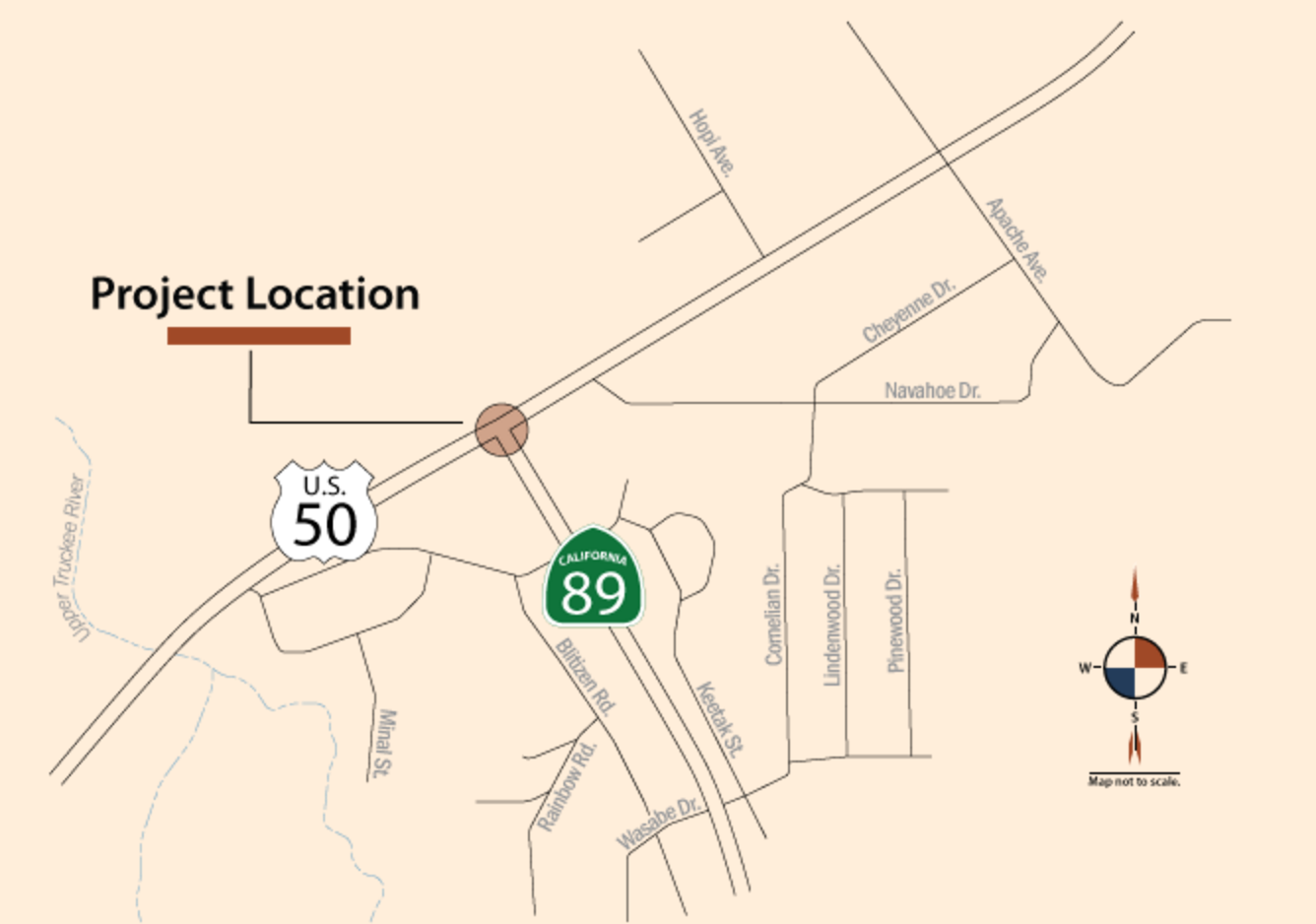
Caltrans on track to build roundabout in Meyers

Caltrans is contemplating a roundabout in Meyers. Map/Caltrans

Caltrans is contemplating a roundabout in Meyers. Map/Caltrans

By Lake Tahoe News

Caltrans is moving forward with making improvements at the intersection of highways 50 and 89 in Meyers.

“A roundabout isn’t the only option being looked it. A signal and design changes to the intersection are also being considered,” Steve Nelson, spokesman for Caltrans, told Lake Tahoe News. “That being said, it is fair to say that the project development team believes a roundabout is the best option to meet the purpose and need of the project, which is safety improvement to reduce collisions and reduce the severity of collisions.”

The project is in the environmental review phase. That should be finished in November.

Caltrans has been working with the Meyers Community Council, El Dorado County, Tahoe Transportation District and Tahoe Regional Planning Agency.

It is projected to cost $3.15 million. The money is in hand from the federal government.

The timeline includes having the right-of-way acquisition and design completed in January 2018, construction beginning in September 2018 and completion in March 2020.

For now, that is the only improvement to the state highway in Meyers.

“There has been interest expressed for a roundabout at 50 and Pioneer Trail, but Caltrans doesn’t have any other projects currently programmed in Meyers,” Nelson said.


U.S. women sweep X Games halfpipe

By USSA

OSLO, Norway – Chloe Kim (La Palma) led a huge U.S. podium sweep for the halfpipe women at X Games Oslo, with Kelly Clark (West Dover, Vt.) earning silver and Arielle Gold (Steamboat Springs, Colo.) taking bronze. Chase Josey (Hailey, Idaho) had a stellar showing for the men, earning bronze.

It was another historic performance for Kim, the 15 year old who has been breaking records as fast as they can be counted. She became the first athlete in X Games history to win two gold before the age of 16 when she won at Aspen less than a month ago. She extended that record to three gold medals in Oslo, also becoming the youngest athlete to win three consecutive golds. She had a groundbreaking run that featured jaw-dropping amplitude and back-to-back 1080s, earning the highest score ever awarded to a female halfpipe rider at X Games – 98.00.

“I was really excited on how tonight went,” Kim said with another X Games gold medal hung around her neck. “It’s really crazy to win three X games medals in a row. It’s just an unbelievable experience.”

Clark, the veteran in the field in her 19th consecutive X Games appearance, powered through an injury to earn her 14th overall medal, the most by a female in X Games history. Clark pulled her groin on the first night of practice and was struggling with obvious pain going into the final. She rode with focus, however, pushing through to land a frontside 1080 on her third and final run and a spot on the podium in the silver-medal position.

Behind the podium sweep, Maddie Mastro (Wrightville) finished fourth and Hannah Teter (Meyers) eighth.

It was a highly-competitive men’s competition as well, and Josey’s bronze-medal performance was an excellent showing at his second X Games appearance (he placed 11th at Aspen in January in a contest that was abbreviated to one run due to inclement weather). He finished behind Ayumu Hirano of Japan in first and Iouri Podladtchikov of Switzerland in second.


2 canoeists missing on Donner Lake

The search for two men who went missing when their canoe capsized on Donner Lake will resume Saturday morning.

Truckee police received a call Feb. 26 at 4:44pm regarding the incident.

Search crews on boats, divers in the water and a helicopter were unable to find the men. The search was called off because of darkness.

The canoe has been recovered. It is believed the men borrowed it from the house they were renting.

Sgt. Bob Womack told Lake Tahoe News one of things investigators are trying to solidify is how far the men were paddling from shore. Reports range from 100 feet to 200 yards. At the time they fell into 40-degree water the winds were blowing between 15 and 25 mph, with 2- to 3-foot waves.

Womack said the men are in their 30s and not from the Truckee area. They also were not wearing life jackets.

— Lake Tahoe News staff report


Letter: Warning from LTUSD to parents

Publisher’s note: The following letter has been sent to parents of Lake Tahoe Unified School District.

Dear Parents:

We would like to make you aware of a situation that may concern you. We were recently notified of the federal court ruling ordering the California Department of Education in Sacramento to release student records to a nonprofit parent group in the Bay Area.

While LTUSD is not involved in this legal matter, we are always concerned about student privacy. Therefore, we are providing you information on how you can protect your student and possibly not have their information released by the state.

At your school site, we have a one page objection form for you to use if you object to the federal court order regarding your child. If you do not object to the release of this information, you need do nothing.  We also have the form and additional information on our website at www.ltusd.org. The specific information is located under the parent tab at the bottom entitled Morgan Hill vs. the California Department of Education.

While submitting a form will not guarantee your student’s information will not be released, it is the only means for expressing an objection to the current order. The court also issued a Protective Order, which prohibits the plaintiff from disclosing any confidential information to anyone other than the parties, plaintiff’s attorneys and/or consultants, and the court. Thus, in no event is the information permitted to be disclosed to the public generally or be used for any reason outside of this lawsuit, and all information must be returned to the CDE or destroyed at the conclusion of the lawsuit.

Note that the Lake Tahoe Unified School District is not a party to the litigation and is not required to disclose any student data. If you have any questions, please contact CDE directly at 916.319.0800.

Thank you,

Lake Tahoe Unified School District


UN report warns of fewer bees, other pollinators

By Seth Borenstein, AP

Many species of wild bees, butterflies and other critters that pollinate plants are shrinking toward extinction, and the world needs to do something about it before our food supply suffers, a new United Nations scientific mega-report warns.

The 20,000 or so species of pollinators are key to hundreds of billions of dollars’ worth of crops each year — from fruits and vegetables to coffee and chocolate. Yet 2 out of 5 species of invertebrate pollinators, such as bees and butterflies, are on the path toward extinction, said the first-of-its-kind report. Pollinators with backbones, such as hummingbirds and bats, are only slightly better off, with 1 in 6 species facing extinction.

“We are in a period of decline and there are going to be increasing consequences,” said report lead author Simon Potts, director of the Centre for Agri-Environmental Research at the University of Reading in England.

And it’s not just honeybees. In some aspects they’re doing better than many of their wild counterparts, like the bumblebee, despite dramatic long-term declines in the United States and a mysterious disorder that has waned.

The trouble is the report can’t point to a single villain. Among the culprits: the way farming has changed so there’s not enough diversity and wild flowers for pollinators to use as food; pesticide use, including a controversial one, neonicotinoid, that attacks the nervous system; habitat loss to cities; disease, parasites and pathogens; and global warming.

The report is the result of more than two years of work by scientists across the globe who got together under several different U.N. agencies to come up with an assessment of Earth’s biodiversity, starting with the pollinators. It’s an effort similar to what the United Nations has done with global warming, putting together an encyclopedic report to tell world leaders what’s happening and give them options for what can be done.

The report, which draws from many scientific studies but no new research, was approved by a congress of 124 nations meeting in Kuala Lumpur on Friday.

“The variety and multiplicity of threats to pollinators and pollination generate risks to people and livelihoods,” the report stated. “These risks are largely driven by changes in land cover and agricultural management systems, including pesticide use.”

But these are problems that can be fixed, and unlike global warming, the solutions don’t require countries to agree on global action — they can act locally, said Robert Watson, a top British ecological scientist and vice chairman of the scientific panel. The solutions offered mostly involve changing the way land and farming is managed.

“There are relatively simple, relatively inexpensive mechanisms for turning the trend around for native pollinators,” said David Inouye of the University of Maryland, a co-author of a couple chapters in the report.

One of the biggest problems, especially in the United States, is that giant swaths of farmland are devoted to just one crop, and wildflowers are disappearing, Potts and others said. Wild pollinators especially do well on grasslands, which are usually more than just grass, and 97 percent of Europe’s grasslands have disappeared since World War II, Potts said.

England now pays farmers to plant wildflowers for bees in hedge rows, Watson said.

There are both general and specific problems with some pesticide use, according to the report.

“Pesticides, particularly insecticides, have been demonstrated to have a broad range of lethal and sub-lethal effects on pollinators in controlled experimental conditions,” the report said. But it noted more study is needed on the effects on pollinators in the wild. Herbicides kill off weeds, which are useful for wild pollinators, the report added.

The report highlighted recent research that said the widely used insecticide neonicotinoid reduces wild bees’ chances for survival and reproduction, but the evidence of effects on honeybees is conflicting.

In a statement, Christian Maus, global pollinator safety manager for Bayer, which makes neonicotinoids, said: “The report confirms the overwhelming majority of the scientific opinion regarding pollinator health — that this is a complex issue affected by many factors. Protecting pollinators and providing a growing population with safe, abundant food will require collaboration.”

Potts said global warming is “very clearly a real future risk” because pollinators and their plants may not be at the same place at the same time. England has seen one-quarter of its bumblebee species threatened, and those are the type of bees most sensitive to climate change, he said.

England has lost two species of wild bumblebees to extinction and the U.S. has lost one, Inouye said.

The story of honeybees is a bit mixed. Globally over the last 50 years, the number of managed honeybee hives — ones where humans keep them either as a hobbyists or as professional pollinators — has increased, but it has dropped in North America and Europe, where there is the most data, the report said.

Potts said the number of managed hives in the United States dropped from 5.5 million in 1961 and dropped to a low of 2.5 million in 2012, when colony collapse disorder was causing increased worries. The number of hives is now back up slightly, to 2.7 million.

Dennis vanEngelsdorp, a University of Maryland bee expert who wasn’t part of the report, praised it for looking at the big picture beyond honeybees.

Doing something is crucial, he said.

“Everything falls apart if you take pollinators out of the game,” vanEngelsdorp said. “If we want to say we can feed the world in 2050, pollinators are going to be part of that.”


Environmentalists sue to better protect sage grouse

By Associated Press

BILLINGS, Mont. — Environmental groups sued Thursday to force the Obama administration to impose more restrictions on oil and gas drilling, grazing and other activities blamed for the decline of greater sage grouse across the American West.

A sweeping sage grouse conservation effort that the government announced last September is riddled with loopholes and will not be enough to protect the bird from extinction, according to the lawsuit filed in U.S. District Court in Idaho.

It follows several legal challenges against the same rules from the opposite end of the political spectrum. Mining companies, ranchers and officials in Utah, Idaho and Nevada argue that the administration’s actions will impede economic development.

The ground-dwelling sage grouse, known for their elaborate mating ritual, range across a 257,000-square-mile region spanning 11 states.

The new rules and land use policies for federal lands in the region were meant to keep the popular game bird off the endangered species list. They are backed by more than $750 million in commitments from the government and outside groups to conserve land and restore the bird’s range.

But the lawsuit from the Western Watersheds Project, Center for Biological Diversity and two other groups said the rules have too many exceptions favorable to industry at the expense of the bird.

“Each state had its own specific loophole,” said Erik Molvar with WildEarth Guardians, another plaintiff in the case. “For Wyoming, there are huge loopholes for oil and gas. Nevada has loopholes for geothermal power. In southeastern Oregon, there were loopholes for wind farms. And everywhere there are loopholes for transmission projects.”

Interior Department spokeswoman Jessica Kershaw declined to comment directly on the lawsuit, but she said the government’s conservation plans follow the best science and were crafted in partnership with state and local officials.

“The plans are both balanced and effective, protecting key sage-grouse habitat and providing for sustainable development,” Kershaw said in an emailed statement.

The grouse population once was estimated at 16 million birds across North America. It’s lost roughly half its habitat to development, livestock grazing and an invasive grass that encourages wildfires in the Great Basin of Nevada and adjoining states. There are now an estimated 200,000 to 500,000 greater sage grouse.

The Prairie Hills Audubon Society of South Dakota was another plaintiff in Thursday’s suit.

Notably absent was its parent organization, the National Audubon Society. The influential, New York-based advocacy group supports the administration’s plans and wants them to be given time to work, spokesman Nicholas Gonzalez said.


2 Incline bartenders accused of selling drugs

Two Incline Village bartenders were arrested this month on narcotics charges following a series of undercover operations by Washoe County sheriff’s detectives.

Juan Pablo Lepe, an employee of Rookies Sports Bar and Grill, was arrested Feb.10 and Nicholas Webber, an employee of the Village Pub, was arrested Feb. 19. Both face multiple drug-related charges.

Detectives said they bought cocaine from the two bartenders. A search of one of their vehicles result in the seizure of 9.2 grams of powder cocaine, officials said.

These undercover operations took place between Jan. 28 and Feb. 4.

— Lake Tahoe News staff report


Study: Poorest areas missed out on recovery

By Nelson D. Schwartz, New York Times 

The gap between the richest and poorest American communities has widened since the Great Recession ended, and distressed areas are faring worse just as the recovery is gaining traction across much of the country.

These findings, outlined in a study released Thursday by the Economic Innovation Group, a new nonprofit research and advocacy organization, may help explain why the country’s economic and political situation has become so polarized in recent years. The results, broken down into areas as small as individual ZIP codes, provide one of the most detailed looks at the nation’s growing inequality.

From 2010 to 2013, for example, employment in the most prosperous neighborhoods in the United States jumped by more than a fifth, according to the group’s analysis of Census Bureau data. But in bottom-ranked neighborhoods, the number of jobs fell sharply: One in 10 businesses closed down.

Read the whole story