Calif. lawmaker seeks mandatory training for alcohol servers

By Guy Kovner, Santa Rosa Press Democrat

In a move to cut down on the deadly toll from drunken driving, a Southern California legislator has proposed a bill that requires training for restaurant and bar workers intended to prevent the serving of alcohol to intoxicated patrons.

Assemblywoman Lorena Gonzalez, D-San Diego, said her measure was a reaction to the deaths of two UC San Diego medical students killed in May by a wrong-way drunken driver. More than 10,000 people a year — an average of one every 52 minutes — die in crashes involving alcohol, the National Highway Traffic Safety Administration says.

The state-approved, four-hour training courses for bartenders, servers and managers would include “intervention techniques to prevent the service or sale of alcoholic beverages to underage or intoxicated persons,” the bill says. Other topics include the “social impact of alcohol” and its impact on the body.

Read the whole story


Deer Valley ski resort, Stein Eriksen Lodge off the charts when it comes to guest services

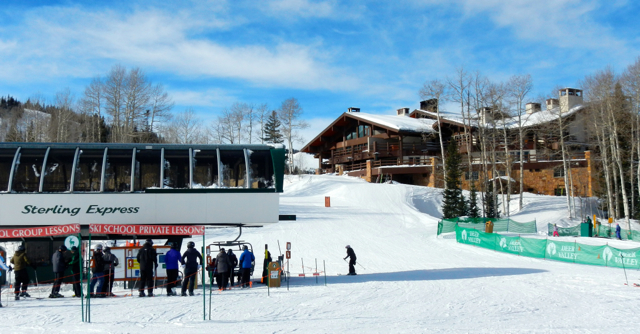
Stein Eriksen Lodge is just above the Sterling lift at Deer Valley. Photo/Kathryn Reed

Stein Eriksen Lodge is just above the Sterling lift at Deer Valley. Photo/Kathryn Reed

Publisher’s note: This is one in a series of stories about Park City, Utah.

By Kathryn Reed  

PARK CITY, Utah – Anticipating a guest’s needs and fulfilling them are what sets Deer Valley ski resort and Stein Eriksen Lodge apart from their competitors.

They are the leaders in their respective industries when it comes to guest services. Employees provide the little touches with ease, as though it is normal. The attitude they bring makes it appear they really enjoy their jobs. The kindness seems sincere, not forced or rehearsed. They may be acting, and if they are, then they should be receiving an Oscar tonight.

Deer Valley workers seem to do everything for skiers – except the actual skiing. And they are doing it just for skiers. Snowboarders still aren’t allowed at this resort, which makes a fantastic difference.

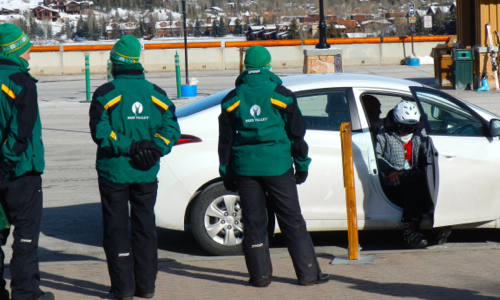
A cadre of employees dressed in green and yellow are at the curb of Snow Park Lodge eagerly opening doors, getting equipment out for people.

Valet service at Deer Valley includes multiple people helping unload a vehicle. Photo/Kathryn Reed

Valet service at Deer Valley includes multiple people helping unload a vehicle. Photo/Kathryn Reed

Workers don’t hole up in the liftie booth, they aren’t chatting with co-workers and ignoring the guests, they don’t act annoyed when asked a question from an out-of-towner. They seem to recognize a puzzled look and are quick to offer help. Employees were stationed on the mountain at most of the large maps, giving tips for where to go.

The mountain is known for it’s perfect corduroy. In some ways this makes it the ideal place to be on a powder day because most people here want to stick to the groomers so the untouched stashes of that fluffy Utah powder lasts a while. At many of the nearby hotels the daily grooming report is available at the front desk in the form of a mini resort trail map.

Don’t get the wrong idea about this mountain that has multi-million dollar houses slopeside. It’s not for the faint of heart. There are plenty of steeps, some moguls and blue (intermediate) runs that would pass for black (advanced) in Lake Tahoe.

In 2002, Deer Valley was the host resort for the Alpine slalom, freestyle aerial and freestyle mogul Olympic events. More than 20,000 people attended each competition.

And in January the U.S. Ski Team was training for the Visa Freestyle International that was Feb. 4-6. This was the biggest stop on the World Cup tour. The events were staged at the same locations where the Olympians skied. This was the 14th time Deer Valley hosted a World Cup event. It also was home to the FIS Freestyle World Ski Championships in 2003 and 2011.

While the base area can get congested, the rest of the mountain isn't because the resort limits the number of skiers. Photo/Kathryn Reed

While the base area can get congested, the rest of the mountain isn’t because the resort limits the number of skiers. Photo/Kathryn Reed

Inside the various lodges that are scattered about the ski hill the workers are courteous, answer questions about local beers and keep the venues spotless – or as close to it as possible. Food ranges from burgers to grilled venison to slices of cheesecake.

Even little things like the racks holding skis outside the restaurants look nicer than at most resorts. Instead of ordinary metal, they are aesthetically pleasing wood devices that fit in more with the natural environment.

Deer Valley limits the number of skiers to 7,500 a day on its 2,000-acre resort. Lift tickets are $120 a day; comparable to Vail Resorts’ properties.

Stein Eriksen's presence is scattered throughout the property. Photo/Kathryn Reed

Stein Eriksen’s presence is scattered throughout the property. Photo/Kathryn Reed

Sitting above Silver Lake Lodge is a hotel named after Stein Eriksen, a 1952 Olympic gold and silver medalist from Norway who died in December at age 88. From 1956-58, he was director of Heavenly Mountain Resort’s ski school.

While Stein Eriksen Lodge is named after the man known as the father of freestyle skiing, he didn’t have an ownership stake in the lodge nor did he make any money off of the use of his name. A trophy case, though, shows off his hardware from his racing days. And there was a time he was like an ambassador for the hotel, mingling with guests and telling stories.

A hotel spokesman said owners are wrestling with how to stay relevant when multiple generations no longer recognize the Stein Eriksen name. They are working on how to keep the name meaningful. And while the service and location are outstanding, I was left with the feeling that the price of the room had more to do with the name and history of the property than the overall experience.

Views from the deck of Stein Eriksen look out to the slopes of Deer Valley. Photo/Kathryn Reed

Views from the deck of Stein Eriksen look out to the slopes of Deer Valley. Photo/Kathryn Reed

This Forbes five-star hotel definitely earned that rating when it came to guest services.

At the end of the day Stein employees are there to assist with the removal of ski boots. What a wonderful luxury that I didn’t know I was missing until that moment. This was after a couple guys hustled down the hill to grab our skis as we were walking up from the ski lodge.

From the valet to the doormen to the restaurant staff – impeccable service, and only worthy of praise. Even the guy who had to come service the television was at the top of the chart for guest services.

Rooms at the Stein Eriksen are comfortable. Photo/Kathryn Reed

Rooms at the Stein Eriksen are comfortable. Photo/Kathryn Reed

What makes this property less than ideal is how it is laid out. The original lodge is where the restaurants are. Through the years it has expanded outward. We were staying about as far away as one could be from the outdoor heated pool, spa, weight room and restaurants. If there weren’t a private hot tub on the balcony of our room (which is the exception, rather than the rule), the communal hot tub across the property would have been inconvenient to get to.

Evening temperatures were in the single digits. This made for a brisk walk to dinner as well as to breakfast.

Casual and more formal restaurants are on property. The scallops are outrageously good, the choices for vegetarians limited, the breakfast good and hearty. The window seats looking out onto all that corduroy are wonderful. A huge wrap-around deck looks like it would be inviting to sit on when the temps are above freezing.

To get to where our skis were stored the front desk staff said the fastest, most convenient route was to walk through the garage. They were correct. But it seemed odd at a five-star hotel to be walking this way. It was another sign that the layout is lacking.

The trophy case belonging to the lake Stein Eriksen. Photo/Kathryn Reed

The trophy case belonging to the late Stein Eriksen. Photo/Kathryn Reed

For a luxury hotel that can fetch more than $1,000 a night for a room in winter – four times the amount compared to summer – there is a relaxed, mountain vibe. The wood and rock décor, along with muted lighting in common spaces even makes it feel a bit rustic – in a good way.

The room itself is spacious and comfortable. But it, too, is laid out a bit odd. A long entranceway is wasted space. While overall the bathroom is almost sprawling, the toilet is tucked into what is like a closet that would seem hard to maneuver in for someone larger than I am. The towels are ordinary – not even as nice as the Park City Marriott, though the robes are the best hotel robes I’ve worn – beyond plush – like being wrapped in a cocoon.


Congressional art competition seeks participants

Rep. Tom McClintock, R-Granite Bay, is looking for high school students in his district to participate in the Congressional Art Competition.  The 2016 theme is American Exceptionalism.

Contest guidelines and release forms are available online. Artwork and student entry forms are due April 1 at 5pm.

A panel of artists and local officials will judge the artwork.

First-place entries from each congressional district will be displayed for one year in the Cannon Tunnel, leading to the U.S. Capitol. Each winning student will be invited, along with one guest, to the unveiling of the exhibit and a reception for all winners in June.


Car chase on Kingsbury Grade reaches 80 mph

Two high-speed chases resulted in three people being arrested Saturday. Speeds at times were in excess of 80 mph on Kingsbury Grade.

The initial chase involving a Mercedes started about 3:30pm Feb. 27 in the Carson Valley. That car at times was clocked at going more than 100 mph on Highway 395.

An hour later another vehicle was spotted racing up Kingsbury Grade. Because of safety reasons officers abandoned that pursuit. The vehicle was later found at the top of Kingsbury Grade in a residential area.

Nevada Highway Patrol officers have not released the names of the men who were arrested or many specifics about the incidents or how the two chases might be related.

— Lake Tahoe News staff report


Then and now: 50 years of a Hwy. 50 block

Highway 50 at Stockton Avenue in South Lake Tahoe in the 1960s. Photo/South Lake Tahoe

Highway 50 at Stockton Avenue in South Lake Tahoe in the 1960s. Photo/South Lake Tahoe

The above photo is looking toward the intersection at Lodi Avenue.

Visible left to right:

Purple Sage Motel
Carson Tahoe Rents
Douglas gas station
76 (ball atop pole) gas station
Standard gas station and neighboring Lowe-Trumbull real estate office

Highway 50 at Stockton Avenue in South Lake Tahoe in 2016. Photo/Bill Kingman

Highway 50 at Stockton Avenue in South Lake Tahoe in 2016. Photo/Bill Kingman

Visible left to right:

Purple Sage Motel now is Pine Cone Plaza
Carson Tahoe Rents now is Old Republic Title
Douglas gas station now is US Gasoline Liquor
76 (ball atop pole) gas station now is the Magic Carpet Golf parking lot corner of Lodi
Standard gas station and neighboring Lowe-Trumbull real estate office now is the Star Tahoe office building corner of Lodi.

— Bill Kingman


Salt Lake Olympic legacy remains on fast track

Skiers during the summer come off the jumps, landing in the pool on the left. Photo/Kathryn Reed

Skiers during the summer come off the jumps, landing in the pool on the left. Photo/Kathryn Reed

Publisher’s note: This is one in a series of stories about Park City, Utah.

By Susan Wood

PARK CITY, Utah – Hurtling down twists and turns at speeds of 80 mph with complete abandon of the danger if the pilot makes a mistake. The centrifugal force to be reckoned with at 4Gs makes a rookie groan, strain to focus, breath heavy and fight back the wind pushing her head down.

I tell myself to sit upright to protect my back, not realizing that after the one minute ride my elbows jammed inside the sled would be the points of my body to have bumps and bruises while gripping the cables seated directly behind the driver, Olympic silver medalist Shauna Rohbock of Orem, Utah.

At the Utah Olympic Park built for the 2002 Salt Lake City Games, I stepped into her vehicle of choice to partake in the second fastest bobsled track in the world. The fastest is at Whistler, British Columbia.

I held on tight to the confidence my four-member bobsled team thrown together with Rohbock at the helm would come out of the open chute surviving and thriving. Jake (the Olympic Park worker in back) told us how rare it is to experience the track without the shade. The sun can wreck the consistency of the track surface in 15 minutes.
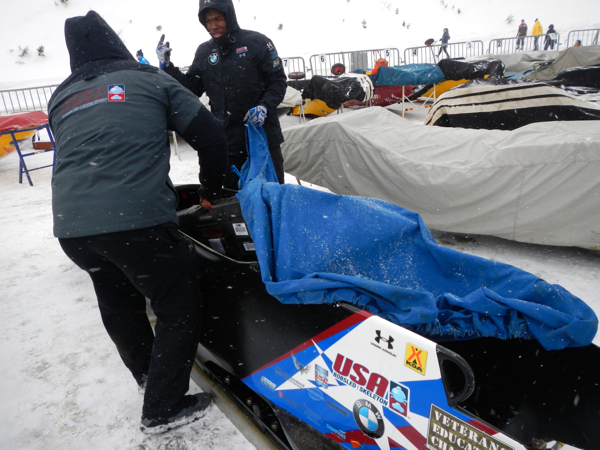
The U.S. bobsled team gets ready for the World Cup event in January. Photo/Kathryn Reed

The U.S. bobsled team gets ready for the World Cup event in January. Photo/Kathryn Reed

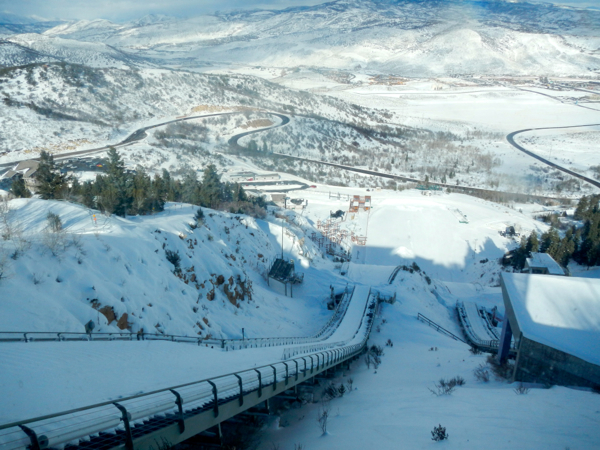
The U.S. Bobsled and Skeleton Team was in town on this January day for World Cup races along with multiple international teams. Before our run from the top, the chatter on the radios reflected a sense of urgency to keep the practice schedule. The track starts with a 400-foot drop and has 15 curves that make even the fastest roller coaster seem like an E-ticket ride. For $175 a person in winter or $150 in summer, the park provides the public rides on the Comet bobsled that start about a third of the way down from the competition start.

“It’s an experience you don’t have anywhere else,” said Sandy Chio, marketing director for the Utah Olympic Legacy.

The legacy foundation that employs 325 employees (60 year-round) was formed to maintain the Olympic facilities and no host events. Venues include the mega Olympic Park just outside Park City; cross country skiing mecca Soldier Hollow southeast of Deer Valley in Midway; gigantic Olympic Oval in suburban Salt Lake City; Maverik Center for ice hockey in West Valley City; Peaks Ice Arena in Provo; Salt Lake Ice Center in downtown; Utah Jazz Stadium in town; Snowbasin ski area northeast of Salt Lake City; The Ice Sheet at Ogden; Deer Valley Ski Resort; and Park City ski resort.

They are staging grounds for Olympians and wannabes. They also provide entertainment for spectators or those who are enamored with learning about the venues.

In January, Lake Tahoe News visited four of the 11 venues, and met with Park City officials and Olympic Legacy staffers to get a glimpse of what it’s like to host the Games, as well as the work involved before and after. Lake Tahoe hosted the 1960 Winter Olympics at Squaw Valley and the West Shore. For years, a Reno-based group has formed a committee and toyed with the idea of putting on another worldwide event, albeit strategically moving the date every few years to better its chances. The latest quest is for the 2026 Games, of which Salt Lake City has expressed an interest in as well.
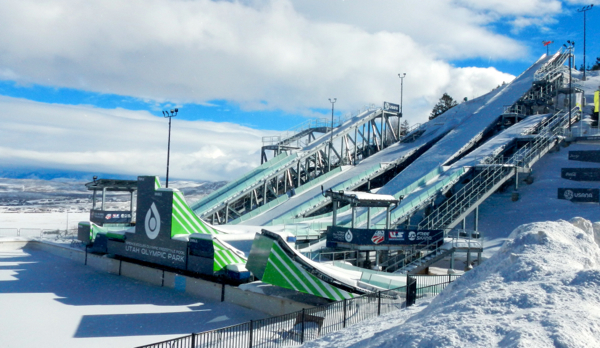
The ski jump has different  starting points based on one's skill level. Photo/Kathryn Reed

The ski jump has different starting points based on one’s skill level. Photo/Kathryn Reed

A park for all seasons

On an estimated $26.3 million investment, the Utah Olympic Park opened with the bobsled-luge track, and ski museum in 1991, four years before the state received the bid to host the 2002 Games. (Salt Lake also bid on the 1998 Games.) Upon winning the bid, plans were quickly put into place that with a $48 million upgrade the park would add chairlifts, storage buildings, roads, bridges and water lines, replace its 90-meter Nordic ski jump and accommodate a new 120-meter jump ramp.

At first glance, one can see from the steepness at the top this isn’t for the faint of heart.
The public may experience a scaled-down version of the Olympic bobsled course. Photo/Kathryn Reed

The public may experience a scaled-down version of the Olympic bobsled course. Photo/Kathryn Reed

Tour guide Patrick Rosevear stressed the real slope isn’t as bad as one thinks.

“Every day, we see 12- and 14-year-olds jump. It’s actually the second safest sport,” he insisted, noting jumpers are really only 7 feet in the air despite how it looks on television. Of course, they are flying about 130 feet off a 36-degree ramp at 55mph. If there’s an 8- to 12mph crosswind, jumps are canceled.

At 7,350 feet, Utah Olympic Park has the highest ski jumps in the world.

The freestyle aerial ramps send mogul and hot-dogging skiers 50 feet up in the air. The 40-degree landing is so steep a snowcat must be winched to groom there.

During the summer freestyle aerial skiers train in a 10-foot deep, 1.2 million-gallon swimming pool, which opened last year upon the $1 million donation from Olympic skier Spence Eccles – a philanthropist who also owns the Goldener Hirsch hotel near Deer Valley.

The freestyle venue hosts many after-school programs for children. The park itself boasts more than 400,000 visitors.

Many are fascinated with the bobsled-luge track maintained by a $15,000 cooling system serving 100 miles of pipes. Rosevear noted that even though a participant sits up instead of lying down like the skeleton (considered one of the easiest and safest “by a huge margin”) the luge represents one of the most dangerous sports.

“It’s the steering. If you come into a turn and you miss by one inch at 91 mph, it can eject you off the sled,” the guide said as a hush came over the tour van. In the luge, the riders wear spikes on their gloves to paddle – not to stop.

For a more relaxed experience, guests may peruse the two museums at the park. One is dedicated to the history of skiing and the other to the 2002 Olympic Games. A whole wall displays Park City’s Olympic giant slalom racer Ted Ligety. Another exhibit features Olympic bobsledder Steve Holcomb, who brought home a medal in the last Winter Olympics in Sochi, Russia.
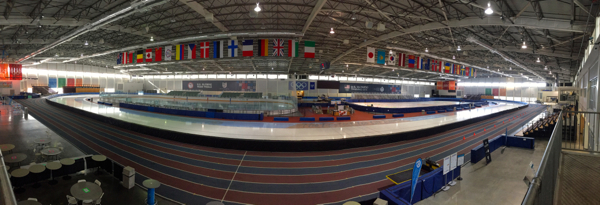
The Oval is used by the U.S. Olympic team to train, but is open to residents as well. Photo/Kathryn Reed

The Oval is used by the U.S. Olympic team to train, but is open to residents as well. Photo/Kathryn Reed

Making the skate world go round

For those who like to get a quad burn on two blades, the Utah Olympic Oval has much to offer for the Olympian, aspiring youth or spectator hoping to catch a glimpse at the next Apollo Ono. The Olympian showed up for an exhibition event last November as part of the Oval’s quest to offer events that bring in visitors. There’s also “cosmic curling” for others wanting to figure out this mysterious sport.

The Oval was built on a 5-acre footprint in Kearns outside Salt Lake City in 1994, a year before Utah received the bid. Olympic revenues were used to cover the up to 4,000-seat oval and build an ice sheet in the center of the track. This sheet is now deemed “the fastest ice on Earth,” Oval Operations Manager Todd Porter told Lake Tahoe News on a special tour. It’s also the highest, at an elevation of 4,675 feet.

Todd Porter, who oversees the Olympic Oval, stands between the running track and ice for racing. Photo/Kathryn Reed

Todd Porter, who oversees the Olympic Oval, stands between the running track and ice for racing. Photo/Kathryn Reed

Porter talks poetically, albeit with a chemist’s know-how, about the Oval’s massive central cooling system, which seems like it could span the globe with pipes. Depending on the event, the ice changes consistency. It’s this control that attracts Olympians such as Jessica Smith-Kooreman, who trains in Salt Lake. She owns four short-track speed skating World Cup titles and came in fourth in 2014 at the Sochi Winter Olympics.

“I moved here for the facility itself. It’s the best and safest ice because it can be controlled. In the Olympic year, we had the ice switched to what is in Russia. Most places can’t do that. The Oval is good for taking care of its athletes,” she told Lake Tahoe News on a break from training. “You’re able to push your limits every day.”

The Oval schedules a host of “learn-to” programs that may spur the next Olympian. It can rent 1,000 skates, but all of the efforts seemed futile in the beginning, Porter admitted.
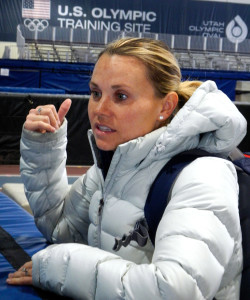
Olympian Jessica Smith-Kooreman raves about the ability to change the consistency of ice at the oval. Photo/Kathryn Reed

Olympian Jessica Smith-Kooreman raves about the ability to change the consistency of ice at the oval. Photo/Kathryn Reed

“At first, marketing to people around here was tough because they thought it wasn’t for them,” he said.

But getting the word out is paying off. Porter reported a record week of attendance between the Christmas and New Year’s holidays, with 20,000 people taking in the large facility the size of four football fields. The place houses 10 locker rooms and a tunnel taking visitors from one side to the other. The concessions are managed in house.

Even the weight room is an experience, with television cameras set up for trainers to evaluate their athletes’ performances.

It’s the Europeans who appear to appreciate the facility the most, making it a stop on their U.S. vacation — with Netherlands television blasting skating events on site.

“To them, it’s like (visiting) Yankee Stadium,” Porter quipped.

The Oval loses about a $1 million year, but “that’s the key part of where the (financial) endowment comes in,” Porter stressed.

Still, Porter is always thinking of new ways to attract revenue and save money. The Oval has adapted a solar program designed to save the facility $2,000 a month in energy efficiency.
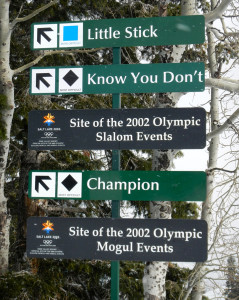
Deer Valley lets skiers know where the Olympic events were. Photo/Kathryn Reed

Deer Valley lets skiers know where the Olympic events were. Photo/Kathryn Reed

Patience, perseverance to put on the Games

It takes good fortune, luck, money and will, according to Park City officials in describing handling the Olympics. After all, the region had tried a handful of times.

“The first challenge was no one believed we could actually do it. At the start, we thought it was a joke,” former city staffer Myles Rodeman, one of the architects of the 2002 Games, told Lake Tahoe News.

Rodeman, who was involved with the effort for 13 years, recalled the effort like it was yesterday. Ski racer and then Mayor Brad Olch walked in his office asked, “What do you think of us going in with Salt Lake for the Olympics?” Thus began a transformation of the ski town that was hard to imagine at the time.
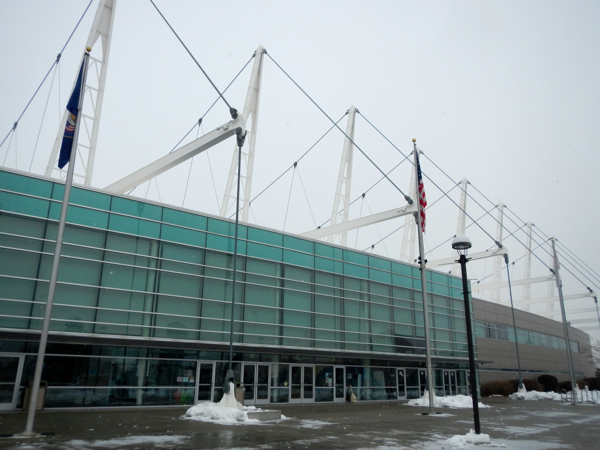
The Olympic Oval located a ways from Park City and  Salt Lake City. Photo/Kathryn Reed

The Olympic Oval is located a ways from Park City and Salt Lake City. Photo/Kathryn Reed

This was the 1980s when the ski industry was clawing out of a dismal period, so a boost for the economy seemed like a promising idea if it were to pay off.

Although now it takes at least $20 million to justify the investment of actually staging the Games, the $7 million raised at that time, mostly by private companies, for the bid was a lot of money. A master plan was devised, the local Rotary became a lobbying partner, and the Ski Utah organization discussed who would be best suited to host the ski events. Park City and Deer Valley appeared prime as host resorts – but not without a little power struggle and politics.

“We knew other resorts up the (Big and Little Cottonwood) canyons would be most difficult to serve in terms of transportation and avalanche conditions,” Rodeman said.

The Olympic Oval in Salt Lake seemed a bit problematic with its location being so far out.

There were so many considerations in hosting the Olympics.

Take transportation. During the Games, the Utah Department of Transportation forced truckers to re-route on Interstate 80.

Take parking. It’s no easy task, but up to 3,500 spaces were created in parking lots outside the downtown area of Park City.

“It was an incredible effort. You could not drive a car here,” Rodeman said.
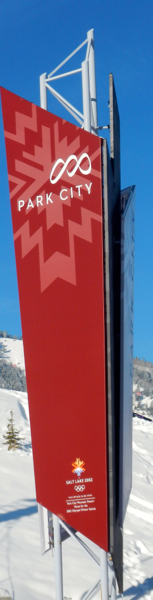
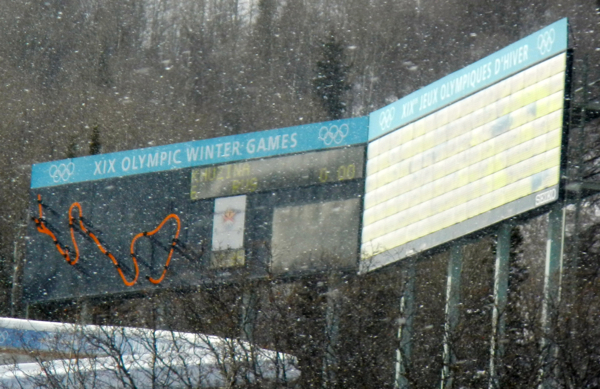
This style of sign is a signature for the Salt Lake Games that is seen at all the legacy venues. Photo/Kathryn Reed

This style of sign is a signature for the Salt Lake Games that is seen at all the legacy venues. Photo/Kathryn Reed

Take the swag. During the bidding process, a “necessary” amount of generous “gifts” are traditionally given to Olympic Committee board members. In these staged events, one might see an assortment of items that exemplify a host city’s profile. At one event, Salt Lake City brought salt-water taffy, pins and hats but lost the bid. Nagano, Japan, won the 1998 bid using violins, computers and cars. Salt Lake won with rifles from Browning, a local company, Rodeman noted. The stakes for hosting appear high.

“Right there, I thought we lost (the bid),” he said. “In those days, you have to get all the (committee) members to support you.”

These days, regulations surround gifting internationally. Much of this came out of the 2002 Games.

Take hometown rules. Utah suspended all drinking laws for the 25 days surrounding the Olympics.

Take housing – which takes creativity as well. The athlete housing now serves as student dorms at the University of Utah.

Take security. The 9/11 terrorist attacks had occurred five months prior. The celebrations were staged in downtown Park City, making city officials and organizers nervous with the feds slow in coming.

“We needed security, but we didn’t want to look like we were armed for the cameras,” said Rodeman, who was in Atlanta on a scouting tour during the 1996 Summer Games when the bomb exploded.

City officials and Olympic organizers toured five Olympic towns to see how they fared in the process – the Georgia city, Nagano, Sydney, Lillehammer and Calgary.

Olch, who served as Park City mayor for 12 years during the Olympic endeavor, recalled how the 1988 Winter Olympics in Calgary were considered as netting a less-than-desirable “Olympic performance” before and after the Games.

So Salt Lake City decided to plan to build facilities under the supervision of the Salt Lake City Olympic Committee ahead of schedule.

“We really stepped up there,” Olch told Lake Tahoe News. “We had the experience (with ski venues), and the community got behind the sports venues and the whole Olympic thing.”

The 40-year Park City resident admitted to spending “a lot of time talking to a lot of people convincing them it’s a good thing,” and in the end, “it worked out incredibly well.” Olch insisted he wouldn’t live anywhere else.

“Sure, putting on the Games is always challenging, but it exceeded all our expectations in how well it went and with what it did for our community – the list is quite long,” he said.

Park City Public Affairs Manager Phyllis Robinson agreed.

The city put out a communitywide visioning process recently and asked its residents what they were most proud of Park City. The Olympics were mentioned often.

“I remember standing on Main Street. We were having this great party. (Comedian David) Letterman was at the bottom of the hill, and I thought this is something really special. I thought: ‘Holy crap, we pulled this off.’ With businesses, everybody put something in the pot to make this happen.”

Her colleague, Economic Development Manager Jonathan Weidenhamer, said it’s possible in the Lake Tahoe region. He visited Tahoe last year during a South Shore tourism forum on economic and community revitalization and turned it into a tutorial.
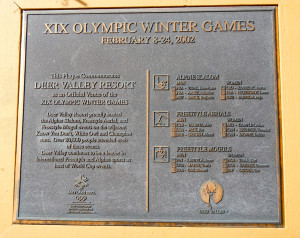
Deer Valley immortalizes those who medaled in the events at the ski resort. Photo/Kathryn Reed

Deer Valley immortalizes those who medaled in the events at the ski resort. Photo/Kathryn Reed

He pledged the South Shore would find a way to get the loop road project through if the region gets the Olympic Games.

“When you have the mission to get the Olympics, you can move mountains,” he said.

Park City taxpayers faced a slew of bonds and tax measures, while a $70 million endowment kicked off the Utah Olympic Legacy foundation – the driving force behind maintaining the benefit of hosting the Olympics.

The 2002 Games cost $1.6 billion, with a little more than half coming from the state. It ended up netting $100 million. The profit went into the foundation coffers to run the Olympic facilities, Foundation President Colin Hilton told Lake Tahoe News.

While it was an overall winner, Park City businesses lost money during the two-week period. This was expected. The entire Main Street was closed to vehicles the entire time.

“The sole focus is on our continued legacy. We’re not caught up in living in the past. We’re living the legacy with our people and programs, contributing to the Olympic movement,” Hilton said.
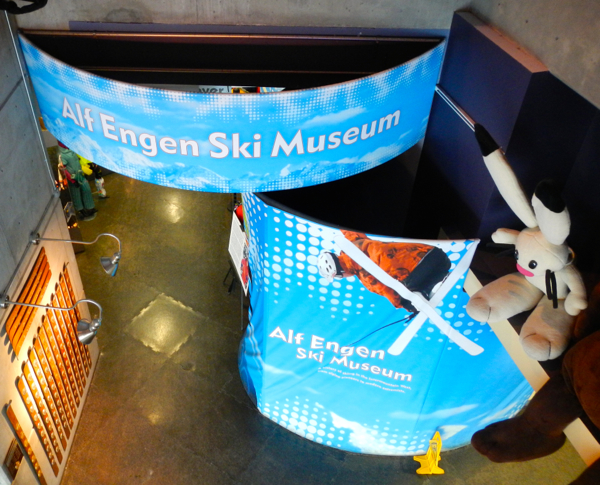
The museum focuses on the 2002 Games and Utah's ski history.

The museum focuses on the 2002 Games and Utah’s ski history.

Already, the Salt Lake-Park City region hosts many World Cup events and makes the programs “the fabric of the community.”

Hilton, one of the early architects of getting the Games to the area, was also more than pleased with the outcome. He is thrilled a new generation is carrying on the tradition – from the athletes (with 50 local Olympians living in the region) to those working behind the scenes at city offices who may have worked in other jobs at the time but stepped up to support the effort.

Assistant City Manager Matt Dias worked in a Park City restaurant during the 2002 Games.

“The Olympics are an incredibly important part of our community’s history, story and legacy. We take great pride in all of the hard work done by various community members and stakeholders that made the Games such a tremendous success,” he said. “Unlike other Games, the vast majority of the 2002 venues and infrastructure was either repurposed and returned to their prior uses and/or built new and now house vibrant and robust programs to ensure self-sustainability.”

Dias singled out the Utah Olympic Park for its off-season programs for providing a backdrop for events, boosting the local economy by filling restaurants and hotels and attracting teams to the area.


Opinion: Will online courses make education a human right?

By Marianne Krasny and Bryce DuBois

Just the first word in the name—massive open online course—poses the question. Just how big can MOOCs be?

MOOCs combine filmed lectures, readings, course material, and online interactions among professors and students—with the goal of reducing costs and expanding access to higher learning. Many MOOCs today already are huge. Andrew Ng, co-founder of the MOOC platform Coursera, used to teach 400 students a year at Stanford, whereas more than 100,000 students registered for his first MOOC on machine learning. Ng calculated he would have had to teach at Stanford for 250 years to reach the same number of students.

But the promise of MOOCs is even bigger than that. Could online courses make real the idea that education is a fundamental human right, regardless of where you live? Ng’s Coursera partner Daphne Koller has argued yes—that MOOCs can educate students all over the world, even identify the next Steve Jobs in a village in Africa.

Right now the overwhelming majority of MOOC students are Western, white, and well off. But experiments are emerging to change that. Take the Kepler experiment in Rwanda. Launched by the nonprofit Generation Rwanda in 2013, its goal is to use MOOCs to bring the best of online education to the brightest survivors of the 1994 genocide. Like a young Rwandan woman who lived in refugee camps until the age of 14, and was selected as part of the first group of Rwandans to test business MOOCs offered by the University of Edinburgh.

Generation Rwanda knew that MOOCs weren’t accessible to students in Rwanda. The first cohort didn’t know how to type on a computer and spoke limited English; they certainly didn’t have the academic background to take college-level courses. So Generation Rwanda lined up American expats in Kigali as mentors. While the program is still working out the kinks, it already can claim success: 49 of its first class of 50 students have graduated.

NGO-university partnerships like Kepler represent an agenda somewhere between educational access and international development. But what might we learn from Kepler about MOOCs and the right to an education in the U.S., where, similar to Rwanda, a persistent underclass lacks access to quality education that might lead not just to better lives for individuals, but to better lives for families and whole communities?

At Cornell University, we tried an experiment to answer questions about MOOCs’ capacity to build stronger communities in America. We designed a MOOC that was different from the business, information technology, and engineering MOOCs that aim to lift up Rwandans and other poor students in developing countries. Our MOOC—Reclaiming Broken Places: Introduction to Civic Ecology—is an exploration of grassroots environmental stewardship. In particular, we want the students to explore why people spontaneously “reclaim” broken places—like vacant lots in Detroit where residents plant community gardens and street trees; beaches destroyed by Hurricane Sandy in New York, where volunteers rebuild sand dunes to protect their shoreline; or polluted streams in Washington, D.C., where young people remove trash. Because many people who reclaim broken places live in the communities where these places scar the landscape, we wanted to see how we could make our MOOC accessible to these same communities and their environmental stewards.

The participants in our experiment were not young people who might be the next Steve Jobs. Rather they were middle-aged African-American ladies in low-income housing in Anacostia (a Washington neighborhood), Latino elders in Providence, R.I., and immigrant and African-American community leaders in Queens, N.Y. Following the Kepler model, we decided that in order to access the MOOC content, these individuals would need local mentors—people living in the communities we were targeting who could understand the lectures and readings. Then we set about answering the question: How do mentors shape access, learning, and local action when people in low-income communities participate in a MOOC?

Our students were not trying to earn a degree. They were what we call “free-choice learners”—people who choose what they want to learn—like visitors to zoos and museums, and adults taking a MOOC just because they’re interested. And for the most part, after watching a couple of the video lectures, the students in our local groups chose not to follow the intended MOOC pathway. Instead of listening to the lectures and reading the materials, they preferred to hear their mentors explain the ideas about how people reclaim broken places because of their love for life and love for the places where they live, and about how planting gardens or trees can bring people and help bring back a sense of community. The students then discussed how the ideas applied to their own broken places—the neighborhoods where they lived. And they planned actions to reclaim the broken places in their own communities.

The mentors—Akiima Price and Xavier Brown in Washington, Bryce DuBois in Providence, and Anandi Premlall in Queens—added their own touch to the lessons. Premlall used a film about the destruction of an urban farm in South Los Angeles as a jumping-off point to debate struggles around urban open space. And Price invited her students to share stories about losing sons and nephews to gun violence, as a way to introduce the concept of broken places. By discussing the course content—or the content as interpreted by the local mentors—the students learned a few things about ecosystem services, environmental governance, and sense of place and sense of community. And they came to realize the larger meanings of—and how to get involved with—grassroots greening efforts.

One way to think about our experiment is that the MOOC acted as a community-organizing tool to help participants identify things they wanted to see changed in their neighborhoods. In Providence, the senior citizens who participated in our MOOC are now working to convince the housing authority to allow them to grow their own food in a housing project garden. In Anacostia, participants are beginning to cultivate planting boxes to memorialize loved ones killed by violence. And the group in Queens launched 103 seed bombs—a mixture of dirt, compost, and wildflower seeds—to reclaim vacant lots.

So what does our experiment—along with experiments in Rwanda and other developing countries—tell us about MOOCs?

Ng shared a vision for what MOOCs can do: “I want to live in a world where students no longer have to choose between paying for tuition and paying for groceries. I want to live in a world where a poor kid born in Africa has nearly equality of opportunity as a kid born in the wealthy suburbs in D.C.” Such a world, however, requires more than MOOCs. Educational access in poor communities—whether in Rwanda or Rhode Island—requires mentors to guide students toward getting a business degree or taking action to reclaim their community. And mentors make MOOCs smaller—mentors will not reach 100,000 students. But mentors may also help make MOOCs larger—not just about educational access for individual students, but a tool for building stronger communities.

Marianne Krasny, director of Cornell University’s Civic Ecology Lab, teaches the Reclaiming Broken Places MOOC and is a Public Voices Fellow; her most recent book (with Keith G. Tidball) is “Civic Ecology: Adaptation and Transformation from the Ground Up”. Bryce DuBois, an extension associate with the Civic Ecology Lab, is researching the political ecology of Rockaway Beach after Hurricane Sandy as a doctoral candidate in environmental psychology at the Graduate Center at CUNY.


ACLU to challenge ruling regarding filming police

By Jeremy Roebuck, Philadelphia Inquirer

Civil rights lawyers said Wednesday that they intend to appeal a federal court ruling in Philadelphia that citizens do not necessarily have a right protected by the First Amendment to record police activity.

In an opinion issued last week, U.S. District Judge Mark A. Kearney wrote that unless a videographer announces the recording as an act of protest or a challenge to officers, police are free to stop it.

“While we instinctively understand the citizens’ argument, particularly with rapidly developing instant image sharing technology, we find no basis to craft a new First Amendment right based solely on ‘observing and recording’ without expressive conduct,” Kearney wrote.

But in an age of expanding surveillance – from instant cellphone photo sharing to increased use of police body cameras – the American Civil Liberties Union and its partners in the case were not alone in raising an eyebrow at Kearney’s conclusions.
Civil rights lawyers say the public’s right to record images has been established in other courts, including U.S. appellate courts based in Boston, Chicago, and Atlanta. Kearney’s ruling also landed in a city with a tumultuous history of conflict over public recording of police activity.

Read the whole story


DOE proposes sparing Nev. from more low-level nuclear waste

By Jim Myers, Las Vegas Review-Journal 

WASHINGTON — A state official on Friday welcomed a new federal report that did not pick the Nevada National Security Site the “preferred alternative” for the disposal of low-level radioactive waste.

Instead, the U.S. Department of Energy gave that designation to the Waste Isolation Pilot Project near Carlsbad, N.M., and possibly generic commercial facilities.

“This outcome is what we wanted,” said Leo Drozdoff, director of the Nevada Department of Conservation and Natural Resources and a member of a working group made up of state and DOE staff.

Read the whole story


Trump says he will weaken libel laws protecting reporters

By Jeff Horwitz, AP

Donald Trump said Friday he will weaken First Amendment protections for reporters as president, making it easier for him to sue them.

The celebrity businessman turned Republican presidential front-runner said he wants to “open up” libel laws at a rally in Fort Worth, Texas. The changes envisioned by Trump would mean that “when they write purposely negative and horrible and false articles, we can sue them and win lots of money,” he said.

Trump added that, should he be elected, news organizations that have criticized him will “have problems.” He specifically mentioned The New York Times and The Washington Post. Trump last month threatened to sue the Post after the newspaper wrote an article about the bankruptcy of his Atlantic City casino. On Twitter, Trump has routinely criticized reporters who cover him and their news organizations, including The Associated Press.

First Amendment advocates condemned Trump’s suggestions.

“His statement shows why we need libel protections,” said Gregg Leslie, the legal defense director for the Washington-based Reporters Committee for Freedom of the Press. “Trump gets offended, he gets upset and he wants to sue to retaliate. That’s not a good reason to sue someone.”

Libel law in the United States generally makes it difficult for public figures to sue reporters or other people who criticize them. To win such a case, the plaintiff must demonstrate that factually incorrect statements were made with actual malice or a reckless disregard for the truth.

Trump said he would like to lower that standard. “We’re going to have people sue you like you never got sued before,” he said.

Because the Supreme Court has repeatedly endorsed this legal standard, Trump could not change libel laws as they affect public figures by executive order or even with an act of Congress, Leslie said.

“I’ve never heard of politicians say they would repeal case law established under the First Amendment,” he said. “You’d really need a constitutional amendment to do that.”

Trump’s comments on libel law are not the first time he has disagreed with widely held conceptions of constitutional law. Last year, he said he saw no obstacle to deporting children born to undocumented immigrants in the United States. Courts have regularly found that such children are natural born citizens entitled to the same rights as any other American. Trump has said he does not believe a constitutional amendment would be necessary to get his way.

“You don’t have to do a constitutional amendment. You need an act of Congress. I’m telling you — you need an act of Congress,” he said in an interview with Bill O’Reilly of Fox News last year.