Truckee-Tahoe trying to be electric vehicle friendly

Screen Shot 2016-03-07 at 7.06.10 AMTahoe Regional Planning Agency, Truckee Donner Public Utility District, a consultant team, and a Plug-in Electric Vehicle Coordinating Council have partnered to accelerate the ability for electric vehicles to refuel in the Tahoe-Truckee region.

According to TRPA: Plug-in electric vehicles (PEVs) have the potential to dramatically reduce petroleum consumption and greenhouse gas emissions, and increase energy independence. The success of long-term transportation electrification depends on near-term deployment of vehicles and charging infrastructure, strategic planning addressing regional needs, and increased PEV use.

Preliminary goals:
• Increase PEV access in the Northern and Eastern Sierra.
• Establish the Tahoe-Truckee region as a PEV destination, gateway, and corridor.
• Create a comprehensive plan to increase local PEV adoption and deploy charging infrastructure.
• Proactively engage local and regional planning agencies and the community.

Project deliverables:
• PEV assessment report: includes an existing conditions report and PEV gap analysis. The regional infrastructure,
policies, programs, PEV use, and behaviors/needs will be assessed.
• Outreach strategy and sector-specific PEV toolkits: addresses funding strategies, best practices, available training,
and outreach materials. Sectors include local governments, fleet owners and operators, energy wholesalers/retailers,
vehicle dealers, Tahoe-Truckee residents and visitors, second homeowners, and tourist destinations.
• Tahoe-Truckee regional PEV readiness plan: includes a market overview, a regional siting analysis, recommendations,
next steps, and readiness action items related to permitting and planning, training, and education. Public
education workshops.


Letter: Ski patrol helps out at B&B kitchen

To the community,

Bread & Broth, a nonprofit, all volunteer organization whose mission is to ease hunger in the South Tahoe community, would like to recognize the Heavenly ski patrol for hosting their second Adopt A Day of Nourishment this year. Heavenly’s ski patrol provided the funding for the 138 meals served at B&B’s Monday evening dinner on Feb. 29. This Adopt A Day was a follow up to their sponsorship on Jan. 18.

Heavenly ski patrol members have raised funds to support local charities and for the past several years. B&B is very fortunate to be the recipient of their cash donations and having ski patrol members join the B&B volunteers at their sponsorship dinners. On Feb. 29, the sponsor crew consisted of Heavenly ski patrol volunteers Tom Taylor and Leilani Connolly; and Heavenly ski patrol team members Jeff Miller, Brandon Commanda and Marissa Streck. They were a fun and hardworking sponsor crew and they were a big help to the B&B volunteers.

“Heavenly Ski Patrol is all about helping people that need help,” said Tom Taylor.  “Teaming up with Bread & Broth seemed like a perfect fit for us, helping those in need.”

B&B diners are seniors living on a fixed income, individuals between jobs, families struggling through difficult times, minimum wage workers and those who have no place to stay. If you ask any of these food insecure people, the meal sponsored by the Heavenly ski patrol was definitely a much needed gift.

Carol Gerard, Bread & Broth


Waiting patiently — dogs find forever homes

Photos/Provided

Aggy and Olivia have found new forever homes after their previous owner died. Photos/Provided

By Kyla Long

What started out as tragedy has turned into love and joy. You may have heard the story of the woman who tragically died in a fire on Kingsbury grade in the ponderosa Mobil home park.

On Nov. 16, Tahoe Tails and Trails agreed to care for her dogs who survived the fire, Aggy and Olivia. The girls were very sad and mourning the loss of their human. They were brought to us by Debbie and Ray Winters, who found them wandering on Kingsbury Grade. Aunt Debbie is what we would call her from then on. The Winters’ were really the dog’s saving grace. Debbie took them to get vaccinated and microchipped, Tahoe Tails and Trails groomed them and got them looking good.

At first, the girls were very sad and not really wanting to do anything other than sleep, so we let them.

We decided to let them open up to us when they were ready, and they sure did. Once they started opening up and loving us we had so much fun with them. They are hilarious, very playful, sloppy kissers, sweet girls with very waggy tails. I decided to let them stay with me at Tahoe Tails and Trails until they found their forever homes as there was no next of kin and no one to take over their care.

So they stayed with us and became part of our family at Tails and Trails. Daily forest walks, lots of love and attention, and slowly came out of their mourning and into living. Aunt Debbie and Uncle Ray came weekly, sometimes more to visit the girls, bring treats, food and take them for a walk. It was good for the girls to have them visit, they knew them in their previous life and I think it brought them comfort.

Olivia’s connection with me and Aunt Debbie was growing stronger by the day. We were concerned that she would struggle adapting to another new home. But through this experience, we have all learned with a little love, anything is possible.

Both Aggy and Olivia went on a couple overnight visits with potential forever families, but it was not the right fit, and they let me know. So we just kept being patient and reminding ourselves that the right person will come along, and so they did.

Adam Marshall contacted me with an interest in Olivia, but it was Aggy who fell in love with him. The connection was immediate and perfect. The way she looked at him was so sweet. Not wanting to separate the girls, we both had to take some time to think about separating them. I decided to take a chance and see how they would do without each other. My heart told me if they both had loving homes they would be OK, and I knew Adam and his family would be a great start for Aggy. So she went on an overnight to meet the family. The way she walked out of Tahoe Tails and Trails made my heart
melt. Head held high, tail up and wagging looking up at Adam with love and admiration. She was saying “let’s go Dad, I am ready!”

Aggy settled into her new home very quickly. She has kids to play with, a loving home with — all attention on her. I would say she is stoked! Aggy has a knee injury and needs ACL surgery. She has been doing very good for two years, but being only three she needs to get it repaired. Ironically, Adam has some knee issues himself and is willing to help her through the
recovery. He is such a patient person, with a huge heart. Adam is a dog lover and has been missing his companion for a long time. When his last dog passed it was very hard to replace him, but Aggy sparked a fire that had been put out for a long time. They both have a long story and have the rest of their lives to tell the next chapter together.

With Aggy happy in her new home, all focus was on Olivia. She was doing just fine at Tails and Trails because she had all her doggy friends, endless amounts of love and exercise. We knew it was going to take a special person for Olivia to open her heart, but she did.

About a week and a half after Aggy left, Ron Hallaway came into Olivia’s life, thanks to Lisa Pinto. Ron had lost his beloved Turbo at 15 years old and was waiting for the right dog. When Olivia and Ron met each other it was love at first sight ‐‐ just like Aggy and Adam. I had never seen Olivia take to anyone that quickly. She knew he was there to take her to a great home with her own beach. She proudly jumped into the back of his truck and looked at me with eyes of content. Lisa went to visit
that day and both she and Ron sent pictures of her on her new beach. She looked so happy.

Aunt Debbie and I went to visit a couple days later and much to our surprise, she had already attached herself to Ron and vice versa. Olivia is his new sidekick, skiing, biking, beach days, oh yeah, and as a carpenter she will be a great dog to keep him company on the job site. I am pretty sure Olivia knew Ron needed her, and he knew she needed him.

When I told Adam about Olivia’s new home, he was thrilled because he knows Ron. What a small world and so perfect that Adam and Ron know each other. Even though we could not keep them together, they will be able to see each other and have great new homes right here in Tahoe. They were both so patient in waiting for their new forever homes and honestly I could not think of a better situation for either of them.

All of us at Tahoe Tails and Trails are so happy we could help these wonderful dogs find homes. We are not a rescue organization, but we strive to help in situations like this. We have actually placed 11 dogs in the past 6½ years. I am very thankful for my amazing staff and support of the community.

Special thanks to the people that helped with Aggy and Olivia. Debbie and Ray Winters, Sandy Shields, Lisa Pinto, Linda, Susan Glascow, Carrie Turner and of course Adam Marshall and Ron Hallaway.

If you are interested in contributing to help with Aggy’s knee surgery, please contact me  at Tahoe Tails and Trails. I will be setting up a Go Fund me account on her behalf.

Love is powerful. If you open your heart, it will find you. Always choose rescue. There are so many wonderful dogs with similar stories.

Kyla Long is the owner of Tahoe Tails ad Trails in Stateline.


Snippets about Lake Tahoe

tryp logo·      TRYP is having a mixer March 9 from 6-9pm at Chimayo Street Grill, 1142 Ski Run Blvd, South Lake Tahoe and one March 15 from 5:30-8pm at Tahoe Biltmore in Crystal Bay. One free drink and complimentary appetizers for attendees. Attendance is free for members and $10 for non-members.

·       Moms’ Morning Out is April 30 from 8am-noon. It will be a morning of pampering, fitness and wellness with Barton Health. Women of all ages – not just moms – may attend. Yoga class starts at 8am. Other complimentary activities start at 9am and include brunch, wellness booths by local businesses, health presentations, and pampering. It is free in the commons area at Lake Tahoe Community College.

·       James Taylor is coming to Harveys in Stateline on July 13.

·      League to Save Lake Tahoe is hosting a Pipe Keepers training on March 9 from 3:30-5:30pm at 2608 Lake Tahoe Blvd., South Lake Tahoe.

·       On March 28, Arcade Belt Co. will host the 2nd annual Mothership Classic on KT-22 at Squaw Valley Ski Resort. This is a pledge driven event benefitting High Fives. For more info, go online.


Washoe County sales tax spike would go to schools

By Trevon Milliard, Reno Gazette-Journal

Washoe County voters have the last details of a record sales tax increase they’ll decide in November, and it wouldn’t be temporary.

The ballot question, written by a group of community leaders, requests a permanent 8.265 percent countywide sales tax, which marks a new Nevada high over Clark County’s 8.15 percent tax rate. Washoe’s current sales tax rate is 7.725 percent.

Revenue from the tax increase would go to the Washoe County School District for capital projects.

Read the whole story


Human trafficking program coming to South Shore

Three Strands Global, a Northern California based nonprofit committed to seeing a world free of human trafficking, will give a 90-minute presentation in South Lake Tahoe on March 14 at 6pm.

According to the California Department of Justice, human trafficking is a $32 billion a year global enterprise and the fastest growing criminal industry. It is a form of modern day slavery that profits from the exploitation of our most vulnerable populations. California’s Attorney General Kamala Harris is focused on combating the pervasive issue of human trafficking in California and has made it one of her top priorities.

Three Strands Global will be presenting the Break Free Education program during the week of March 14 to all ninth-graders at South Tahoe High School. This program raises awareness about human trafficking and offers a free, onsite education program designed to help students understand and recognize human trafficking

This community presentation will be in South Tahoe Middle School’s multipurpose room.

For further information, contact Amanda Hammond at 530.525.2410 or ahammond@ltusd.org.


Burning Man a test for medical personnel

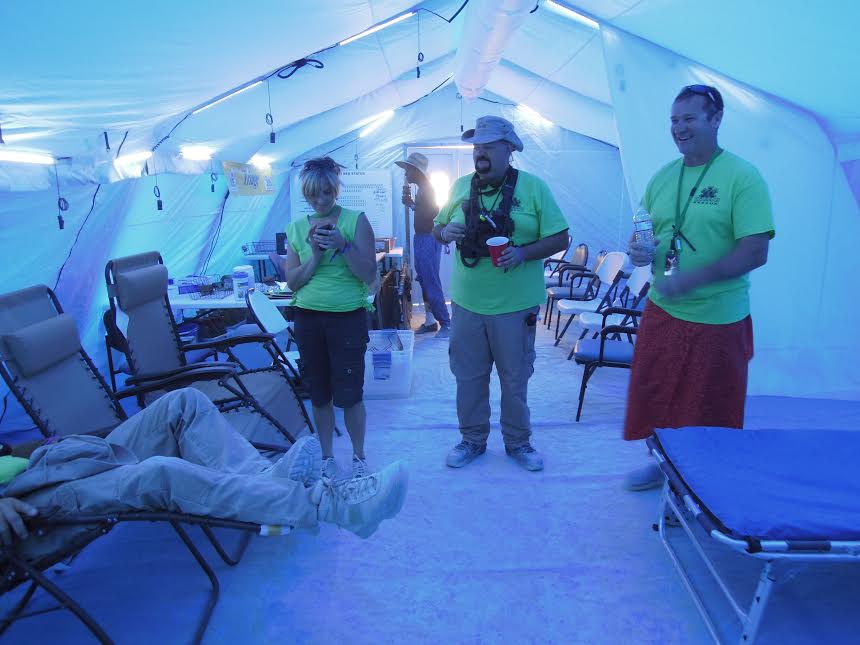
Medical staff at Burning Man contend with a variety of conditions. Photos/Gary Johnson

Medical staff at Burning Man contend with a variety of conditions. Photos/Gary Johnson

By Linda Fine Conaboy

RENO – Burning Man can be the best and the worst experience of your life — “you can die out there.”

Although Gary Johnson, an assistant professor and practicing doctor at UNR Medical School, said this with a bit of a tongue-in-cheek attitude, the doctor in him took over as he listed some of the maladies that have become familiar to the medical team he heads up.

Five years ago, the medical school asked him to become officially involved in Burning Man by providing care administered by UNR medical students; hence his nickname, G-Man or the Dusty Doctor. G-Man refers to his first name.

Even though all of the medical services are free, a trip in a helicopter provided by CareFlight can run as much as $25,000. In the hospital tent, seven doctors are on staff at all times, with nine ambulances at the ready. In 2010, they treated 4,700 people with a few of those triaged to outside medical facilities.

Some of the unique medical problems include what Johnson calls playa foot, a condition that can eat away the skin of the foot, caused by alkali dust. The remedy, he said, is easy and includes washing the feet in vinegar and water followed by lots of lotion.

Tents temporarily secured by metal rebar tend to fly away in the wind leaving the unforgiving rebar exposed. Because of this, many people each year are treated in the medical tents for wounds caused by tripping over it. It’s an easy problem to fix, Johnson said, recommending using tennis balls to cover and mark the exposed menace.

Drugs, especially ecstasy, are wildly available and can cause numerous problems. Burning Man may not be the best place for a first experience with LSD, he added.

The dust, although a vital part of the experience, must be reckoned with. You have to prepare for it, Johnson said, adding that asthmatics are particularly vulnerable in the dust. He recommends ski goggles, masks and even bandanas worn over the face.

Burning Man has become more regulated through the years.

Burning Man has become more regulated through the years.

In his humorous yet serious way, Johnson listed some basic survival tips including good hydration, lubrication and salinization. Wear your vinegar, he said, indicating the importance of the stuff. Stay off trampolines unless you’re 10; bring your own prescription drugs; avoid helicopters; and recreate within your comfort zone.

Surprisingly, despite the news stories that filter out of Burning Man each year, substance abuse-related accidents are much lower than expected—generally only about 2.5 percent of those treated.

With four satellite first aid stations, climate-controlled MASH tents, rehydration stations, X-ray, suturing and casting facilities, a limited formulary pharmacy, a basic lab and even a sanctuary where overwhelmed folks can come to talk out their problems, Johnson said Burning Man is now safer than ever.

For the newcomers, he has a few wise words: Don’t get overly ambitious with your camp; go with experienced people in an established camp for your first time out and perhaps most important, don’t stay too long.

Johnson discovered Burning Man by accident in 1992 when he and some of his Fernley High School friends decided to spend a few days camping on the playa outside of Gerlach.

“It sounded like some satanic thing in the dessert,” he laughed during his recent presentation at Mathewson-IGT Knowledge Center on the UNR campus. But satanic or not, he was intrigued enough to return the following year and said he was “totally welcome.”

Although the history of the massive event has been fairly well told, Johnson succinctly recapped its evolution, which began on Baker Beach in San Francisco in 1986, moved to Nevada in 1990, and each year becomes the state’s fourth or fifth largest city for a few days.

“It was a surreal experience then,” Johnson said. “There were no police. Those were the good old days. Burning Man is not the same as it was.” He said there was lots of sex, even more drugs and the area abounded with an ample supply of explosives.

The population on the playa doubled each year with, in Johnson’s words, weird tents and cars driving everywhere. “Thousands of people were going to the dessert. Lots of problems developed in the early days.”

Perhaps because of a freak accident in the early days—two people were run over in their tent—nowadays, the only motorized vehicles allowed to traverse the area are service vehicles or “substantially modified vehicles with interactive art,” and then, they can only drive 5 mph.

To make getting around in the huge, temporary city easier, a grid pattern was developed and street signs erected. Even with these precautions, Johnson said getting lost amid the dust and total nighttime darkness at Black Rock City is easy. For this reason he recommends carrying a GPS and a flashlight, especially at night.

The place is patrolled day and night by fire and police units. “They’re very serious out there now,” Johnson said. “Now it’s an organized city with an infrastructure and it’s become much more family friendly.”

In 2010, there were 600 registered art cars and 700 officially registered theme camps and villages. All individual camps are encouraged to be visually interesting and interactive; those offering food must be cleared by the health department, and if there’s liquor involved, camp hosts are required to card anyone partaking.

People are dressed up 24/7, although it’s considered tacky for a man to wear a shirt and no pants, he chuckled. Even though all food must be approved by the Pershing County Health Department, gifting is a good thing, he said.

The best part of Burning Man for Johnson is the art. “But the friendly, warm attitude of the people is overwhelming—it’s good. I enjoy the melting pot aspect with so many people from many different countries. It’s truly an international audience, especially among South Africans.”

After all the Burners are finally able to make their way out of the huge traffic jams created by the mass migration of campers heading home, the clean-up crew takes over, sweeping and cleaning the site meticulously. Because there are no trash cans, it’s important to take everything out.

Johnson said for him Burning Man gets better each year. “The early years were a little scary. I loved the freedom, but now, I like the organization.”



Opinion: Government won’t stop disease-carrying mosquitoes

By Kenn K. Fujioka

On Sept. 2, 2011, two employees of mosquito and vector control district where I work told me they had found a mosquito — Aedes albopictus – that had supposedly been eradicated from Los Angeles for 10 years.

Aedes albopictus (“albos” for short) is a mosquito that keeps vector control officers up at night, especially with the attention that mosquito-borne Zika virus is garnering as it moves through Brazil, Latin America, and the Caribbean. Mosquitoes of the genus Aedes, including “albos,” are the ones in the U.S. capable of transmitting chikungunya, dengue, and Zika virus, all of which cause serious human diseases.

Worse, these black-striped mosquitoes are not shy about their love for humans: They prefer feeding on us and bite relentlessly during the day, enhancing the risk that they will spread viruses from the infected to the uninfected.

In 2001, Aedes albopictus, the “Asian tiger mosquito” arrived in California as a stowaway in shipments of popular plants marketed as “lucky bamboo.” Getting rid of that infestation took a massive effort by multiple agencies. Regulations were enacted to ensure “lucky bamboo” was no longer shipped in standing water. For the next three years, no one found Aedes albopictus. We surmised that Southern California’s climate was too inhospitable for Aedes albopictus to easily gain a foothold, and the pressure we exerted on them caused their demise.

We were very wrong.

The genetics of the mosquitoes we collected in 2011 most closely resembled those from south China, where the 2001 infestation originated. Somehow, Aedes albopictus had lived under the radar here for a decade. Surveillance to detect small populations of these mosquitoes is difficult, so by the time we found them in 2011, they had infested a large area.

Because of our relative success in 2001, we started fighting 2011’s infestation brimming with confidence we could wipe them out by spring 2012. Famous last words. When spring came, “albos” emerged with a vengeance. Although we tried everything, Aedes albopictus doubled its range every year after that. We expect to find them in each of the 24 cities in our jurisdiction by the end of 2016. The drought that plagues Southern California will have little effect on Aedes albopictus; they hardly need any water to develop. Even without water, their eggs will remain poised for months, waiting for the next rain to fall.

Toward the end of 2014, the fight against Aedes albopictus took an ominous turn when Aedes aegypti was discovered in Commerce. Now, two of the world’s most infamous vectors were present in L.A. County. Aedes aegypti’s common name, the “yellow fever mosquito” says it all. Its biology is similar to Aedes albopictus, but Aedes aegypti is considered the most versatile vector of all when it comes to transmitting human diseases.

2015 was a banner year for both species of Aedes. By its end, Aedes aegypti or albopictus could be found in 12 counties and 76 cities in California. And Aedes mosquitoes have made themselves quite at home in the southeastern U.S., with a range as far north as Connecticut and the Midwest, and through much of Texas.

The good news: it’s not likely that a widespread epidemic like Zika in Central and South America will occur in the U.S. The viruses are not transmitted when Aedes aegypti and Aedes albopictus stop biting during winter, and the viruses cannot live in hosts other than humans. This means chikungunya, dengue, and Zika viruses must be introduced to mosquitoes each year by infected humans.

Even though the Zika virus is getting the attention, the mosquito-borne virus that we should really worry about is the deadly West Nile virus. Unlike Zika, West Nile virus lives primarily in birds and is continuously present, ready to infect humans. Last year there were 299 cases in Los Angeles County and 22 deaths. These numbers are high—especially for a disease that doesn’t get much press anymore—but there may have been as many as 7,000 cases of West Nile in Los Angeles alone last year, based on statistics from 2015 and the CDC’s estimates of symptomatic illness.

Our biggest challenge will be getting people to change their behavior. No agency’s budget is sufficiently large to hire enough workers to get into everyone’s backyard. We must motivate residents to remove all the sources of water on their property that may produce mosquitoes.

This time, we might get lucky. Californians are not used to mosquitoes, and the ferocious daytime bites of Aedes aegypti and Aedes albopictus will interrupt our famous outdoor lifestyle—making people uncomfortable enough to take action.

Kenn K. Fujioka is the district manager of the San Gabriel Valley Vector Control District and the current president of the Mosquito and Vector Control Association of California. He is a graduate of UCLA.


‘Excessive water users’ fine would elevate drought-shaming

By Alexei Koseff, Sacramento Bee

When Oakland A’s executive Billy Beane found himself on the East Bay Municipal Utility District’s list of its biggest water users in October, he released a statement that he was “more than displeased and embarrassed by the usage” and promised to take “immediate action” to repair irrigation and pool leaks recently discovered at his Danville home.

Welcome to a new era of “drought-shaming.” As California enters its fifth year of a historic dry period and residents buckle down to reduce urban water use by one-fourth, a novel strategy adopted by the East Bay water utility has turned the spotlight on the region’s most wasteful consumers – among them the rich and famous – and could become the basis for statewide policy.

Last month, Sen. Jerry Hill, D-San Mateo, introduced Senate Bill 814, which would require local water districts to set a definition of “excessive water use” and then fine customers by up to $500 for each hundred cubic feet, or about 748 gallons, of water above the limit when the state has declared emergency drought conditions.

Read the whole story


‘Like-farming’ a common scam on Facebook

By Kim Komando, USA Today

Facebook has changed the way people do a lot of things online. For example, you probably notice yourself reflexively clicking ‘like’ on anything your friends post on Facebook, even if it’s just to acknowledge you saw it. Scammers are taking advantage of that reflex for a dangerous scam called “like-farming.”

What is like-farming?

Like-farming is when scammers post an attention-grabbing story on Facebook for the express purpose of cultivating likes and shares. Based on the way Facebook works, the more likes and shares a post has, the more likely it is to show up in people’s News Feeds.

This gives the scammer more eyeballs for posts that trick people out of information or send them to malicious downloads. The big question, of course, is why Facebook doesn’t stop these posts before they get too big. And that’s where the real scam comes in.

Read the whole story