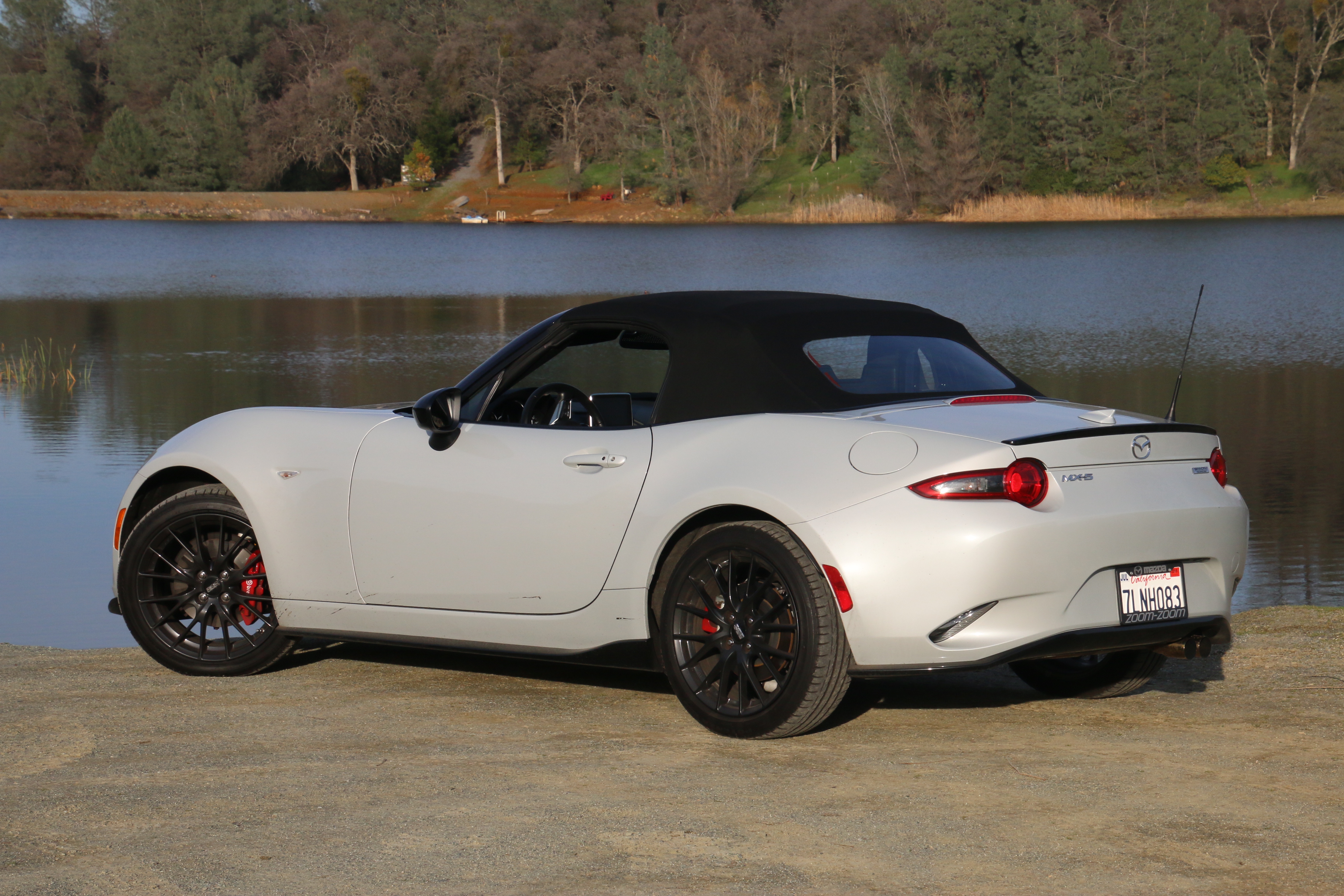
Collection showcases Reagan-Laxalt friendship

Ronald Reagan materials found in the Paul Laxalt U.S. Senatorial Papers, housed in Special Collections & University Archives at the University of Nevada, Reno Libraries, showcase the friendship between the two politicians. “Paul Laxalt’s Reagan Years: Campaigns, Elections and the Road to the White House” is now open for use.

Ronald Reagan materials found in the Paul Laxalt U.S. Senatorial Papers, housed in Special Collections & University Archives at the UNR Library, showcase the friendship between the two politicians.

By Sandra Chereb, Las Vegas Review-Journal

CARSON CITY — Newly released mementos from revered native Nevada son Paul Laxalt offers a glimpse into presidential politics of a bygone era and the close bond the former governor and U.S. senator forged with former President Ronald Reagan.

A collection of letters, handwritten notes, photographs, audio/visual resources and scrapbooks were made available last week to the public through the University of Nevada, Reno’s Special Collections and Archives.

The collection, called “ ‘The First Friend’ of Ronald Reagan,” is an extraction of personal materials donated by Laxalt to the university. The snippets span the years from 1975 through 1987, a time when Laxalt, the son of an immigrant Basque sheepherder, was national chairman of Reagan’s 1976, 1980 and 1984 presidential campaigns.

Jacquelyn Sundstrand, special collections manuscript and archives librarian, said the materials are a time capsule into the politics and issues of the day.

Read the whole story


Pot shop owner buying SLT property

By Kathryn Reed

Tahoe Wellness Cooperative owner Cody Bass and a group of investors are about to be the owners of the property that houses the medical marijuana collective.

Bass is in escrow with Patty Olson, who for years has owned that strip of land in the Bijou Center. The corporation that was formed to buy the parcel is also purchasing the house Olson lived in until earlier this year when she moved to Reno. Bass intends to make it his home.

The building with CVS and other businesses is a separate parcel with a different owner.

“My first goal is I’m to lease the bank space. I want the city to allow me to have 800 more square feet to have the bank vault and more admin space,” Bass told Lake Tahoe News.

El Dorado Savings used to be in that location.

The need for the bank vault is to allow the co-op to be compliant with the law that requires such businesses to have certain vault compliance by 2018. The current vault is not sufficient.

Bass is working with city of South Lake Tahoe officials to make this work. He contends the wellness center is its own business and should be spun off from the co-op. The center is an entity any member of the public may access, while the collective if for people with a prescription.

The spot where Hot Gossip was is vacant. Bass envisions a tenant selling coffee, tea and superfoods going in there. To start with, it will just be beverages. The kitchen needs to be rebuilt.

Originally, an alehouse wanted to lease that space, but Bass believes that would not be a good fit with the co-op in the same center.

Down the road he foresees adding a second floor to the building. Bass’ goal, if construction is in the future, is to have it LEED certified. He believes the city should adopt a policy so new construction conforms to the U.S. Green Building Council’s guidelines.

Bass also plans to hire a security guard this summer to deal with people using his parking spaces when their destination is the nearby beach.


Road beat: Miata good on twisties, not for commuting

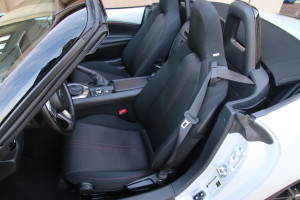
The latest Miata returns to its roots with design and handling. Photos/Larry Weitzman

The latest Miata returns to its roots with design and handling. Photos/Larry Weitzman

By Larry Weitzman and Mitchell Weitzman

It’s hard to believe the Miata has been with us for nearly 30 years. The British-inspired Japanese icon started a revolution in motoring, bringing back raw, driving thrills in a small, lightweight, and most important, affordable package.

Not everyone is a fan of the Miata, it must be said. While some can’t get over its image or lack of power compared to Miatas past, it’s always been respected for its stubbornness to die off. Just when you think the Miata is finished, it gets reinvented again. The new Miata is, quite simply, the best ever and total production for this fourth generation should pass 1 million total production. Additionally, Miatas have become the most raced car in the world with more than 5,000 competing, most of them here in the United States.
Specifications Price $24,915 to about $33,000 plus $820 for the boat from Hiroshima, Japan Engine 2.0L inline four cylinder DOHC, 16 valves 155 hp @ 6,000 rpm     		 148 lb.-ft. of torque @ 4,600 rpm	 Transmission Six-speed manual Six-speed torque converter automatic Configuration Longitudinal front engine/rear wheel drive Dimensions Wheelbase 90.9 inches Length 154.1 inches Width 68.3 inches Height (17 inch wheels) 48.8 inches Ground Clearance (17 inch wheels) 5.32 inches Track (f/r) 58.9/59.2 inches Fuel Capacity 11.9 gallons Truck volume 4.6 cubic feet Turning circle (wall to wall) 32.9 feet Steering lock to lock 2.7 turns Wheels (std/opt) 16X6.5/17X7 inches  Tires (std//opt) 195/50X16//205/45X17 Weight 2,332 pounds Weight distribution (f/r) 53/47 percent Performance 0-60 mph 5.75 seconds 50-70 mph 3.42 seconds (3rd gear) 50-70 up hill (6%) 4.55 seconds Top Speed Estimate 140 plus mph (have ear plugs) Fuel economy EPA rated 27/34/30 mpg city/highway/combined. Estimate 30-32 mpg in suburban driving, 35 mpg in rural driving and 37-38 mpg at 70 mph on level ground.

Specifications
Price $24,915 to about $33,000 plus $820 for the boat from Hiroshima, Japan
Engine
2.0L inline four cylinder DOHC, 16 valves 155 hp @ 6,000 rpm
148 lb.-ft. of torque @ 4,600 rpm
Transmission
Six-speed manual
Six-speed torque converter automatic
Configuration
Longitudinal front engine/rear wheel drive
Dimensions
Wheelbase 90.9 inches
Length 154.1 inches
Width 68.3 inches
Height (17 inch wheels) 48.8 inches
Ground Clearance (17 inch wheels) 5.32 inches
Track (f/r) 58.9/59.2 inches
Fuel Capacity 11.9 gallons
Truck volume 4.6 cubic feet
Turning circle (wall to wall) 32.9 feet
Steering lock to lock 2.7 turns
Wheels (std/opt) 16X6.5/17X7 inches
Tires (std//opt) 195/50X16//205/45X17
Weight 2,332 pounds
Weight distribution (f/r) 53/47 percent
Performance
0-60 mph 5.75 seconds
50-70 mph 3.42 seconds (3rd gear)
50-70 up hill (6%) 4.55 seconds
Top Speed Estimate 140 plus mph (have ear plugs)
Fuel economy EPA rated 27/34/30 mpg city/highway/combined. Estimate 30-32 mpg in suburban driving, 35 mpg in rural driving and 37-38 mpg at 70 mph on level ground.

Surely, you must think, after having the aging period of a $1,000 bottle of Scotch, it must be good. Truth is the Miata started off life as brilliant and then faded to the ranks of good in the midst of its own mid-life crisis, gaining weight and betraying the principles of the original. Luckily, that mid-life crisis has been resolved, as the 2016 has lost its beer belly and updated its wardrobe. It’s also taken dance lessons. So, yes, nearly 30 years has made it the Miata of Miatas.

So, you want some specs then? Try this: trim the weight several hundred pounds down to a lithe 2,300, add a compelling, Skyactiv, small-capacity (2.0) four-cylinder producing 155 HP at a low 6,000 rpm plus 148 pounds of twist at 4,600 rpm, a NASA-precise 6-speed manual, and you get 0-60 in just 5.8 seconds. For the record, the original took about 9 for the same sprint.

Essentially this is the same engine used in the Mazda 3, CX-3 and CX-5. And it is super high tech using direct injection, a sky-high 13:1 compression plus variable valve timing that allows the engine during low loads run as an Atkinson cycle.

But power isn’t everything. This new Miata sips fuel. Rated at 27/34/30, fuel economy is up by 20 percent. Overall, we averaged 35 mpg and 37-38 mpg at 70 mph on the highway. That is almost the same as the super economical Mazda 3 (the 3 returned over 40 mpg on the highway). Brakes are also benchmark stopping the Miata in just 36 feet from 40 mph.

The rear-wheel drive chassis is Nobel Prize winning exhibit in physics and feedback. Climb down into the new, improved cabin featuring far better materials, position yourself firmly in the tight hugging seat with your hands on the finely wrapped wheel and it’s as if you’re connecting your brain and body into the car. All the motions are just that: telepathic. The steering, though now electrically assisted, has real feel and precision and is a quick 2.7 turns lock to lock. Possibly the best EPAS system I’ve tried yet, and far outshining those found on modern BMWs.

Positioned in the center console is a snick-snick 6-speed butter smooth manual. A purist might think driving a car like this with an automatic would render you a heretic. If you have a bad hip, sure, but otherwise get the manual. The way the gear lever passes through each gate into gear is a real thing of beauty. Like a blacksmith forging a sword for a samurai, it’s an art that must not be forgotten.

Speaking of swords and samurai, the whole car looks like it’s shaped by one. Sharp creases sliced down the front and rear flanks with a chiseled front end. Did I mention it’s the best-looking Miata to date as well? It’s a design that oozes star quality and a premium price; such are the intricacies of the design used. Italians take note.

Back on the road though, this is what the thrill of driving is supposed to be. With the top down, wind rustling quietly beside you and exposed to the outside of the world, it feels as one with the road. And while we’re at it, though the top is manual, it can be put up or down in 5 seconds or less each way, it’s that easy. It also helps make this car as light as it is.

Wind up the motor, go through the gears, hit a few apexes and it’s startling to think that some people don’t like Miatas. They clearly need to drive this one. Though not a 300 hp powerhouse, this trick four-banger revs eagerly through each of its six short gears with amazing flexibility as it pulls smartly from 1,500-2,000 rpm in the first four gears. Even on sweeping 50 MPH mountain roads it never leaves you wanting for more power. Third gear rocks.
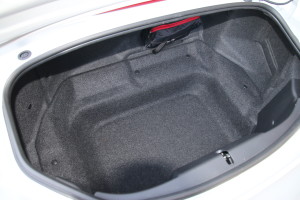
The two-seater even has some truck space.

The two-seater even has some truck space.

Seeing a sign for a 15 mph hairpin clearly illustrates that, as throwing it into second gear allows for easy, deliberate over steer on corner exit, courtesy of the 205/45X17 summer rubber that permits this level of exuberance. What was more surprising was on a left-hander taken at 60, 25 over the posted recommendation. Nearing the exit, aim the nose toward the apex and instantly the back end gave up, requiring a “dab of oppo” and you are on your way again with the power down.

The power doesn’t overcook the tires, but rather the chassis itself broke into a beautiful slide of over steer at the limits of its handling. This is good news and I’ll tell you why. Today, too many cars have too large of tires in the pursuit of ultimate grip. Grip is good; grip is safe. But grip isn’t always fun. Here’s the Miata, showing that smaller tires matched with supreme balance is the most fun way around a corner. Because you don’t have to be going a million miles per hour to push boundaries where things really start to go silly. All of the handling depictions above were performed with the TCS and DSC switched off. If on, the systems intercede with the fun.

So, it’s perfect then? No, not quite. Through 50 miles of winding country and mountain roads it was supremely sublime. But following that up the next day with 200 miles of freeway driving and the memories of sliding quickly fade. With the roof up and at highway speeds (70 mph plus), the noise can be intrusive. It’s might be improved with the top down. Conversations have to be held at higher than normal volumes and the stereo must be turned up halfway for it to be heard, but by then the road noise and music make for a very tiring experience. The seats momma-bear hug that was so welcome before becomes too tight as well. A GT car this is not. The sat-nav and infotainment system is far from the best. And in time of trouble having missed an exit, I found using my phone for an alternate route was easier than trying to make the nav comply.

A base Sport model stickers for $24,915 plus $820 for the boat from Japan. The high end Club Miata lists at $28,600 with its state of the art Bilstein suspension. The Brembo/BBS package adds $3,400 and includes Brembo brakes (calipers and rotors) and gorgeous 17X7 inch wheels pushing the price with the boat ride close to $33 large. That’s a bit more than another driver’s tool known as the FR-S/BRZ, which also require a hacksaw to take the top off. A base Miata is a couple of grand less and you don’t have to buy a hacksaw. However, the go-faster bits are great on the Club such as the hard-stopping Brembo front brakes, but the creature comforts such as the infotainment system can be passed over. The cheapest Miata is the Miata to have. The price of my tester betrays its core value too, of being affordable.

Confusing verdict? Yes, slightly. The new Miata on a good road is an experience worthy of a bucket-list. But at high cruising speeds its lack of comfort is exposed. For those looking for raw, open-top motoring thrills look no further. But if looking for a commuter, I would suggest elsewhere, unless your commute includes Wentworth Springs Road. Don’t get me wrong, we loved driving the new Miata. Just be sure to take the twisty route to work.

Larry Weitzman has been into cars since he was 5 years old. At 8 he could recite from memory the hp of every car made in the U.S. He has put in thousands of laps on racetracks all over the Western United States. Mitchell Weitzman has been around cars most of his life, and has hundreds of hours of lap track experience. He is a recent graduate of UC Santa Barbara, with a degree in English.


STR recyclables take a hit as oil prices drop

By Kathryn Reed

South Tahoe Refuse is stockpiling some of its recyclables in hopes the market changes so the value for them goes up.

Large bales of plastic are worth about $112, while a year ago they went for $230.

“The price we are receiving (for plastic) has significantly dropped – over 50 percent in the last year,” John Marchini with STR told Lake Tahoe News. “How it relates to oil is very specific to plastic. Instead of large companies using pellets from plastic bottles it is cheaper to use oil because crude is low.”

In other words, food products, including bottled water, are being packaged in plastic made without recycled material.

While many consumers are thrilled with the price of oil going down, when it does so it takes the value of plastics with it. After all, plastic is a byproduct of petroleum.

Recycling is a commodities business, and as such is subject to the whims of the market. It’s not just plastic that is fetching a low price, Marchini said it’s pretty much across the board.

“We absolutely hold on to the more valuable material and play the market. It’s similar to someone who plays the stock market,” Marchini said. Aluminum and PET plastic No. 1 are the most valuable.

He said when such fluctuations occur – and they are cyclical, though this is admittedly a huge downward swing – the recycling focus is adjusted. Something like film plastic, which includes the actual blue bag STR customers use for recycling, green-black bags for yard waste, and grocery store plastic bags, become less of a priority.

South Tahoe Refuse has an assembly line for its garbage, with workers plucking recyclables from the debris. When the blue bags are emptied onto conveyor belt all of those goods are recycled.

“The downturn in the economy in China is also affecting our recycling markets because they are the primary buyer for a lot of our materials. All of our junk mail, mixed paper goes to China,” Marchini said.

Less income from recycling inevitably affects STR’s bottom line.

“What happens with recycling revenues is that it all goes back into the operating budget to help eliminate or minimize rate increases,” Marchini said.

The largest recycler in California – rePlanet – had to close 191 recycling centers in the state, including in Placer County. In turn, nearly 300 people lost their jobs.

No jobs at STR have been lost because of the downturn. This is because the company has the same recycling goals to meet. California mandates refuse companies recycle 50 percent of the trash that is collected.

The state is upping that goal to 75 percent in 2020. STR is at about 64 percent diversion rate.

According to the Environmental Protection Agency, 34 percent of waste in the United States was recycled in 2013. This compares to 1990 when 19 percent was recycled.


Opinion: Loop road is essential to South Shore

By Carl Hasty

The South Shore of Lake Tahoe is divided by lines. These state, county, and city lines work well on a map, but they do not define the day-to-day reality of the people who live and work in this community. In the last decade we have seen definitive projects reshape South Shore – Heavenly Village, Lakeview Commons, Harrison Avenue streetscape. We have seen new bike trails and the opening of a bi-state park.

Tahoe Transportation District’s Highway 50 South Shore Community Revitalization Project is the next step. It goes well beyond transportation to building the community we want to live and work in, and like the projects before it, it won’t be easy, but things that matter rarely are. The future potential gains are worth it for our residents, businesses, and visitors.

Carl Hasty

Carl Hasty

We only need look to the North Shore and the success of Kings Beach, the Incline Gateway, and the construction that will start this summer on both Highway 89/Fanny Bridge Community Revitalization and the Highway 28 National Scenic Byway to see the future. By realigning Highway 50 from Pioneer Trail in California to Lake Parkway in Nevada behind the casinos on the mountain side, we open the possibility for a “complete street” transformation to include everyone, not only motorists, but pedestrians, bicyclists, and public transit users.

We open the potential for economic development and business revitalization. We add an avenue to respond to the resident’s housing needs with improved, attractive, affordable, mixed use housing projects to replace the combination of retired housing and business units: 53-97 depending on the chosen alternative.

Highway 50 South Shore Community Revitalization Project has suffered at times from the long shadow of failed projects of the past. Many have asked if this project is doomed to repeat the mistakes of its predecessors. The answer is no.

We have learned and listened. Since January 2012, public comment has been garnered through a series of 140 community open houses and workshops, service club presentations, business and community review committees, and eight City Council presentations.

South Shore community members know what they want:

·       A more attractive community to complement the surrounding mountains and lake;

·       Less traffic congestion and environmental impacts — a previous study indicated that 70 percent of the pollutants impacting Lake Tahoe’s clarity come from transportation systems and developed area run-off;

·       Economic improvement and health with opportunities for businesses large and small to flourish;

·       Safer streets and more walking and biking paths;

·       Better and affordable housing for our workforce.

The community also has concerns:

·      The construction will take away businesses and homes that will not be replaced for years;

·      It will cost the city taxpayer revenue and it will disrupt businesses and the community like past project holes;

·      Other areas of the city need attention.

All of these are legitimate concerns, but there are solutions. This project can be done in phases. Rights-of-ways can be acquired without tearing down structures. Replacement housing could be completed before the current infrastructure is demolished, thus ensuring no lax in property tax revenues for the city and minimal disruption to the community as possible. Do other areas need attention? Yes. This project is just one in a string of projects working to improve South Shore.

From where will the funding for this bold, new South Shore be derived? Federal and state funding will make up the bulk with private sector and some local government funds from Douglas County. We are not looking to the city of South Lake Tahoe to finance this project.

Will everyone support this project? No. In fact, some people would rather put this to a vote. They would abandon the public project process that has directly shaped this plan to date. Others think since the current infrastructure works for them, why do anything at all? Yet, there is a cost to doing nothing. The community can’t afford to paralyze the positive momentum that’s been moving South Lake Tahoe forward these past few years as a more desirable community to live and visit.

The “Nevada versus California,” “big versus small” contention is a non-starter and a red herring. It’s long gone, overplayed, overdone and divisive. This community depends on each other. This project is about the entire South Shore and what locals want in their future. It’s a catalyst and one in a series of transportation enhancements to create a connection system not only for South Lake Tahoe but the Tahoe Basin.

The five alternatives for Highway 50 are currently undergoing an environmental impact report on the environment, costs, benefits, and concerns. Public comment will be accepted for 60 days after the draft is released. We are going to take the next couple of months to continue to work with the community and business owners to address these concerns.

We welcome the public’s opinions – as we have the past four years. These proactive opinions and suggestions have guided and impacted this project in a positive way.

Examples of the benefits of “complete street” projects like this one can be found across the United States, and in cities and towns comparable to South Lake Tahoe. This is not speculative. This is fact.

Is this going to be hard? Yes. Is this going to be smooth? No. Will it be worth it? Absolutely, and with community involvement we can accomplish it.

Be a part of the continued renaissance of South Shore and get involved. Your time will help shape our collective future.

For more information, go online.

Carl Hasty is district manager of Tahoe Transportation District.


How exercise may lower cancer risk

By Gretchen Reynolds, New York Times

The relationship between exercise and cancer has long both intrigued and puzzled oncologists and exercise physiologists.

Exercise is strongly associated with lowered risks for many types of cancer. In epidemiological studies, people who regularly exercise generally prove to be much less likely to develop or die from the disease than people who do not. At the same time, exercise involves biological stress, which typically leads to a short-term increase in inflammation throughout the body. Inflammation can contribute to elevated risks for many cancers.

Now, a study in mice may offer some clues into the exercise-cancer paradox. It suggests that exercise may change how the immune system deals with cancer by boosting adrenaline, certain immune cells and other chemicals that, together, can reduce the severity of cancer or fight it off altogether.

Read the whole story


Young skiers draw closer after death of friends in avalanche

By Pat Graham, AP

Erik Arvidsson and four of his ski team buddies crammed onto the tiny podium in Sochi, Russia. He was the newly crowned world junior downhill champion, yet they all celebrated as if they earned a piece of the gold medal.

They laughed. They held up their index fingers to announce, “We’re No. 1.” They posed for picture after picture.

Only something was painfully missing from the scene: Bryce Astle and Ronnie Berlack, two skiing prospects who were killed in an avalanche in Soelden, Austria, in January 2015.

Arvidsson also was caught in the slide that day and escaped. So did Drew Duffy and Addison Dvoracek.

Why them? It’s a question they’re making peace with through the support of Astle’s and Berlack’s parents. Their coaches and teammates, too.

A tragedy has bonded this young squad — the next generation of American racers — even tighter together.

“Every day, when I look at a course or the hill, I find something that I know one of those two guys would be psyched about,” said Arvidsson, 19, who won the world junior downhill title last week on the same venue as the 2014 Sochi Games. “We’ve been through something traumatic together. We lean on each other. We hold each other up.”

It remains difficult for Arvidsson to talk about the avalanche. For a harrowing moment, he was stuck in the path of the rushing snow. Somehow, he was able to make it off to the side.

All the support has helped.

“It’s definitely still a struggle,” said Arvidsson, who’s from the San Francisco area and grew up skiing in Squaw Valley and Bear Valley. “But their parents were like, ‘Guys, I know this is hard and this feels hard, but I definitely promise you that to live out their legacy is to keep going every day.’

“I think about them in every moment. I think about them when I’m skiing. I think about them when I’m hanging out with my friends. I think about them when I’m (racing). That makes me happy and hopefully that makes Bryce and Ronnie happy.”

This is how much Astle and Berlack mean to this team: They were named to the squad this season. During a ceremony in November, family and friends gathered in Copper Mountain, Colorado, to remember the talented duo. Berlack’s ashes were spread along the course at Copper’s speed center.

They told stories — lots of stories. Some were skiing related (“Ronnie was sure of what he wanted and he wasn’t afraid of talking about it,” Arvidsson said), but most were a stroll down memory lane (Olympic and slalom world champion Mikaela Shiffrin recalled Berlack giving her a rainbow-colored hair tie as a Secret Santa gift).

To honor his friend, Dvoracek wears a necklace with a pendant containing some of Astle’s ashes. Arvidsson has stickers with the initials “BA” and “RB” plastered on his ski helmet (“Every single time I put on my helmet, I look at that,” he said).

And Duffy had a teammate paint the initials on the front of his helmet, along with the slogan “Fly On.” The back of the helmet features the tongue and lips logo of the Rolling Stones, Berlack’s favorite band. Next to it is Astle’s favorite mantra: “Good vibes only.”

Duffy was given a jacket by Berlack’s father that Berlack used to wear featuring the Rolling Stones logo. Duffy wore it on the podium when he won the super-G at the U.S. Alpine championships last spring.

“Two summers ago, we were all really close — just a good group to hang out with,” said Duffy, 20, of Warren, Vermont. “We were friends in training, friends just hanging out. After January of last year, it was tough for all of us. But it brought us together.”

The tight-knit crew also includes Sam Morse and Patrick Kenney, along with Kipling Weisel and newcomer Florian Szwebel. They do quite a bit together, from dinners to mountain biking to pickup basketball games to playing hockey.

Recently, the group was in Lake Placid, New York, for a NorAm race and checked out the rink where Team USA memorably upset the Soviet Union on its way to a gold medal at the 1980 Winter Olympics.

The closeness of Mike Eruzione & Co. inspired them. The racers carried that sort of camaraderie with them to Sochi for the junior world ski championships. For inspiration going into the downhill race, they played an audio clip of coach Herb Brooks’ speech before the “Miracle on Ice” game.

Arvidsson went out and captured downhill gold. It was part of a banner day for the Americans, who placed four in the top 10 — the first time that’s happened for the U.S. at world juniors.

“Since the passing of Ronnie and Bryce, I’ve spent a lot of time with this group,” U.S. men’s coach Sasha Rearick said. “They push each other. They joke around. They challenge each other. It’s one of the coolest groups I’ve ever had a chance to be around.

“I’m very encouraged with their ability to bounce back from such a tragedy.”

Whether it’s in the starting gate or just enjoying a day on the slopes, Arvidsson constantly thinks about Astle and Berlack. Same with Duffy.

“I know that those guys would want us all to keep doing what we’re doing — go fast every day,” Duffy said. “That’s what they would’ve done. That’s what they would’ve wanted us to do.”


Skiing, dinner and movie all in 1 event

Tahoe XC Ski Area, Tahoe City Winter Sports Park, Zia Lina and Tahoe Art Haus Cinema are teaming up to bring for an afternoon of skiing, dinner and a movie.

The March 13event starts off with skiing (2:30-4:45pm) at the Tahoe City Winter Sports Park; includes free XC ski trail pass and/or sledding pass with saucer. Sports Park activities include challenge stations and games to complete while traveling along the 3K trail on snowshoes or XC skis. Then ski over to dinner at Zia Lina, which includes soup/salad or pizza/pasta for adults; one course for kids (first seating at 5pm, second seating 7:30pm). This is followed by a screening of the new ski jump movie “Eddie the Eagle” at the Art Haus (first screening 5pm, second screening 7:30pm).

It’s possible to opt for movie first and then dinner.

Cost is $39 for adults and $21 for kids. Go online to make a reservation.


Storms filling up waterways throughout Calif.

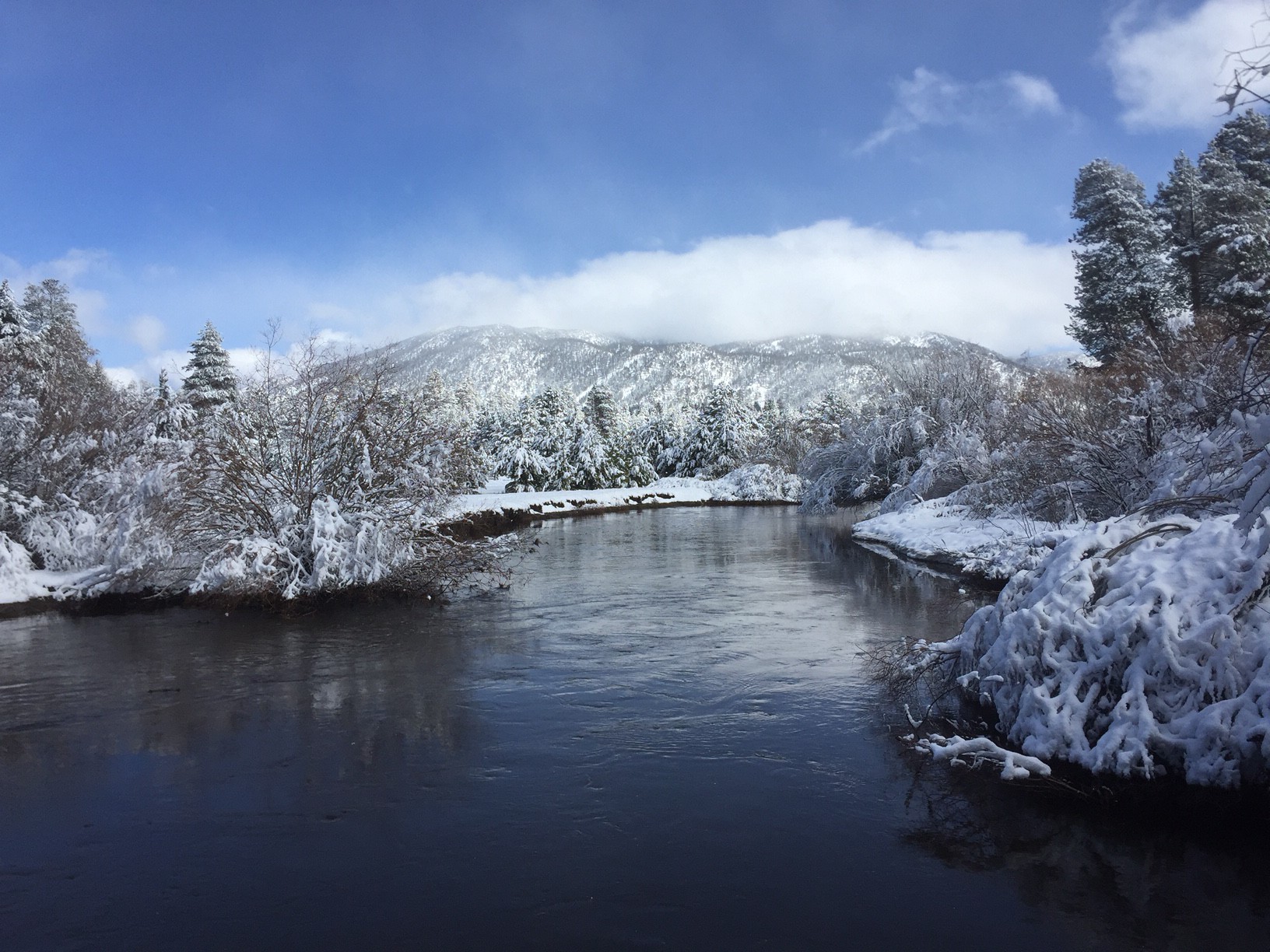
The Upper Truckee River on March 6 is higher than is has been in years. Photo/Kathryn Reed

The Upper Truckee River on March 6 is nearly full. Photo/Kathryn Reed

By Paul Rogers

This weekend’s soaking rains delivered just what drought-weary Northern California needed: billions of gallons of water pouring into the state’s major reservoirs — and more predicted for later this week.

With rain totals reaching 10 inches or more in some mountain areas, 46 of the largest reservoirs in California, closely tracked by the state Department of Water Resources, collectively added 391 billion gallons of water between Friday and Monday morning — enough for the needs of 6 million people for a year.

The reservoir list, which includes such massive lakes as Shasta, Oroville, Folsom, San Luis and New Melones, jumped in storage by 10 percent to 13.2 million acre-feet, as powerful storms pouring off the Pacific sent torrents of water surging down creeks, rivers and hillsides.

Even with that increase, however, the 46 reservoirs bumped up from 66 percent of their historic average on Friday to just 72 percent now. Like somebody with a badly overdrawn checking account, California’s lakes need a continued infusion to get back to normal.

Read the whole story


El Dorado County man confesses to 2006 murder

Nearly 10 years after shooting a man to death in El Dorado County, Eric Mehlmauer this month admitted to having committed the crime and will be going to prison for 10 years.

Tobias Kaiser and Mehlmauer were roommates in Fair Play. They were arguing about the theft of personal property that escalated into the shooting on Nov. 30, 2006. According to the El Dorado County District Attorney’s Office, the two “had a history of bad blood stemming from an illegal marijuana cultivation scheme that failed to produce expected profits.”

Investigators said Mehlmauer and several accomplices put Kaiser’s body inside a metal tank, welded it shut, and then buried it on the rental property.

The missing person investigation soon turned into a homicide investigation when a confidential witness and other evidence came to light, investigators said. But the case got cold quickly when no body was could be located.

The cold case detectives resurrected the case in 2014, which led to the arrest of Mehlmauer and an accomplice on Jan. 15, 2015. Kaiser’s body was recovered March 27, 2015.

On March 4, 2016, Mehlmauer pleaded guilty to voluntary manslaughter and admitted to a special allegation that he used a firearm in the commission of that crime. El Dorado County Superior Court Judge Ken Melikian sentenced him to 10 years in prison.

— Lake Tahoe News staff report