Opinion: Being prepared for a hospital visit

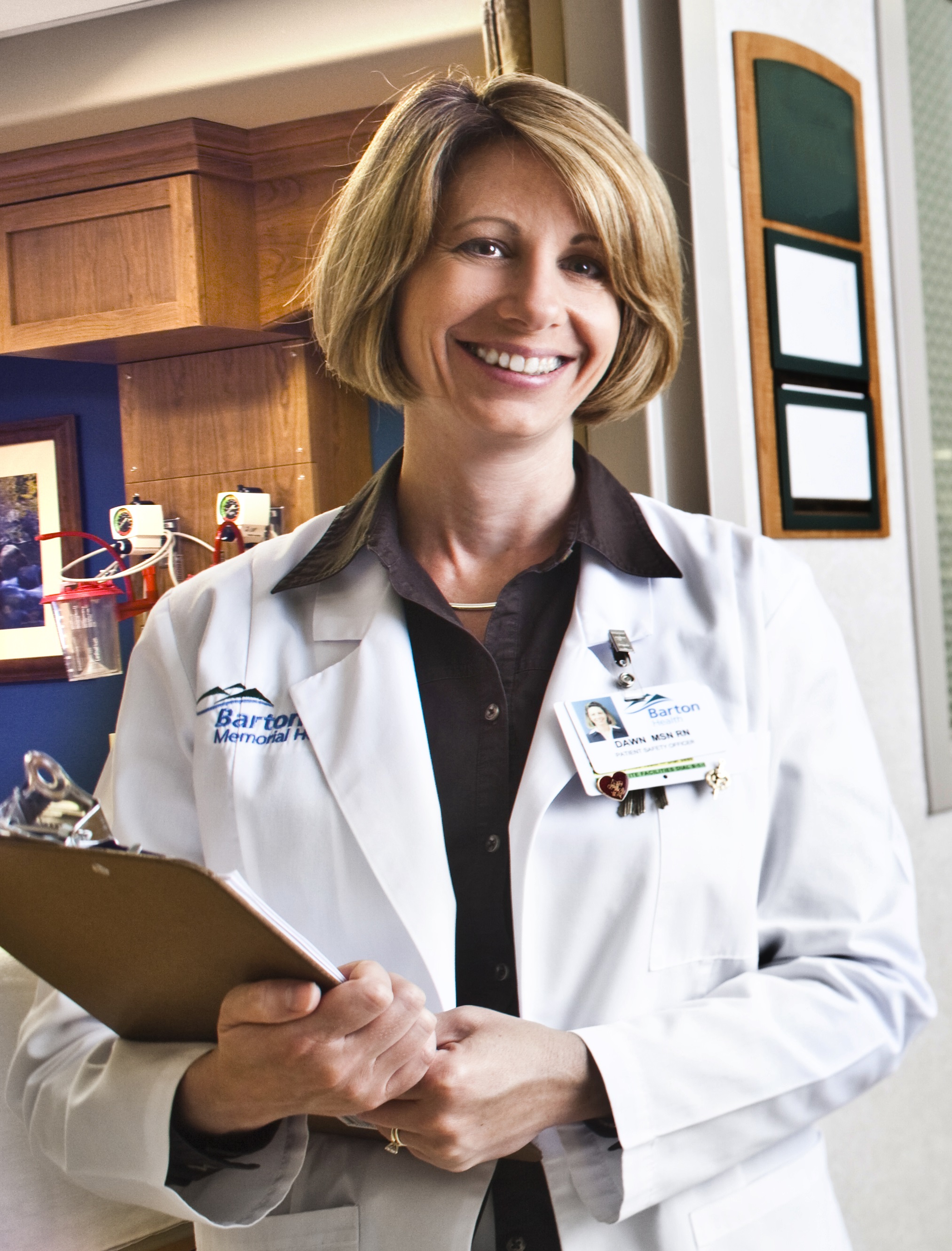
By Dawn Evans

At Barton Health we strive to provide consistently exceptional care for our patients and their families. But what can someone do before a hospital visit is needed or after being released?

Dawn Evans

Dawn Evans

Here are some safety tips to help you and your loved ones stay safe, healthy, and out of harm’s way.

  • Focus on balance
    More than a third of adults over age 65 fall each year. Injuries from falls can lead to broken bones, bleeding, and even death.

What can you do?

·         Improve your balance with exercise. Yoga, cardio activity, and strength exercises help build muscles, activate your core, and improve balance.

·         Have your eyes examined regularly and wear corrective glasses or contacts as prescribed.

·         Remove any hazards in walkways.

·         Be aware of the side effects of medications.  The risk of falling can increase by three times with certain medications.

  • Know your meds
    Medication errors occur when the wrong medication or correct medication with the wrong dosage are taken. Every year, more than 1.5 million Americans receive the wrong medication, the wrong dose, the wrong form (for example, taking a pill rather than liquid), or take their medication at the wrong time.

What can you do?

·         Fill your prescriptions at one pharmacy. Pharmacists are trained to look for drug interactions.

·         Tell your pharmacist all the medications, over-the-counter medications, vitamins, herbals, and nutritional supplements you take.

·         Know what medications you take and why you take them. This includes prescriptions, over-the counter medications, and other vitamins or supplements.

·         Keep a list of the medications you take.  Bring it to all medical appointments and have ready if you are admitted to the hospital.

  • Become a patient advocate
    You are your best advocate when it comes to patient safety. Your healthcare providers want you to speak up and ask questions.

What can you do?

·         Write down questions before your appointment. It’s easy to get nervous and forget what you want to ask.

·         Bring a loved one with you to your appointment. This person can recall and confirm what you heard.

·         Become a member of the Patient Family Advisory Council. Advisors represent patients and families of patients that receive care at Barton Hospital. They work closely with hospital doctors, nurses, and administrators to help improve the quality of care for all patients and family members.

March 13 to 19 is the National Patient Safety Awareness Week. For more information about joining the Patient and Family Advisory Council, call 530.543.5537.

Dawns Evans is the patient safety officer at Barton Memorial Hospital. 


Inroads being made into Alzheimer’s, ALS

By Linda Fine Conaboy

RENO – To claim that ethnobotanist Paul Alan Cox has discovered a cure for ALS, sometimes called Lou Gehrig’s disease, Alzheimer’s and other neurodegenerative conditions would be a wild stretch of any imagination; but to say he and his team could be close is spot on.

It is estimated that every day an average of 15 people are diagnosed with ALS — more than 5,600 people per year. As many as 30,000 Americans may currently be affected by it. Annually, ALS is responsible for two deaths per 100,000 people.

Paul Alan Cox

Paul Alan Cox

Add to that the estimated 5.3 million Americans who have Alzheimer’s; this becomes a huge medical dilemma.

“ALS is a terrible disease,” Cox said during last week’s lecture at UNR’s College of Science 2016 lecture series. “Stephen Hawking can now only move his eyebrow. And no new drugs have been discovered to treat it since 1994.”

Alzheimer’s, he continued, is one of the top 10 causes of death. “There have been 455 clinical trials of Alzheimer’s drugs,” the doctor said. “They all failed. It’s time to start thinking outside the box.”

And that’s what he’s doing in his small lab, the Jackson Hole, Wyo.-based Institute for Ethnomedicine where he’s been working to discover new cures from plants and where he and his colleagues are studying the results gathered from people in remote Pacific Island villages that have high incidences of ALS and Alzheimer’s.

“We started looking at populations of people who have these diseases—up to 25 percent have died of ALS—it has killed a quarter of all the village adults,” Cox said.

What they discovered is that cycads, plants found in tropical and subtropical regions, produce neurotoxins called BMAAS, substances that are poisonous or destructive to human nerve tissue. These substances are found in the plants’ seeds. For years, people have eaten the seeds, usually in the form of flour dumplings, a food popular in the region.

The indigenous people also like to eat flying foxes, who also find the cycad seeds tasty, resulting in still another dose of lethal neurotoxins, hence, the overwhelming incidence of ALS and other diseases.

Cox also learned that in certain areas around Lake Michigan, these same neurotoxins flourish. Armed with their discoveries, Cox and crew began studying the results in earnest. There’s a sense of urgency to his studies, he said during his lecture. “People just don’t have time to wait.” He added, “I focus on patients, not profits.” He also said he targets cures and prevention rather than symptoms.

As he delved into his research, he decided perhaps there are areas in the world that are free of these neurodegenerative diseases. A remote area in Japan yielded such a place.

“The people here live very long lives. Nobody wears glasses and they have total recall even at 104-years-old. The median age is 86,” he said.

The key to the longevity turned out to be seaweed containing a substance called L-serine, a plant Cox called an environmental trigger.

Internet research shed more light on L-serine. In an interview, Cox said that laboratory experiments showed that the seaweed substance can block BMAA (the substance found in the Pacific Islanders) from entering body proteins thus preventing the tangles found in the brains of those with Alzheimer’s.

Based on the findings, the Food and Drug Administration granted permission for human clinical trials on L-serine in Alzheimer’s patients. With trials nearly complete, patients tolerated the oral doses well, although no conclusions have been reached.

During the lecture, Cox called the findings “breaking news” in ALS and Alzheimer’s. “We discovered that L-serine in animals produced an 85 percent reduction in Alzheimer’s. It is my hope that everybody can jump on this,” he said.

Over the years, Cox has received numerous awards, including prizes for his efforts to preserve Samoan rainforests. Of the people living in those forests, he said, “We must ensure equitable return to indigenous people. We guaranteed an equitable sharing of results to those countries losing their rain forests so quickly. We must form profitable partnerships for them so they will continue to cooperate with us.”


Letter: Loop road may not be best for SLT

Publisher’s note: This letter was sent to the South Lake Tahoe City Council and city manager. It is published with permission.

Dear Mayor David, Council Members, and City Manager Kerry:

Once again, thank you for your work and service to the people of South Lake Tahoe. I know that you all want to do what you think is best for South Lake Tahoe.

Dave Jinkens

Dave Jinkens

I am again writing to you as a resident of the city regarding the proposed loop road. The comments and suggestions below are mine alone are not intended to reflect the opinions of organizations of which I am a member. I write once again because specific answers to important questions I and other concerned residents have raised on this matter in the distant past and recent past have not been answered. While pundits in favor of the project exhort its virtues in the media, sound and informed public policy decisions in favor or against the project cannot be made without these answers.

The City Council needs accurate and complete information about the cost and the environmental and financial impact of the proposed loop road before you are asked to make a decision. Residents of South Lake Tahoe need and deserve the same information so that they can make an informed judgment on the benefit of the project and how it might affect them. While we have some answers after three years of asking for them, and this is good thing, there are important questions remaining.

In addition, some government officials have recently said that there is little city government can do to decide the fate of the loop road, because the Tahoe Transportation District (TTD) is a separate legal entity. I beg to differ, and I will explain why below.

Important outstanding questions remain

1. Impact on existing city residents and businesses: Loop Road proponents and TTD officials say that hard-working city residents displaced by the destruction of their homes will be helped to find new housing somewhere and that new affordable housing will be constructed for them. The remainder questions are: who will build the housing; when will it be built; where will it be built in the city limits; how will it be financed; and what are the guarantees, not just promises, that it will be built? As you know, affordable housing for working families is a scarce commodity in South Lake Tahoe and many working people already have trouble finding affordable housing.

2. Economic impact of the project on existing businesses in the city and the city economy: The June 7, 2013, Economic Analysis of the US 50/South Shore Community Revitalization Project prepared by EPS is cited by TTD officials as proof that there is substantial benefit to the city economy from the project. However, the analysis did not go far enough. This is not the fault of the EPS, a respected California economic firm. It is because the firm was not tasked by TTD to do a broader and more complete study of the economic impact of the loop road and the attendant development it will support in Nevada on the business community in South Lake Tahoe as a whole.  Will the Highway 50 realignment and the linked new Nevada development grow the total economy of the South Shore or will it simply shift business from the California side to Nevada? We do not know, and we need to know the answer.

An expanded study by EPS should and could be done at a cost of about $60,000 so that we know the positive and negative impacts of the loop road on South Lake Tahoe. After we have these answers we can then determine how and if negative economic impacts on the entire city business community can be eliminated. Concerned citizens and business organizations examining this proposed project have been asking for this vital information since early in 2013 — March 2013 to be exact. Had this expanded study been done, then we would not still be asking for it. As you might agree, spending $60,000 to get answers on a proposed $100,000,000 loop road is a prudent investment.

Loop road advocates and proponents say that we are one South Shore, and while we are in spirit and we should cooperate and collaborate when possible, we live in two very different states with very different revenue streams, taxes, and business opportunities. I always wish our Nevada neighbors and friends success, but I want projects they propose to be in the best interest of the people of South Lake Tahoe if they want our support and our land to build the realignment of Highway 50.

3. Promises made and how they will be kept: As we learned painfully with the convention center project, developers and proponents make promises that sometimes they can’t or won’t keep. Sometimes projects go bankrupt. Sometimes not all of the promises are known by public officials. The questions are what are those loop road promises made to affected residents and businesses owners and operators in the path of the road to co-opt them into supporting the project, how will these promises be kept, and what guarantees/promises/assurances and binding agreements have been made that will be kept? The general public and public officials need to know the full and complete story in advance of a vote on the project. Let’s not have another hole in the ground and painful results and disappointments it created.

What is city government’s role and what can and should it do?

Contrary to what some public officials have recently stated, city government has an important role in determining whether the loop road is built in the city limits,  and it has many options it can take in regard to the  proposal. While it may not be necessary or even desirable for city government to take all of the actions below, it is possible that they could do so if regional and/or state agencies try to force a loop road on the city of South Lake Tahoe. We have learned from hard lessons of the past. Let’s not make the same or similar mistakes.

·      The City Council will be required to accept the dedication of a street now part of Highway 50 if the highway is relocated. Dedication of the street is part of the entire project and thus the project needs City Council approval.

·      The City Council and Planning Commission must find that the project is consistent with all elements of the city’s adopted General Plan and make factual findings in this regard including a finding that it consistent with the City’s Housing Element (a part of the General Plan) and state law.

·      The City Council has a responsibility and arguably a duty to ensure that existing affordable housing in the city limits is not eliminated by a loop road unless replaced with affordable housing in the city limits for those displaced. The guarantees must be firm, backed up with real money, and enforceable.

·      The City Council can affirm once again that it will not use its power of eminent domain to acquire title to land needed to build the realigned highway and that it will oppose the use of eminent domain by any other public entity. (Note 1).

·      The City Council should insist and require that a complete, comprehensive and independent economic analysis be undertaken to determine the fiscal impact of the Project that will serve new developed areas in Nevada be evaluated on a citywide basis. An updated EPS study as described previously is essential and must be done.

·      The City Council could initiate legal action to prevent TRPA and/or TTD from building the highway unless its information and guarantees are met.

·      The City Council could oppose federal and state funds being allocated for this “community displacement” project unless its requests are met.

·      The City Council could join in these actions with STPUD to oppose the project and litigate the issue if STPUD is required to relocate utilities to a realigned road costing millions of dollars that will be borne by city taxpayers.

·      The City Council could on its own amend the General Plan to eliminate the loop road; however, this approach could take some time and require at least an environmental assessment to be prepared.

·      The City Council could decide on its own volition to place the measure on the June or November ballot without the need for an initiative to be circulated. A general plan may be amended by initiative. (See DeVita v. County of Napa, 9 Cal. 4th 763, 777 [1995]). It is not clear that an initiative by the people amending the general plan requires and EIR. Placement on the June ballot would be the best course and cost less because of the June primary election.

·      The City Council can and should insist that all guarantees, and promises made to property owners and residents be made public and that a comprehensive financial impact analysis be completed and available to the public before any action on the project is taken by any agency.

·      The City Council could vote and direct its representative on TRPA and TTD to oppose the project if it comes up for a vote. The council has the power to so direct its representatives.

·      The City Council could request its county supervisor or her alternate to oppose the project at TTD and TRPA unless its demands and requests are met.

·      The City Council must be given sufficient time by TTD to get answers to the questions and concerns presented herein before moving forward with Project approvals or City government can and should oppose the project outright including ways defined in this letter.

Conclusion

As a resident of South Lake Tahoe, I want our City Council and city staff to have the best information possible about the loop road before any decision is made about it. I want a bright future and opportunity for all city residents and all existing businesses in town. City officials should insist that TTD and regional officials provide the requested information before actions are taken on the loop road. I remain proud of our Nevada neighbor’s efforts to improve their community. I want them to be successful. I just want to be certain that what they are proposing and asking for city cooperation does not harm South Lake Tahoe.

Best wishes and regards. I would like to see a positive outcome for all parties in this matter on the basis of mutual interests and respect. Cooperation, collaboration and respect are the keys. I am available to help in whatever way I can to see an amicable resolution.

Sincerely,

Dave Jinkens, South Lake Tahoe

Note (1) Eminent domain is the power of local, state, and federal government agencies to take private property for public use so long as the government provides just compensation. Arguably, while there are some public benefits to the proposed Project, the proposed Highway 50 realignment is designed mostly to serve a private purpose for property development in Nevada.

Science helps people ride a bike the right way

By Christopher Ingraham, Washington Post

About 94 percent of American adults know how to ride a bike, according to an August 2013 YouGov survey. Once you learn how to ride one, you probably never forget (thanks, muscle memory!). But most of us probably don’t think too hard about how we actually ride a bike — how we hop on board and get our balance and start pedaling away.

If you were a professor of mechanical engineering, you might say that “the control strategies humans employ to balance a bicycle while riding are not well understood.” That’s the question that motivated Stephen Cain and his colleagues at the University of Michigan Ann-Arbor to figure out what separates novice bike riders — those folks you see wobbling uncomfortably down the street on a CitiBike — from the more skilled riders who go whizzing past them.


In a piece for the Conversation, Cain describes the experiment: “We conducted our experiments in a motion capture laboratory, where the riders rode a typical mountain bike on rollers.” Think of rollers as a low-tech treadmill that you can put a bike on. “They require a bicycle rider to maintain balance by pedaling, steering and leaning, as one would outdoors,” Cain writes.

Read the whole story


‘The Horse’ exhibition makes final stop in Reno

By Jenny Kane, Reno Gazette-Journal

Worldwide, horses have played an important role in wars, sports and agriculture.

In Nevada, they have helped to deliver mail on the Pony Express trail, they have riled the crowds at the rodeos, and they have changed the landscape of our high desert hills.

The Nevada Museum of Art’s newest exhibition: “The Horse,” focuses on humans and their relationship with horses from a natural history angle. The exhibition, which opened Saturday, will last through July 3 in the John Hawley Olds LaGatta Gallery and the Robert Z. Hawkins Gallery.

“If there’s one place to learn about horses and what they mean to our civilization, this is where you should go,” said JoAnne Northrup, director of contemporary art initiatives at the Nevada Museum of Art.

Read the whole story


Justice Dept. warns local courts about unlawful fines, fees

By Matt Zapotosky, Washington Post

The Justice Department is asking local courts across the country to be wary of how they slap poor defendants with fines and fees to fill their jurisdictions’ coffers, warning that such practices often run afoul of the U.S. Constitution and have serious real-world consequences.

In a letter that was sent Monday morning to the chief judges and court administrators in all 50 states, Vanita Gupta, the head of the department’s Civil Rights Division, and Lisa Foster, director of the Office for Access to Justice, wrote that illegal enforcement of fines and fees had been receiving increased attention in recent years, and the Justice Department had a “strong interest” in making sure the rights of citizens were protected.

“Individuals may confront escalating debt; face repeated, unnecessary incarceration for nonpayment despite posing no danger to the community; lose their jobs; and become trapped in cycles of poverty that can be nearly impossible to escape,” Gupta and Foster wrote. “Furthermore, in addition to being unlawful, to the extent that these practices are geared not toward addressing public safety, but rather toward raising revenue, they can cast doubt on the impartiality of the tribunal and erode trust between local governments and their constituents.”

Read the whole story


Snippets about Lake Tahoe

sierra club·       The next Tahoe Area Sierra Club meeting will feature Virginia Chandler talking about her time in the Peace Corps in Mongolia and Grace Anderson speaking about her hike on the Haute Route through the Alps. The free talk is March 24 at 7pm at Unity of the Lake, 1195 Rufus Allen Blvd., South Lake Tahoe.

·       Loren Holt is now administrative manager for North Tahoe Public Utility District.

·       From April 8-10, the URN Nevada Chamber Opera will stage the world premiere production of “The Big Bonanza,” an American opera about the Comstock Era.

·       Officers from Truckee police and the local CHP office will take on the Truckee High School boys varsity basketball team at the school on March 18 at 6pm. Proceeds benefit the team and Sober Graduation. Cost is $5.

·       Courtney Walker has been hired as Douglas County’s stormwater program manager.


Why Reno Aces doesn’t have bat girls

By Mark Robison, Reno Gazette-Journal

Why are the Reno Aces seeking bat girls but not bat boys?

Short answer: Hiring 16-year-old girls to work around adult men in a locker room would not be appropriate.


A bat boy for a minor league team has many more duties than is what are seen by fans.

“They have pre- and post-game locker room duties which include all that may be seen in a male adult locker room,” said Reno Aces President Eric Edelstein. “That’s why it has to be different [regarding gender]. Typically, the work is done by someone with an eligible age of 16 but not an adult.”

Read the whole story


SLT museum to share inside treasures

Archivist and sleuth Marilyn Long will be leading guests through the mysteries of the Lake Tahoe Museum collection.

The event is March 22 at 2pm at the South Lake Tahoe museum.

To reserve a spot, call 530.541.5458 by March 19. Leave your name, phone number, and number guests attending. You will receive a return phone call to confirm your reservation.

Cost is $3 for historical society members and $5 for others.


Bookmakers flummoxed by Oregon No. 1 seed over Michigan State

By Case Keefer, Las Vegas Sun

The first upset of the NCAA Tournament took place days before the games tipped off.

The tournament’s selection committee deemed the team leading most Las Vegas betting boards in odds to win the national championship over the last few weeks unworthy of a top seed.

Despite almost all projections indicating the contrary before the selection show, Oregon beat out Michigan State to join Kansas, North Carolina and Virginia as the No. 1 seeds.

Read the whole story