Nevada economy draws a winning hand

By Jeff Daniels, CNBC

Nevada’s economy is on a roll, winning business from other states and attracting more jobs. It marks a significant turnaround from just after the nation’s financial crisis, when it looked like the party was finally over for Nevada after years of heady growth.

Fast forward to today: Nevada’s jobless rate is at the lowest level in about eight years. And experts say there’s more stability in the Las Vegas housing market heading into spring buying season.

“It feels healthier than it has been in a real long time,” said Bill Lerner, co-founder of Union Gaming Group, a Las Vegas-based boutique investment bank. “The roads are busier, the restaurants in the local markets and in and around the Strip are busier. There’s more development, both residential, office, commercial and retail.”

Read the whole story


Opinion: Tahoe ahead of the game at landscape level

By Joanne Marchetta

Restoring and conserving our environment at Lake Tahoe means setting our aspirations at the right scale. That’s what TRPA and many partners are working to do through strategic initiatives to ensure the health of our basin’s forests, streams, and lake, and to improve our communities and transportation infrastructure.

Regions around the world are now working to conserve natural resources and ecosystems at the landscape level, not the political boundary level. That includes Chesapeake Bay, Puget Sound, and the Great Lakes; large, complicated watersheds whose conservation requires multiple jurisdictions working together.

Joann Marchetta

Joann Marchetta

We are fortunate that trailblazers in California and Nevada had the vision decades ago to recognize the need to protect Tahoe as a watershed. They realized their initiative would fall short unless both states and all of our local governments were on board.

As a leader in environmental conservation and restoration at the landscape level, TRPA has a seat on the executive committee of the Large Landscape Conservation Practitioners’ Network. Natural resource managers nationwide are starting to address issues at the ecosystem scale, the same scale our regional collaborative uses to make real progress at Tahoe. And we are committed to sharing our knowledge and learning from others how we can do better.

Lake Tahoe faces major challenges. Population growth in nearby metropolitan areas will drive increased visitation to our communities and our public lands, stressing our infrastructure and natural resources. A changing climate and its potential for prolonged drought will impact the health of our forests, lake, and recreation-based economy. Our strategic initiatives at TRPA focus on facing these challenges and making our region as resilient as possible.

One of our strategic initiatives focuses on improving the system of development commodities in the Tahoe Basin, which has brought private investment in property upgrades to a virtual crawl. The movement, conversion, use, and supply of residential units, commercial floor area, and tourist accommodation units are all limited at Tahoe. While maintaining limits on total development, we must improve the commodities system to make sure it allows and encourages the kind of environmental redevelopment projects we need to protect our lake, restore environmentally sensitive areas like marshes and streams, and revitalize our town centers.

On another part of the landscape, TRPA and other members of the Tahoe Fire and Fuels Team have worked together to reduce hazardous fuels on tens of thousands of acres of forest in the Tahoe Basin. We have treated about half of the 117,000 acres of wildland urban interface where communities and forests meet and we have plans to treat the rest over the next 10 years.

But we are also working on a strategic initiative to scale those projects up to remove fuels from the extensive forested lands beyond the wildland urban interface. In light of the drought and warming climate, this work is critical to maintain the health of our forests and protect our water resources and communities from the risk of both catastrophic wildfire and emerging insect threats causing vast tree mortality associated with the drought that could, with a foothold here, change the face of the Sierra forest as we know it.

As TRPA and partner agencies complete the 2015 Threshold Evaluation Report, the latest five-year snapshot of Lake Tahoe’s environmental health, we are also working to overhaul our outdated system of threshold indicators.

More than 150 indicators are used to gauge our progress in conserving and restoring Tahoe’s water and air quality, soil, vegetation, fish and wildlife habitat, scenic qualities, and recreation opportunities. We need to comprehensively update this 30-year-old monitoring system to ensure it is as efficient and scientifically sound as possible, so Tahoe agencies have the information they need to assess the health of our environment and the effectiveness of our policies.

We’ll complete another major priority this year, an update to our Regional Transportation Plan. The plan’s main focus is to better handle the heavy visitation our region sees and improve transportation options in our communities so people don’t need cars to get to work, school, shopping centers, or recreation areas. This will involve better regional transit service, better bike and pedestrian trails, and the adoption of new technologies. Transportation is transformation at Lake Tahoe, and by upgrading our transportation system we can improve our air and water quality and our communities.

We set our aspirations high on the large challenges on our horizon at Lake Tahoe, and we can reach them working together.

We are fortunate to be one of the country’s first regions to realize the need to work together at the landscape level to ensure the Jewel of the Sierra remains healthy for future generations to enjoy. Tahoe has been a leader in collaboration for decades, but now is the time to redouble our will and energy to collaborate and work together to confront the challenges that face our environment and our communities.

Joanne Marchetta is executive director of the Tahoe Regional Planning Agency.


How skinny people stay skinny

By Dianne de Guzman, San Francisco Chronicle

The eating routines of slender people seem counterintuitive to those who have struggled with their weight: adults who maintain a healthy weight reported that they don’t diet.

Well, mostly they don’t.

Researchers at the Cornell University Food and Brand Lab took a look at the eating and workout habits of those who have been able to remain a healthy weight for their entire life. At the group’s online site, the Global Healthy Weight Registry, researchers asked healthy adults how they work to maintain their weight, in order to figure out how others can do so, also.


Feds giving Eldorado National Forest millions

The Eldorado National Forest has received $5.1 million in special supplemental funding this year to support efforts to reduce the threat of wildfire and the risk of insect and disease in the South Fork American River Watershed.

The 2016 supplemental funding will be used to accomplish work on five major multi-year, multi-phase projects:

  • Fire Adapted 50 Project – A series of fuel breaks using an all lands approach to treat fuel across multiple jurisdictions in the Highway 50 corridor for community protection, emergency access and egress. This year’s work will include reducing fuel on National Forest System lands to create a 300 foot buffer on the north side of Highway 50. It will also support work by partners in the Sly Park area.
  • Cleveland-Ice House Forest Health Project – Thinning of dense, overstocked plantations and neighboring natural stands which are at risk of loss to insect and disease and are highly susceptible to wildfire.
  • King Fire Restoration Project – This year’s work in the SOFAR watershed will focus on removal of fire killed trees in strategic fire management zones for the purpose of controlling future wildfires.
  • Wright’s Lake Recreation Area Fuels Reduction Project – Fuel reduction around developed areas and along roads to create safety corridors in an area that is heavily used for public recreation and includes 75 privately owned cabins.
  • Caples Ecological Restoration Project – Fire control lines will be completed in preparation for the use of prescribed fire in the Caples Creek drainage. This drainage has not had substantial wildland fire occurrence for more than a century which has decreased biodiversity and created a build-up of hazardous fuels.
  • The Pilliken Plantation Restoration Project, another major project in the watershed, will not require supplemental funding because it includes commercial timber sales that will generate revenue. This project also involves thinning dense stands which are at risk of loss to insect and disease and are highly susceptible to wildfire.


Snippets about Lake Tahoe

bona fide·      Thinking about self-publishing, but not sure it’s for you? Bona Fide Publisher Kim Wyatt on March 26 from 10am-2pm will cover the pros and cons of self-publishing; how to design a book; how to market and promote it; details of book production and distribution; and common mistakes to avoid. Cost is $60. Signup online.

·      Alaska Airlines has added a direct flight from Reno-Tahoe International Airport to Orange County.

·      Stateline’s Sho Kashima, with Bryon Wilson, Brad Wilson, formed ID One USA. They raised $27,600 through Park City, Utah’s, annual day of giving to help the 12 U.S. Freestyle Ski Team moguls athletes with competition expenses this season.

·      Literary Arts & Wine is a monthly reading series on the third Sunday of every month at 6pm at Coffeebar in Truckee. March 20 features Philip Barron and “Tahoe Blues” contributor Liz Tucker.

·       The Humane Society of Truckee Tahoe’s eighth annual Black Tie & Tails event in February included nearly 330 guests and 100 dogs, with $105,000 raised for the organization.


Johnson Meadows in SLT to be preserved

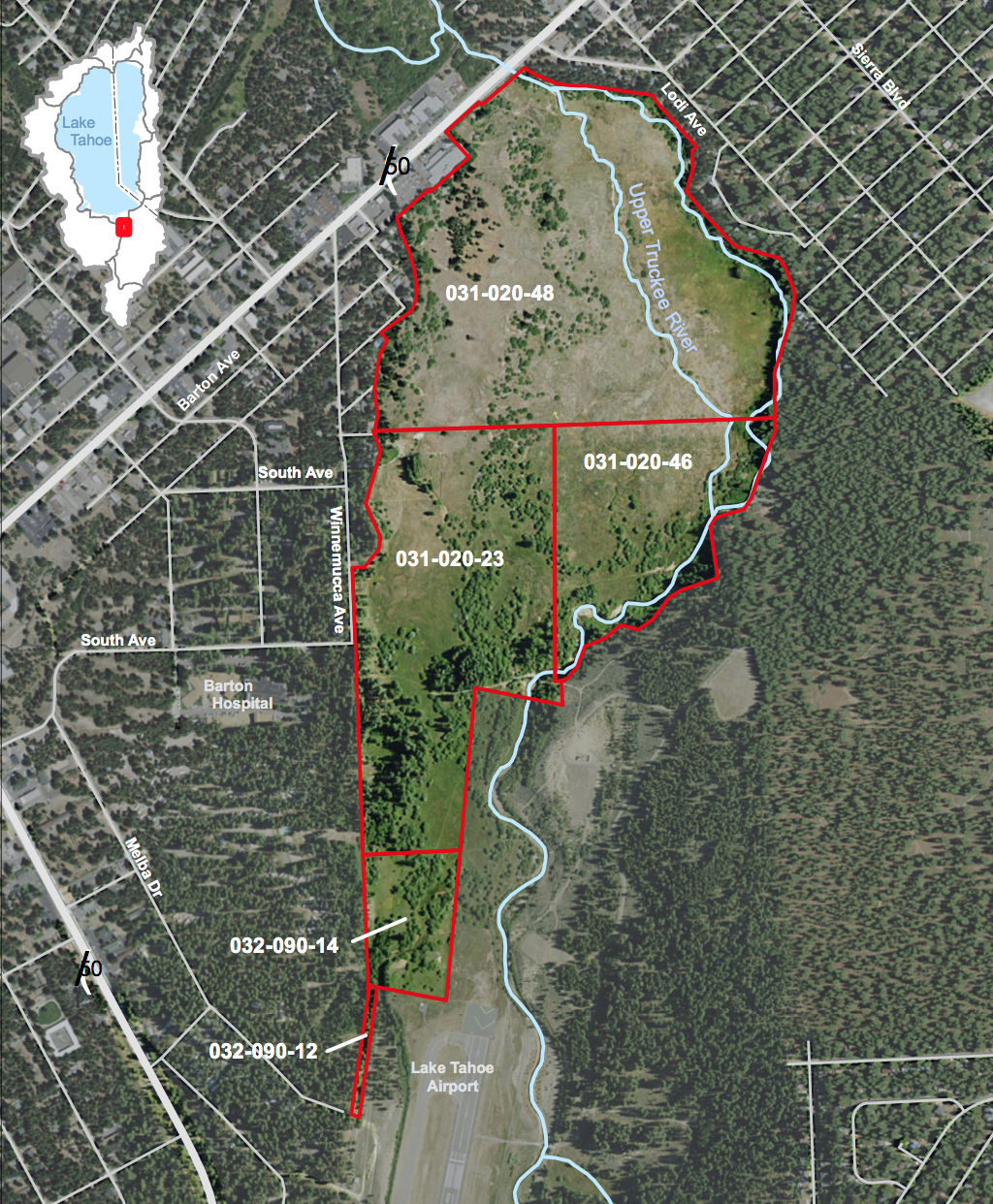
The Johnson Meadows parcel will soon be owned by the Tahoe Resource Conservation District.

The Johnson Meadows parcel in South Lake Tahoe will soon be owned by the Tahoe Resource Conservation District.

By Kathryn Reed

Most of the lower nine miles of the Upper Truckee River are about to come under public ownership.

On Thursday the California Tahoe Conservancy awarded a $4.234 million grant to Tahoe Resource Conservation District to help buy the nearly 209-acre plot known as Johnson Meadows. This equates to half of the selling price. The property is south of Highway 50 in South Lake Tahoe and near the Upper Truckee Marsh.

“Originally, the UTR meandered through the middle of the property’s meadow and overtopped its banks regularly, depositing fine material onto the floodplain almost every year. Some time prior to 1940, the UTR was moved to the east side of the meadow and flows to the meadow were controlled for irrigation purposes,” the staff report from the March 17 meeting reads.

The acquisition means more then 1,000 acres of the river’s floodplain is publicly owned. The Conservancy owns the marsh that borders the Johnson Meadows and Lake Tahoe, as well as the Sunset reach on the other side of the meadow.

The money for the purchase comes from Proposition 1 funds, the 2014 voter approved water bond.

The board awarded seven grants totaling $7,161,568.

Thirty applications valued at more than $30 million were submitted. Conservancy staff and an outside panel whittled the list down to the one that was approved.

The other approved projects include:

·      Lake Tahoe Invasive Plant Control Project, Tahoe Resource Conservation District, $700,000: To remove aquatic invasive plants from several marinas on the South Shore.

·      Meeks Meadow Restoration, Washoe Tribe, $228,530: To support planning related to restoring the ecological, hydrologic, and cultural functions of Meeks Meadow.

·      Lake Tahoe West Collaborative: A Multi-Jurisdictional Landscape Restoration Strategy, National Forest Foundation, $849,100: To develop an interagency plan to restore and protect forest health and key watersheds from Emerald Bay to Tahoe City.

·      Tahoe Basin Wildlife Protection and Water Quality Enhancement Project, Lake Valley and North Tahoe fire protection districts, $850,000: To develop a plan to streamline permitting of forest health projects surrounding Tahoe’s urban and residential communities.

·      Antone Meadows Dam Removal and Restoration, Burton Creek State Park, California Department of State Parks, $149,938: For planning activities to restore sections of Burton Creek and remove the Antone Meadows dam and related infrastructure.

·      Tahoe Storm Water Resource Plan, Tahoe Resource Conservation District, $150,000: To develop a comprehensive water quality plan to reduce and treat runoff that degrades the lake’s clarity.

Another $6.3 million has been set aside to possibly fund three projects that have yet to complete the CEQA environmental review. This includes $4 million for what is called the Bijou Park Creek Watershed and SEZ restoration project. South Lake Tahoe had asked for $4.67 million.

This is the proposal to raze the Knights Inn on Highway 50, combine the parcel with the one at the corner of Highway 50 and Ski Run Boulevard, then restore the creek flowing underground, reduce fine sediment by 8,000 pounds a year and then build something new there.

South Lake Tahoe City Councilman Tom Davis, who is the city’s rep on the CTC board, said, “If we don’t get that additional $670,000, we can’t do that project. This is a once in a lifetime shot for us.”

Three members of the city’s staff spoke during public comment, giving more specifics about the project. They, however, did not say the project would not go forward without full funding.

Resident Ed Moser spoke against that project, saying the CTC could better spend the money elsewhere.

The other two projects in limbo include a potential $1.3 million for Griff Creek corridor in Placer County and $1 million for stream environmental restoration in Meyers.

Assuming those three projects are awarded at the June or September meetings at the levels staff recommends, the CTC still has $488,432 to spend.




Basketball game to benefit Truckee CHP officer

A basketball game between police officers and Truckee High School’s varsity team is being turned into a fundraiser for the family of fallen CHP Officer Nathan Taylor.

Taylor died this week from injuries he sustained while working on Interstate 80 in Truckee.

The March 18 game was already going to feature members of the local California Highway Patrol office and Truckee Police Department.

It starts at 6pm. Cost is $5. Proceeds will also benefit the boys’ basketball program.

Donations may be made to the Nathan Taylor Memorial Fund at the CAHP Credit Union by mailing checks to P.O. Box 276507, Sacramento, CA 95827.


Author Kotler to give talk at Squaw Valley

Steven Kotler will be in Tahoe area next month giving insights and theories presented in his and co-author Peter H. Diamandis’ book “Bold: How to Go Big, Create Wealth and Impact the World”.

It all started with a question: What does it really take to change the world? The book is about the art of impact, the idea that everything around us was made up by people who are no smarter than you. That you can change and influence things and generate ideas and new technologies that can change the world. This keynote will examine how individuals and organizations can level up their game like never before. Kotler closes his presentation with five tangible steps for applying his theories and ideas to your own life and business.

The evening also features a motivational and inspirational opening presentation by polar explorer Doug Stoup on the science of flow state in business and adventure sports. Stoup is widely known as a polar pioneer and ski adventurer (having skied to both the North and South Poles more than anyone on the planet), an expedition guide (leading life-changing adventures all across the globe) and an environmental advocate (collecting scientific data for climate change scientists and teaching environmental stewardship). Stoup kicks things off as he shares the challenges, achievements, and lessons of his adventures.

Doors open April 2 at 5:30pm, and the presentation begins promptly at 6:30pm at the Resort at Squaw Creek.

Tickets are $25 for adults, $10 for students and as part of their annual membership. Squaw Valley Institute SVI members are admitted at no charge.


Rest rooms to be added to STHS field

Port-a-potties at South Tahoe High School’s football field are soon going to be replaced with permanent facilities.

Originally the rest rooms were to go in two years ago with the concession stand was built. However, certain Americans with Disability Act features had to be installed first.

The cost is about $372,000. The bulk of that is to add a sewer line. Water was already on site. It will be built in front of  the current scoreboard.

The Lake Tahoe Unified School District board also agreed this month to replace the 25-year-old scoreboard with one that has video.

“It will tie into the career-tech part of the marketing and production class,” Superintendent Jim Tarwater told Lake Tahoe News.

A fund-raising campaign will begin soon to pay for that amenity.

— Lake Tahoe News staff report


TSA wait is longer at Reno airport

By Marcella Corona, Reno Gazette-Journal

Reno-Tahoe International Airport officials and travelers say they’re concerned over longer security lines – a recent nationwide phenomenon.

On average, it takes about 10 minutes to clear through the Transportation Security Administration checkpoint in Reno, spokesman Brian Kulpin said Tuesday. But lately, it’s taken longer, he said.

Travelers have complained about the TSA lines on social media, and an influx of travelers this month hasn’t helped.

Read the whole story