Obtaining police emails can take months, cost thousands

By Terry Spencer, AP

When the editor of a gay-oriented newspaper in Florida requested records that he thought should be public, he cast a wide net, asking that the email of every employee of the Broward County Sheriff’s Office be searched for specific gay slurs over a five-month period.

The sheriff’s office initially told Jason Parsley that his request would cost $399,000, take four years and require the hiring of a dedicated staffer. The response set off a public-records marathon that lasted nearly a year. The Associated Press featured Parsley’s effort last year during Sunshine Week, a national government-transparency initiative that takes place each March, and then decided to join forces with his newspaper, the South Florida Gay News.

The goal was to determine whether such police emails were indeed public and, if so, how the public and media could obtain them in a timely and cost-efficient way.

After making multiple records request to four Florida law enforcement agencies, the two news organizations have at least a partial answer, which could provide a blueprint for other news organizations reporting on police accountability.

As law enforcement agencies have come under increased scrutiny in recent years, media organizations, watchdog groups and others have become more vigilant about filing public-records requests for emails and documents, particularly after police shootings. Police agencies have not always complied, and those that do sometimes put up obstacles, charging fees that many open-government advocates say are excessive and aimed at keeping hidden information that should be public.

“They throw up ridiculous costs, ridiculous delays as a roadblock,” said Barbara Petersen, head of Florida’s First Amendment Foundation. “If you throw out a humongous number, the person is going to walk away,” particularly private citizens who often do not have the money to hire lawyers or the know-how to challenge inflated fees.

In many states, including Florida, government agencies can waive records fees if they deem releasing the information in the public interest. While it is routine for media organizations and others to seek such waivers, it is rare for agencies to grant them.

Other examples of excessive fees abound in Florida and elsewhere.

After the fatal 2014 shooting of Michael Brown by a Ferguson, Missouri, police officer, the city hired an outside firm to handle the requests for police officers’ and city officials’ emails, said Adam Marshall, a lawyer with the Reporters Committee for Freedom of the Press.

The firm charged requesters $500 plus $135 an hour. If done by Ferguson clerks, the cost would have been $13.90 an hour. In one example, he said, a search for emails containing any of seven key words cost $1,375. Two Ferguson police officers resigned after they were found to have sent racist emails.

“Anyone who uses modern email programs knows you can find any email containing a key word in about a half a second,” Marshall said. “The practical effect is that it is inhibiting the public’s right to know. … That shouldn’t depend on an individual’s ability to pay thousands or tens of thousands of dollars, particularly when it comes to law enforcement, which has the power to shoot and arrest people.”

The AP and Parsley decided to press the issue in Florida, rather than let his original request die after he received the estimate for $399,000 in fees.

Last May, the AP asked two other Florida sheriff’s offices, in Hillsborough and Orange counties, to search for employee emails containing any words on a list of specific racial and gay slurs. Hillsborough County said the search would cost $2,668, a cost that was prohibitive.

Orange County originally said the search would cost $37, an amount the AP paid. In November, six months after the request, Orange responded and said it was mistaken — the search would cost $1,224. When AP questioned the jump, Orange County responded by saying it again had provided a mistaken figure: The actual cost to search its officers’ emails would be $44,360.

After negotiations between the Orange County sheriff and lawyers for the AP, the request was modified to delete a gay slur that contains the word “she,” because sheriff’s officials said “she” was causing the system to capture too many emails. The cost dropped last month, nine months after the original request, to $349, a cost the AP and South Florida Gay News paid. Officials with the Orange County Sheriff’s Office say those emails are now being processed.

Parsley, meanwhile, made fresh requests to both the Broward County sheriff and the Fort Lauderdale Police Department. After discussions with officials at the agencies and information technology experts, both news outlets ultimately asked only for more recent emails that would still be on the law enforcement agencies’ servers. Older emails that reside on backup systems are more cumbersome to search, requiring more time and expense.

Parsley has yet to receive the emails he requested from Broward or Fort Lauderdale. But local prosecutors decided to pursue the same information on their own, filing a request for derogatory emails with Fort Lauderdale police. The police department acted relatively swiftly, fulfilling prosecutors’ request within months.

Prosecutors wanted to make sure no arresting officers had a bias against minorities or gays that could be exploited by defense attorneys at trial, said Ron Ishoy, spokesman for the Broward County state attorney’s office. The office did not have to pay for the information because it was for a law enforcement purpose, he said.

It is common practice to provide information to other law enforcement agencies without charging a fee, according to Detective Keven Dupree.

After being tipped off, Parsley paid $5 to get a copy of the Fort Lauderdale police emails that were shared with prosecutors. They revealed that two department employees used a racial slur and another used a gay slur. Two officers were recommended for short suspensions, while a civilian employee received a one-day suspension.

In an emailed statement to the AP, a Fort Lauderdale police spokesman said the department is waiting to hear back from Parsley after giving him the cost estimate.

Parsley said he has no confidence he will ever get the information from the two agencies.

“In Fort Lauderdale, the price tag for our request came out to be $1,215, significantly less than the $399,000 we got from (Broward). But even that price is a lot of money for a small publication,” he said. “I’ve looked into narrowing my search even more to continue to bring down the cost.”

David Herzog, an associate professor of journalism at the University of Missouri, said such conflicts could be avoided if law enforcement agencies simply posted relevant emails and documents to their websites when a major case develops.

“That way,” he said, “the department doesn’t have to go through repeated public records requests.”



‘Living Last Words’ on Good Friday

There will a special Good Friday performance of “The Living Last Words,” a dramatic musical experience commemorating the seven last words of Christ, written by Ruth Elaine Schram, with music direction by Maureen Leonard, and stage direction by Susan Boulanger.

This free performance will be March 25 at 6pm at St. Theresa Catholic Church, 1041 Lyons Ave., South Lake Tahoe.

In this dramatic work, choral music combines with dramatic monologues as Schram imagines the responses of those who were present at the cross as Jesus died. Characters such as a contemptuous soldier; the crucified thief’s sympathetic sister; a scornful priest; the anguished shepherd; the heartbroken disciple searching for answers; and Mary, the grieving mother of Jesus, share how they are impacted by Jesus and the last words he spoke on the cross.

The actors include parish and community members, and members of the Lake Tahoe Community College Theater Department.  The cast includes Kurt Munger, Thomas Lopez, Ryan Adams, Frank Dixon, Joanie San Agustin, Sharon Kerrigan, and Scott Blumenthal. They are joined by the St. Theresa Choir and soloists Angie Guitierrez, Alejandra Quirarte, and Carmen Mieras.

For further information, call 530.544.3533.


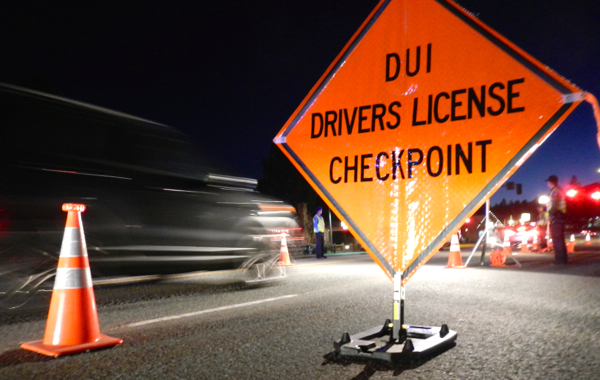
S. Tahoe DUI checkpoint keeps drivers in line

A DUI checkpoint March 17 in South Lake Tahoe snared people driving on a suspended  license. Photos/Kathryn Reed

A DUI checkpoint March 17 in South Lake Tahoe snared people driving on a suspended license. Photos/Kathryn Reed

By Kathryn Reed

Lights were swirling and signs were posted about what was going on up ahead. There was even an opportunity to bail and take another route. But no one ever said those breaking the law are the smartest individuals.

During the St. Patrick’s Day DUI checkpoint in South Lake Tahoe thousands of vehicles rolled by. No one was intoxicated and most had valid driver’s licenses.

Officers arrested three people on charges of driving on a suspended license.

“We can see drunk drivers before they are through the checkpoint,” South Lake Tahoe police Sgt. Travis Cabral told Lake Tahoe News as he watched the stream of vehicles inch by. “They get fixated on the lights and tend to swerve. They are trying to miss anything on the road.”

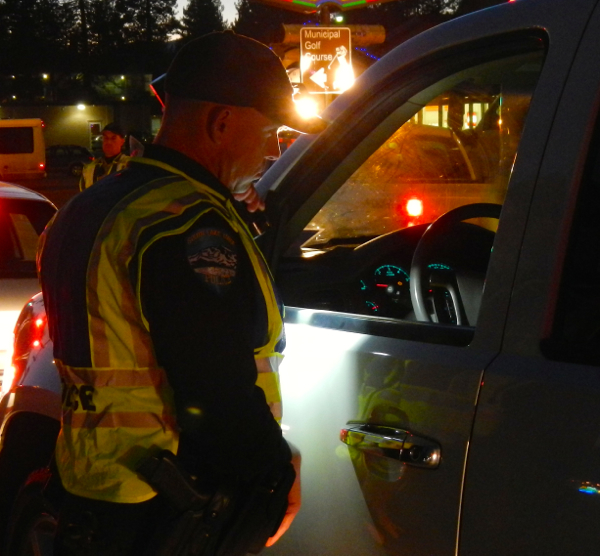
Officer Chris Mahoney  asks to see the driver's license.

Officer Chris Mahoney asks to see the driver’s license.

Twice a year local officers conduct a driving under the influence and driver’s license checkpoint – usually at Fourth of July and St. Patrick’s Day because they are big drinking days. The money to do these comes from the Office of Traffic Safety. The grant covers overtime and little things like the new lights that sit atop the safety cones. No longer are flares needed; which is better for the environment, plus batteries for the lights last longer and the lights can be programmed to flash in different patterns.

“It shows people they need to be safe. It’s a deterrent,” Cabral said of the purpose of the checkpoint.

Thursday’s checkpoint was near the Bijou Center from 7pm-2am.

The majority of people were friendly, even thanking the officers for being out there and telling them to be safe.

Officers in turn were giving residents and visitors a chance to see they aren’t such bad guys. And while the job at hand is serious, a detective joked with drivers to lighten the mood, asking if any bodies were in the vehicle.

One visitor from Florida asked what there is to do in town since they don’t ski. One talks about being here for March Madness and how his bets are paying off so far. Plenty of people from out of town drove through – from Mississippi, Oklahoma, Alabama, Hawaii, New York and Wisconsin.

Officer Chris Mahoney leads a man through a series of field sobriety tests.

Officer Chris Mahoney leads a man through a series of sobriety tests.

No one got special treatment. A Tahoe Transportation District bus driver was questioned, people in other work vehicles had licenses examined, all ages, genders and races were part of the checkpoint.

When people were detained their license was checked by the dispatchers in the mobile command post. Those with suspended licenses had their vehicles towed and now face even more charges than what led them to be in that state.

A local guy had beer on his breath and was told to pull into the parking lot. Officer Chris Mahoney pocketed the man’s keys, had him get out of the car and then started asking him a string of questions – medical issues, where he’s been, what he had to drink. Two 24-ounce Buds about 3:30pm and a cheeseburger and chicken soup at noon. He and a friend were on their way to get tacos.

He’s asked to follow a pen horizontally and vertically. His eyes don’t jerk – good news for him.

Then he has to walk heel to toe with his hands at his side, counting to nine. With his feet together, he is told to lift one straight ahead and count out loud until Mahoney says stop.

Sgt. Shannon Laney explained to LTN these tasks are all about testing the ability to multitask just like drivers do on the road – drive, change the radio station, talk to whoever is in the car, know what other drivers are doing. They are called “divided attention tests”.

While there is no pass or fail to these tests per se, the man does them as though he consumed no alcohol.

At the end he voluntarily agrees to a breath test. It’s not one that could be used as evidence – those are administered at booking. He blew a zero.

He and his friend were able to go have those tacos.

Not everyone drove home.

Not everyone drove home.

“The checkpoint was a success. The amount of people we were able to screen who were not intoxicated shows they are aware of what they are doing, they had watched their alcohol intake,” Cabral said.

He also pointed out how a number of cabs as well as Uber drivers came through; which demonstrated people had found a designated driver.

While the checkpoint did not lead to any DUI arrests, there were three DUI related accidents March 17 that led to two arrests. One person struck a vehicle near Ski Run Liquor, fled on foot and is still wanted. Another accident was on Pine Hill Road and the other by Raley’s at Stateline, which resulted in the drivers being arrested.


Snippets about Lake Tahoe

opinion-stop-congress-from-taking-bike-money·      Lake Tahoe Bike Coalition was awarded a $10,000 grant from the Tahoe Regional Planning Agency’s On Our Way Small Grants Program. The grant will fund the development of an interactive, online bike map for the Tahoe region.

·      Bona Fide Print Club meets from 6-9pm on the third Monday of the month. Carve linoleum and wood blocks, and print cards, fine art for fun. Bring supplies, some are also available. Cost is $10. Bona Fide HQ is at 1069 Magua St., No. 4, Meyers.

·      Lake Tahoe Windjammers Yacht Club is having a spring social March 26 at 6pm at the clubhouse, 2435 Venice Drive East in the Tahoe Keys Marina. Physical therapist Christina Frolich will talk about preparing one’s body for the upcoming sailing season. The cost is $5 and covers a full salad bar, bread and dessert. Bring a main dish to share and rsvp by March 22 to vicecommodorewyc@gmail.com. Prospective members are encouraged to attend.

·       The annual Underwater Egg Hunt at the Incline Village Rec Center pool is March 19 from noon-1:30pm.

·       The 2016 Polar Plunge benefit for Special Olympics is March 19 at noon at Zephyr Cove.


No jail or fine for South Shore bear killer

This is the bear that was killed last summer. Photo/Toogee Sielsch

This is the bear that was killed last summer. Photo/Toogee Sielsch

Gilbert Wetenkamp won’t be spending any time behind bars for the killing of a bear on the South Shore.

Before handing down the sentence today El Dorado County Superior Court Judge Suzanne Kingsbury didn’t hold back in telling Wetenkamp his actions were dangerous and that he needs to follow the law – which means not shooting wildlife because they are bothering him.

Wetenkamp on March 18 was sentenced to two years probation, six months in jail – which was stayed, a $2,084 fine – also stayed, forfeiture of the gun used to kill the 2½-year-old bear last July near his house, and 200 hours of community service that must be spent working with animals.

He was also told that any future wildlife issues on his property must be handled by proper authorities.

— Lake Tahoe News staff report


Hwy. 50 to be closed early Sunday on West Slope

Both directions of Highway 50 between El Dorado Hills Boulevard and Bass Lake Road will be closed part of Sunday.

Latrobe Road on-ramp to eastbound Highway 50, the Bass Lake Road on-ramp to westbound Highway 50, and White Rock Road between Valley View Parkway and Entrada Circle will also be closed.

Closures are as follows: 

  • Eastbound lanes from Latrobe Road to Bass Lake Road will be closed from 6-8am.
  • Eastbound on-ramp at El Dorado Hills Boulevard-Latrobe Road will be closed from 4-8am.
  • Westbound lanes from Bass Lake Road to El Dorado Hills Boulevard-Latrobe Road will be closed from 6-8am.
  • Westbound on-ramp at Bass Lake Road will be closed from 4-8am.

These closures are necessary to facilitate blasting operations on the north side of Highway 50 for the county’s Silva Valley Interchange Project. While the closures are in place, both directions of Highway 50 traffic will be detoured around the closures via El Dorado Hills Boulevard, Serrano Parkway and Bass Lake Road.


Beyond record hot, February was ‘strange’

By Seth Borenstein, AP

WASHINGTON — Earth got so hot last month that federal scientists struggled to find words, describing temperatures as “astronomical,” ”staggering” and “strange.” They warned that the climate may have moved into a new and hotter neighborhood.

This was not just another of the drumbeat of 10 straight broken monthly global heat records, triggered by a super El Nino and man-made global warming. February 2016 obliterated old marks by such a margin that it was the most above-normal month since meteorologists started keeping track in 1880, according to the National Oceanic and Atmospheric Administration.

The old record was set just last December and the last three months have been the most above-normal months on record, said NOAA climate scientist Jessica Blunden. And it’s not just NOAA. NASA, which uses different statistical techniques, as well as a University of Alabama Huntsville team and the private Remote Sensing System team, which measure using satellites, also said February 2016 had the biggest departure from normal on record.

NOAA said Earth averaged 56.08 degrees (13.38 degrees Celsius) in February, 2.18 degrees (1.21 degrees Celsius) above average, beating the old record for February set in 2015 by nearly six-tenths of a degree (one-third of a degree Celsius). These were figures that had federal scientists grasping for superlatives.

“The departures are what we would consider astronomical,” Blunden said. “It’s on land. It’s in the oceans. It’s in the upper atmosphere. It’s in the lower atmosphere. The Arctic had record low sea ice.”

“Everything everywhere is a record this month, except Antarctica,” Blunden said. “It’s insane.”

In the Arctic, where sea ice reached a record low for February, land temperatures averaged 8 degrees above normal (4.5 degrees Celsius), Blunden said. That’s after January, when Arctic land temperatures were 10.4 degrees above normal (5.8 degrees Celsius).

Worldwide, February 2016 was warmer than about 125 of the last 136 Marches.

It was also the warmest winter — December through February — on record, beating the previous year’s record by more than half a degree (0.29 degrees Celsius).

Georgia Tech climate scientist Kim Cobb said she normally doesn’t concern herself much with the new high temperature records that are broken regularly.

“However,” she added in an email,” when I look at the new February 2016 temperatures, I feel like I’m looking at something out of a sci-fi movie. In a way we are: it’s like someone plucked a value off a graph from 2030 and stuck it on a graph of present temperatures. It is a portent of things to come, and it is sobering that such temperature extremes are already on our doorstep.”

Scientists at NOAA’s National Centers for Environmental Information in Asheville, N.C., were astonished by the “staggering” numbers, said Deke Arndt, the centers’ global monitoring chief.

“Usually these are monthly reminders that things are changing,” Arndt said. “The last six months have been more than a reminder, it’s been like a punch in the nose.”

NASA’s chief climate scientist Gavin Schmidt usually discounts the importance of individual record hot months, but said this month was different, calling it “obviously strange.”

This was due to the long-term warming from heat-trapping gases and the powerful El Nino, so these types of records will continue for a few more months, but probably will not be a permanent situation, Schmidt said in an email.

But other were not so sure, including Arndt, who compared it to moving into a new hotter neighborhood.

“We are in a new era,” Arndt said. “We have started a new piece of modern history for this climate.”

Jason Furtado, a meteorology professor at the University of Oklahoma who wasn’t part of any of the government teams, simply wrote in an email: “Welcome to the new normal.”


West Shore roadwork unraveling

Last summer’s chip-seal roadwork on the West Shore is looking more like a chip project than a seal one.

The sticky oil is becoming exposed because snowplows are scraping off what was meant to be a more permanent fix to residential streets. El Dorado County did chip-seal work on 21 miles worth of roads. For now, sand is being placed on the oil.

Don Spear, with the county’s transportation department, sent a letter to Tahoma area residents about the issue. In part it said, “There apparently is a problem with the emulsion used as a binder for the aggregate. We are in discussions with our material vendor to resolve the situation as soon as weather permits.”

County employees say to fix the mess it could cost $700,000. This will come out of an already depleted roads maintenance fund. Work will occur in late spring.

— Lake Tahoe News staff report


Murnane Scholarship Fund created in Tahoe City

The Tahoe Cross Country Ski Education Association has developed the Kevin Murnane Scholarship for athletes and coaches.

When Murnane lost his battle with clinical depression in 2015, the community was shaken. The board of directors wants all the qualities Murnane embodied to be remembered through these scholarships.

Kevin Murnane

Kevin Murnane

Murnane transformed Tahoe Cross Country into a thriving social and athletic hub. Thanks to him, TCCSEA now works closely with local Middle and High schools, provides daily clinics, rentals, world-class grooming, and hosts numerous community events like the Alpenglow 20k, the Great Ski Race, the Tahoe Rim Trail Summer mountain bike ride, and more.

TCCSEA will give up to two scholarships worth up to $1,000 each to deserving graduating seniors from North Tahoe High School. Any athlete who has participated in nordic program(s) in his or her middle and high school years and who shows kindness, generosity, a welcoming community spirit, and more is eligible.

TCCSEA is also offering a Coaching Development Scholarship to support hard-working coaches who teach our young North Tahoe athletes and who need financial support to attend clinics, symposiums, classes, trainings, or help paying wages at events like Junior Nationals.

Donations will be accepted all year online.


Casino testing technology to curb gambling addiction

By Associated Press

BOSTON — A first-in-the nation system allowing casino patrons to set limits on their betting is expected to be unveiled next month in Massachusetts.

The system is meant to curb gambling addiction. It’s being piloted at Plainridge Park, a slots parlor in Plainville that’s the state’s first casino. If successful, the system would be imposed statewide, including in major resorts being planned by Wynn and MGM.

No U.S. jurisdiction has yet imposed such a system, according to regulators. Only a handful of casinos in Singapore, Norway, Sweden, Canada and elsewhere have so called “play management” systems in place.

Massachusetts’ system, which is called “Play My Way,” would allow slot machine players to electronically set a budget before gambling and receive automatic notifications tracking their spending.