Tahoe Tails — Adoptable Pets in South Lake Tahoe

Mewtoo

Mewtoo

Mewtoo is a nice 1 year old girl who has been at the shelter the longest of all cats, almost exactly six months, perhaps because she needs to be an only pet. But the shelter isn’t giving up on her. She is affectionate and likes children, and deserves a good home.

Her adoption fee has been paid by a kind donor.

Mewtoo is spayed, microchipped, tested for FIV, and vaccinated. She is at the El Dorado County Animal Services shelter in Meyers, along with many other dogs and cats who are waiting for their new homes. Go to the Tahoe animal shelter’s Facebook page to see photos and descriptions of all pets at the shelter.

Call 530.573.7925 for directions, hours, and other information on adopting a pet.

For spay-neuter assistance for South Tahoe residents, go online.

— Karen Kuentz


LTVA ad campaign to focus on the water

By Kathryn Reed

Is it all that tap water? Or maybe being immersed in the lake – even if it’s only ankle deep? Perhaps just being near it? Whatever it is, people who come to Tahoe seem to be transformed into another being – someone more fun, adventurous and outdoorsy.

That’s the message behind the Lake Tahoe Visitors Authority’s new ad campaign called – There Must be Something in the Water.

While the final ads have not been devised, the concept is showing someone in their normal, every day work life, perhaps sitting in a cubicle and then seeing them playing in Tahoe. From ordinary and mundane to fun and vibrant – all because of the waters of Lake Tahoe.

“This doesn’t have any animation. It has outdoor scenery or indoor entertainment,” Carol Chaplin, LTVA executive director, told Lake Tahoe News. “It won’t have that fanciful imagery (of the last campaign). It is much more straightforward.”

Still, it is designed to be a bit humorous and quirky.

The board approved the concept last month, with the nearly $900,000 contract with Duncan/Channon of San Francisco OK’d this month.

Paddle boarding at Lake Tahoe will be featured in summer ads for the South Shore. Photo/LTN file

Paddle boarding at Lake Tahoe will be featured in summer ads for the South Shore. Photo/LTN file

Summer shots will include people paddle boarding, parasailing, biking and ziplining. Nightlife will also be included, and is something that can be used year-round. Skiing, a family playing in the snow, and potentially dog sledding will be used next winter.

This will be the second year the South Shore tourism bureau will focus on San Diego in addition to the traditional Bay Area-Sacramento market. One reason for San Diego is half those people tend to drive here and then they stay longer than those who can make it here in four hours or less.

Ads will run online where they can be targeted to people interested in Tahoe and what it has to offer, during select Giants and A’s baseball games on Comcast, radio and on billboards.

There had been criticism of the previous campaign that used animated characters and no actual pictures of Lake Tahoe. Some of the board members said it was time to change the visuals, the ad agency agreed and that’s how the There Must be Something in the Water campaign came about.

The LTVA is cognizant there may be concern using the tagline in light of the turmoil in Flint, Mich. Still, considering the purity of Tahoe’s water and this being a gambling destination, the powers that be are confident the message will resonate with potential visitors.

While LTVA tends to support events more than stage them, the agency is involved in some of the bigger undertakings. The fireworks will be back on Fourth of July and the Sunday of Labor Day weekend. A vendor is being sought now.

Promoters hope Amgen cyclists won't be able to have a snowball fight like they did in 2011, where snow canceled the local leg. Photo/Lisa J. Tolda

Promoters hope Amgen cyclists won’t be able to have a snowball fight like they did in 2011, when snow canceled the local leg. Photo/Lisa J. Tolda

A huge chunk of time of being devoted to the Amgen Tour of California bike race that features the women starting and ending the first leg at Heavenly’s California Lodge and the men ending stage 4 at the lodge. Both will be May 19. The women’s can be seen online and the men’s will be televised.

Much like the American Century Championship celebrity golf tournament in July, both cycling events will be opportunities to showcase the lake, especially with the women riding the 72 miles around it.

For viewers – in person or on a screen – it will also be a chance to see athletes who may be competing this summer in the Olympics.

The LTVA is also an integral part of the annual golf tournament at Edgewood Tahoe. Another seven-year contract was signed last year, so American Century and NBC are on board at least through 2022.

Something new this year that LTVA will be involved in is the restaurant week in September. Sample the Sierra, an event run by the Lake Tahoe South Shore Chamber of Commerce, is moving from Labor Day to mid-month and will now include a restaurant week.

While locally there has been a restaurant week in January to tie in with what California tourism officials do, it has not taken off. In large part this is because it’s already a busy time of year.

“We felt that putting it with Sample the Sierra, it might help both of those events and create some synergy,” Chaplin said.

A public relations campaign by Stateline’s Weidinger Public Relations will complement the ads in trying to get media to write about the area and the events. Their efforts have also been focused on a renaissance theme for the area – how the economy is improving and new venues are opening.


Opinion: Body Mass Index not a good health measure

By A. Janet Tomiyama and Jeffrey M. Hunger

You’ve just returned from your morning run and you’re rustling through your snail mail when you receive some shocking news—an official memo from your employer informing you that your health insurance premium is increasing by 30 percent. You’ve been deemed a health risk, and you are being charged accordingly.

Yet you’re the picture of health: A run is part of your daily routine, you passed your last physical with flying colors, and kale is your favorite food. This must be some sort of mistake. But you read the fine print to discover that your employer has decided that the most accurate measure of your health is your Body Mass Index, or BMI, which is derived by a formula that compares your weight to your height.

Even though you’re a paragon of health, at 5 foot 2 inches and 164 pounds, your BMI places you within a range considered “obese.” So your insurance company and your employer have determined that you are no longer among the “healthy.”

This may sound Orwellian, but the federal government is working to make it common. Recently proposed rules by the U.S. Equal Employment Opportunity Commission (EEOC) would set clear guidelines for employers to use metrics like BMI to charge higher-BMI employees more for their health insurance. The apparent goal of these rules is to get higher-BMI employees to reduce their weight; a standpoint based on the assumption that such individuals must uniformly face poor health. Our research, however, suggests that this assumption is flawed and these rules will not accomplish this goal. In fact, the proposed rules could yield the opposite results.

The problem is that BMI is a problematic metric. It was invented more than 200 years ago by a Belgian mathematician named Quetelet, who based it on what he called the “average” human: a white male in Europe in the early 1800s. BMI also gets human biology wrong—it fails to distinguish between bone, muscle, or fat. You’ve probably heard about athletes, including the starting lineup of the Super bowl champion Denver Broncos, being “obese” by BMI standards, even though they’re very obviously in great shape. National Public Radio called the BMI formula “mathematical snake oil”.

As psychological scientists who study health, we were well versed in the pitfalls of BMI. We knew we had to push back and illustrate the fallacy of this thinking in such a way that policymakers would understand just how many healthy people would be adversely affected.

In a stroke of good fortune rarely seen outside the movies, we found the perfect dataset. The National Health and Nutrition Examination Survey (NHANES) is a nationally representative sample of Americans surveyed every two years about their health and BMI. NHANES allowed us to look at established health markers to see who was healthy, and then see how many of those healthy folks actually fell in the higher-BMI categories employers deem “unhealthy.”

Our next challenge was to come up with an ironclad definition of “healthy.” For our analysis to have credibility, we had to have a definition that would be difficult to attack on scientific grounds. We dove into the research literature to look for different definitions and found quite a few, so we chose the definition that set the highest bar for health and used six different metrics including blood pressure, blood sugar, and cholesterol. These index the health of a person’s heart and blood vessels, risk for diabetes, and inflammation.

After crunching the numbers, the results were stunning. BMI did not map onto the real markers of health. Some 34.4 million of the 70 million-plus Americans categorized as “overweight” by BMI were perfectly healthy. That’s 47 percent. The chances of BMI being a good predictor were not much better than flipping a coin. And 29 percent of Americans rated “obese” under BMI were healthy as well. Add those numbers together—and it means that more than 54 million healthy Americans would be unfairly penalized under the EEOC rules.

Our analysis uncovered another pitfall of BMI: 21 million individuals in the “normal” BMI range—those who would be considered perfectly healthy by employers and insurance companies—were actually unhealthy according to the criteria. These are people who would likely have higher health costs but who would skate by without added penalties under the new EEOC rules. More alarming, the fallacious assumption that “normal” BMI individuals are healthy could mean they wouldn’t get preventive care or that important diagnoses could be delayed or missed altogether.

Clearly, BMI needs to go. We hope our analysis is the final nail in the coffin for this flawed measure.

But the obsession with BMI is really a symptom of a larger issue: a national infatuation with weight that not only affects how people in power define health, but also perpetuates an entrenched stigma against heavier people. We’ve run many studies in our labs showing that this weight stigma gives rise to situations that make it hard for people to be healthy. We’ve shown, for example, that experiencing weight stigma makes individuals eat more high-calorie snack foods and feel less confident in their ability to maintain a healthy diet. These are things that are bad for you no matter what you weigh.

We’ve also found that people who experience weight stigma have higher levels of the stress hormone cortisol. That’s a problem because cortisol increases a person’s drive to eat unhealthy foods, and sends a signal to the body to start storing visceral fat. That’s a type of fat that sticks to your organs and won’t necessarily make your body bigger, meaning it flies under the radar of BMI. It’s also the type of fat that increases your risk for diabetes and cardiovascular disease.

Our cultural obsession with weight has led us to misguidedly prioritize numbers on the scale over important modifiable health behaviors—eating, exercise, and sleep. Beyond leading us astray from health, this obsession perpetuates the stigma attached to heavier bodies, which is itself an impediment to health.

The evidence is clear: It’s well past time to forget about weight, both as a marker of person’s health and as a marker of a person’s standing in society.

A. Janet Tomiyama is assistant professor of psychology at UCLA. Jeffrey M. Hunger is a doctoral candidate of psychology at the UC Santa Barbara.


TTD’s Incline bike path costs questioned

By Sean Whaley, Las Vegas Review-Journal

CARSON CITY — Visitors to Lake Tahoe’s East Shore could soon have a new bike path linking upscale Incline Village to Nevada’s Sand Harbor State Park, but the price tag might induce sticker shock: $12.5 million for the 3-mile project.

Yes, that is more than $4 million a mile in taxpayer dollars for a 10-foot-wide bike path traveling just about 16,000 feet along the picturesque mountain lake.

Not to mention another $7 million to $9 million that the Nevada Transportation Department plans to spend in state gas taxes in conjunction with the project on related environmental and safety needs.

Another $750,000 in private donations has also been raised for the path.

Read the whole story


Chinese firm snatches Starwood from Marriott

By Chris Isidore, CNNMoney

The proposed merger to create the world’s largest hotel chain is off — at least for now.

Starwood Hotels and Resort said Friday it was pulling out of a deal to sell to Marriott International after determining that a $12.8 billion all-cash bid from an investment group led by Chinese insurer Anbang Insurance Group is superior. In November Starwood agreed to a $12 billion cash and stock purchase by Marriott that had been due to close by the end of this month.

Marriott has five days to decide whether to top this new offer, and it says it will consider doing so.

Read the whole story


Teens to attend aeronautics camp

Truckee Chapter 1073 of the Experimental Aircraft Association is awarding three scholarships to local Young Eagles to attend EAA’s Air Academy this summer at Oshkosh, Wis.

Keely Hoyt of Truckee will attend the Advanced Air Academy for 16- to 18-year-olds; Kestrel Sura of Kings Beach and Hayden Ruttenberg of Truckee will attend the Basic Air Academy for 14- and15-year-olds.

Air Academy camps designed to introduce young people to the aviation world. Participants explore aviation through technical and learning classrooms as well as hands-on experiences from knowledgeable instructors.

The next Young Eagles rally will occur the day after the July 9 Truckee Tahoe Air Show & Family Festival. Registration occurs at the air show, at the EAA chapter hangar on the airport, and flights will start at 8am on July 10.

For more information on the Young Eagles program, go online.


Anderson claims crystal globe in 2 events

By USSA

SPINDLERUV MLYN, Czech Republic – The final snowboard FIS World Cup slopestyle event took place Sunday, where Chris Corning (Arvada, Colo.) hit the podium for the men with a second-place finish, and secured the overall World Cup slopestyle title.

The 16-year-old from Colorado scored two World Cup podiums this season, including a victory at the Cardrona, New Zealand, event in August. Fellow American Brandon Davis (Mammoth Lakes) was second behind Corning in the overall slopestyle standings.

Ryan Stassel (Anchorage) finished fifth at the Spindleruv Mlyn event and Eric Beauchemin (Grand Blanc, Mich.) was sixth.

Karly Shorr (Milford, Mich.) and Jessika Jenson (Rigby, Idaho) both made the final, finishing fifth and sixth, respectively. Jamie Anderson (Meyers) won the crystal globe award for women’s snowboard slopestyle despite skipping the final event of the season. Anderson also claimed the crystal globe for overall freestyle snowboarding.


Amid cycling boom, penalties for errant drivers remain light

By Scott McFetridge, AP

When Iowa’s largest city joined the boom in urban cycling, work crews painted more bike lanes, erected traffic signals especially for cyclists and installed rental bikes at self-service stands that catered to commuters and tourists alike.

In Des Moines and scores of other U.S. cities, the efforts drew bike riders onto busy streets that were once the sole province of cars and trucks. The changes also heightened the risk of serious collisions like the one that threw Ken Sherman from his bicycle with such force that his body tore off the vehicle’s side mirror.

Cyclists are frustrated that the growing support for two-wheeled transportation has only rarely led to tougher penalties for drivers who hit bikes, many of whom are never ticketed or receive only minor citations, even in accidents that permanently disable or kill cyclists. The motorist who hit Sherman was deemed to be at fault but was never charged with any wrongdoing.

“I was upset and outraged,” said Sherman, who suffered a punctured lung and broke his shoulder blade and collarbone. “I’ve wanted to get my arms around the laws we have and how they’re being enforced.”

After his 2009 crash, he joined a bicycling association and began lobbying the Iowa Legislature for changes.

Concerns about cycling safety have risen along with ridership. Bicycle commuting nationwide climbed 62 percent from 2000 to 2013, according to a census survey. In cities such as Chicago, San Francisco and Washington, it shot up by more than 300 percent.

Studies show that having more bicyclists on the road can actually improve overall safety by making motorists more aware of riders. But the increase in cycling has coincided with a 6.6 percent rise in injuries from car-bike crashes and a 1.5 percent increase in deaths between 2001 and 2013, according to the National Traffic Safety Administration. In 2013, 743 cyclists died in crashes with cars, and an estimated 48,000 cyclists were injured.

Nearly 40 states have laws requiring passing motorists to give bicycles at least 3 feet of space, and at least six offer special protections to cyclists and pedestrians. But few have backed up those laws with stiff fines for violators.

That means even though it’s illegal for passing motorists to get too close to bicyclists in most states, violators face only small penalties, such as California’s $35 fine, which can rise to $220 if the bicyclist is injured. The penalty is the same in Virginia. A first offense in Wisconsin can range from $20 to $200.

Minnesota last year became one of the few states to significantly stiffen the penalty for motorists who hit cyclists, with passage of a $3,000 fine, but prosecutors must prove the driver was acting carelessly when the cyclist was killed or seriously injured. For simply passing too close, the fine remains small.

Dorian Grilley, executive director of the Bicycle Alliance of Minnesota, said he’s heard of only one person being ticketed for the offense in the past 25 years.

A driver was cited for driving without insurance after he hit David Wuest in St. Paul, Minn., knocking him to the pavement and causing a brain injury that has left Wuest unable to work nearly two years after the April 2014 crash. An investigation determined that the motorist was at fault, but since he was not under the influence of drugs or alcohol, the driver only had a pay a small fine.

Wuest, of Minneapolis, said higher penalties could lead some motorists to be more careful around cyclists, but he thinks crashes will happen as long as bicycles travel so close to cars. He’s resumed riding but only on bike paths.

“I assume people don’t want to hit cyclists,” he said, “but it keeps happening.”

Dave Snyder, who leads the California Bicycle Coalition, said bicyclists are injured and killed so often that it seems normal. Although he said he’s appalled that motorists who hit cyclists usually don’t pay significant penalties, his group is more focused on creating separation between bikes and cars.

Gov. Jerry Brown has called for funding changes to roadways to protect cyclists, and Snyder said that could save far more lives than prosecuting motorists.

“Those cases of drivers not being charged are outrageous, but fixing that problem is not the most important problem,” he said.

Robin Stallings, executive director of the group Bike Texas, took a similar view, saying laws should be toughened and more motorists prosecuted for hitting bicycles, but that may never happen. It’s more likely, he said, that local and state governments will build protected lanes for cyclists so they’re less vulnerable.

Jeff Gray was severely injured and a friend killed on a sunny morning in 2014 when a van hit them on a rural road in western Iowa. The driver, who said he didn’t see the bikers, paid a $2,400 fine.

People need to be more aware of the number of cyclists injured and killed in such crash, Gray said.

“They don’t understand they’re racing past someone going 10 mph. They don’t understand it,” Gray said. “I don’t think people even think about it.”


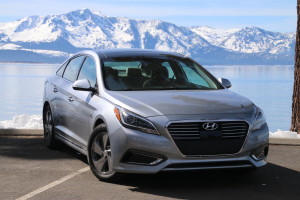
Road beat: Sonata redefines hybrid

IMG_0172

A hybrid worthy of the Sierra. Photos/Larry Weitzman

By Larry Weitzman

Let’s get one thing clear from the beginning, this new second generation Sonata Hybrid is the best hybrid I’ve ever tested. Understand there still are some hybrids I haven’t driven including some of the newer PHEV’s like the Chevy Volt. What makes this Sonata Hybrid so good are its seamless transitions between gas and electric, the smoothness of the gas engine coming on line (it doesn’t drive like a hybrid), its incredible fuel economy and its overall performance all while exhibiting excellent driving characteristics and the smoothness and quiet of a (near) luxury car.

Sonata Hybrid starts with a beautiful Sonata body and platform with a slightly different grille and other mods some that aren’t readily apparent, and its own set of low drag wheels that don’t exactly excite. But when the car goes down the road, you can’t see them anyway and in motion they look OK. It has a coefficient of drag of 0.24, which is like the limbo, “how low can you go.” That’s one slick wind cheating body.

Size-wise, the Sonata is a mid-size on the outside, but is less than half of a percent of having a full-size car interior. Overall, it is 191-inches long, a wide 73 inches and stands 58-inches tall. Track is huge at 63 inches, front and rear. Remember those numbers for later.
Specifications Price $30,975 to about $36,000 Engine  2.0L DOHC, 16 valve, inline four 154 hp @ 6,000 140 lb.-ft. of torque @ 5,000 rpm Electric package 38 kW electric motor (51 hp) Battery 1.62 kWh Lithium-polymer, max output 56 kW (75 hp) Transmission Six-speed (no torque converter) automatic Configuration Transverse front engine/motor//front wheel drive Dimensions Wheelbase 110.4 inches Length 191.1 inches Width 73.4 inches Height 57.9 inches Track (f/r) 63.1/63.6 inches Weight 3,560 pounds Fuel capacity 15.85 gallons Trunk capacity 13.3 cubic feet Passenger volume 106.1 cubic feet Wheels (std/opt) 16X6.5/17X6.5 inch alloys Tires (std//opt) 205/55X16//215/55X17 Steering lock to lock 2.78 turns Turning circle 35.6 feet Co-efficient of drag 0.24 Performance 0-60 mph 7.18 seconds 50-70 mph 3.98 seconds 50-70 uphill 5.62 seconds Top speed you are kidding, right? Ok way into triple digits. Fuel economy EPA rated at 39/43/41 mpg. Expect 43 plus mpg in rural driving, 45-46 mpg on a level highway at 70 mph.

Specifications
Price $30,975 to about $36,000
Engine
2.0L DOHC, 16 valve, inline four 154 hp @ 6,000
140 lb.-ft. of torque @ 5,000 rpm
Electric package
38 kW electric motor (51 hp)
Battery 1.62 kWh Lithium-polymer, max output 56 kW (75 hp)
Transmission
Six-speed (no torque converter) automatic
Configuration
Transverse front engine/motor//front wheel drive
Dimensions
Wheelbase 110.4 inches
Length 191.1 inches
Width 73.4 inches
Height 57.9 inches
Track (f/r) 63.1/63.6 inches
Weight 3,560 pounds
Fuel capacity 15.85 gallons
Trunk capacity 13.3 cubic feet
Passenger volume 106.1 cubic feet
Wheels (std/opt) 16X6.5/17X6.5 inch alloys
Tires (std//opt) 205/55X16//215/55X17
Steering lock to lock 2.78 turns
Turning circle 35.6 feet
Co-efficient of drag 0.24
Performance
0-60 mph 7.18 seconds
50-70 mph 3.98 seconds
50-70 uphill 5.62 seconds
Top speed you are kidding, right? Ok way into triple digits.
Fuel economy EPA rated at 39/43/41 mpg. Expect 43 plus mpg in rural driving, 45-46 mpg on a level highway at 70 mph.

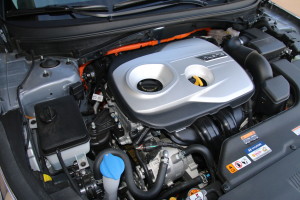
Under the hood are two power systems, a 2.0L 154 hp at 6,000 rpm, 140 pounds of twist at 5,000 rpm inline four plus a 51 hp electric motor which allows for a maximum concerted effort of 193 hp at 6,000 rpm. Of course your next question, why not 205 hp? The simple answer is that the 1.62 kWh L-po battery pack located in the trunk floor (so it does not significantly reduce trunk capacity) has an output of 56 kWh, which is equal to 75 hp. But at 6,000 rpm when the engine is producing 193 hp, peak hp of the electric motor is 39 hp which when added to 154 equals 193 hp. In hybrid cars, it’s not how powerful the electric motor is, it’s usually governed what is the maximum battery output or peak engine rpm hp. You can forget about the technical drivel, as it’s all smoothly integrated through a silky six-speed tranny that drives the front wheels. The electric motor is between the tranny and engine and supplants the torque converter to improve fuel economy. Trick stuff.

All those machinations produce a high performance automobile with a 0-60 mph time of just 7.18 seconds. Passing times also reflect quality performance with a 50-70 mph time of 3.98 seconds and the same parameter up a 6 percent grade only slowing that time to 5.62 seconds. Compared to a Prius, the Hyundai is a rocket ship and it outperforms all standard mid-size normally aspirated four cylinder sedans, even its sibling Sonatas. This Sonata is a peppy vehicle, step on the accelerator with authority and it will get your attention pronto.

But in the Sonata Hybrid’s case performance and fuel economy are not mutually exclusive. At 70 mph the Sonata averaged 45.6 mpg and on a 200-mile highway trip with about 20 percent of the time in congestion, it averaged 44.5 mpg. On a 165 miles round trip from Placerville to South Lake Tahoe the Sonata Hybrid averaged an incredible 47.6 mpg and during the 50 miles of downhill on the western slope, over 80 percent the Sonata operated as a pure electric vehicle with traffic operating at least 55 mph (the speed limit) in the 30 miles of two lane road (echo Summit to Ice House Road). Imagine going to Lake Tahoe and back on less than 4 gallons of gas. Overall, the Sonata Hybrid averaged 43.7 mpg for 539 miles of driving. Oh, the EPA numbers are 39/43/41 mpg city/highway/combined. This is the first hybrid tested that has exceeded its EPA numbers.

So how does it ride and handle? A one-word answer is “great.” Suspension is state of the art independent in all four corners with specific high performance shocks and stab bars at both ends. Quick rack and pinion electric power steering (2.8 turns lock to lock) while a bit numb, has good feel and weighting. Track is wide and the tires are decent sized 215/55X17s with all of this giving very good cornering power and surprisingly good handling. Yeah sure, it doesn’t have the credentials of sports car, but it gives the driver plenty of confidence when being pushed hard in the twisties. It is a capable handler.

Ride quality, especially with its “think in a whisper quiet” is excellent. What a great road car and around town it’s a veritable sponge when it comes to bumps. There is no tach, but engine rpm at 70 mph should be close to a low 2,000 rpm. But it’s most fun when you are able to run pure electric at 60 and sometimes even 70 mph. Much of that ability is due to its compact, high capacity battery and in its management. Its energy storage is significant larger than some other hybrids.

Braking power with its large four wheel ventilated discs arrested forward progress from 40 mph in 42 feet. In most mid-size cars, only the front discs are ventilated. My loaded tester had every safety devise including lane departure warning, pre-emptive braking, stability control and probably oxygen masks that drop from the ceiling at 10,000 feet (Colorado’s Independence Pass exceeds 12,000 feet or maybe good for a Pike’s Peak run). Just kidding about the masks. With turbocharging, an engine can make sea-level hp to high altitudes. In a normally aspirated engine car, at 10,000 feet it is making 30 percent less hp or a 200 hp engine at 10,000 feet is only capable of 140 hp. A turbo engine with a higher critical altitude still makes 200 hp. Would this Sonata be great in the Sierra or Colorado.

Inside is a nearly full size interior. At 106.1 cubes, it is actually bigger than some full sized counter parts. But its slightly smaller trunk of 13.3 cubic feet (the battery takes the place of where a spare tire would have gone), it misses being a large car by half a cubic foot. But a nice interior it is with sublime standard power everything, leather on the seats including heating and cooling in the front and heat in the rear. Rear seats are perfect for a basketball team’s front line.
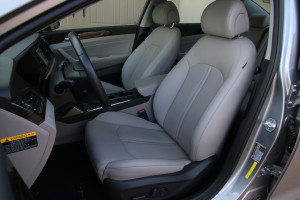
Comfort is one of the hallmarks of this vehicle.

Comfort is one of the hallmarks of this vehicle.

As with most hybrids, there is no tach which in this case is replaced by a battery use meter from 0-100 percent. OK, but the rest of the instrumentation is clear, concise and complete. Fit and finish demonstrate the fabulous quality of a car that stickers for $30 large plus $825 for the boat from Asan, Korea, (a first class car should be afforded first class accommodations).

My tester had the $4,500 Ultimate package which offered a full glass roof sunroof, an eight inch nav, upgraded radio, smart cruise, and lane departure, forward collision warning and more. Otherwise the base model is extremely well equipped. The total cost of admission all in is $35,765. That is less than my last Prius 5 tested about 10 months ago which did 0-60 mph in 9.48 seconds, had passing times of 2-5 seconds longer, but returned about two mpg more on the highway but the overall fuel economy was only one mpg more.

One more comparison is to that of the Sonata Eco which virtually has identical performance numbers and was only one mpg short on highway fuel economy. But overall fuel economy averaged about eight mpg less. Those are great numbers, too. And with a base price of about $24,000 (not as well equipped as the Hybrid), it offers and interesting dilemma.



Controlled burns planned for much of Tahoe

Weather permitting, California State Parks, the Nevada Division of Forestry and the U.S. Forest Service may continue prescribed fire operations beginning March 21.

On the North and West shores, operations may take place in Burton Creek and Sugar Pine Point state parks. On the East Shore, operations may take place near Sand Harbor, Spooner Summit and Camp Galilee. On the South Shore, operations may take place near Lake Tahoe Boulevard and Sawmill Road, Panther Lane near South Tahoe High School and off Highway 89 near Spring Creek. To view a map with project locations and details, go online.

Residual smoke may be seen in locations where operations have taken place over the last several weeks.